Wall Art Guide, Wall Art Tutoriels
Jute Wall Art: Natural Fiber Rope & Macrame Designs
Mar
So I’ve been completely obsessed with jute wall art lately and honestly it started because I bought this massive roll of jute rope thinking I’d use it for staging a farmhouse listing and then… didn’t. Had like 300 feet of the stuff sitting in my garage next to my daughter’s bike and I was like, well, might as well figure out what to do with this.
The Basic Jute Varieties You’ll Actually Find
Okay so first thing, not all jute rope is created equal and this matters way more than you’d think. There’s the twisted rope which is what most people picture – it’s got that chunky, rustic look. Comes in different ply counts, usually 3-ply or 4-ply. The 3-ply is softer, easier to work with for macrame, but it can unravel if you’re not careful. I learned this the hard way when I made this whole wall hanging and my cat decided it was a toy and now there’s just… loose fibers everywhere.
Then there’s braided jute which is smoother, holds its shape better, but it’s harder to do certain macrame knots with because it doesn’t have that same give. I use braided mostly for geometric wall pieces where I want really clean lines.
The thickness matters too – I usually work with 6mm to 12mm diameter. The 6mm is good for delicate stuff, intricate patterns. The 10-12mm is what you want for statement pieces that you can see from across the room.
Where to Actually Buy This Stuff
Hardware stores have jute rope but it’s usually pretty rough and sometimes it’s been treated with oils that smell weird. I got some from Home Depot once and my studio smelled like… I don’t even know, old barn? for like a week.
Better options are craft suppliers – I order from a place called Ravenox online, they have untreated natural jute that’s perfect for indoor art. Etsy sellers are hit or miss but there’s this shop called JuteWorks or something like that, they sell these pre-cut bundles specifically for macrame which is actually kinda convenient if you don’t wanna deal with measuring.
Oh and another thing, if you’re gonna buy a lot of it, check wholesale suppliers. I found a textile wholesaler in my area that sells jute by the spool and it’s like half the price. You gotta buy minimum 500 feet but if you’re making multiple pieces it’s worth it.
Basic Techniques That Don’t Require Being Crafty
I’m gonna be real with you, I’m not naturally good at this stuff. My hands do not want to cooperate with detailed knot work. But there are some techniques that are basically foolproof.
The Wrapped Dowel Method
This is probably the easiest thing you can do and it looks intentional and expensive. Get a wooden dowel or branch – I raided my backyard for branches which my neighbor definitely saw me doing and probably thought I was weird. You literally just wrap jute rope around it in different patterns. Tight wraps, loose wraps, diagonal wraps. Secure the ends with hot glue on the back.
I made three of these in different lengths, hung them at varying heights, and a client asked where I bought them. They thought it was like a $400 installation.
Simple Loop Hanging
Cut your jute into equal lengths – I usually do like 3 feet each. Fold them in half, loop them over a dowel rod using a basic lark’s head knot which sounds complicated but it’s literally just folding the rope in half and pulling the ends through the loop. That’s it. You can leave the ends hanging straight for a minimalist look, or trim them at angles, or unravel them for a frayed boho thing.
The key is varying the lengths slightly – don’t make them all perfectly even unless you want it to look too manufactured.
Actual Macrame Patterns for Beginners
Okay so funny story, I avoided macrame for years because I thought you needed to know like 50 different knots. Turns out you can make probably 80% of designs with just three knots.
Square Knot
This is your foundation. Take four strands of jute. The two middle ones stay stationary – they’re your “filler cords.” The two outer ones do all the work. Left cord goes over the middle two and under the right cord. Right cord goes under the middle two and up through the loop on the left. Pull tight. Then reverse it – right over middle and under left, left under middle and up through the right loop.
I watched probably 15 YouTube videos before this clicked and then I was like oh, it’s just over-under-over-under but alternating sides. My hands finally got it when I stopped thinking about it too hard.
Half Square Knot (Spiral)
Same as above but you only do the first part, don’t reverse it. Keep doing the same motion over and over and the rope naturally spirals. It’s kinda mesmerizing to watch happen. I made a wall piece that’s just multiple spirals in different lengths and it’s one of my most photographed pieces on Instagram.
Double Half Hitch
This one’s for creating diagonal or horizontal lines. You need one anchor cord that stays taut, and then you take your working cord and loop it over and around the anchor cord twice. It creates these neat ridges that add texture.
I’m not gonna lie, my first attempt at this looked like a tangled mess. But once you get the rhythm it’s actually really meditative. I did this while watching The Crown and suddenly had made like 4 feet of pattern without realizing.
Design Ideas That Actually Work in Real Spaces
So here’s where I’ve actually used jute wall art in ways that didn’t look too crafty or Pinterest-try-hard.
Oversized Minimalist Pieces
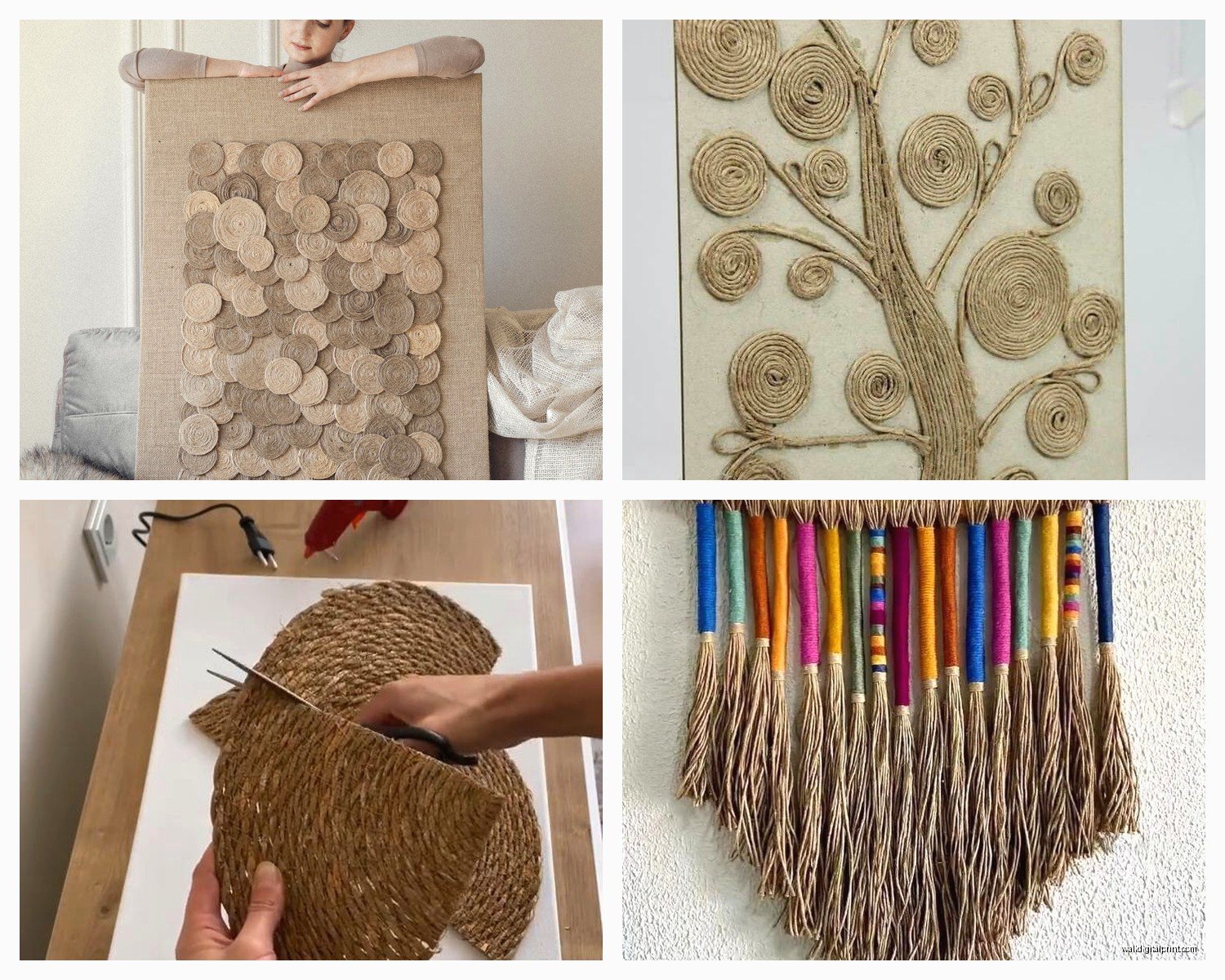
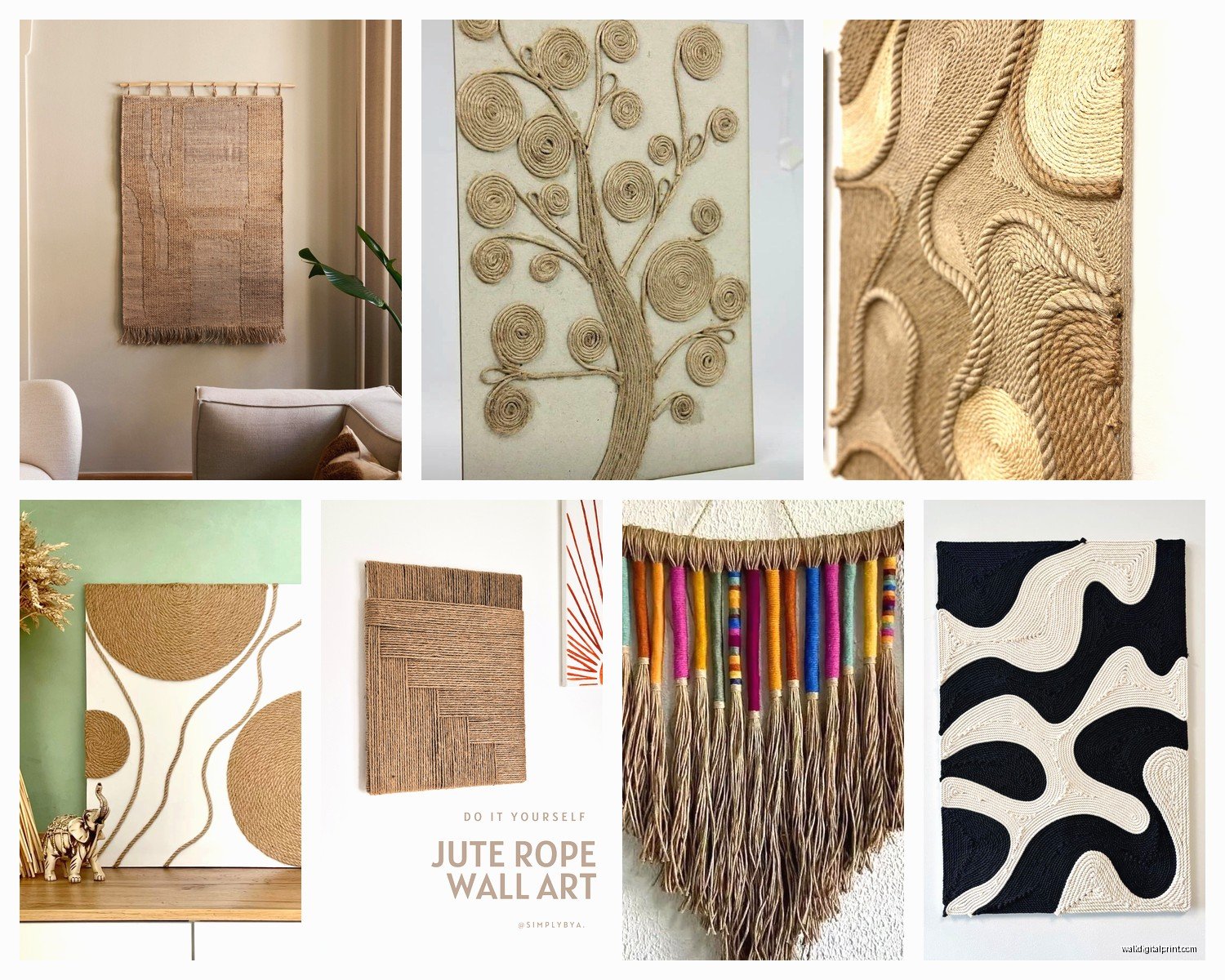
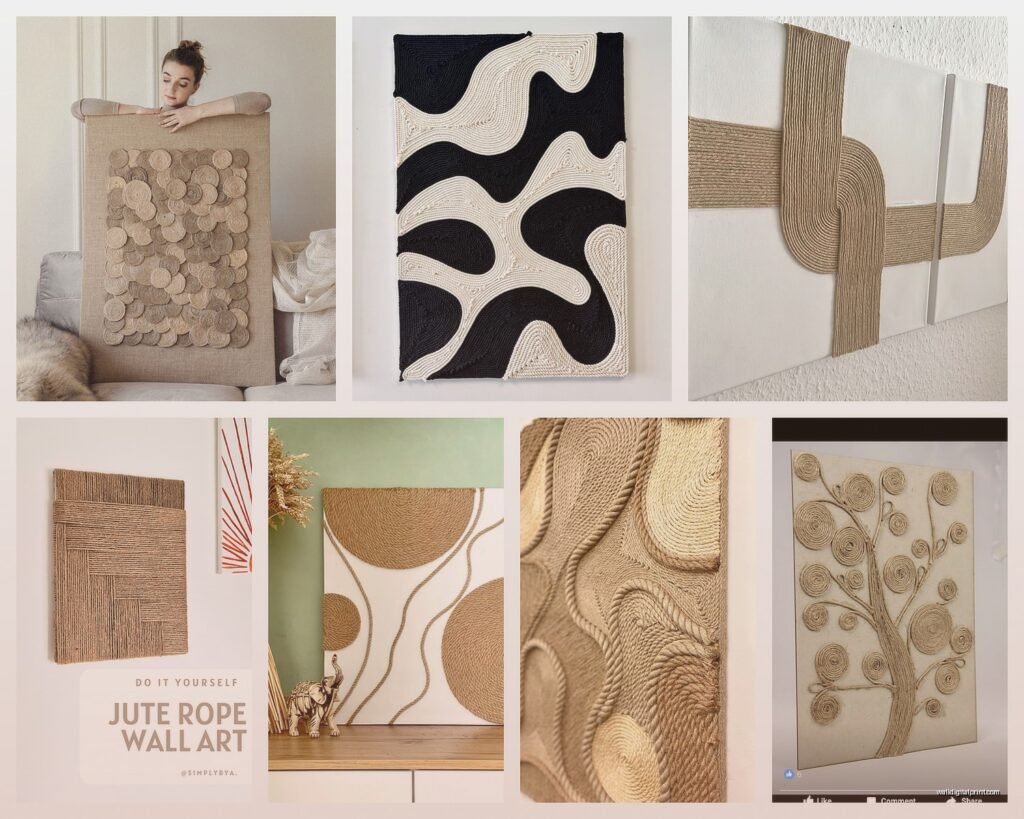
Take a large canvas frame or stretch canvas, remove the canvas part, and you’re left with just the wooden frame. Wrap thick jute rope around it in geometric patterns – straight lines, X patterns, asymmetrical designs. The negative space is what makes it interesting.
I did one that’s just three horizontal lines of 12mm jute across a 36×48 inch frame and it’s so simple but it works in modern spaces. You wouldn’t think jute fits with modern but the natural fiber actually softens industrial spaces really well.
Layered Texture Walls
Instead of one piece, do multiple smaller pieces in a cluster. Mix wrapped dowels with macrame sections with maybe some coiled rope mounted on small canvases. The different textures all being the same material creates this cohesive but not matchy-matchy look.
I’m working on one for a client’s dining room right now where we’re doing like 9 different pieces in a grid layout but each one is slightly different. Some are tight geometric patterns, some are loose and flowy, but they all read as one installation.
Corner Installations
This is gonna sound weird but jute wall art works really well in corners where you can’t fit regular art. Drape long macrame pieces from ceiling to floor in a corner, maybe add some shelving in front of it. The jute becomes like a textural backdrop.
The Practical Problems Nobody Tells You About
Okay so jute sheds. Like, a lot. Especially when you’re working with it. I now keep a lint roller in my studio because I’ll finish a piece and I’m just covered in jute fibers. They get everywhere. My dog has jute fibers on him and he wasn’t even in the room.
It also holds dust. If you’re putting jute art somewhere humid or dusty, you gotta vacuum it occasionally with like a brush attachment. I learned this when a piece I installed in a client’s bathroom started looking dingy after a few months.
The natural color variation is beautiful but inconsistent. Sometimes you’ll get rope that’s more golden, sometimes it’s more gray-brown. If you’re buying multiple spools for one project, try to get them from the same batch. Or embrace the variation, which is what I usually do because trying to match it perfectly is gonna drive you crazy.
Finishing and Sealing
Most jute doesn’t need sealing if it’s indoors, but if you want to prevent shedding you can lightly spray it with watered-down Mod Podge or hairspray. Don’t soak it, just a light mist. Test it first though because some jute darkens when you do this.
For the ends, you can leave them raw and frayed, trim them clean with sharp scissors, or wrap them with thinner jute twine. I also sometimes dip the ends in white glue and let them dry so they don’t unravel, then trim them once the glue’s dry.
Mounting Methods That Won’t Destroy Your Walls
So mounting jute art is different than regular frames because the weight distribution is weird. A macrame piece that looks light can actually be pretty heavy once you factor in the dowel and all that rope.
For pieces under 2 feet, I use those 3M Command hooks rated for like 5 pounds. Haven’t had one fall yet. For bigger pieces, you gotta find studs or use proper wall anchors. I use toggle bolts for anything over 3 feet.
If you’re doing a wrapped dowel piece, drill small holes in the ends of the dowel and thread wire through for hanging. Makes it way more secure than trying to hang from the jute itself.
Wait I forgot to mention – for rental-friendly options, you can lean large jute pieces against the wall on a shelf or mantel. Or use a picture rail system if your place has crown molding. I installed a gallery rail in my studio and it’s been a game changer for rotating art without making new holes.
Combining with Other Materials
Jute looks really good mixed with wood, obviously, but also with metal. I’ve done pieces where I wrapped jute around copper pipes mounted on the wall. The warm metal tones play off the natural fiber really well.
Concrete is another good pairing – if you’re doing like an industrial loft vibe, jute softens it without making it feel too bohemian. And if you dye the jute (which you can do with fabric dye, by the way) you can make it work with pretty much any color scheme.
My favorite recent project was dying some jute a deep indigo blue and mixing it with natural jute in a geometric pattern. The contrast was *chef’s kiss* and it worked in a space that had no business having “boho” decor but the client loved it anyway.
Care and Longevity
Jute wall art lasts surprisingly long if you’re not putting it in direct sunlight. UV rays will fade and weaken the fibers. I had a piece in a south-facing window that started looking bleached after like 6 months.
You can’t really wash jute without it getting weird and stiff, so if something spills on it or it gets dirty, you’re kinda out of luck. This is why I don’t usually put jute art in kitchens or kids’ rooms. Living rooms, bedrooms, offices – those are the sweet spots.
If you’re in a really humid climate, check it occasionally for mold. Jute is a natural fiber and it can get musty. A dehumidifier in the room usually solves this, or just don’t put it in your bathroom even though I know it would look cute there.
The nice thing about jute art though is that it’s relatively inexpensive to make, so if a piece gets damaged or you get tired of it, you’re not out hundreds of dollars. I rotate my jute pieces seasonally sometimes just because I can, which I would never do with expensive art.