
Wall Art Guide, Wall Art Tutoriels
Natural Wood Wall Art: Unfinished Organic Grain Designs
Mar
So I’ve been working with unfinished wood wall art for like three years now and honestly it’s one of those things where you think it’ll be simple but then you’re standing in a lumber yard at 2pm on a Tuesday wondering why there are seventeen types of pine.
The Wood Types That Actually Matter
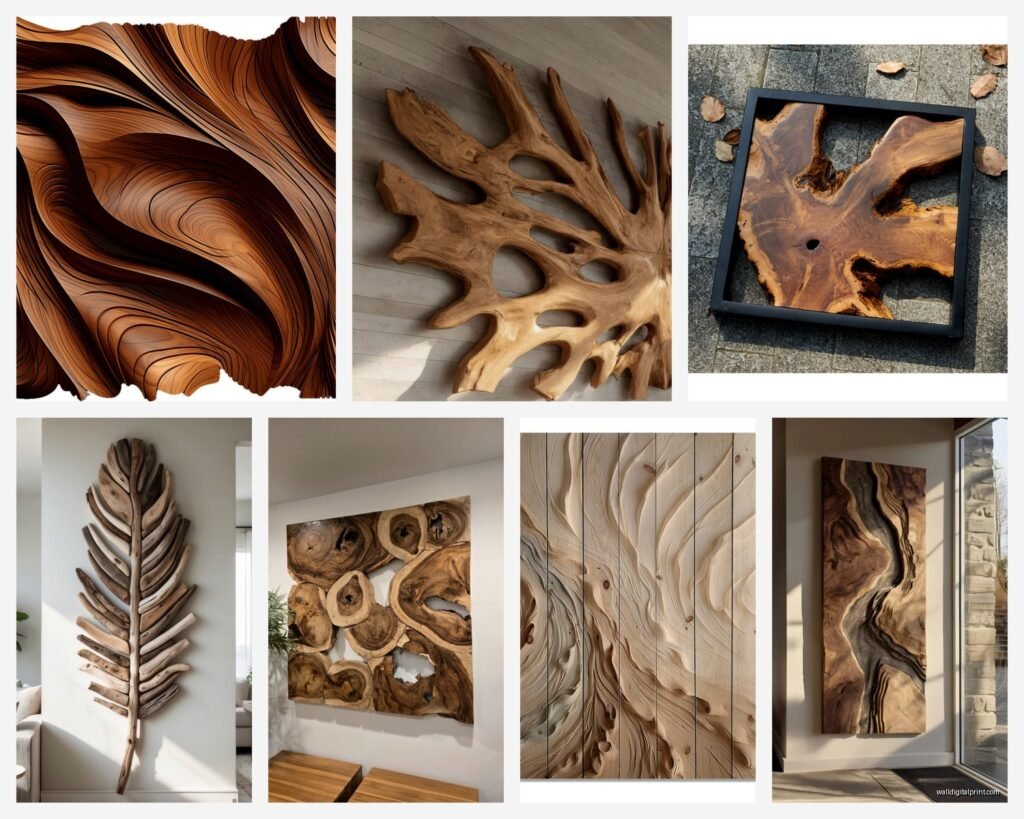
Okay so the grain is everything here. You want unfinished pieces that show off the natural pattern, which means some woods are gonna look amazing and others are just… boring planks on your wall.
Cedar is my go-to for clients who want that rustic cabin vibe but don’t actually live in a cabin. The grain is pronounced without being aggressive, and it smells incredible for like the first six months. I had this one piece in my office and my dog would just sit under it sniffing the air. The red undertones are gorgeous too, they catch light in this really subtle way that photographs terribly but looks amazing in person.
Walnut is the expensive option but worth it if you’re doing a smaller piece. The grain patterns are insane, like nature’s own abstract art. I used a walnut slab for a client’s bedroom last year and the chocolate brown tones with those dark grain lines… it basically became the focal point of the entire room. But yeah, it’s pricey. You’re looking at probably 3-4 times what you’d pay for pine.
Pine is the budget-friendly choice and honestly don’t sleep on it. The grain can be really interesting especially if you find older growth wood. New pine is kinda plain, but if you can source reclaimed pine or stuff from a specialty lumber yard, those knots and grain variations are perfect for that organic look everyone’s after right now.
White Oak vs Red Oak
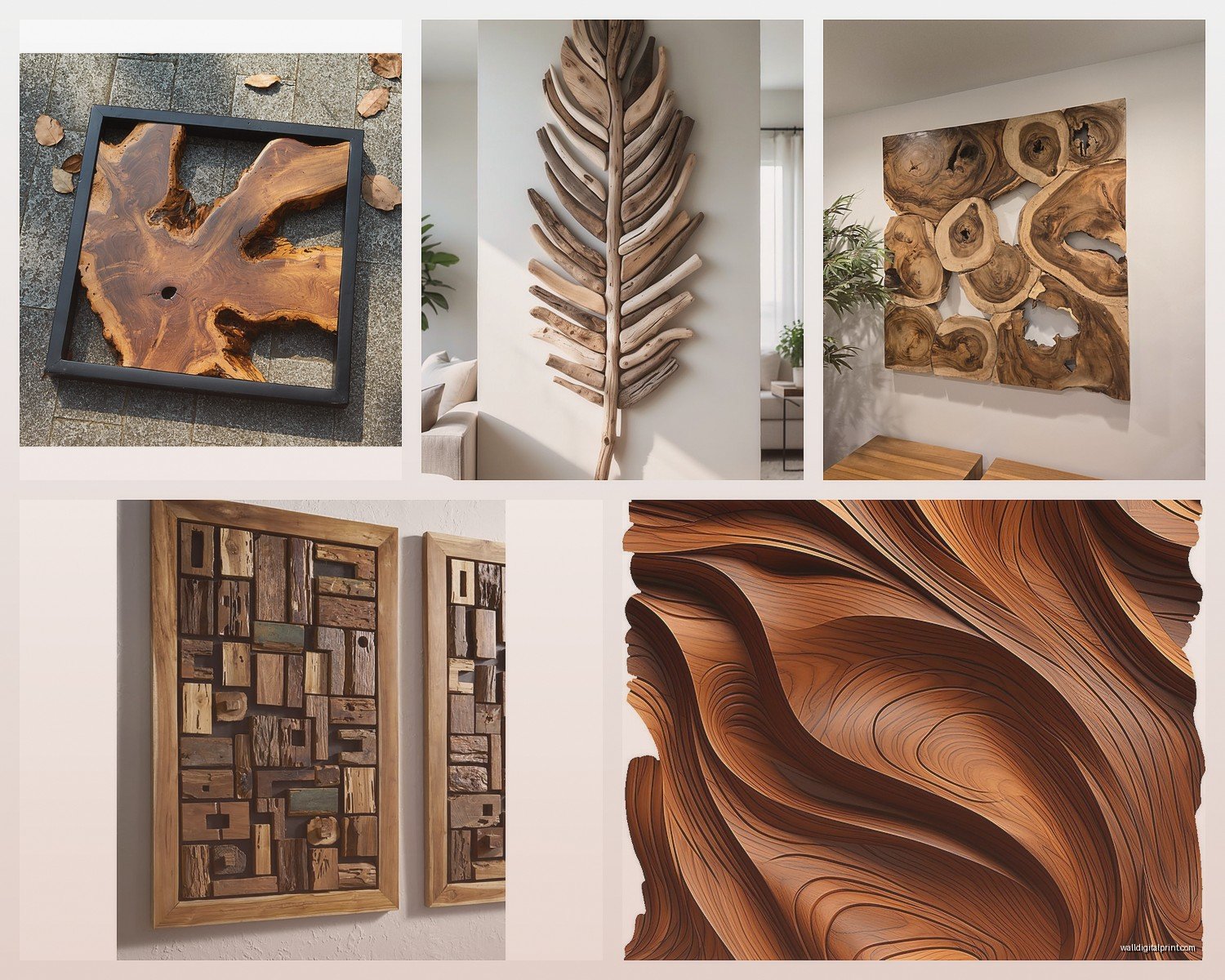
This is gonna sound weird but I smell the difference before I see it sometimes. White oak has this slightly sweet smell when it’s freshly cut, and the grain is tighter, more uniform. Red oak has wider grain patterns with more variation. For wall art, I usually go with red oak because those cathedral patterns and rays are more dramatic. White oak is beautiful but almost too refined? Like it wants to be furniture instead of art.
Where to Actually Source This Stuff
Home Depot is fine for basic projects but their selection of interesting grain patterns is pretty limited. Everything’s been milled for construction, not aesthetics. I go there for backing boards and mounting hardware, not the actual display wood.
Local lumber yards are where it’s at. The guys there (it’s always guys for some reason) will let you dig through stacks to find the pieces with the best grain. Bring gloves btw, learned that one the hard way with a splinter situation that lasted three days.
Reclaimed wood suppliers are gold mines but you gotta inspect everything carefully. I found this barn wood supplier outside the city and the grain patterns are incredible, but you’re also dealing with old nail holes, weathering, potential rot. Which can be part of the aesthetic, but you need to know what you’re getting into.
Thickness and Size Considerations
So everyone wants these thin, floating pieces that look all minimal and modern. But here’s the thing, anything under 3/4 inch is gonna warp unless you do some serious reinforcement on the back. I learned this the expensive way when a client’s cherry wood piece turned into a subtle curve after two months on their wall.
For most wall art applications, I stick with 1 inch to 2 inch thickness. It’s substantial enough to stay flat, looks intentional, and the edge profile becomes part of the design. You can see the growth rings from the side which is actually a really nice detail.
Size-wise, I’ve done everything from 12×12 inch squares to a 6 foot horizontal piece that took two people to hang. The sweet spot for impact without overwhelming a space is usually 24-36 inches in the longest dimension. Big enough to be a statement, small enough that the grain pattern reads as a cohesive design instead of just “wood on wall.”
Preparing Unfinished Wood
Okay so this is where people mess up. You can’t just cut a piece of wood and throw it on the wall. Well, you can, but it’s gonna split, warp, or collect dust in a really gross way.
First, the wood needs to be dried properly. Kiln-dried is what you want. Air-dried can work but it’s riskier with indoor climate control. The moisture content should be around 6-8% for interior applications. You can get a moisture meter for like twenty bucks and it’s honestly worth it. I check every piece now after the warping incident.
Sanding Without Losing Character
This is the balance you’re trying to strike: smooth enough that it won’t give anyone splinters, rough enough that it still looks organic and unfinished. I start with 80 grit to knock down any really rough spots, then 120 grit for the general surface. Some people go up to 220 but I think that’s too smooth for this application. You want to feel the grain texture when you run your hand across it.
Sand with the grain direction, never against it. Seems obvious but I’ve seen people mess this up and create these weird scratches that catch the light wrong.
Oh and another thing, the edges. You can leave them sharp and geometric, or hit them with sandpaper to soften them slightly. I usually do a light chamfer, just enough to prevent that sharp corner but not so much that it looks beveled. It’s subtle but it makes the piece look more intentional.
To Finish or Not to Finish (Sort Of)
So technically we’re talking about unfinished wood, but in practice, you probably want some kind of treatment unless you’re going for a super raw look and don’t mind dust becoming a permanent texture.
My favorite is a clear matte wax. It protects the wood without adding any sheen or color. You just rub it in with a cloth, let it sit for like 15 minutes, buff it out. The grain pops slightly but it still looks completely natural. I use Briwax Clear, have been for years. My client canceled last month so I spent an hour comparing different waxes at the hardware store and nothing else gives you that same totally-unfinished look with actual protection.
Tung oil is another option. It penetrates the wood instead of sitting on top, brings out the grain depth without adding obvious shine. Takes forever to dry though, like days between coats. And you need at least two coats, sometimes three. But the result is this rich, dimensional look that still reads as unfinished.
What NOT to use: polyurethane, shellac, or anything that creates a film on the surface. It’ll look plasticky and defeat the entire organic aesthetic you’re going for.
Mounting Methods That Won’t Fail
Wall mounting is where things get real. A heavy piece of walnut falling off the wall at 3am is not the vibe.
For lighter pieces (under 10 pounds), French cleats are perfect. You route or cut a 45-degree angle on a strip of wood, attach one piece to the wall, one to the back of your art. They lock together and the weight distributes evenly. Plus you can slide the piece left or right for perfect positioning.
Heavier pieces need something more substantial. I use keyhole hangers rated for at least double the weight of the piece. Mount them into studs, not just drywall. I know everyone says this but seriously, studs. I’ve seen too many drywall anchor failures to trust them with something heavy and wooden.
Another method I’ve been using lately: floating mounts with standoffs. You attach these small metal spacers to the back corners, they have threaded holes, and you screw through them into the wall. Creates this shadow gap between the wood and wall that looks really contemporary. Works best with 1.5-2 inch thick pieces.
The Backing Board Trick
For pieces that might warp or if you’re joining multiple boards together, attach a backing board. Use thin plywood, like 1/4 inch, and attach it with figure-eight fasteners or L-brackets. The backing stays hidden but keeps everything flat and gives you more mounting options.
Arrangement Ideas That Actually Work
Single large pieces are the easiest to pull off. Find a wood slab with amazing grain, prep it, mount it centered over a bed or sofa. Done. The grain pattern is the art.
Multiple smaller pieces can work but it gets tricky fast. I did a grid of nine 12×12 inch squares in different wood species once, all the same thickness, arranged with equal spacing. The variation in grain and color between species created the visual interest. But if the spacing is off or the pieces are different thicknesses, it looks accidental instead of intentional.
Horizontal planks in varying widths is a look I keep coming back to. Like, a 4-inch plank, then a 6-inch, then a 3-inch, all different lengths, mounted with small gaps between them. The randomness feels organic but you need to plan the layout carefully. I literally lay everything out on the floor first, take a photo, live with it for a day, adjust, repeat.
Wood Species Cheat Sheet for Grain Patterns
Ash: super pronounced grain, almost looks like waves, lighter color
Maple: subtle grain, more about the overall tone than pattern, very smooth
Cherry: fine grain with occasional darker streaks, darkens beautifully over time
Hickory: dramatic grain variation, lots of character, lighter sapwood with darker heartwood
Douglas Fir: straight grain with distinct growth rings, that classic wood look
Dealing with Live Edge
Live edge is huge right now but it’s also where people make mistakes. The natural edge of the tree looks amazing but it needs to be stable. Bark needs to be completely removed or it’ll flake off and make a mess. I use a wire brush attachment on a drill to get into all the crevices.
Check for bug damage along the live edge. Little holes mean insects were there, might still be there. Not something you want in your home. If you find evidence of bugs, the wood needs treatment or you skip it entirely.
The live edge should be the feature, so keep the rest simple. I usually do a live edge piece with minimal other treatment, let that organic edge do all the talking.
Maintenance Reality Check
Unfinished or minimally finished wood will age. That’s part of the appeal but also something to manage. Dust it regularly with a dry cloth, don’t use water or cleaning products. If you waxed it, you can rewax every year or two to refresh the protection.
Sun exposure will change the color over time. Walnut fades lighter, cherry darkens. It’s actually kinda cool watching the piece evolve but if you want to prevent it, keep the art out of direct sunlight.
Humidity is the enemy. Big swings in moisture will cause expansion and contraction, potentially leading to cracks. Try to maintain consistent humidity levels, especially in extreme climates. I use a humidifier in winter, dehumidifier in summer in my workspace.
Cost Breakdown
Since everyone always asks… A basic pine piece, maybe 24×36 inches, you’re looking at $30-50 for the wood, assuming you’re doing the prep work yourself. Nice grain pattern walnut in the same size could be $150-300 depending on the supplier and thickness.
Tools you’ll need: saw (circular or miter), sander (orbital is fine), moisture meter if you wanna be safe, mounting hardware. If you don’t have tools, factor in either buying them or paying someone to do the cuts.
Time investment is significant. Between sourcing, cutting, sanding, treating, drying, and mounting, you’re looking at several days minimum. Most of that is waiting for finishes to dry, but still.
Or you can buy pre-made pieces but honestly they’re marked up like 300% and the wood selection is usually whatever the maker found on sale. Making your own means you control the grain pattern, size, everything.
Wait I forgot to mention, some lumber yards will do rough cuts for free or cheap. Take advantage of that if you don’t have a way to cut large pieces. Bring your measurements, they’ll get you close, you can refine at home.
What Doesn’t Work
Treated lumber looks wrong for this application. The green or brown tint, the chemical smell, just no.
Super thin wood trying to span large dimensions. Physics wins, it’ll warp.
Ignoring the room’s existing wood tones. If you have orange-y oak floors and you throw a cool-toned ash piece on the wall, it’s gonna fight. Not impossible to make work but requires intention.
Over-sanding. Once you hit that super smooth surface, you’ve lost the organic quality. Stop earlier than you think you should.
I’ve been working on a maple piece while watching this detective show and keep getting distracted by the plot, which is how I over-sanded one section and now it’s noticeably different from the rest. Gotta start over on that part probably.
Anyway, the main thing with natural wood wall art is just letting the material be the star. Find beautiful grain, prep it properly, mount it securely, and get out of the way. The wood knows what it’s doing.
