Wall Art Guide, Wall Art Tutoriels
Wooden Fish Wall Art: Carved Aquatic Ocean Decor
Mar
So I’ve been kinda obsessed with wooden fish wall art lately and honestly it started because a client wanted this whole coastal vibe but didn’t want the typical seashells-and-rope situation everyone does. Let me tell you what I’ve learned because I’ve literally handled like 30 different pieces in the past few months.
Material Types You’ll Actually Encounter
Okay so the wood itself matters way more than I initially thought. Most carved fish art comes in a few main materials and they all behave differently on your wall.
Teak is probably what you’ll see most often. It’s got this gorgeous honey-brown color and here’s the thing – it actually holds up really well in humid environments. I put a teak fish sculpture in my bathroom (the one with the terrible ventilation) like eight months ago and it still looks perfect. The natural oils in teak make it resistant to moisture which is why you see it in outdoor furniture too. Expect to pay anywhere from $80 to $300 depending on size and detail level.
Mango wood is lighter both in weight and color. It’s sustainable which is cool because mango trees that stop producing fruit get repurposed. The grain is really interesting, kinda swirly? But it’s softer than teak so the carvings aren’t quite as crisp. I’ve noticed it scratches easier if you’re not careful during installation. Price range is usually $40 to $150.
Mahogany gives you that rich reddish-brown tone that photographs SO well. My Instagram engagement literally went up when I posted a mahogany fish piece in a client’s entryway, not gonna lie. It’s durable but needs to stay away from direct sunlight or it’ll fade. Found that out the hard way with a piece near a west-facing window.
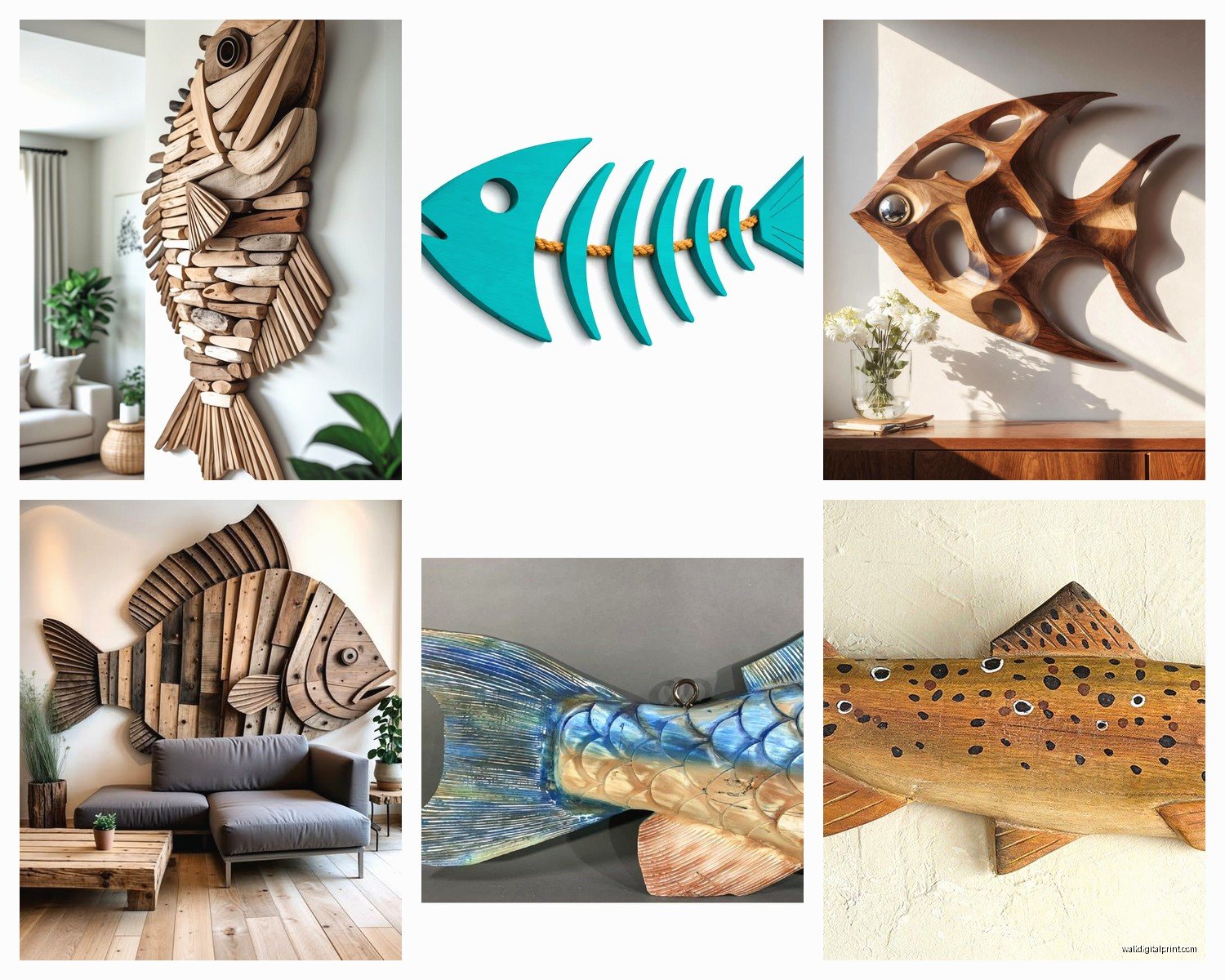
Then there’s reclaimed wood or driftwood pieces which are hit or miss. When they’re good, they’re REALLY good – all weathered and textured with this organic beach-found vibe. When they’re bad, they’re literally just painted plywood someone’s trying to pass off as driftwood. You gotta inspect these in person if possible.
Carved vs. Assembled Pieces
This is where it gets interesting. True carved fish are made from a single piece of wood or maybe 2-3 joined sections. A craftsman actually carves the shape, scales, fins, everything. These have depth and you can see tool marks if you look close.
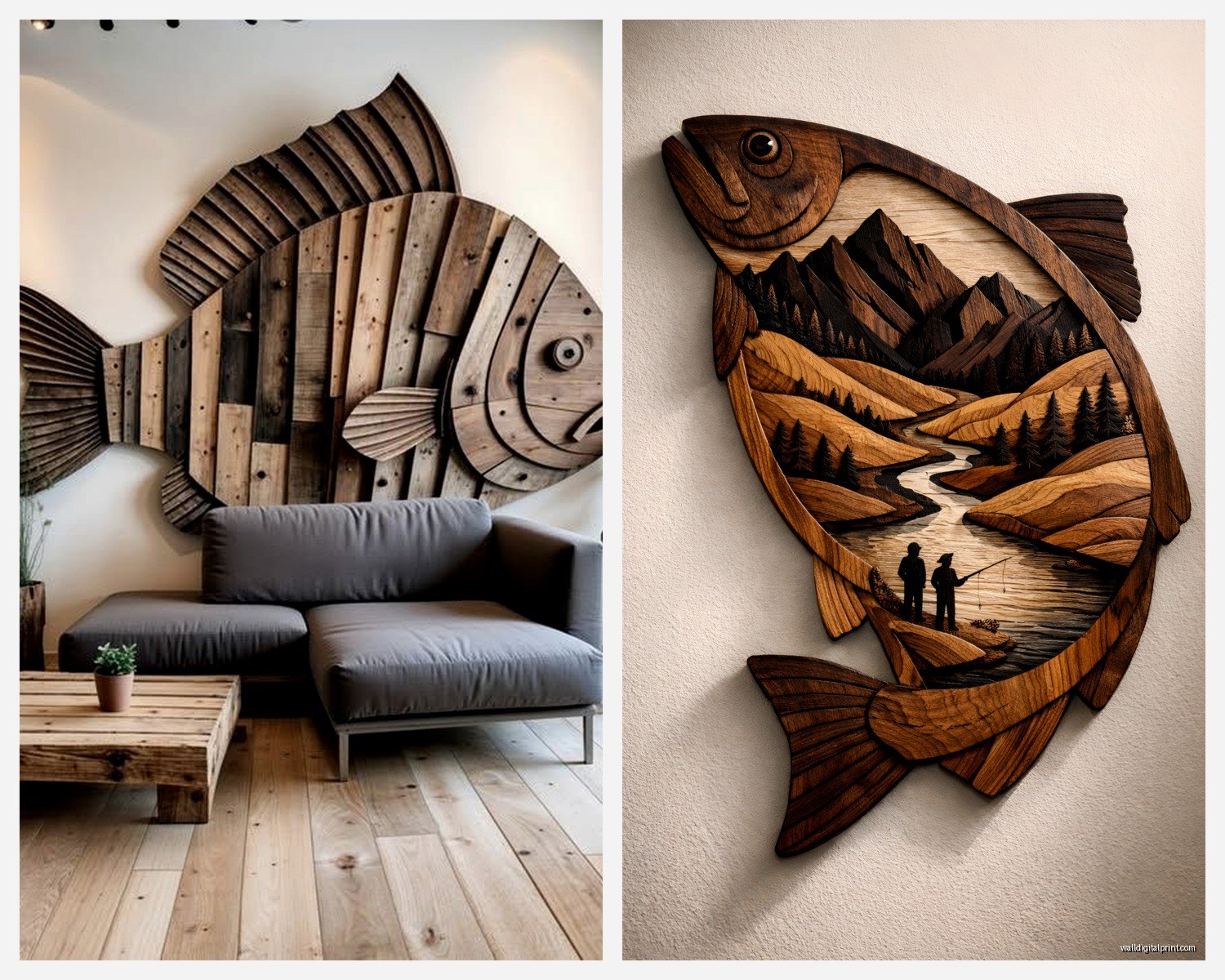
Assembled pieces are cut from thinner wood (sometimes laser cut now) and layered together. They’re not bad – actually some of the coolest dimensional effects come from layering. But they’re different. The assembled ones are usually lighter weight which matters if you’re hanging on drywall without studs.
I have this one carved piece that’s probably 15 pounds and my cat knocked it off the console table once… let’s just say I’m glad it missed the hardwood floor. The assembled pieces are more forgiving for renters or people who don’t wanna deal with heavy-duty hanging systems.
Checking Quality Before You Buy
Run your hand over the surface – it should be smooth with intentional texture from carving, not rough or splintery. If you get splinters, it wasn’t finished properly.
Look at the finish itself. Most pieces come with either oil, wax, or polyurethane coating. Oil finish looks most natural but needs reapplication yearly. Wax gives a soft sheen. Poly is basically bulletproof but can look plasticky on cheaper pieces.
Check the edges and back. Sloppy work on the back usually means sloppy work overall. The hanging hardware should be securely attached – I’ve seen sawtooth hangers literally stapled on which is a disaster waiting to happen.
Size and Scale Issues Nobody Warns You About
Okay so funny story – I ordered a “large” fish sculpture online without checking actual dimensions and it arrived like 6 feet long. My living room is not that big. It’s now in a client’s office and looks amazing but MEASURE YOUR WALL.
For standard residential spaces:
– Small (12-18 inches): good for gallery walls or narrow spaces like between windows
– Medium (24-36 inches): works above consoles, in dining rooms, bathroom focal points
– Large (48+ inches): needs significant wall space, works great in living rooms or above king beds
But here’s what the dimensions don’t tell you – depth matters too. Some carved fish stick out 3-4 inches from the wall. This creates awesome shadows but you gotta account for it if you’re putting it above a sofa or anywhere people walk close by. I’ve definitely bumped my head on a protruding fin before.
Installation Methods That Actually Work
The hanging hardware situation is honestly all over the place with these pieces.
Sawtooth hangers are common but I don’t trust them for anything over 5 pounds. They work okay for lightweight assembled pieces but that’s it.
D-rings or triangle hangers are better. Mount them about 1/3 down from the top of the piece. Use two for balance – nothing worse than a crooked fish that you have to readjust every week.
For heavy carved pieces, I use French cleats now. It’s a two-part system where one piece mounts to the wall (into studs!) and one mounts to the back of the art. They interlock and it’s SOLID. You can buy cleat sets at hardware stores or make them from wood strips if you’re handy.
Wait I forgot to mention – some pieces come with wire hanging systems. These are fine but the wire needs to be heavy gauge. I’ve had thin wire actually bend under weight which made the whole piece hang at a weird angle.
Adhesive strips are tempting for renters but honestly I only use them for the smallest, lightest pieces. The risk isn’t worth it for a $200 carving.
Wall Type Considerations
Drywall without studs: use toggle bolts or molly bolts rated for the weight. Don’t skip this step.
Plaster: drill carefully, use plastic anchors designed for plaster. It’s more brittle than drywall.
Brick or concrete: masonry anchors and a proper drill bit. This is actually the most secure option once it’s done.
Tile (like in bathrooms): you need special tile bits and extreme patience. Or mount a board to the wall first and attach the art to that.
Finish Options and What They Mean for Maintenance
Natural/oil finish pieces need love. I use teak oil or danish oil once a year, wipe it on with a cloth, let it soak in for 15 minutes, wipe off excess. Takes maybe 10 minutes total. These finishes let the wood breathe and age naturally but they’re not waterproof.
Painted or stained pieces are usually sealed with poly or lacquer. They’re low maintenance – just dust them. The downside is if they get damaged you can’t really blend repairs easily. I’ve got a piece with a chip in the blue paint and it’s just… there. Forever.
Whitewashed or distressed finishes are trendy right now. They’re typically sealed but the weathered look hides imperfections well. Good choice if you have kids or pets who might bump into things.
Color Choices Beyond Natural Wood
Oh and another thing – the color situation is wild. You can find these fish in literally every color.
Natural wood tones are classic and versatile. They warm up modern spaces and work with traditional decor. Can’t go wrong unless your entire room is already dark wood, then it might be too much.
Blue painted fish are the obvious choice for coastal themes. Navy, turquoise, aqua – I’ve used them all. The trick is matching your blue to something else in the room. A random bright blue fish on a neutral wall with no other blue tones looks odd.
Multi-colored pieces with blues, greens, teals give you more design flexibility. Easier to tie into existing color schemes. There’s this one set I used that had like 5 different blue-green shades and it pulled together a room that had both blue and green accents.
Metallic finishes (gold, silver, bronze) are having a moment. They read more glam than beachy. I put a gold-leafed wooden fish in a client’s Art Deco-inspired bedroom and it was perfect. Wouldn’t work in a casual coastal space though.
White or cream pieces are subtle. They add texture without adding color which is great for minimalist spaces or when you want the shape to be the statement, not the color.
Where to Actually Source These Things
Okay so where do you find quality pieces without getting scammed…
Local artisan markets and craft fairs are hit or miss but when you find a good woodworker, stick with them. You can often commission custom sizes and finishes. I have a carver I work with who’ll match wood tone to a sample I send. Worth the extra cost for custom projects.
Import stores and pier1-type places (RIP to actual Pier1) carry mass-produced versions. Quality varies wildly. Inspect in person if possible. I’ve bought gorgeous pieces and also complete garbage from these places.
Etsy is actually pretty good for this. You can message sellers, see reviews, get custom options. Search terms that work: “carved wooden fish wall art,” “teak fish sculpture,” “reclaimed wood fish decor.” Filter by your country if you want faster shipping.
West Elm, CB2, Anthropologie carry higher-end options. You’re paying for curation and easier returns. I’ve gotten beautiful pieces from West Elm but you’re definitely paying a premium for the brand.
Bali and Indonesian import shops online have AMAZING carved pieces at reasonable prices. Shipping takes forever and you gotta factor in potential customs fees but the craftsmanship is often exceptional. Just… the shipping. Budget like 6-8 weeks.
Avoid Amazon unless you’re okay with possibly receiving something that looks nothing like the photo. I mean some sellers are fine but it’s a gamble. Read recent reviews carefully.
Styling These Things So They Don’t Look Cheesy
This is gonna sound weird but the key to not looking like a beach-themed restaurant is restraint and context.
One large statement fish is usually better than a school of small ones. Unless you’re doing a proper gallery wall with other elements mixed in. All fish and nothing else reads very themed.
Mix materials in the same space. Wooden fish + metal wall sconce + ceramic vase = collected over time. All wooden ocean stuff = you went to HomeGoods once and got carried away.
Consider the room’s purpose. Wooden fish in a bathroom? Totally works, especially with the moisture resistance. In a home office? Can work if it’s styled modern and the rest of the space is professional. In a formal dining room? Harder to pull off unless it’s a really artistic piece.
Scale it to your architecture. High ceilings can handle bigger pieces. Standard 8-foot ceilings do better with medium sizes unless you have a lot of wall space.
My dog just knocked over my coffee so gonna wrap this up quick –
Actual Problems You Might Encounter
Wood splitting happens, especially with climate changes. If you live somewhere with big humidity swings, this is real. A humidifier in winter helps. I’ve had fins crack when the heat kicks on in fall.
Fading is real with any finish in direct sunlight. UV-protective glass nearby or just keeping it out of harsh sun extends the life.
Dust accumulation in the carved details is annoying. I use a soft brush attachment on my vacuum on low power, works way better than trying to dust with a cloth.
The piece might not be exactly like the photo online. Wood grain varies, carving details vary if they’re handmade. This is actually part of the charm but can be disappointing if you wanted an exact match.
Weight miscalculations lead to falling art. Always overestimate hardware needs. Better to use a heavy-duty anchor you didn’t need than to have a fish sculpture crash down at 3am.
Look just get something you actually like, make sure it’s real wood and not resin (knock on it, wood sounds different), install it properly with appropriate hardware, and don’t overthink the coastal thing. Some of the best installations I’ve done were wooden fish in completely non-beachy contexts where they just worked as sculptural elements.