Wall Art Guide, Wall Art Tutoriels
Buddha Wall Art for Living Room: Zen & Mindful Decor
Apr
So I’ve been obsessing over Buddha wall art lately because honestly my living room was giving me anxiety every time I walked in, and someone told me adding some zen elements might help. Turns out they were right, but wow there’s so much bad stuff out there mixed in with the actually good pieces.
Materials That Actually Matter
Okay so first thing – canvas prints are everywhere and they’re cheap but here’s what nobody tells you. The quality difference between a $30 canvas and a $150 canvas is HUGE. I bought three different Buddha pieces to test this (my partner thought I was losing it) and the cheap ones looked washed out within like two months. The ink fades if you have any natural light in your room at all.
What worked for me was looking for giclée prints on cotton canvas, minimum 400 GSM thickness. That GSM number is basically how dense the canvas is – anything under 300 feels flimsy and you can see the wooden frame through it which looks terrible. The Buddha face I ended up keeping is printed on 440 GSM and it has this weight to it that just feels more intentional, you know?
Metal Prints Are Underrated
Wait I forgot to mention metal prints because everyone sleeps on these. My friend Sarah has this gorgeous Buddha silhouette printed directly onto brushed aluminum and it’s actually stunning. The metallic surface gives it this subtle shimmer that changes with the light throughout the day. They’re more expensive – like $200-$400 for a decent sized piece – but they last forever and you don’t need to frame them.
The thing with metal is you gotta make sure it’s HD aluminum specifically. I saw some cheap versions at HomeGoods that were basically just stickers on tin and they looked awful up close. Real metal prints use a dye-sublimation process that infuses the ink INTO the metal so it won’t scratch off or fade.
Wood and Natural Materials
This is gonna sound weird but some of my favorite Buddha art isn’t actually printed at all. There’s these carved wood panels you can find – teak is the best but also pricey. I found a reclaimed wood piece on Etsy that’s a simple Buddha outline carved into weathered barn wood and it has so much more character than any print.
If you go the wood route:
- Teak holds up best and has natural oils that prevent warping
- Mango wood is cheaper but needs to be sealed properly or it’ll crack
- Reclaimed wood looks amazing but check that it’s actually sealed because you don’t want whatever chemicals soaking into your wall
- Bamboo is trendy right now but honestly it can look cheap if it’s not done well
The carved pieces usually run $100-$300 depending on size. I spent like three hours comparing different Etsy shops last month (was avoiding doing my taxes) and the sweet spot seems to be around $180 for something hand-carved that’s roughly 24×18 inches.
Tapestries and Fabric Wall Hangings
Okay so tapestries are tricky because most of them look college-dorm-y which isn’t the vibe for a grown-up living room. But I found this cotton-linen blend one that’s actually sophisticated – it’s a minimalist Buddha head in charcoal on natural linen and it doesn’t scream “I just discovered meditation.”
What to look for in fabric pieces:
- Natural fibers only – polyester tapestries look plasticky and catch dust like crazy
- Weight matters here too, you want something substantial not see-through
- Hand-blocked or screen-printed designs look way better than digital prints on fabric
- Get one with a proper hanging system, not just those corner loops that make it sag weird
My cat destroyed my first tapestry attempt by using it as a climbing wall so now I only hang fabric art above furniture where she can’t reach. Just a thought if you have pets.
Size and Placement Strategy
This is where I messed up initially and had to redo everything. I bought this beautiful 16×20 Buddha canvas and hung it on my main wall and it just… disappeared. Looked like a postage stamp. The wall was like 12 feet wide and I needed something way bigger.
The rule I learned from an interior designer friend (shoutout to Maya) is that your art should take up roughly two-thirds to three-quarters of the furniture width beneath it. So if you have an 8-foot sofa, you’re looking at art that’s about 5-6 feet wide. This can be one large piece or a grouping.
Single Statement Piece vs Gallery Wall
For Buddha art specifically I actually think one large statement piece works better than multiple smaller ones. The whole point is creating a focal point for meditation or mindfulness or just like… calming your brain down when you look at it. Multiple pieces can feel cluttered.
That said I’ve seen some really cool triptychs where the Buddha image is split across three panels. There’s this one I’m still thinking about buying where it’s a Buddha face fragmented across three vertical canvases – creates movement and feels more contemporary. Those usually come in sets and you hang them with like 2-3 inches between each panel.
Color Palettes That Don’t Look Cheesy
Oh and another thing – the gold Buddha art is everywhere right now and most of it looks tacky. I’m sorry but it’s true. Unless you commit to a really luxe metallic finish (like actual gold leaf which is $$$$) the printed gold just looks flat and cheap.
What actually works:
- Charcoal or black on white/cream for minimalist modern spaces
- Sepia tones or brown ink on natural canvas for earthy organic vibes
- Deep teals or navy blue for something with color that still feels calm
- White on dark backgrounds for drama without being too much
- Natural wood tones if you’re going carved or printed on wood
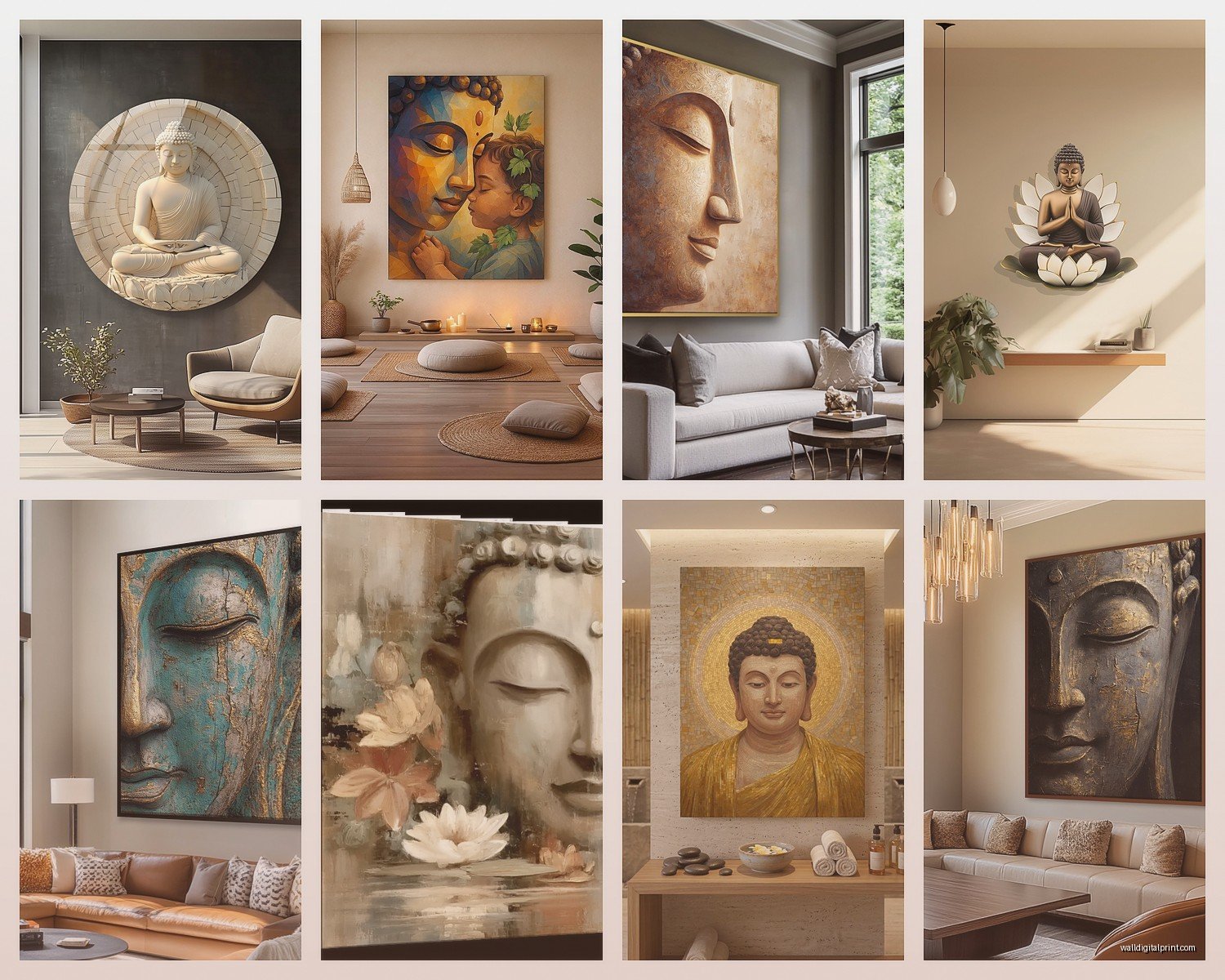
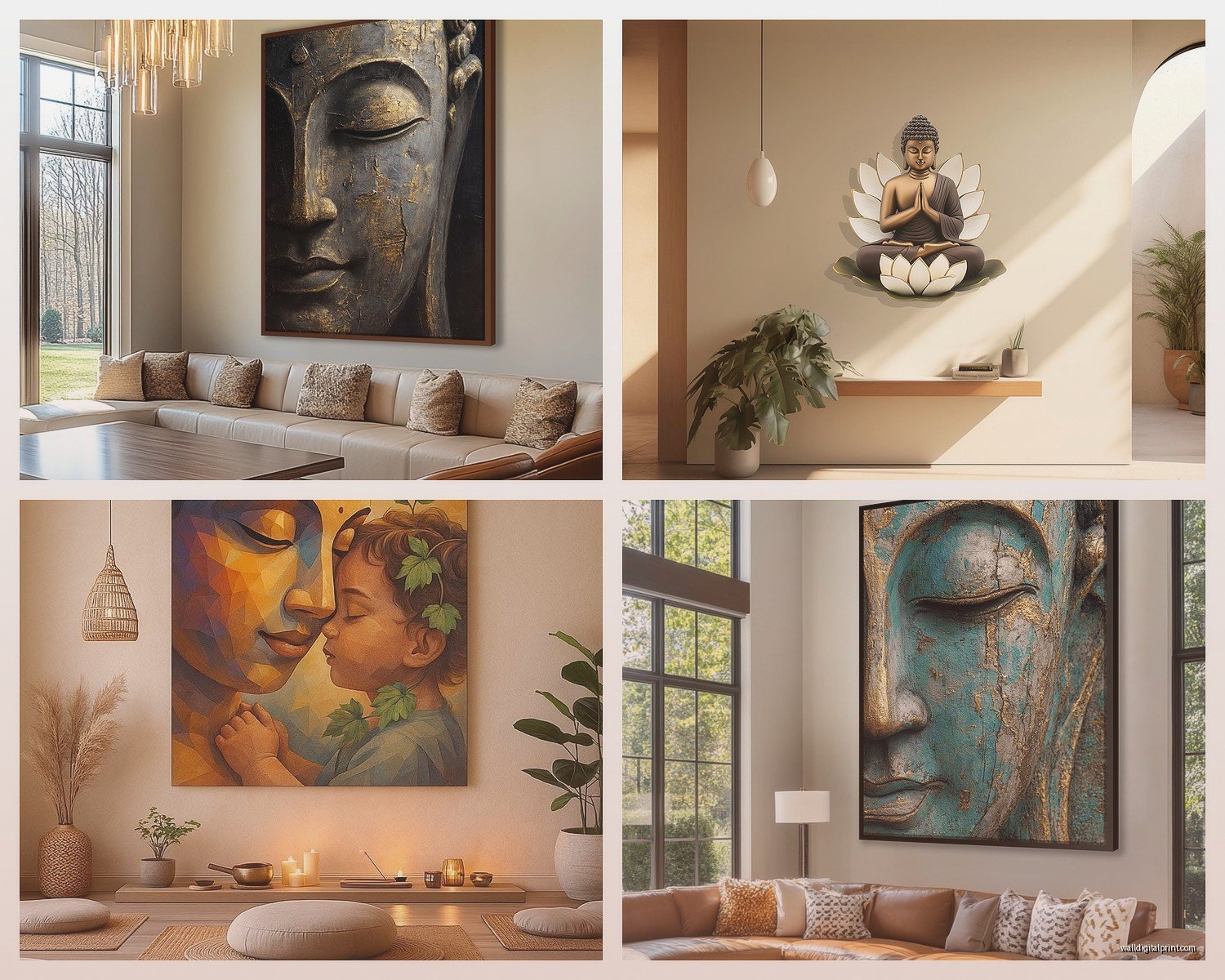
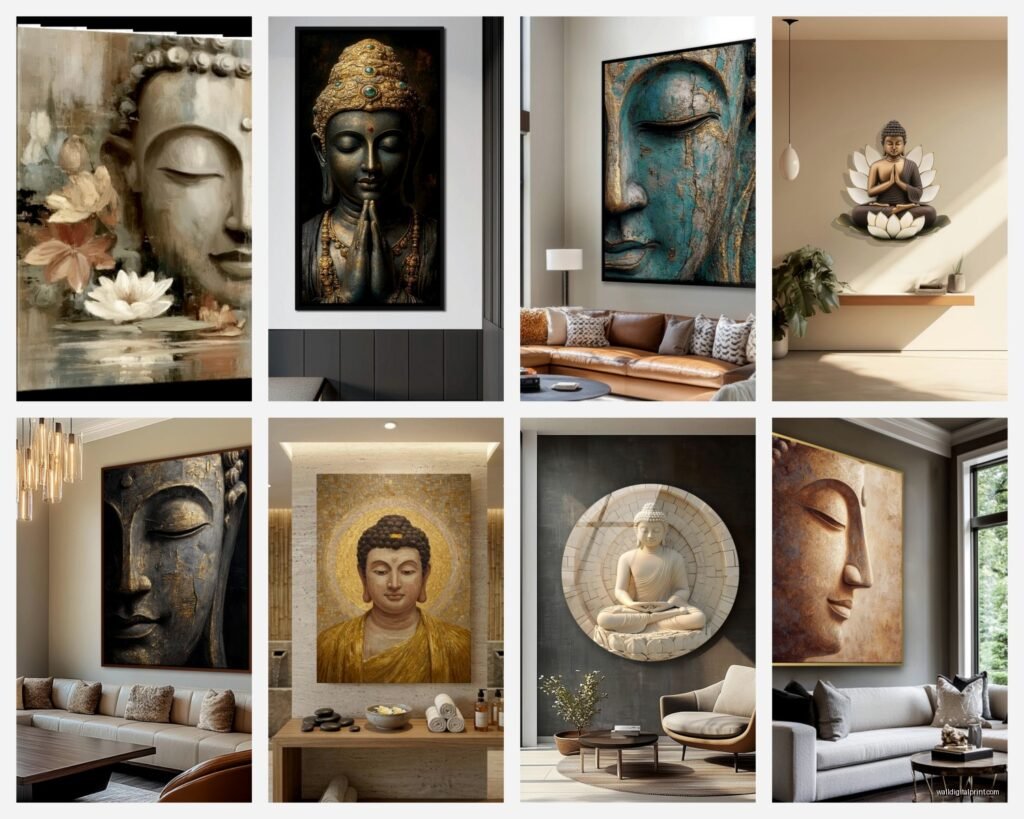
I have warm gray walls in my living room and went with a charcoal Buddha on cream canvas and it’s perfect. Doesn’t compete with anything else but still has presence.
The really colorful chakra-themed Buddha art with all the rainbow colors can work but you gotta have a pretty neutral room for it to not feel overwhelming. My client last year wanted one and her living room had like burgundy walls and patterned rugs and it was just too much happening.
Framing Options That Elevate Everything
So here’s something I learned the hard way – even expensive art looks cheap without proper framing or mounting. I had a $200 canvas Buddha print that I just hung as-is and my friend thought it was from Target (it wasn’t! I was offended!).
For canvas prints you have two routes:
Gallery wrapped means the image continues around the sides of the wooden frame. This looks clean and modern and you don’t need an additional frame. But make sure the sides are actually painted/printed, not just white canvas showing.
Framed canvas is when you put the canvas in an actual frame. This looks more traditional and polished. I use simple black floating frames for most of my Buddha art – the floating style means there’s a small gap between the canvas edge and the frame which looks really sophisticated.
For paper prints you absolutely need proper framing with mat boards and everything. A museum-quality print behind glass with a mat in a simple frame will always look better than a cheap canvas. I got a vintage Buddha print from an antique shop, had it professionally framed with conservation glass and a linen mat, cost about $180 for the framing alone but totally worth it.
Mounting and Hardware
This is boring but important – don’t use those tiny nails that come with frames. Get proper picture hanging hooks rated for the actual weight. I’ve had two pieces crash down at like 3am (scared the hell outta me both times) because I was lazy about hardware.
For anything over 20 pounds use two hooks spaced apart for balance. For really heavy wood pieces or metal art, get those heavy-duty wall anchors if you’re not hitting a stud. My metal Buddha is like 35 pounds and I used three anchors because I’m paranoid now.
Where to Actually Buy Quality Pieces
Okay so after buying and returning like fifteen different Buddha art pieces I’ve figured out where to find the good stuff:
Etsy is hit or miss but has some amazing independent artists doing original work. Search for “handmade Buddha art” or “carved Buddha wood” not just “Buddha wall art” to filter out the dropshippers. Read reviews carefully and look for shops that show production photos.
Society6 and Minted have curated artist collections and better quality printing than random Amazon sellers. More expensive but worth it. They also do sales pretty regularly so wait for 20% off.
Local art fairs and markets if you have them – I found my favorite piece at a craft fair from a woman who does woodburning art. It’s a pyrography Buddha on a round birch slice and I get compliments every single time someone comes over.
Antique shops for vintage prints and thangka paintings if you want something with actual history. Just make sure you’re not buying sacred religious items that shouldn’t be used as decoration – there’s a difference between art inspired by Buddhism and actual religious artifacts.
West Elm, CB2, and similar have surprisingly good Buddha art sometimes. It’s mass-produced but their quality control is decent and you can see it in person before buying.
Avoid Amazon unless you’re okay with probably getting something that looks nothing like the photo. I ordered what looked like a gorgeous Buddha canvas and received what can only be described as a blurry printout. Returned it immediately.
Styles That Work for Different Living Room Vibes
Your existing decor really matters here because Buddha art comes in so many styles and not all of them will work with what you’ve got going on.
Modern minimalist spaces – stick with line drawings or silhouettes in black/white/gray. Clean simple Buddha faces or meditation poses without extra decoration. The less detail the better.
Bohemian eclectic rooms – you have more freedom here. Colorful mandalas with Buddha imagery, mixed media pieces, vintage thangka paintings, macrame with Buddha elements. Just watch that it doesn’t tip into cluttered territory.
Scandinavian or hygge style – natural wood carvings, simple prints on linen or cotton, neutral color palettes. Think organic textures and minimal designs.
Contemporary glam – this is where metallic finishes can actually work. Rose gold or copper Buddha silhouettes, geometric interpretations, maybe even a neon outline if you’re feeling bold (I saw one in a designer showroom and it was actually cool but very specific vibe).
Traditional or transitional – framed prints with substantial matting, carved wood panels in rich tones, classical Buddha portraiture rather than abstract interpretations.
I have mostly modern furniture with some vintage pieces mixed in so I went with a minimalist approach – one large charcoal Buddha head on cream canvas in a black floating frame. Keeps things calm and doesn’t fight with my mid-century credenza.
Maintenance and Longevity
Nobody talks about this but it matters – some materials need way more upkeep than others. Canvas collects dust like you wouldn’t believe. I have to gently vacuum mine with the brush attachment every couple weeks or it gets this gray film on it that dulls the image.
Metal and wood just need occasional dusting with a microfiber cloth. Super easy. Glass-covered framed prints need cleaning but at least you can use glass cleaner without worrying about damaging the art itself.
If you have your Buddha art in a spot that gets direct sunlight definitely invest in UV-protective glass or coating. The sun will absolutely destroy canvas prints and fade even quality giclée work. I learned this when my first Buddha canvas got this weird yellow tint on one side from afternoon sun exposure.
When to Splurge vs Save
Okay real talk – you don’t need to spend $500 on Buddha wall art for it to look good. But you also shouldn’t buy the $25 Amazon special and expect it to look expensive.
My recommendation is spend $100-250 on the actual art piece whether that’s a quality print, metal work, or carved wood. Then budget another $50-100 for proper framing or mounting if needed. So you’re looking at $150-350 total for something that actually enhances your space and lasts.
The exception is if you find an original piece from a local artist or a genuine vintage print – those might be more but you’re getting something unique with actual value.
I probably spent $600 total across three different pieces before I figured out what worked and kept just the one. So learn from my mistakes and really think about your space before buying.
The Actual Zen Part
Last thing I’ll say is that the whole point of Buddha imagery in your living room is supposed to be about creating peaceful energy and mindfulness. So if you get a piece that stresses you out because it’s too expensive or too trendy or doesn’t actually make you feel calm when you look at it – it’s the wrong piece.
I had this elaborate mandala Buddha thing that I thought I should like because it was “authentic” and expensive but every time I looked at it I felt anxious about all the detail and pattern. Swapped it for something simpler and my whole nervous system relaxed. Trust your gut on what actually brings you peace vs what you think should work.
Also maybe don’t do what I did and buy three at once while watching some documentary about meditation at 2am. One good piece is genuinely all you need.