Wall Art Guide, Wall Art Tutoriels
Theatre Room Wall Art: Drama Performance Art Decor
Apr
So I’ve been working on this theatre room project for like three weeks now and honestly the wall art thing is way more complicated than people think? Like everyone assumes you just slap up some movie posters and call it a day but there’s actually a whole science to making it look intentional instead of like a college dorm.
The Canvas vs Print Debate Nobody Tells You About
Okay first thing – canvas prints are gonna be your friend in a dark theatre room because they don’t have that glass glare situation. I learned this the hard way last year when I hung these gorgeous framed playbills in a client’s space and every time they turned on the projector it was like a mirror ball effect. Not cute. Canvas absorbs light better and you can get really dramatic with texture.
But here’s where it gets interesting – metal prints are actually amazing for theatre spaces if you’re going for that modern industrial vibe. The aluminum backing makes colors super vibrant even in low light and they’re literally weightless compared to framed pieces. I used some Displate metal posters in my own screening room (okay it’s my basement but whatever) with classic Broadway show art and the reflection is minimal because of the matte coating options.
Size Actually Matters More Than You Think
So everyone gets this wrong and buys art that’s too small. In a theatre room you need to go BIG because you’re usually viewing from like 10-15 feet away. My rule is nothing smaller than 24×36 inches for a medium-sized room. I did a consultation last month where the homeowner had these tiny 11×14 prints and they just disappeared into the wall.
For a standard theatre room (thinking like 12×16 feet), you want:
- One statement piece at 40×60 inches or larger
- Or a gallery wall with pieces ranging 24×36 to 30×40 inches
- Side walls can handle 20×30 minimum
The back wall behind seating is perfect for a massive piece because nobody’s craning their neck to look at it. I found this 48×72 canvas of the Comedy and Tragedy masks on Etsy from a seller called ArtWallDecor and it’s become my go-to recommendation. Not sponsored or anything, just actually good quality for like $180.
What Actually Works Theme-Wise
Oh and another thing – you gotta decide if you’re going full theatre/drama theme or mixing it up. Pure theatre rooms with all Broadway posters can feel a bit… much? Unless that’s specifically your thing. I usually do like 60/40 – mostly theatre-related but then throw in some abstract pieces or vintage film noir stuff.
Wait I forgot to mention – vintage playbills and programs are INCREDIBLE as wall art and nobody thinks of this. You can find original 1950s-70s Broadway programs on eBay for like $15-40 each. I frame them in simple black frames (gonna get to framing in a sec) and they add so much authenticity. My cat knocked over a whole stack of these last week while I was cataloging them and I almost cried but they were fine.
Specific Art Types That Actually Look Good
Theatre masks – Classic but can look cheesy if too literal. Go for abstract interpretations or vintage-style illustrations rather than the shiny gold plastic look.
Stage spotlights and curtains – These work really well as side pieces. There’s this seller on Society6 who does beautiful watercolor curtain art that doesn’t feel tacky.
Famous plays and musicals – Phantom, Hamilton, Les Mis, Wicked posters are easy to find. But also consider lesser-known productions for a more curated look. I love using regional theatre posters from the 1960s-80s.
Actor portraits – Black and white photography of classic stage actors (Olivier, Hepburn, Brando) in character adds sophistication. Avoid the super glossy Hollywood headshot vibe.
Script pages – Enlarged sections of famous play scripts look surprisingly modern. You can literally print these yourself if you have access to public domain texts.
The Framing Situation
This is gonna sound weird but I actually don’t frame most theatre room art anymore. The casual canvas look works better in a dark entertainment space than formal frames. BUT if you’re doing vintage pieces or paper items, you need UV-protective glass because theatre rooms can get warm with all the equipment running.
I use mostly:
- Floating frames for a modern gallery look – like 1-2 inch depth
- Simple black wood frames from Framebridge for vintage materials
- No frame at all for canvas wraps
Michael’s has these cinema-style frames with beveled edges that are perfect for playbills and they’re always on sale. Like literally always. Never pay full price there.
Lighting Your Art Without Ruining Movie Time
Okay so funny story – I installed these beautiful picture lights above some theatre posters in a client’s room and they hated them because the lights stayed on during movies. We ended up putting everything on smart switches so they could control what’s lit when.
Best lighting options:
- LED strip lights behind canvas for a backlit glow effect – these are like $20 on Amazon and you can set them to deep red or amber
- Recessed spotlights on dimmer switches
- Small battery-operated puck lights if you don’t wanna deal with wiring
- Honestly just good ambient lighting from the room itself works fine
The key is warm temperature bulbs (2700K-3000K) because cool white looks harsh and institutional in a theatre setting.
Where to Actually Buy This Stuff
I’ve tested like every source at this point and here’s what actually delivers quality:
Etsy – Best for custom and vintage. Search “theatre art print” or “Broadway poster vintage” and you’ll find tons. Read reviews obsessively though because quality varies wildly.
Society6 – Great for independent artists doing theatre themes. Their canvas quality is solid and they have tons of size options. Ships fast too.
eBay – Unbeatable for authentic vintage playbills and programs. Just make sure you’re okay with the condition described.
AllPosters.com – Huge selection of licensed Broadway and West End show posters. Prices are reasonable and they do custom sizing.
Local theatre companies – This is my secret weapon. Email local theatres and ask if they have old production posters they’d sell. I’ve gotten incredible pieces for $10-50 this way.
Installation Tips Nobody Mentions
Command strips work for lightweight canvas up to about 16×20 but don’t trust them for anything heavier, I don’t care what the package says. I’ve had pieces crash down at 3am and it’s terrifying.
For proper installation in a theatre room:
- Use wall anchors rated for 2x the actual weight
- Measure from the ceiling down, not the floor up (floors aren’t level, ceilings usually are)
- Center of art should be at 57-60 inches from floor for main viewing pieces
- Gallery walls should be planned on paper first – I use kraft paper templates taped to the wall
Oh and if you have acoustic panels, work around them instead of covering them up. The panels are doing actual work for your sound quality.
The Gallery Wall Formula That Actually Works
I was watching The Great British Baking Show while planning a gallery wall last week and realized it’s kinda like bread – you need structure but also room to breathe? Anyway, here’s the formula:
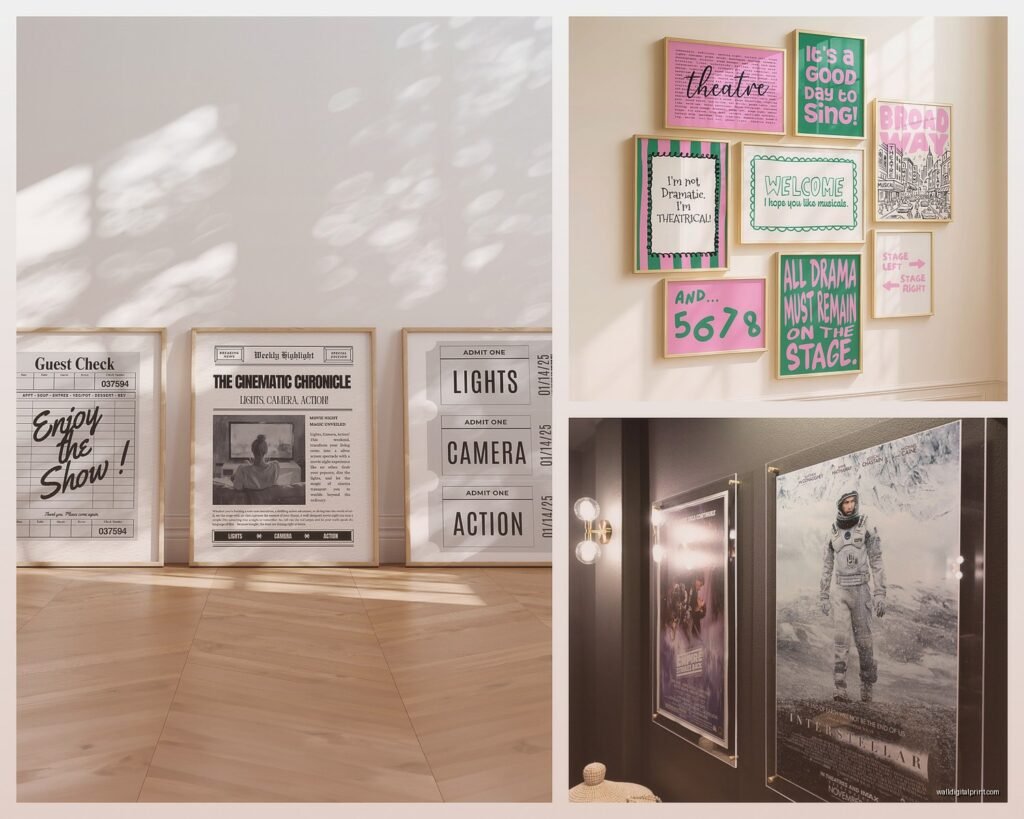
Start with your largest piece slightly off-center (not dead center, that’s boring). Then build around it with medium pieces, then fill gaps with small pieces. Keep 2-3 inches between frames consistently. Use 5-7 pieces for a cohesive look – fewer feels sparse, more feels cluttered.
Mix orientations – don’t do all horizontal or all vertical. And vary your content – playbills, posters, photographs, maybe one text-based piece.
Color Coordination Without Getting Boring
Theatre rooms are usually dark – burgundy, navy, black, deep grey walls. So your art needs to either complement or pop. I usually go for:
Monochromatic – All black and white photography and prints. Super classic, never looks dated.
Red accent – Since red is the classic theatre color, using art with red elements ties everything together. But not like, ALL red. That’s a lot.
Metallic touches – Gold and silver frames or art with metallic elements catch light beautifully in dim spaces.
What doesn’t work – pastel colors just disappear in a dark theatre room. Save those for literally any other room in your house.
Budget Breakdown Reality Check
You can do a full theatre room art installation for anywhere from $200 to $5000+ depending on how extra you wanna be. Here’s what I typically budget:
Budget tier ($200-500):
- 5-7 canvas prints from Etsy or Society6
- Simple hanging hardware
- Maybe one vintage playbill framed
Mid-range ($500-1500):
- Mix of canvas and metal prints
- 2-3 custom framed vintage pieces
- Better quality reproductions
- Proper lighting setup
High-end ($1500+):
- Original vintage posters professionally framed
- Custom commissioned pieces
- Museum-quality materials
- Professional installation
I usually tell clients to spend about 10-15% of their total theatre room budget on wall art because it’s what makes the space feel intentional instead of just “room with TV.”
Maintenance You Gotta Think About
Canvas collects dust like crazy. I use a microfiber duster every couple weeks and that’s it. Don’t use cleaning products directly on canvas – if something gets on it, barely damp cloth and pray.
Framed pieces need glass cleaned obviously. The UV-protective glass I mentioned earlier prevents fading but costs about 3x regular glass. Worth it for anything vintage or valuable.
Check your hanging hardware every 6 months especially if you live somewhere humid. Screws can loosen over time and nobody wants a 40×60 canvas landing on their head during movie night.
The thing about theatre room wall art is it should enhance the experience without distracting from it. When the lights are down and the movie’s playing, you shouldn’t really notice it. But when the lights come up, it should make people go “oh wow, this is an actual theatre space” not just a basement with a big TV. That’s the balance you’re going for and it takes some trial and error to get right but it’s totally doable.