Wall Art Guide, Wall Art Tutoriels
Triangle Wall Art: Geometric Three-Sided Shape Designs
May
So I’ve been obsessing over triangle wall art lately and honestly it started because my neighbor put up this terrible chevron thing that looked like a 90s Etsy nightmare, and I was like, there HAS to be a better way to do geometric shapes without looking dated.
Why Triangles Actually Work Better Than You’d Think
The thing about triangles is they create movement without being aggressive? Like circles are soft, squares are stable and boring, but triangles literally point your eye somewhere. I did this whole gallery wall in a client’s office last month with just triangle pieces and the energy completely shifted. People actually commented on it during meetings which like, never happens with art.
You gotta think about scale first though. I made this mistake in my own living room where I bought these cute 8×10 triangle prints and they just disappeared on my wall. Total waste of $60. Triangles need to be either really small in a cluster OR big enough to make a statement. Nothing in between really works.
The Size Thing Nobody Tells You
For a standard living room wall, you want at least 24 inches on one side of the triangle if you’re doing a single piece. Smaller than that and it looks like you’re decorating a dorm room. I usually go for 36-48 inches for a real impact piece.
But here’s where it gets interesting—you can do a cluster of smaller triangles (like 12-16 inches each) and arrange them to create one larger triangle shape. My friend Sarah did this behind her couch and it’s honestly the best solution I’ve seen for people who can’t commit to one giant piece.
Materials That Don’t Look Cheap
Okay so I’ve tested basically everything at this point because my client budget last quarter was specifically for geometric art and I went a little crazy.
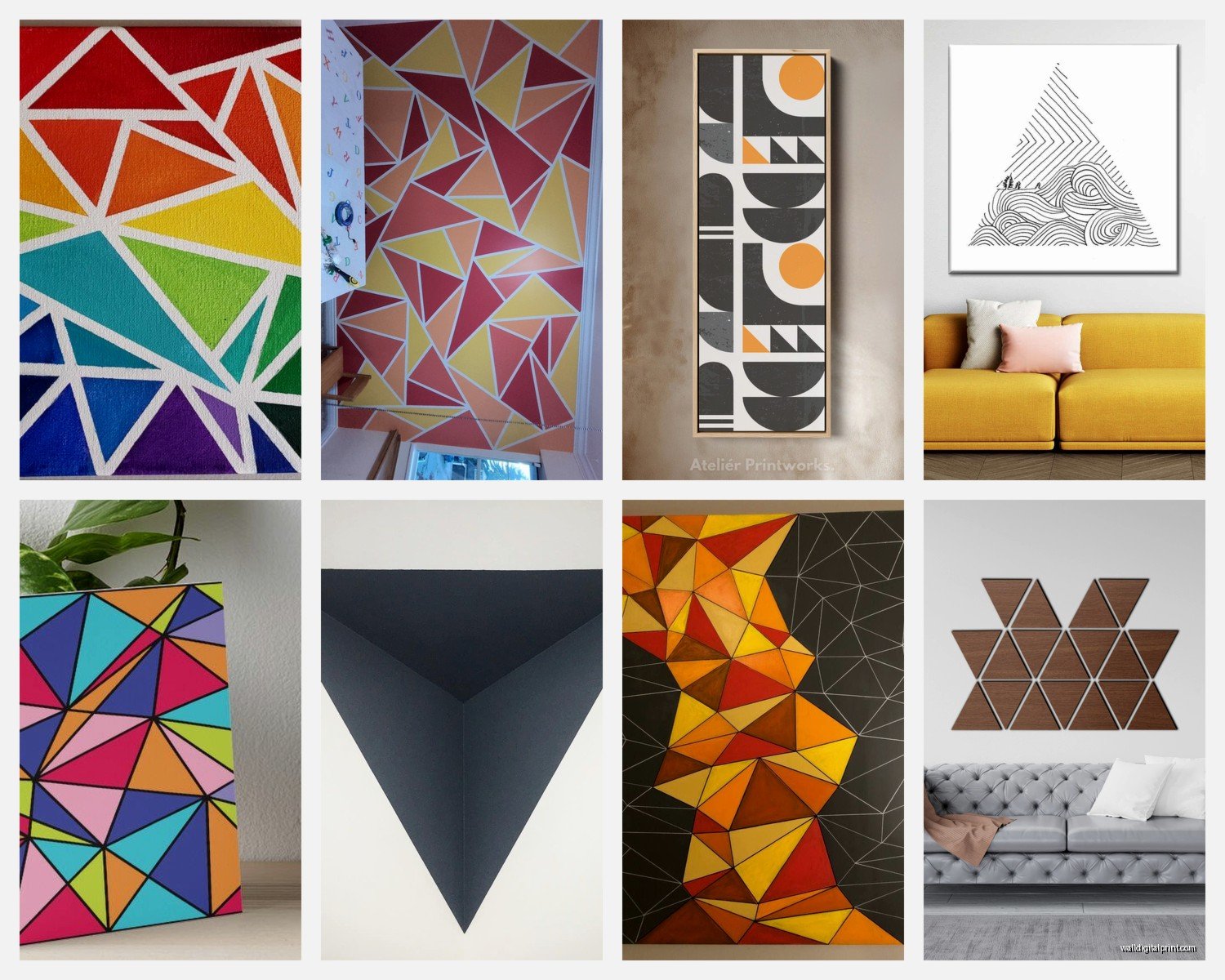
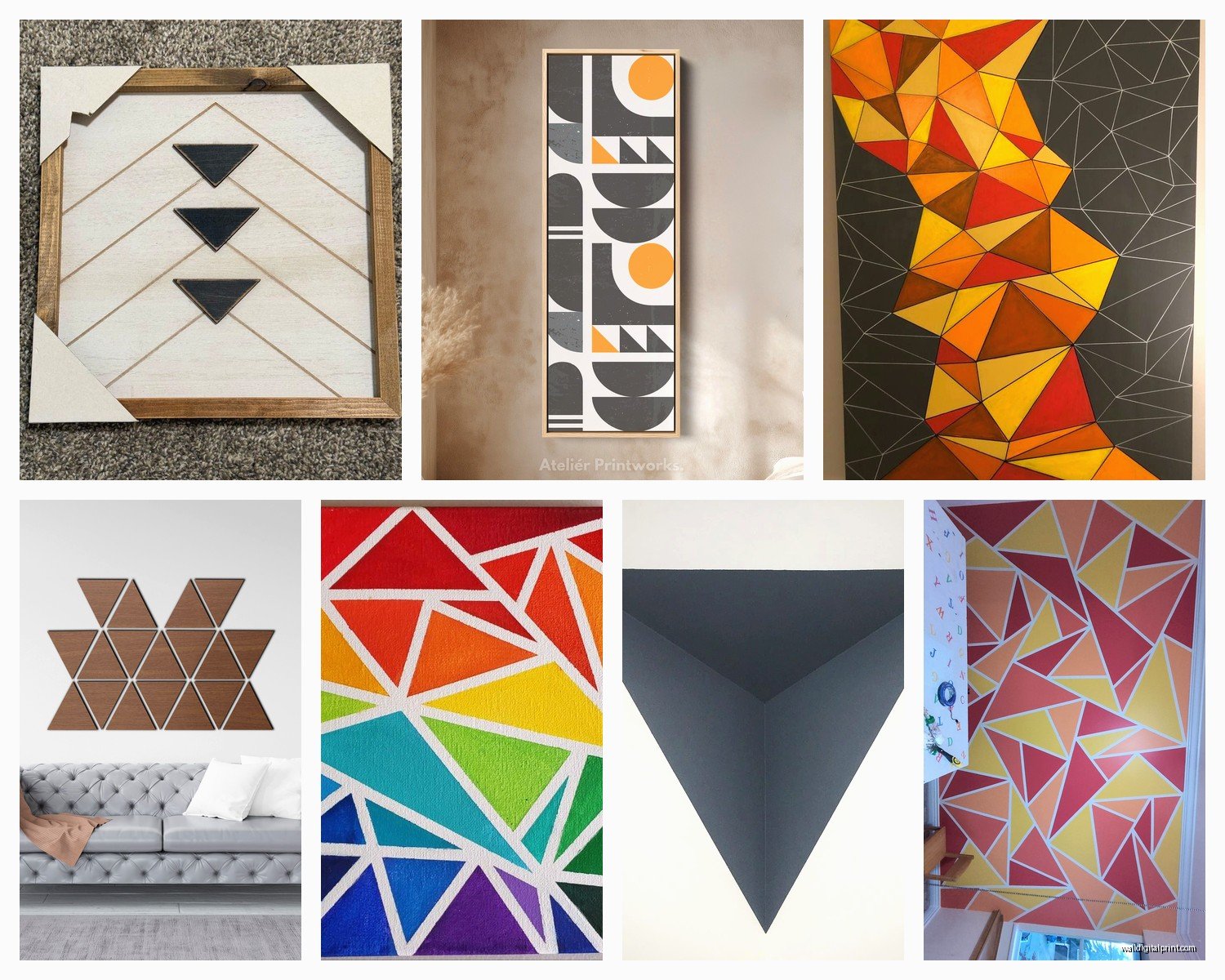
Wood triangles: These are my favorite right now. You can get them in natural wood, painted, or stained. The 3D aspect creates actual shadows on your wall which changes throughout the day with the light. I have three walnut-stained ones in my hallway and every time the afternoon sun hits them it’s like a whole different piece. They usually run $40-120 depending on size. The cheap ones from those home decor sites are usually plywood which is fine but you can tell up close.
Metal triangles: Super modern, very “I have my life together” vibes. Brass and copper are having a moment but they need the right space. I wouldn’t put them in a room with warm lighting because they can look orange-ish and weird. Brushed steel or black metal is safer. These range from $50-200 and the weight matters—heavier pieces look more expensive, simple as that.
Canvas prints: The most affordable option but also the easiest to mess up. The print quality HAS to be good or it looks like you downloaded something from a free website and had it printed at Staples. Look for giclée prints or at least 300 dpi resolution. I’ve found good ones on Etsy from $35-80.
Acrylic: This is gonna sound weird but acrylic triangle art is amazing in small spaces. It reflects light without being a mirror and adds depth. My bathroom has a frosted acrylic triangle piece and it makes the whole room feel bigger. They’re pricey though, usually $80-250.
Color Combinations That Work
I spent way too much time on this because I kept buying pieces that looked great online and terrible on my walls. Here’s what actually works:
Monochromatic is the safest bet. Different shades of blue, different shades of grey, whatever. You can’t really mess this up and it looks intentional even when it’s not.
Black and white with ONE accent color. I did this in my dining room with black, white, and mustard yellow triangles and it’s chef’s kiss. The key is the accent color should be in your room already—pull it from a throw pillow or rug or something.
Oh and another thing—if you’re doing multiple triangle pieces, they don’t all have to be the same color scheme but they should share at least one color. I learned this the hard way when I tried to do a “rainbow” triangle wall and it looked like a preschool.
Natural wood tones with ONE bold color also works really well. Like three natural wood triangles and one navy blue or forest green. Very California modern farmhouse without being too trendy.
Arrangement Ideas That Don’t Require a Pinterest Board
Okay so funny story, I once spent four hours arranging triangle pieces for a client and took probably 200 photos before we got it right. Here’s what I learned so you don’t have to do that:
The ascending method: Start with the smallest triangle at the bottom, stack larger ones above it going up and to the right (or left). Creates a mountain-ish shape. Works great on narrow walls like next to doorways or windows. Use 3-5 pieces.
The scatter: This is what I did in my bedroom. Just place triangles randomly but make sure they’re all pointing different directions. The trick is keeping roughly equal spacing between them—like 6-8 inches apart. Use 5-9 pieces for this to work. Less than that looks unfinished, more than that looks chaotic.
The constellation: One large triangle (36+ inches) with 2-4 smaller triangles (8-12 inches) around it like satellites. The small ones should be at different distances from the big one. This is my go-to for above sofas.
The geometric grid: This requires more planning but looks SO good. Use all the same size triangles and arrange them in rows, but rotate every other one 180 degrees so they create diamond shapes where they meet. I did this in a client’s office with 12 triangles and it’s very satisfying if you’re into symmetry.
wait I forgot to mention—before you hammer anything into your wall, use painter’s tape to mark where each piece will go. Cut triangle shapes from paper bags if you need to visualize it better. I know it seems extra but I’ve patched so many unnecessary holes in my walls from not doing this.
The Direction Thing
Which way the triangle points actually matters more than you’d think. Pointing up feels energetic and uplifting—good for offices, workout spaces, kitchens. Pointing down feels more grounded and calm—better for bedrooms and reading nooks.
Pointing sideways creates horizontal movement which can make a room feel wider. I used right-pointing triangles in my narrow entryway and it genuinely helps with the cramped feeling.
You can also mix directions but that’s advanced level stuff. If you’re just starting with triangle art, stick to all the same direction.
Room-Specific Applications
Living rooms: Go big or go home. One statement piece above the sofa or a large cluster on the main wall. I like mixing wood and metal here—three wood triangles with one brass accent triangle is *chef’s kiss*.
Bedrooms: Keep it calmer. Soft colors, downward-pointing triangles, nothing too energetic. I have two sage green canvas triangles above my bed and that’s it. My cat knocked one down once and honestly it looked fine with just one for a while.
Home offices: This is where you can get playful. Bright colors, mixed materials, upward-pointing for energy. I did a whole wall of black, white, and coral triangles in my office and I swear it makes me more productive. Or maybe that’s just the cold brew talking.
Bathrooms: Small spaces need small art. One or two 12-inch triangles max. Acrylic or metal works better here because of humidity—canvas can get weird over time.
Kitchens: I usually do one triangle piece near the dining area rather than above counters where it’ll get splattered. Wood triangles work great here because they tie into cutting boards and other kitchen textures.
Lighting Considerations
This is so important and nobody talks about it. Triangle art creates shadows because of the angles, so lighting placement matters.
If you have overhead lighting, the shadows will fall below the art. If you have wall sconces or track lighting, you can aim them to create really dramatic shadows that become part of the art itself. I installed two small spotlights aimed at my wood triangles in the hallway and the shadow effect is honestly better than the actual pieces.
Avoid placing triangle art directly opposite windows if the pieces are reflective—learned this when my brass triangle basically blinded me every afternoon at 3pm.
Mixing Triangle Art with Other Shapes
You CAN mix triangles with other geometric shapes but it’s tricky. The rule I follow is triangles should be the dominant shape—like 60-70% of the pieces. Then you can add a few circles or rectangles.
I did a gallery wall last month with five triangles, two circles, and one rectangle and it worked because the triangles were larger and more prominent. If you do equal amounts of each shape it looks confused.
Also triangles pair really well with hexagons for some reason? Both have that angular thing going on. My dining room has three triangle pieces and two hexagon shelves and it’s very cohesive.
Budget Breakdown
If you’re just testing this out, start with 2-3 pieces around $50 each. That’s enough to see if you like the look without committing hundreds of dollars.
For a full statement wall (5-7 pieces), budget $300-600 for quality pieces that won’t look cheap.
If you’re going high-end with large custom pieces or designer art, expect $200-500 per piece. I have a client who spent $2000 on a massive custom wood triangle installation and it’s stunning but definitely not necessary for most people.
DIY Options If You’re Handy
I’m not super crafty but I did make triangle art once during lockdown when I was bored. Got wood triangles cut at Home Depot (they’ll do this for you), sanded them, stained them different shades of grey, and mounted them on my office wall. Total cost was maybe $60 for five triangles.
You can also do painted canvas triangles pretty easily. Buy blank canvases, tape off triangle shapes with painter’s tape, paint, remove tape. I’ve seen people do this really successfully with metallic paints.
The key with DIY is making sure your triangles are actually equilateral or isosceles—wonky triangles look intentionally wonky and not in a good way. Use a protractor or print templates.
Where to Actually Buy This Stuff
Etsy has the most variety but quality varies wildly. Read reviews and look at customer photos, not just the listing photos.
West Elm and CB2 have good geometric art sections but it’s pricey and everyone else will have the same pieces.
I’ve found surprisingly good triangle art at HomeGoods and TJ Maxx—you gotta hunt but the prices are like 50% less than anywhere else.
For custom pieces, search for local woodworkers or metal artists. I found my favorite wood triangle artist through Instagram and he makes custom sizes for reasonable prices.
Common Mistakes to Avoid
Hanging them too high. The center of your art should be at eye level, which is around 57-60 inches from the floor. I see so many people hang art way too high and it throws off the whole room.
Matching your wall color too closely. If you have grey walls, grey triangle art will disappear. You need contrast—at least three shades darker or lighter than your wall.
Buying all the same size. This looks like you bought a set and hung it up without thinking, even if you didn’t. Mix sizes for a more curated look.
Overthinking it. Honestly I’ve spent hours agonizing over placement and then just hung stuff randomly and it looked fine. Sometimes you gotta just commit and adjust later if needed.
Oh wait, one more thing—if you’re renting and can’t put holes in walls, command strips work for lightweight triangle art (under 5 pounds). I used them in my last apartment and they held up fine for two years. Just follow the weight limits or you’ll come home to art on the floor like I did once. My dog was very confused.
The whole triangle art thing is way more versatile than it seems at first. You can go super modern and minimalist or warm and organic depending on materials and colors. Just start with one piece and see how you feel about it before committing to a whole wall situation.