Wall Art Guide, Wall Art Tutoriels
Meditation Wall Art: Mindfulness Zen Spiritual Decor
Jul
So I’ve been down this rabbit hole with meditation wall art for like the past year, ever since I realized my own meditation corner looked kinda pathetic with just a random print I grabbed from Target. Let me tell you what actually works versus what just looks good on Pinterest.
The Stuff That Actually Makes a Difference
Okay first thing – you gotta decide if you want something that’s gonna help you meditate or something that just looks spiritual. Sounds obvious but I see this mistake constantly. Like my friend Sarah bought this massive mandala tapestry because it was gorgeous, but the colors were so intense she couldn’t actually focus when she tried to meditate facing it. Too much visual noise.
The pieces that work best for actual meditation practice are usually pretty minimal. Think soft colors, simple geometric patterns, or just calming nature scenes. I’ve tested this with my own clients and the feedback is always the same – busy artwork = busy mind during meditation.
Color Psychology Thing Nobody Talks About
Blues and greens are obviously the go-to, but here’s what I figured out after buying way too many pieces… the shade matters SO much more than the color itself. A bright turquoise is gonna be as distracting as red. You want those muted, almost dusty versions of colors. Sage green instead of kelly green. Slate blue instead of royal blue.
I actually spent three hours one Tuesday (my cat kept knocking things off my desk while I was doing this, so annoying) comparing different blue meditation prints and the ones that felt most calming were all in that 60-70% saturation range if you look at the color codes. Not washed out completely but definitely not vibrant.
Types of Meditation Art That Don’t Suck
Mandalas – Classic for a reason but they’re tricky. The super intricate ones are better for active meditation where you’re actually studying the pattern. For breath work or body scans, you want simpler mandala designs. I have this one from Etsy that’s basically just concentric circles with minimal detail and it’s perfect for not stealing attention.
Enso circles – These Japanese brush stroke circles are having a moment and honestly they deserve it. The incomplete circle thing is supposed to represent imperfection and it’s way less pretentious than it sounds. They work because there’s literally nothing to distract you. Just a brushstroke. I hung one in my meditation space and it’s the piece I recommend most often now.
Nature photography – This is where people go wrong constantly. They pick dramatic sunset photos or intense ocean waves. What you actually want is… boring nature? Like a misty forest, a calm lake, gentle hills. The less dramatic the better. I found this print of basically just fog and trees and it’s incredible for meditation because your eyes don’t get caught on any particular element.
Abstract minimalism – Rothko-style color field paintings work surprisingly well. Just blocks of soft color. They give your eyes somewhere to rest without giving your brain anything to analyze. You can find affordable prints that copy this style without spending thousands.
The Text Debate
Okay so spiritual quotes on wall art… I’m gonna be honest, most of them are cringy. “Breathe” in fancy script, “Namaste” in gold foil, all that stuff. It feels forced. BUT there are exceptions. Single words in really subtle typography can work. Or Sanskrit/Japanese characters if that connects to your practice. Just please don’t get the ones with like full paragraphs of inspirational text. That’s not meditation art, that’s a motivational poster.
Size and Placement Strategy
This is where I see the most mistakes in people’s spaces. They either go too small (looks like an afterthought) or too big (overwhelming). For a meditation corner or small room, you want something in the 24×36 inch range typically. Big enough to create a focal point but not so big it dominates.
If you’re putting it in a larger yoga/meditation room, you can go bigger, but here’s the trick – leave tons of negative space around it. The wall space matters as much as the art. I tell my clients to imagine a frame of empty wall that’s at least 12 inches on each side of the piece.
Height matters too and everyone hangs stuff too high. For meditation art specifically, you want it at seated eye level, not standing eye level. So lower than you’d hang regular art. When you’re sitting on your cushion or chair, it should be naturally in your sight line without having to look up.
The Multi-Piece Situation
Triptychs and multi-panel sets can be really beautiful but they’re harder to pull off. If you’re gonna do multiple pieces, keep them simple and make sure they’re hung close together – like 2-3 inches apart max. I tried a three-panel lotus flower thing with too much space between panels and it just looked messy and broke up the meditation vibe.
Materials and Textures Worth Considering
Canvas prints are fine but kinda basic at this point. What’s working better lately:
- Wood prints – these have this subtle texture that adds warmth without being distracting
- Rice paper or textured paper prints – very zen, light diffuses nicely on them
- Metal prints – sounds weird for meditation but the matte finish ones are actually really calming
- Fabric wall hangings – tapestries or canvas hangings have this softness that works well
Glass and acrylic are usually too shiny and reflective for meditation spaces. You don’t want glare catching your eye.
Oh and another thing – frames matter more than you’d think. Heavy ornate frames completely kill the zen vibe. Either go frameless, use a simple float frame, or do a thin wooden frame in natural wood or black. That’s it. No gold, no white baroque frames, none of that.
DIY vs Buying
I’m all about supporting artists but let’s be real about budget. You can get really good meditation art on Etsy for $30-80 as digital downloads that you print yourself. The quality is honestly fine if you use a decent print service. I’ve done both expensive original pieces and $40 Etsy prints and for meditation purposes, the expensive ones don’t necessarily work better.
If you wanna go DIY, the easiest meditation art to create yourself is actually the abstract stuff. Get some canvas panels and acrylic paint in muted colors and just… make gradients or color blocks. Doesn’t need to be skilled. The imperfection adds to it honestly. I made one while watching that new series on Netflix (the one about the chef, so good) and it turned out better than some stuff I bought.
Lighting Considerations Nobody Mentions
Your meditation art needs the right lighting or it’s just gonna sit there doing nothing. Natural light is ideal but not direct sunlight – that’s too harsh and will fade your prints anyway. I use sheer curtains to diffuse the light in my meditation space.
If you’re in a room without good natural light, get a soft uplighter or wall sconce with warm LED bulbs. Those track lights or overhead fixtures are too intense. You want gentle, indirect lighting that makes the colors in your art glow softly.
What to Avoid
Real talk about stuff that doesn’t work:
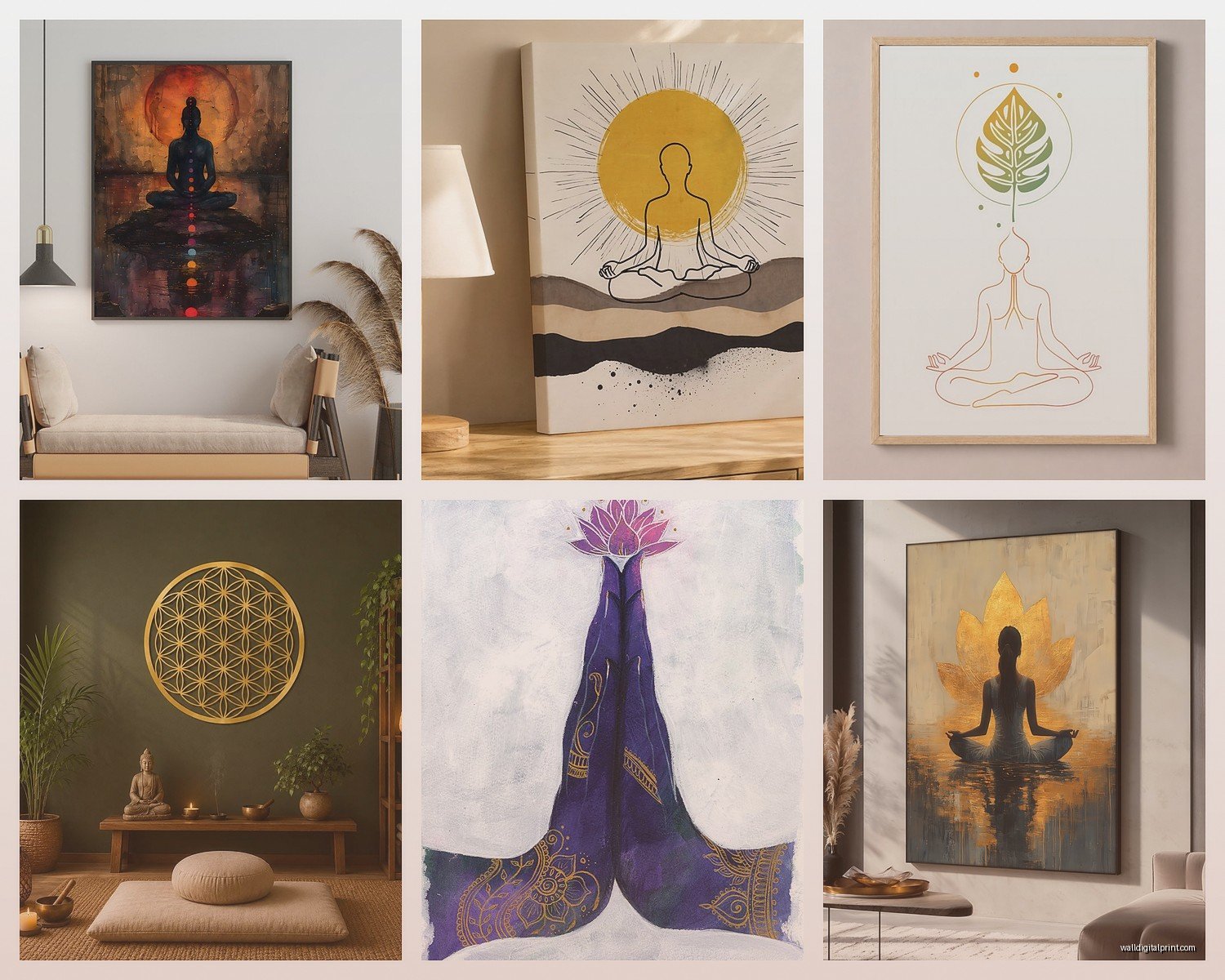
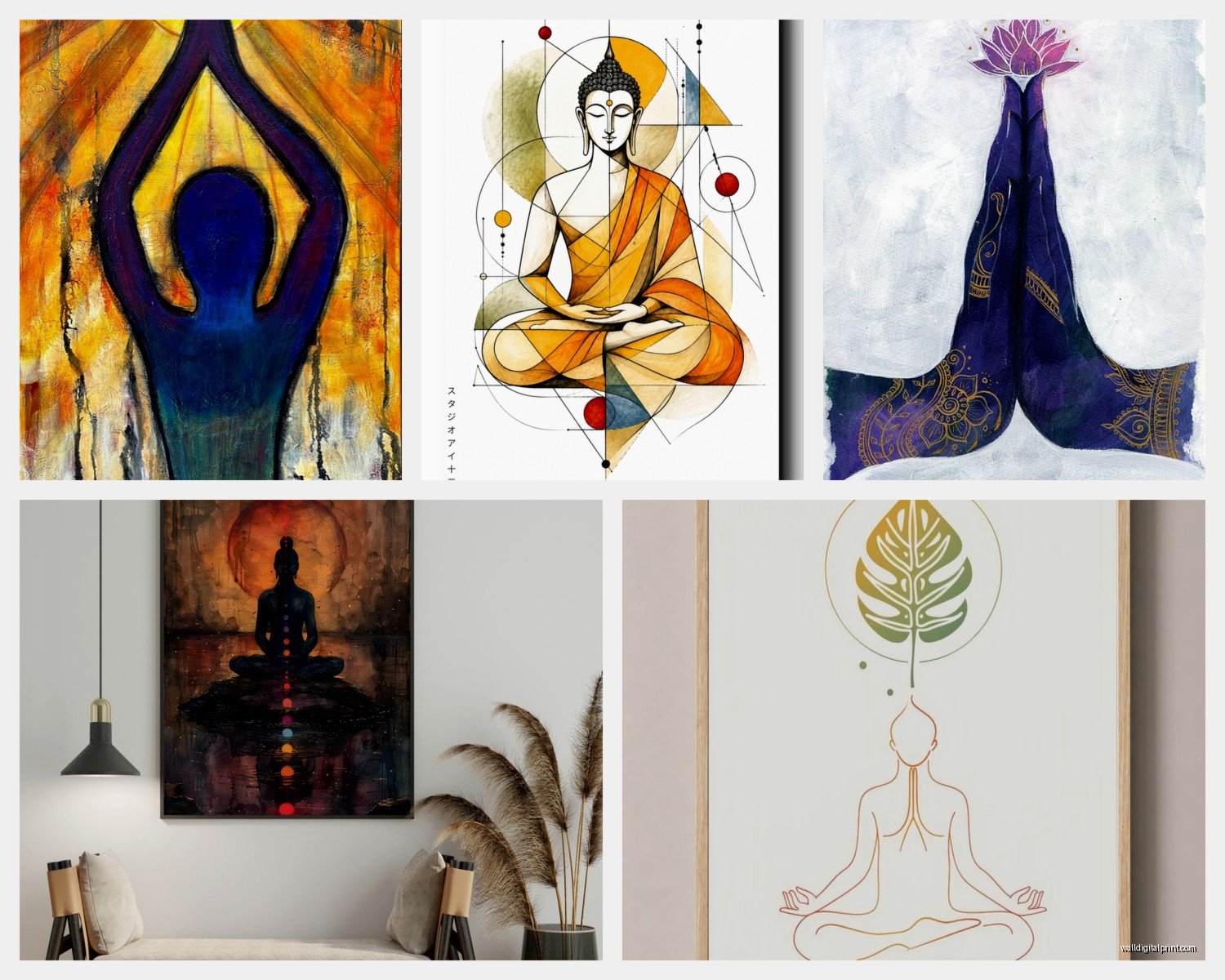
Anything too literal – Pictures of people meditating, Buddha statues in photographs (actual statues are different), yoga poses. It’s too on the nose and weirdly distracting.
Neon colors – I don’t care how spiritual the symbol is, if it’s in hot pink and electric blue, it’s not meditation art.
Busy patterns – Paisley, intricate mandalas with a million details, complex geometric patterns. Your eyes will wander and analyze instead of settling.
Anything that evokes strong emotions – Dramatic scenes, intense color contrasts, sharp angles. Meditation is about calm, not stimulation.
Mass-produced obvious stuff – If you’ve seen it in every HomeGoods and TJ Maxx, maybe skip it. Not because there’s anything wrong with those stores, but because that stuff is designed to sell quickly, not to support meditation practice.
Mixing Meditation Art with Other Decor
This is tricky because you probably don’t have a dedicated meditation room. Most people are working with a corner of their bedroom or living room. The meditation art needs to fit but also create its own little zone.
What works: Keep the meditation wall pretty minimal. Your zen art, maybe a small shelf with a candle or singing bowl, and that’s it. The rest of the room can be more decorated, but that wall should feel intentionally simple. Creates a visual cue that this space is different.
I have clients who use a folding screen or room divider to separate their meditation corner, which lets them go full zen on that wall without it clashing with their regular decor. Pretty smart solution actually.
Seasonal Rotation?
Some people swap their meditation art seasonally and some keep the same piece for years. Both approaches work. I personally think there’s value in consistency – the same piece becomes part of your practice, familiar and grounding. But if you get bored easily or your meditation practice shifts, rotating makes sense.
Just don’t change it constantly. Give each piece at least a few months so it actually becomes part of your meditation environment rather than just decoration.
Budget Breakdown Reality Check
You can absolutely do this affordably. Here’s what I’d recommend at different price points:
Under $50 – Etsy digital downloads, print at Costco or a local print shop, hang with command strips or a basic frame from Amazon
$50-150 – Original prints from emerging artists on Etsy or Society6, decent framing, maybe a small original watercolor from a local artist
$150-500 – Larger original pieces, better quality printing and framing, custom work from artists you follow
Over $500 – Only if you’re really committed and want investment pieces, original paintings, commissioned work
The under $50 option is honestly where I’d start. Test what actually helps your practice before dropping serious money.
Combining Different Elements
Sometimes one piece isn’t enough to create the vibe. You might want to layer a textile wall hanging with a smaller print, or combine a main piece with some simple floating shelves holding small objects. The key is keeping it intentional and minimal.
I did this thing where I hung a simple enso circle print and then added a narrow floating shelf below it with just a small plant and a candle. The vertical arrangement created this little meditation vignette without feeling cluttered. Works way better than just the print alone would have.
The Whole Sacred Geometry Thing
Flower of life, Metatron’s cube, Sri Yantra – these are popular in meditation art and they can work but you gotta be careful. Some of them are so complex they’re almost anxiety-inducing to look at. The simpler sacred geometry pieces (like basic hexagons or simple mandalas) are better for actual meditation use.
And honestly? You don’t need to understand all the spiritual symbolism for something to work in your meditation space. If a piece makes you feel calm and helps you focus, that’s what matters. Don’t get too caught up in whether you’re using the “right” sacred symbol.
Look, at the end of the day, your meditation wall art should disappear while you’re meditating. It’s there to create an environment, not to be the focus. If you find yourself staring at your wall art instead of meditating, it’s the wrong piece. The best meditation art is almost forgettable – it sets the tone and then gets out of the way.