Wall Art Guide, Wall Art Tutoriels
Catholic Wall Art: Religious Saints Virgin Mary Decor
Aug
So I’ve been down this rabbit hole of Catholic wall art lately because honestly, a friend asked me to help stage her prayer room and I didn’t realize how much there is to actually consider when you’re picking religious pieces. It’s not like just grabbing any Virgin Mary print off Etsy and calling it a day.
Figure Out Your Actual Wall Space First
Okay so before you even start looking at beautiful saints and Madonna art, you gotta measure your wall. I know, boring, but I watched my sister buy this gorgeous Sacred Heart piece that was like 40×60 inches and her wall could barely fit it. She had to return it which was a whole thing because it was custom framed.
Get your tape measure and actually write down the dimensions. Then think about what’s already on that wall or near it. Is there a shelf? A crucifix already hanging? I usually tell people to leave at least 6-8 inches of breathing room on each side of a major piece. Catholic art tends to be pretty detailed and ornate, so it needs space to actually be seen properly.
Different Styles and What Actually Works Where
The thing about Catholic wall art is there’s like a million different styles and they all give off completely different vibes. You’ve got your traditional Renaissance-style paintings, modern minimalist line drawings, vintage holy cards blown up and framed, those ornate gold-leaf Byzantine icons… it goes on.
For a formal dining room or living room, I’m usually drawn to the more classical oil painting reproductions. Think Caravaggio or Murillo style Virgin Mary pieces. They have this timeless thing going on and they don’t scream “church basement” if that makes sense. I found this amazing print of Our Lady of Guadalupe done in traditional style but on canvas with a floating frame and it looked expensive even though it was like $80.
Bedrooms though, I think you can go softer. Watercolor saints, gentle Madonna and child scenes, maybe St. Therese with roses in muted tones. My client last month wanted St. Joseph for her son’s room and we went with this really simple line art version that felt modern but still reverent.
The Icon Situation
Byzantine icons are having a moment right now and honestly they’re gorgeous but here’s the thing – they’re DETAILED. Like, so much gold, so many intricate patterns. If you’re gonna do an icon, make sure your wall color isn’t competing with it. I’ve seen people put elaborate icons on busy wallpaper and it’s just… too much happening.
Icons look incredible on deep colors though. Navy blue, forest green, even a dark burgundy. The gold leaf just pops in a way that’s actually stunning.
Where to Actually Buy This Stuff
Alright so you’re probably wondering where to even find quality Catholic art because yeah, there’s a lot of cheap looking stuff out there.
Etsy is honestly great if you filter carefully. Search for “Catholic art print” or specific saints by name. I’ve bought from shops that do digital downloads which is perfect if you want to choose your own frame and mat. Usually runs $5-15 for a high-res file you can print at whatever size you need. Just make sure the resolution is at least 300 dpi if you’re going bigger than 8×10.
Catholic gift shops online – places like The Catholic Company or Monastery Icons – have curated selections but they’re pricier. You’re paying for quality though. I got a St. Michael canvas from Monastery Icons last year and the colors are still perfect, no fading even in a room that gets afternoon sun.
Wait I forgot to mention – there’s this site called Holy Discount that sounds sketchy but actually has decent reproductions of famous Catholic paintings. My mom got a Divine Mercy image from there and it’s held up fine for like three years now.
Custom vs. Ready-Made
If you want something specific that you can’t find anywhere, commissioning an artist might be the way. I worked with this woman on Instagram who does modern Catholic art and she painted St. Cecilia for a client’s music room. Took about 6 weeks and cost around $300 for a 16×20 original, which honestly isn’t bad.
But if you’re just looking for standard saints – Mary, Joseph, Francis, Anthony, Padre Pio – you can definitely find ready-made options that look great. No need to go custom unless you want a specific pose or combination of saints or something.
Framing Makes or Breaks It
Oh and another thing, the frame is SO important with religious art. I cannot stress this enough. A beautiful image in a cheap plastic frame looks like a cheap plastic frame.
For traditional Catholic art, I usually go with wood frames. Dark walnut or cherry for Renaissance-style pieces, lighter oak for softer imagery. Gold frames can work but they need to be the right gold – not shiny brass looking, more of a muted antique gold. Michael’s has decent options when they do their 50% off frame sales which is like every other week.
If you’re doing modern or minimalist Catholic art, floating frames are really nice. It’s where the print or canvas sits slightly forward from the backing, creates this shadow effect. Very clean looking.
Mat boards – yes or no? For prints, usually yes. A cream or off-white mat gives the image room to breathe and looks more finished. I did a whole gallery wall of different saints for someone and we used matching cream mats with simple black frames and it tied everything together even though the art styles were all different.
Glass Considerations
Regular glass is fine for most situations but if you’re hanging something in a sunny spot, consider UV-protective glass. It’s more expensive but religious art is meant to last, you know? You don’t want your Virgin Mary fading to a weird orange tint in two years.
Non-glare glass is worth it for pieces you’re hanging opposite windows. Otherwise you get that annoying reflection and can’t actually see the image half the day.
Arranging Multiple Pieces
Okay so funny story, I once tried to do a Catholic art gallery wall in my own house and it looked absolutely chaotic for like three days because I didn’t plan it out first. Here’s what I learned.
If you’re doing multiple saints or religious images on one wall, lay them out on the floor first. Take a picture. Live with that picture for a day. See if it still looks good. I use painter’s tape to mark where frames will go on the wall before I start hammering nails in.
For a cohesive look, pick ONE element that ties everything together. Same frame style, same mat color, same general color palette in the images, or same size. You don’t need all of these, just one unifying thing.
I’ve seen people do a vertical line of three saints – usually Mary at top, Jesus in middle, their patron saint at bottom. Works nicely in narrow spaces like hallways or between windows.
Placement Height and Viewing Distance
This is gonna sound weird but the standard “57 inches to center” rule doesn’t always work for religious art because you might actually want it positioned for prayer or meditation, not just aesthetic viewing.
If you’re putting a piece above a prayer kneeler or in a prayer corner, you want it at eye level when you’re kneeling, which is obviously lower than standing eye level. I usually go about 40-45 inches to center for these situations.
Above furniture like a dresser or console table, leave 6-10 inches between the furniture top and the bottom of the frame. This grounds the piece and makes it feel connected to the furniture instead of just floating randomly on the wall.
My cat keeps trying to sit on my keyboard so excuse any typos here but anyway –
Mixing Religious Art with Regular Decor
You don’t have to make your whole house look like a monastery to have Catholic art. I mean you can if you want, but it’s not necessary.
I mix religious pieces with regular art all the time. In my living room I have a print of St. Francis with animals next to a botanical print and a landscape painting. They all have nature elements so it flows. The key is finding visual connections.
Color is your friend here. If you have a blue-toned Virgin Mary image, pull blues into other decor elements. Throw pillows, a vase, whatever. It makes the religious art feel intentional rather than randomly placed.
The Subtlety Question
Some people want their faith obvious, some want it more subtle. Both are totally valid. For subtle Catholic art, look for:
– Black and white or sepia-toned images
– Simple line drawings of saints
– Abstract representations (like a lily for Mary, a lamb for Jesus)
– Vintage holy cards in small frames
– Scripture quotes in nice typography
I helped a client who wanted her faith present but didn’t want guests immediately clocking it as a “Catholic house” and we used a lot of symbolic imagery. Worked perfectly for her.
Caring for Your Religious Art
Dust frames regularly with a microfiber cloth. Sounds basic but dust buildup is real and makes everything look dingy.
Don’t hang valuable or sentimental pieces in bathrooms. The humidity will warp frames and potentially damage prints over time. I learned this the hard way with a blessed image that got all wavy.
If you have canvas prints, you can very gently vacuum them with a brush attachment to remove dust. Don’t press hard, just let the suction do the work.
For actual paintings or expensive pieces, consider getting them professionally cleaned every few years. It’s not cheap but it maintains the integrity of the work.
Blessed vs. Unblessed Images
Something to think about – some people specifically want their religious art blessed by a priest. If that’s important to you, it’s easier to do with prints or canvases before you frame them. Take them to your parish and ask.
Blessed sacramentals have a different spiritual significance for a lot of Catholics, so if that matters to you, plan accordingly. Doesn’t change how you hang or display them though.
Budget-Friendly Options That Don’t Look Cheap
Not everyone can drop $500 on a hand-painted icon and that’s completely fine. Here’s what actually works on a budget:
Digital downloads from Etsy printed at a local print shop – usually under $30 total for an 11×14. I’ve done this dozens of times and if you pick a good image file and decent cardstock, people think you spent way more.
Thrift stores sometimes have vintage Catholic art. It’s hit or miss but I’ve found amazing pieces for like $5. Check estate sales too, especially in areas with large Catholic populations.
Create a gallery wall of small prints rather than one large expensive piece. Eight 5×7 prints in matching frames can look just as impactful as one big canvas and costs way less.
DIY printing – if you have access to a good quality printer, you can print public domain Catholic art yourself. Museum websites often have high-res downloads of religious paintings that are old enough to be copyright-free.
Common Mistakes I See People Make
Hanging things too high. Seriously, most people hang art way higher than it should be.
Mixing too many different frame styles in one space. Pick a lane.
Overcrowding. Religious art needs breathing room. Don’t cram every saint you love onto one wall.
Ignoring the room’s existing color scheme. A bright red Sacred Heart might not work in your all-beige living room, just saying.
Buying frames that are too small for the print and trying to make it work. It never looks good. Just get the right size frame.
Not considering lighting. A beautiful piece in a dark corner where no one can see it is kinda pointless. Add a picture light or position it where natural or ambient light hits it.
Oh wait, I should mention the whole landscape vs. portrait orientation thing because it matters for wall space planning. Most traditional Catholic art is portrait orientation (taller than wide) because that’s how people are shaped. But if you have a wide wall space above a sofa, you might need to look specifically for landscape-oriented religious art or do a horizontal arrangement of multiple pieces.
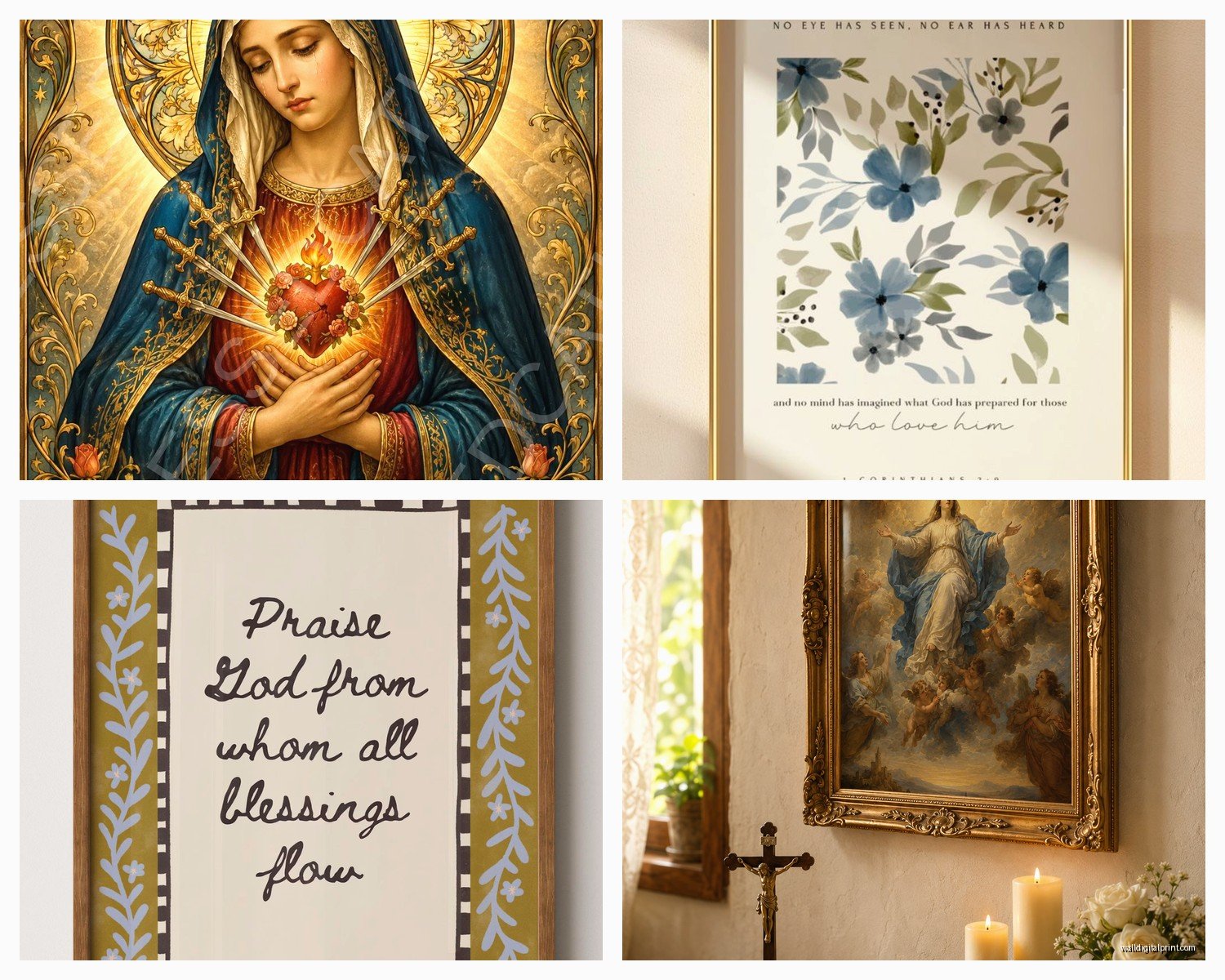
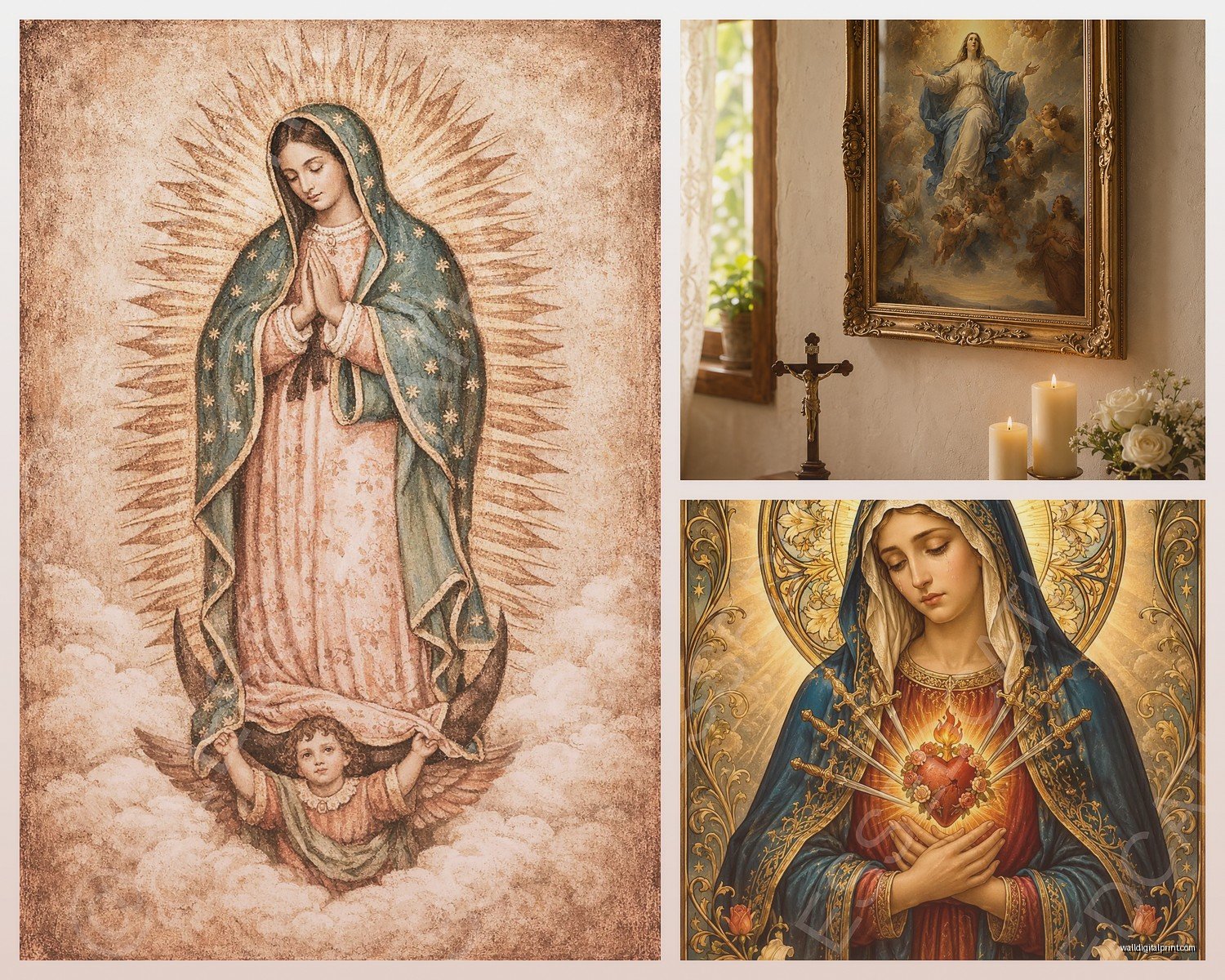
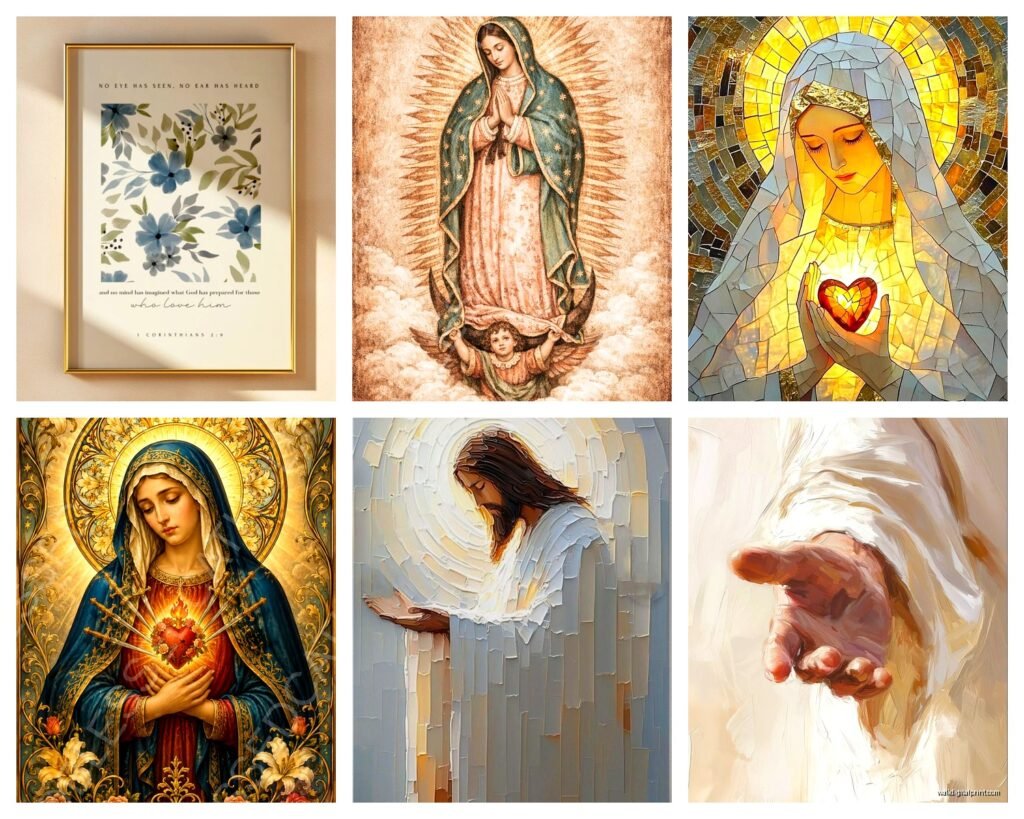
The Virgin Mary is probably the most common subject in Catholic wall art and honestly the variety is endless. From Our Lady of Guadalupe to the Immaculate Heart to just Madonna and child scenes, you’ve got options. I usually ask people if they have a particular devotion or if a certain depiction means something to them personally. That helps narrow it down because otherwise you’re just scrolling through thousands of Mary images.
Anyway, I think that covers most of what I’ve figured out through trial and error with Catholic wall art. The main thing is just to pick pieces that actually mean something to you rather than just buying something because it looks churchy or whatever. Your space should reflect your actual faith and taste, not what you think a Catholic home is “supposed” to look like.