Wall Art Guide, Wall Art Tutoriels
Agate Wall Art: Gemstone Crystal Slice Natural Designs
Mar
So I’ve been obsessing over agate wall art lately and honestly it started because a client wanted something “natural but luxe” and I went down this whole rabbit hole. Let me tell you what I’ve learned because there’s actually a lot more to these gemstone slices than just sticking a pretty rock on your wall.
What You’re Actually Getting When You Buy Agate Slices
Okay so first thing – not all agate is created equal and this matters way more than I thought it would. Real agate slices come from actual geodes that get sliced super thin, and the price variation is WILD. You can find pieces for like $15 on Etsy or drop $300+ for larger statement pieces.
The thickness matters a ton. Most decorative slices are between 3-8mm thick. Thinner ones (3-4mm) are more translucent which is gorgeous when backlit, but they’re also more fragile. I learned this the hard way when my dog’s tail knocked one off a shelf and it just… shattered. The thicker ones (6-8mm) feel more substantial and you can actually use them on surfaces people might bump into.
Natural vs Dyed Agate
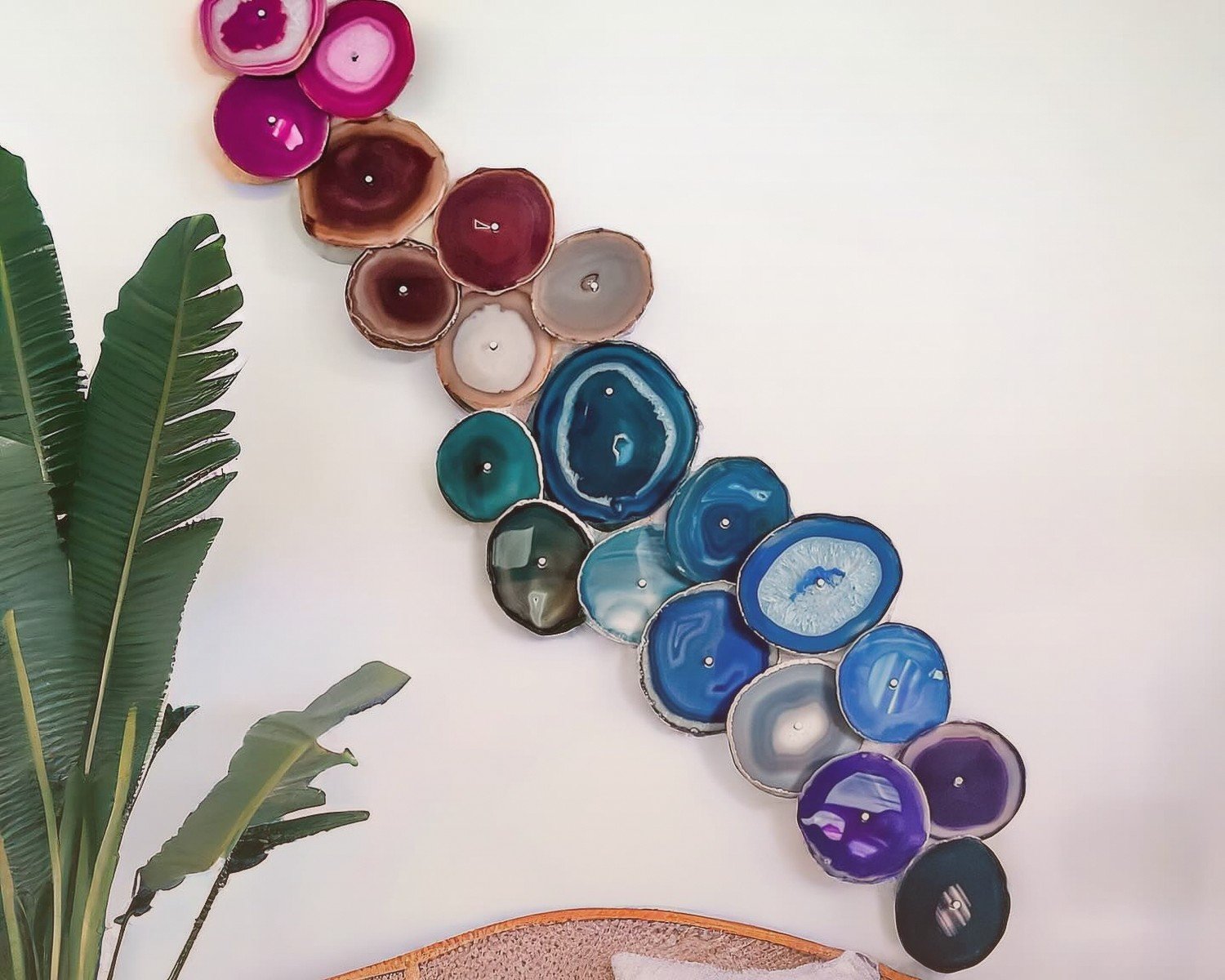
This is gonna sound weird but I actually prefer some of the dyed options? Like hear me out. Natural agate comes in browns, grays, whites, soft blues – really earthy tones. They’re beautiful and if you’re going for that organic minimalist vibe, perfect. But dyed agate gives you those insane fuchsias, teals, purples, and greens you see all over Instagram.
The dye process is pretty straightforward – they soak the slices in colored solutions and the porous parts of the stone absorb it. Quality dyed pieces still show the natural banding patterns, just in more dramatic colors. Cheap dyed agate looks flat and fake, so you gotta watch for that.
I did a comparison last month when my client canceled and I had free time – took photos of natural vs dyed under different lighting. The dyed pieces photographed better for social media content but the natural ones had this subtle sophistication in person that didn’t translate to photos.
How to Choose the Right Size and Shape
Most sellers don’t tell you this but agate slices are measured by their longest dimension, not like traditional art where you get height x width. So a “6-inch slice” might be 6 inches tall but only 4 inches wide because it follows the natural shape of the geode.
For wall art purposes:
- Small slices (2-4 inches) work best in groupings of 3, 5, or 7
- Medium pieces (5-8 inches) can stand alone or pair nicely
- Large statement slices (10+ inches) need serious wall space and become the focal point
- Extra large pieces (15+ inches) are heavy AF and need proper mounting
The weight thing is real – a 12-inch agate slice can weigh several pounds. I mounted one with regular command strips once and it crashed down at like 2am. Scared the hell out of me.
Mounting Options That Actually Work
Okay so this is where I’ve done the most trial and error. There are basically four ways to hang these things:
Pre-Drilled with Chain or Wire
Some slices come with a hole drilled through the top. This is the easiest option but you’re stuck with how the seller positioned the hole. Sometimes the balance is off and the slice hangs crooked. You can fix this with museum putty on the back to adjust the angle against the wall.
Adhesive Mounting
For lighter pieces under 8 ounces, I’ve had good luck with clear adhesive hooks or heavy-duty mounting squares. The trick is to rough up the back of the agate slice slightly with fine sandpaper so the adhesive has something to grip. Clean both surfaces with rubbing alcohol first.
Stand Mounts
These are those metal stand things that hold the slice upright on a shelf. Great for renters or if you’re indecisive about placement. The quality varies hugely though – cheap ones tip over easily. Look for stands with a wide base and rubber feet.
Custom Framing
This is my favorite for high-end installations but it’s pricey. You can get agate slices mounted between two pieces of glass (like a floating frame) or set into a shadow box. I worked with a framer who backlit one with LED strips and oh my god it was stunning. Cost like $400 total but the client was obsessed.
The Backlit Situation
Speaking of lighting – if you’re gonna backlight your agate, you need thinner slices. Anything over 5mm thick won’t let enough light through. I tested this extensively because I was watching that design show on Netflix and got inspired.
LED strip lights work better than individual bulbs because you get even distribution. Stick them on the wall behind the slice, leaving about an inch gap. Warm white (2700-3000K) brings out the natural tones, while cool white (5000K+) makes dyed pieces pop more.
The purple and blue agates are the most dramatic when backlit. Pinks and oranges can look kinda muddy unless they’re really high quality. And brown/gray natural ones? Honestly they just look brown and gray, even with light. Still pretty but not as “wow” as you’d expect.
Where to Actually Buy These Things
I’ve ordered from probably 15 different sources at this point and here’s the real talk:
Etsy has the most variety but quality is all over the place. Read reviews carefully and look for sellers who show the actual slice you’re buying, not stock photos. I got burned once with a “large purple slice” that arrived the size of a coaster.
Amazon is hit or miss. Lots of sets of small slices that are fine for craft projects but the color can be inconsistent within a set. Good for testing if you’re not sure about the look yet.
Specialty crystal shops (online and physical) tend to have better quality control but charge more. I found this one shop in Arizona that sources directly and their pieces are consistently gorgeous. Worth it if you’re doing a big installation.
Home goods stores like HomeGoods and TJMaxx sometimes have pre-framed agate art. These are usually dyed pieces in trendy colors. The framing quality is meh but for the price it’s not bad if you find one that fits your space.
Caring for Agate Wall Art
These are pretty low maintenance but there’s a few things. Dust them with a dry microfiber cloth. If you need to actually clean them, slightly damp cloth only – no cleaners. The sealant on some pieces can get cloudy if you use harsh chemicals.
Agate can fade over time in direct sunlight. Not like dramatically, but I noticed one piece I had in a south-facing window for two years definitely lost some color intensity. If you’re using expensive natural pieces, keep them out of constant sun.
The edges can be sharp depending on how they’re finished. Some sellers polish the edges smooth, others leave them rough. If you have kids or pets, smooth edges are worth seeking out.
Styling These Without Looking Like a Crystal Shop
Okay so the challenge with agate is making it look sophisticated and not like you’re trying to sell healing crystals. No shade to crystal people but that’s a specific aesthetic.
I group agate with other natural materials – wood frames, ceramic vessels, linen textiles. It plays well with metals too, especially brass and copper which pick up the warm tones.
For gallery walls, mix agate slices with traditional framed art. Use them as accent pieces rather than the whole wall. I did one wall with black and white photography and three small agate slices scattered throughout – looked really editorial.
Color coordination matters more than you’d think. If your room has cool tones, stick with gray, white, or cool-toned dyed pieces like teal or purple. Warm rooms need the browns, pinks, oranges. Sounds obvious but I’ve seen people try to force hot pink agate into a greige minimalist space and it just fights everything.
Unexpected Pairings That Work
Industrial spaces – the organic shapes contrast nicely with hard edges
Modern glam – pair with mirrors and metallics
Boho obviously but that’s almost too expected
Scandinavian minimalism if you stick to natural colors and clean mounting
What Nobody Tells You About Quality
The banding patterns are what make agate special. Look for pieces with distinct, interesting patterns – concentric circles, fortification patterns, or dramatic color transitions. Muddy, indistinct patterns usually mean lower quality stone.
Edge finishing tells you a lot. Quality pieces have smooth, polished edges. Rough or chipped edges mean it was rushed through processing.
Some sellers coat their agates with resin or sealant to enhance color and add shine. This isn’t necessarily bad but it can yellow over time. Natural finish pieces have a more matte appearance but age better.
oh and another thing – check if the slice has any repairs. Sometimes geodes crack during cutting and sellers fill the cracks with resin. Again, not a dealbreaker but you should know what you’re paying for. Hold it up to light and you can usually spot filled areas.
Price Expectations and When to Splurge
Small slices (2-4 inches): $10-$30
Medium pieces (5-8 inches): $25-$80
Large slices (10-14 inches): $75-$200
Statement pieces (15+ inches): $150-$500+
Dyed pieces are usually cheaper than natural in the same size. Brazilian agate tends to be more affordable than pieces from other locations. The rarest colors in natural agate (like true blue) command premium prices.
Splurge on your statement piece if you’re only getting one. The quality difference is noticeable. But for groupings of small slices, mid-range is totally fine because the overall effect matters more than individual perfection.
I usually tell people to buy one really nice piece first, live with it for a while, then add more if you’re still into the look. I’ve had clients go hard on a whole agate wall situation and then decide six months later it wasn’t their vibe. That’s an expensive mistake.
The thing about agate wall art is it’s very tactile and dimensional in person. Photos don’t capture the depth and how light plays through the layers. So if you’re buying online, make sure there’s a decent return policy because what looks amazing in listing photos might not work in your actual space.
wait I forgot to mention – seasonal stuff actually matters. Agate art tends to go on sale in late summer and after holidays when home decor demand drops. I’ve snagged some really good deals in August and January. If you’re not in a rush, worth waiting for those windows.