Wall Art Guide, Wall Art Tutoriels
Kitchen Printable Wall Art: Free Download Cooking Space
Apr
So I’ve been downloading and printing kitchen wall art for like three years now and honestly it’s one of those things that sounds super simple until you’re staring at a blurry lemon print at 2am wondering where you went wrong.
First thing – not all free downloads are actually print-ready. I learned this the hard way when I grabbed this gorgeous herb illustration from Pinterest and it printed out looking like someone sneezed pixels onto paper. You gotta check the resolution before you get excited. Look for files that are at least 300 DPI (dots per inch). Anything less and you’re gonna get that fuzzy, amateur look that screams “I printed this on my home printer” in a bad way.
Where to Actually Find Good Free Kitchen Printables
Okay so my go-to spots: Unsplash has amazing high-res food photography that you can literally just download and print. I grabbed this moody coffee bean close-up last month and it looks like I paid $50 for it. Creative Market does free goods every Monday – you have to sign up for their emails but they rotate through different designers and sometimes you’ll snag kitchen-specific stuff.
Canva has a whole section of free templates you can customize. The trick here is to upgrade the images they give you or swap them out with your own high-res photos because their free stock images are… fine? But everyone’s using them. Oh and The Graphics Fairy is weirdly good for vintage kitchen illustrations if that’s your vibe. Like old French advertisements and botanical prints of vegetables.
Wait I forgot to mention – check the licensing. Most free downloads are for personal use only which means you can’t print them and sell them at a craft fair or whatever. But for your own kitchen? You’re good.
File Formats That Won’t Make You Cry
PDF and PNG are your friends. JPEGs work too but sometimes they get compressed weird when you download them and the quality tanks. I always save everything as a PDF if I have the option because it holds the quality better when you’re sending it to print.
This is gonna sound weird but I keep a folder on my desktop called “kitchen prints maybe” and I just dump everything in there when I find it, then once a month I go through and delete the ones that don’t spark joy or whatever. My cat stepped on my keyboard once and somehow renamed the folder to “kjkjkjkj” and I just… left it like that for six months.
Printing Options Because Your Home Printer Might Hate You
Home printing: If you’ve got a decent inkjet printer and you’re doing 8×10 or smaller, you can totally print at home. BUT you need good paper. I use Epson Premium Presentation Paper Matte for most stuff – it’s thick enough that it doesn’t curl and the colors stay true. Regular printer paper looks cheap and feels cheap and you’ll be sad about it.
For anything bigger than 8×10 I go to a print shop. Staples is fine for basic stuff and they’re everywhere. FedEx Office (used to be Kinko’s) does nice work too. I upload the file to their website, pick matte or glossy, and grab it the next day. Costs like $3-8 depending on size.
Glossy vs matte – matte is better for kitchens honestly because glossy shows fingerprints and glare. Unless you’re doing food photography prints where you want that punchy look, then glossy can work.
Oh and another thing – some print shops will auto-correct your colors and it can mess with your whole aesthetic. I always tell them “print as is, no color correction” when I’m picking up. Learned that when they made my sage green herbs print look like nuclear waste green.
The Frame Situation
IKEA frames are totally acceptable. The RIBBA series comes in every standard size and they’re like $5-15. I’ve used probably thirty of them across different projects. They’re basic but that’s the point – you want the art to be the focus.
Target’s Threshold frames are slightly nicer if you wanna spend a bit more. Michael’s has good sales but their regular prices are ridiculous so never pay full price.
Standard sizes are your friend: 5×7, 8×10, 11×14, 16×20. If you download art in weird dimensions you’re gonna have to custom frame it and that gets expensive fast. When I’m browsing free printables I literally skip anything that’s not a standard ratio.
Design Styles That Actually Work in Kitchens
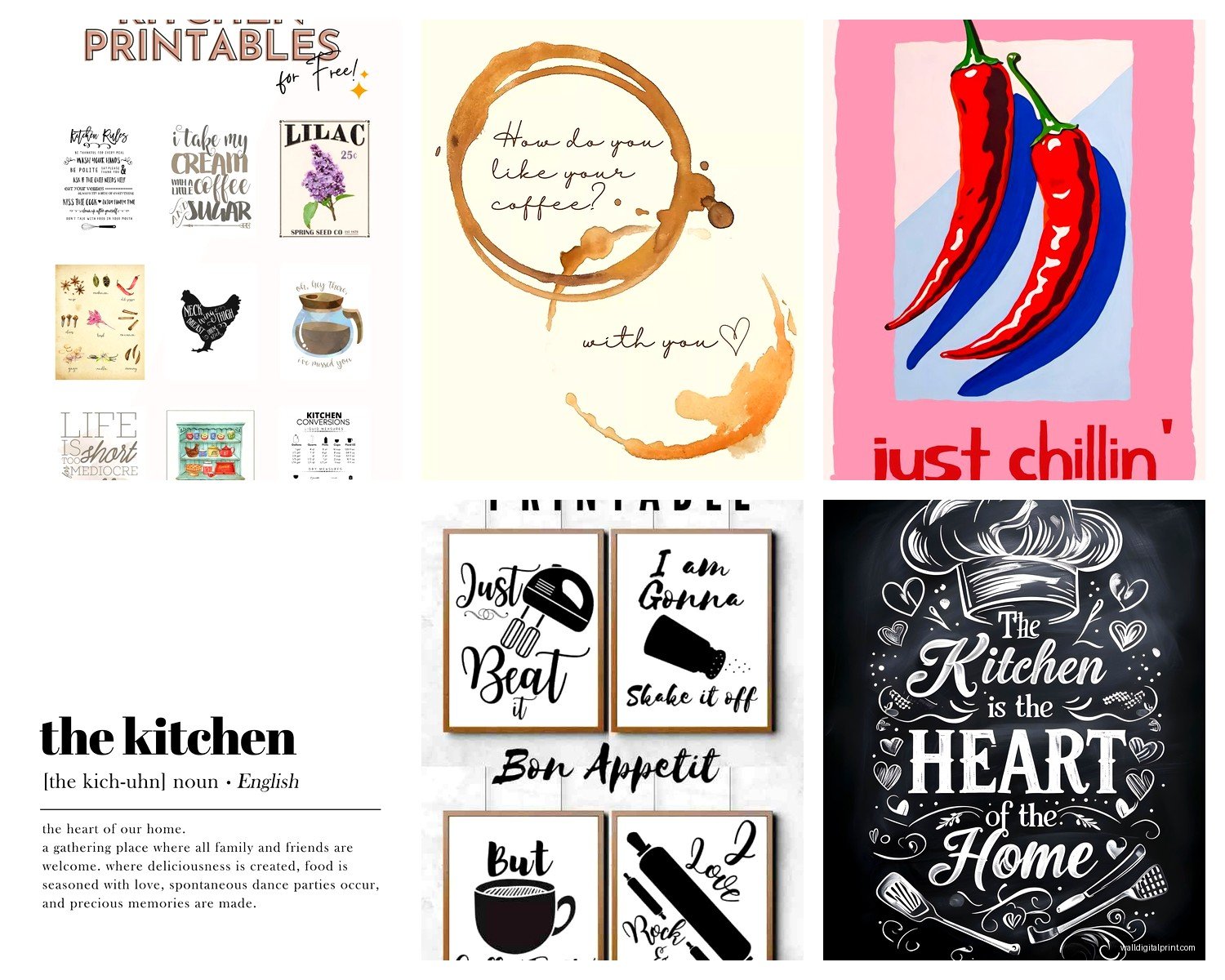
Minimalist line drawings of kitchen tools or food items – these are everywhere right now and they work because they don’t compete with your actual kitchen stuff. Simple black and white or one accent color.
Vintage seed packet reproductions or old produce crate labels. There’s something about that aged look that feels right in a cooking space. Plus they hide kitchen splatters better than pristine white backgrounds (trust me on this).
Typography prints with recipes, measurements, or food quotes. I have mixed feelings about the “eat pray love” style quote prints but a simple “1 cup = 16 tablespoons” conversion chart is actually useful AND decorative.
Botanical prints of herbs and vegetables. Classic, timeless, works with literally any kitchen style. I downloaded a set of vintage herb illustrations from the New York Public Library digital collection – they have thousands of images in the public domain and the quality is insane.
Food photography if you go moody and artistic. Bright, saturated food pics can look dated fast but dark, dramatic shots of ingredients or cooking processes have staying power.
Color Coordination Without Overthinking It
Match your prints to something already in your kitchen. Pull colors from your backsplash, dishware, or even your dish towels. I did a whole gallery wall in mustard yellow and navy because those were the colors in my vintage rug and it tied everything together without looking too matchy-matchy.
Or go neutral – black and white prints work in every kitchen ever. When in doubt, grayscale is your safety net.
I’ve seen people do all warm tones (terracotta, sage, cream) or all cool tones (navy, gray, white) and both look intentional and pulled-together.
Actually Hanging the Stuff
Okay so funny story, I hung an entire gallery wall in my old apartment using the wrong anchors and everything crashed down at 3am. My dog lost his mind. It was a whole thing.
For lightweight frames (under 5 pounds) those 3M Command strips work great and don’t damage walls. Follow the weight limits they’re not lying about those.
For anything heavier use proper picture hanging hooks with nails. If you’re going into drywall you might need anchors depending on the weight.
Gallery wall hack: trace your frames on kraft paper, tape the paper to the wall, arrange until you like it, then nail through the paper where the hooks should go. Remove paper and hang frames. Saves you from having seventeen nail holes you gotta patch later.
I usually do odd numbers of frames – three, five, seven. It looks more balanced somehow. And mix sizes but keep similar frame styles or colors so it doesn’t look chaotic.
Protecting Your Prints From Kitchen Grossness
Kitchens are humid and greasy and your prints will know it. Don’t hang anything directly above the stove unless it’s behind glass in a frame. Even then… I’ve had to clean grease off glass before and it’s annoying.
If you’re printing at home on regular paper, the frame glass protects it somewhat but UV-resistant glass or acrylic is better for preventing fading. Most cheap frames don’t have this but if you’re near a window you might wanna upgrade.
Laminating is an option for smaller prints if you wanna go frameless and wipeable. I’ve seen people laminate recipe cards or measurement charts and stick them inside cabinet doors which is actually genius.
Sizing Things Right
This is where people mess up the most. Too small and your art disappears into the wall. Too big and it overwhelms the space.
For the wall space above a small breakfast nook or coffee station: 8×10 or 11×14 works. You can also do a set of three 5x7s arranged horizontally.
Blank wall next to the fridge or pantry: Go bigger. 16×20 or a gallery wall arrangement. You’ve got the real estate, use it.
That weird narrow space between cabinets and doorways: Vertical orientation, maybe 5×7 or 8×10. Or a tall skinny print if you can find one in standard sizing.
I measure the wall space and then divide by three – your art should take up about one-third to two-thirds of the available space. This isn’t a hard rule but it’s a good starting point.
Customizing Free Downloads
Sometimes you’ll find a print that’s ALMOST perfect but the text is wrong or you wanna change colors. If it’s editable (like a Canva template) you can tweak it yourself. Change the background color, swap fonts, adjust the text.
For non-editable files you can still play with them in basic photo editing. I use Photoshop but honestly Canva’s free version does most of what you need. Crop it differently, add a colored border, convert to black and white, adjust contrast.
Just keep that 300 DPI resolution when you’re exporting. If you’re resizing make it smaller not bigger – you can shrink a high-res image but you can’t add resolution that isn’t there.
My Current Favorite Free Resources
The Smithsonian Open Access has wild vintage food advertisements and botanical illustrations. You can search by keyword and download high-res files of stuff from their archives.
Rawpixel has a free section with tons of public domain images you can download and use. Their search actually works which is more than I can say for some sites.
FreePik has free options but you gotta credit the artist or pay for premium. Read the licensing on each download.
Oh and just searching “public domain vintage kitchen” on Google Images and filtering by usage rights gets you into rabbit holes of amazing old stuff. I found a 1950s appliance advertisement collection this way and printed a toaster ad that I’m obsessed with.
Things I’ve Learned to Avoid
Super trendy stuff that’s gonna look dated in two years. Like those farmhouse-style prints that say “fresh eggs” with a rooster – cute now maybe but in 2028? Questionable.
Anything with too much text. Your kitchen doesn’t need to be a novel. A short quote or simple label is fine but paragraphs on the wall feel cluttered.
Really bright neon colors unless that’s truly your aesthetic. They’re hard to coordinate with and they can feel overwhelming in a space where you’re trying to cook dinner.
Religious or political food quotes. Just… no. Keep it neutral.
Prints that are trying too hard to be funny. “I like big bundts and I cannot lie” was maybe cute once but now it’s tired.
I spent way too long on this but honestly once you get the hang of downloading, printing, and framing you can refresh your kitchen art whenever you want for basically the cost of printing and maybe a new frame. I change mine seasonally sometimes just because I get bored. Right now I’ve got a whole citrus theme happening because it’s winter and I needed something bright.
The main thing is just start with one or two pieces and see how you feel. You don’t need a whole gallery wall on day one. Download some free options, print them at whatever shop is convenient, grab some basic frames, and stick them up there. You can always change your mind later and that’s the beauty of printables – they’re basically disposable art.