Wall Art Guide, Wall Art Tutoriels
Oval Wall Art: Elliptical Rounded Edge Shape Designs
May
So I’ve been totally obsessed with oval wall art lately and honestly it started because my sister bought this giant circular mirror and I was like…wait, what about ovals? They’re having this moment right now and nobody’s really talking about how different they are to work with compared to regular rectangular pieces.
Why Oval Shapes Are Weirdly Tricky But Worth It
Okay so here’s the thing about oval art that I didn’t realize until I hung like fifteen different pieces in various client homes. The shape creates this vertical or horizontal flow depending on how you orient it, and your eye follows that direction. Rectangles just sit there, but ovals? They move. Which means you gotta think about what direction you want people’s eyes to travel in your room.
I had this client last month who bought three oval botanical prints without measuring anything (classic mistake) and when we got to her living room, they were all horizontal ovals but her walls are like 9 feet tall and narrow. Made the whole room feel squashed. We ended up returning two and getting vertical ovals instead and it completely changed the feel.
Measuring Your Wall Space
This is gonna sound obvious but measure the actual wall space where you want the oval, not just eyeball it. I use my phone calculator and do this weird thing where I calculate what percentage of the wall the art will take up. For ovals, you want them to fill about 60-75% of the width of whatever furniture is below them. Less than that and they look like they’re floating away, more and it’s overwhelming.
My cat knocked over my tape measure yesterday so I’ve been using a piece of string which actually works better for visualizing curved edges? You can hold it up and see the approximate shape before committing.
Horizontal vs Vertical Orientation
Horizontal ovals work best:
- Above sofas or consoles that are wider than they are tall
- In rooms with low ceilings where you want to emphasize width
- For landscape scenes or wide subject matter
- In dining rooms above sideboards
Vertical ovals are better for:
- Narrow wall spaces like between windows or doors
- Hallways and entryways
- Above tall furniture like bookcases
- When you want to draw the eye upward in rooms with high ceilings
I tested this theory in my own bedroom and switched a horizontal oval to vertical and it made my 8-foot ceilings look like 9-foot ceilings somehow. The vertical line just pulls your gaze up.
What Actually Looks Good in Oval Frames
Oh and another thing – not every subject works in an oval. I learned this the hard way when I tried to frame a geometric abstract print in an oval frame and it looked completely wrong. The soft edges of the oval fought with the hard lines of the geometry.
What works really well:
- Portraits (obviously, this is what ovals were made for originally)
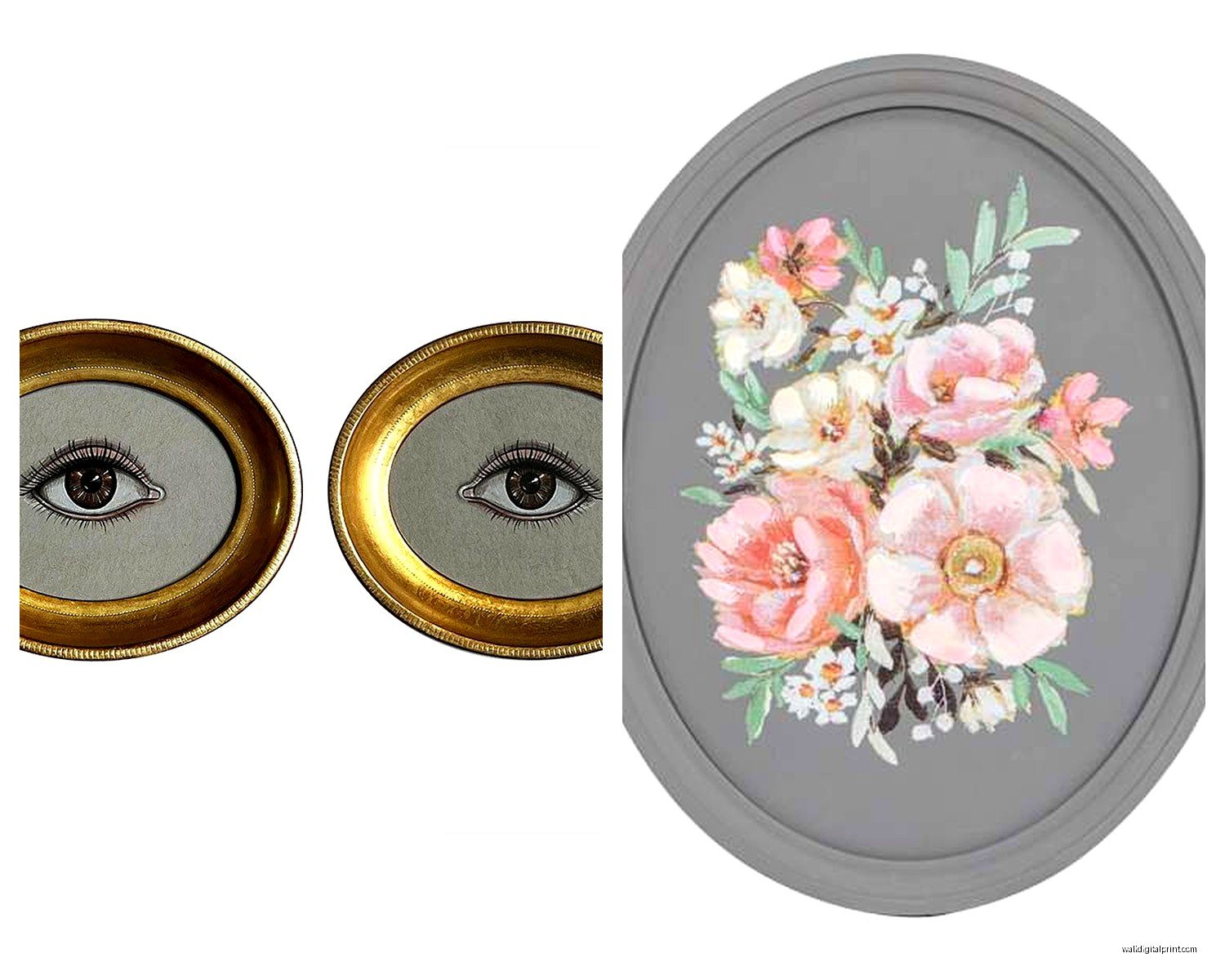
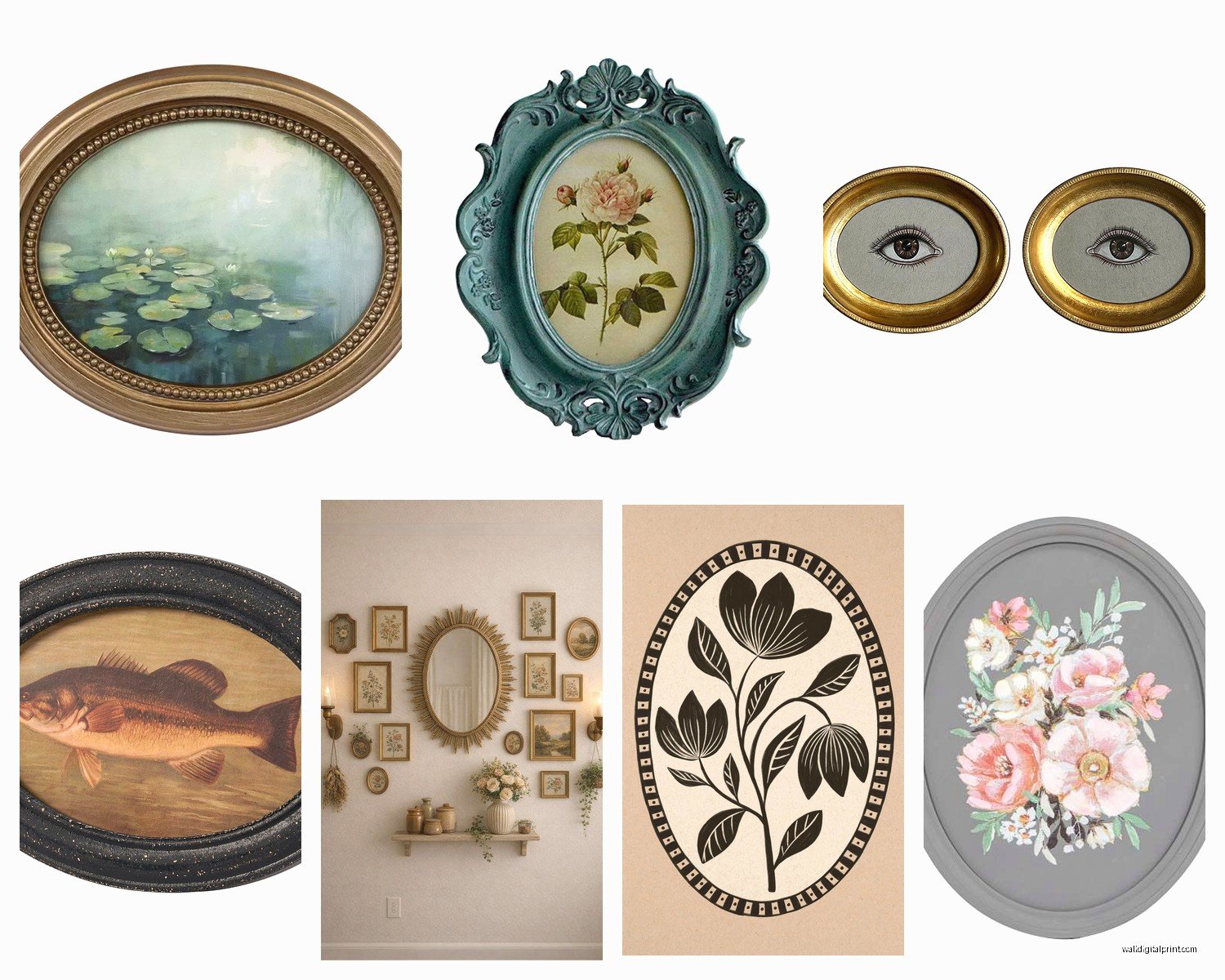
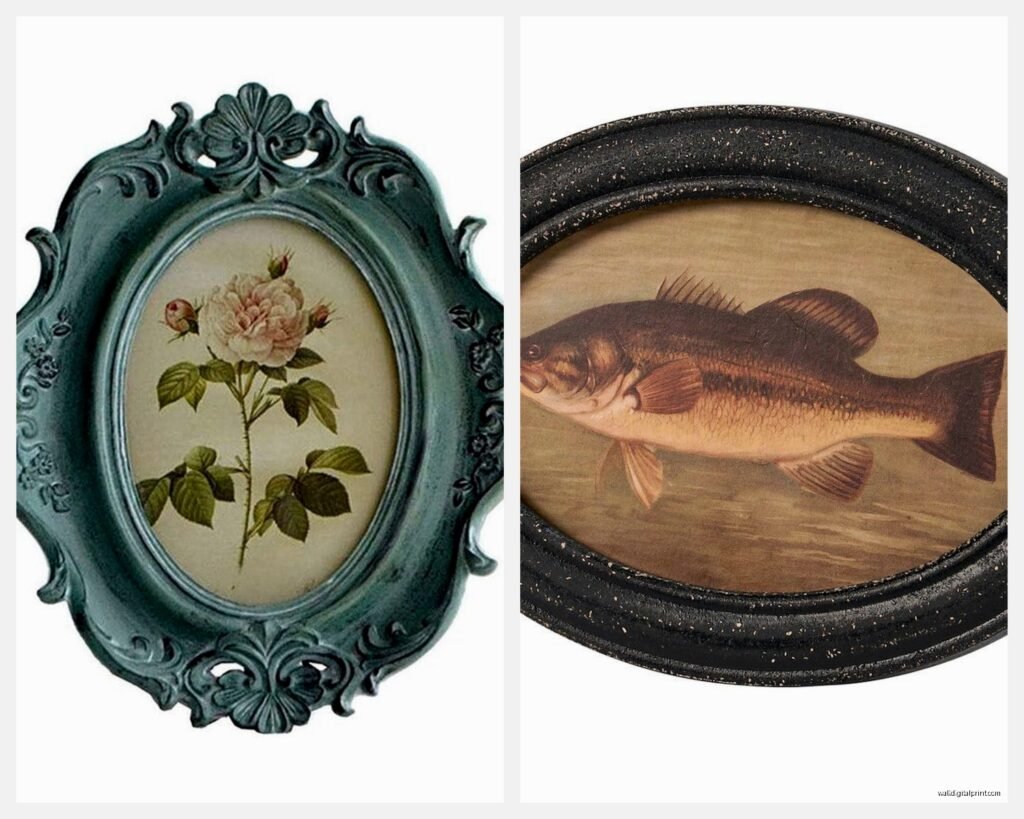
- Botanical prints and florals
- Vintage maps
- Soft landscapes with curved horizons
- Mirrors with decorative frames
- Watercolor paintings
- Black and white photography with soft focus
What looks weird:
- Hard-edge geometric art
- Architecture photography
- Comic book art or anything with panels
- Really busy patterns that need the structure of straight edges
The Matting Situation
This is gonna sound weird but oval matting makes a huge difference and most people skip it. If you’re buying oval art, get a mat that’s at least 2-3 inches wider than the actual image on all sides. The mat gives your eye a place to rest before hitting the frame, and with ovals this is extra important because the curved edge can feel abrupt without that buffer.
I found these pre-cut oval mats on Etsy that are way cheaper than custom framing. My client canceled last week so I spent like an hour comparing different mat widths and the 3-inch mat made a $30 print look like a $200 piece.
Hanging Height for Oval Art
Standard rule is center of the art at 57-60 inches from the floor, but with ovals I cheat this a bit depending on orientation. Vertical ovals I hang slightly higher (center at 60-62 inches) because they draw the eye up anyway. Horizontal ovals I keep at 57 inches or even slightly lower if they’re above furniture.
The math is annoying – you measure from the floor to where you want the center, then measure your oval’s height, divide by two, subtract the distance from the top of the frame to where your hanging hardware sits, and that’s where your nail goes. I always mess this up at least once and have to patch holes.
The Furniture Relationship
Leave 6-8 inches between the top of your furniture and the bottom of your oval art. Less than 6 inches and they look connected in a weird way, more than 10 inches and they’re not relating to each other at all. I measured this in like twenty rooms and 6-8 inches is the sweet spot.
For ovals specifically, if your furniture has curved elements (like a curved sofa back or rounded console), the oval echoes that beautifully. If your furniture is super boxy and modern, you might want to add some curved accessories to bridge the style gap.
Creating Oval Gallery Walls
Okay so funny story – I tried to do an all-oval gallery wall in my hallway last year and it looked like a collection of cameos from 1890. Too many ovals is overwhelming. What works better is mixing one or two ovals with rectangular pieces.
Here’s a layout that actually works:
- Start with one large horizontal or vertical oval as your anchor piece
- Add 2-4 rectangular pieces in varying sizes around it
- Maybe add one small circular piece if you’re feeling fancy
- Keep the spacing consistent at 2-3 inches between all pieces
The oval becomes this interesting focal point that breaks up the predictability of rectangles. I usually put the oval slightly off-center rather than dead center because perfectly centered gallery walls feel too formal.
Spacing and Balance
With ovals in a gallery wall, you gotta think about visual weight differently. An oval of the same size as a rectangle will feel lighter because of all that negative space in the corners. So if you’re mixing shapes, your oval might need to be slightly larger than your rectangles to feel balanced.
I use painter’s tape to map everything out on the wall first. Cut pieces of tape in the shapes and sizes of your frames and stick them up. Live with it for a day or two. Take photos. The camera shows you things your eye misses when you’re standing too close.
Color and Frame Selection
Frame color makes such a huge difference with ovals. I’ve noticed that:
Gold or brass frames make ovals feel vintage and formal. Great for traditional spaces or if you’re going for that grandmillennial look that’s everywhere right now. But in a modern space they can feel costumey unless you commit to the vibe.
Black frames modernize ovals like crazy. A botanical print in a black oval frame feels contemporary instead of dated. This is my go-to for clients who like the oval shape but don’t want their house to look like a historic inn.
Natural wood frames work with basically everything and tone down the formality of the oval shape. Light woods like oak or maple keep it casual, darker woods like walnut add sophistication.
White or cream frames – honestly these can wash out depending on your wall color. They work best on darker walls or if the art itself has strong colors.
wait I forgot to mention – the frame width matters too. Thin frames (under 1 inch) make ovals feel delicate and can look cheap if the piece is large. Medium frames (1-2 inches) are that goldilocks zone. Thick frames (over 3 inches) make a statement but can overwhelm smaller ovals.
Room-Specific Advice
Living Rooms
In living rooms, horizontal ovals work above the sofa but you gotta make sure they’re wide enough. I see so many people hang an oval that’s like half the width of their sofa and it looks lost. Your oval should be roughly 2/3 to 3/4 the width of your sofa.
If you have a fireplace, a vertical oval above the mantel can be really striking, especially if the fireplace itself is rectangular. The shape contrast is interesting. Just make sure it’s not so tall that it touches the ceiling – leave at least 6 inches of space.
Bedrooms
Vertical ovals are amazing above beds, especially in the place where people usually put rectangular art. It feels unexpected but still balanced. I hung a 36×48 inch vertical oval above my guest bed and everyone comments on it.
For bedrooms, I lean toward softer subjects in ovals – florals, landscapes, abstract washes of color. The curved edges already create a gentle vibe, might as well commit to it.
Dining Rooms
Horizontal ovals above a sideboard or buffet are *chef’s kiss* in dining rooms. They echo the shape of the table if you have an oval dining table. Even if your table is rectangular, the oval adds visual interest without competing.
I installed a 40×28 inch horizontal oval with a vintage map in a client’s dining room last month and the curved edges soften the room in a way that a rectangular frame wouldn’t have.
Bathrooms
Oval mirrors are the obvious choice but also consider small oval art in bathrooms. Like 12×16 inch ovals with botanical prints look really sophisticated in powder rooms. Hang them higher than you think – around 65-70 inches to the center because people are usually standing in bathrooms.
Hallways and Entryways
Vertical ovals are perfect for narrow hallway walls. I did a series of three vertical ovals in graduating sizes down a hallway and the repetition of the shape creates rhythm. Spaced them about 8 inches apart vertically.
In entryways, one large statement oval (like 30×40 inches or bigger) makes an impact without taking up too much visual space because of those rounded edges.
Practical Shopping Tips
Where to actually find oval art that doesn’t look like your grandmother’s cameo collection:
Etsy has tons of printable oval art that you can download and print at FedEx or wherever. Then get it framed locally or order oval frames online. This is the cheapest route and you can control the size exactly.
Anthropologie usually has a few oval pieces that trend more modern. Pricey but good quality frames.
Target’s Threshold line sometimes has oval prints. I grabbed a set of two botanical ovals there last spring for like $40 total.
Local frame shops can cut custom oval mats and frames. More expensive but worth it if you have art you love that needs an oval treatment.
Estate sales and thrift stores are goldmines for vintage oval frames. I’ve found ornate gold ones for like $8 and just spray painted them black or white. Pop in new art and you’re set.
Common Mistakes I See All The Time
Hanging ovals too low – people treat them like rectangles and hang them at the same height but ovals need different math because of how the curved edges sit.
Buying ovals that are too small for the space – the curved edges make them feel smaller than same-sized rectangles so go bigger than you think.
Mixing too many ovals – one or two per room is the max unless you’re deliberately going for a collected vintage vibe.
Ignoring the orientation – just because an oval comes horizontal doesn’t mean that’s how it should be hung in your space.
Not considering the subject matter – modern graphic art looks weird in ovals, stick with softer organic subjects.
Using the wrong hanging hardware – ovals need sturdy picture hooks because the weight distribution is different than rectangles. I use two hooks for anything over 20 inches wide.
Oh and don’t hang ovals in rooms that already have a ton of curved elements unless you want it to feel really soft and feminine. Sometimes you need the contrast of straight edges to balance out all those curves.
Anyway that’s basically everything I’ve figured out through trial and error with oval art. The shape is having a real moment and it’s nice to use something other than the standard rectangle but you gotta think about it differently. The rounded edges change how your eye moves through a room and once you understand that, you can use it to your advantage.