Wall Art Guide, Wall Art Tutoriels
Oversized Black and White Wall Art: Large Monochrome Pieces
May
So I’ve been obsessing over oversized black and white art lately and honestly it’s because I messed up a client’s living room last month by going too small. Like, we’re talking a 24×36 inch piece on a wall that could’ve handled something triple that size. Never again.
The thing about large monochrome pieces is they’re actually way more forgiving than you’d think? Everyone gets scared about commitment but black and white literally goes with everything you’ll ever do to that room. I switched my own dining room from navy to terracotta last spring and that massive black and white abstract I got from Minted didn’t even blink.
Size Really Does Matter Here
Okay so the biggest mistake is going too small. If you’re looking at a wall and thinking “hmm maybe 40 inches wide?” you probably need 60. I learned this the hard way in my own apartment. The rule I use now is measure your wall width, multiply by 0.6 or 0.7, and that’s your minimum art width. So a 10-foot wall needs at least 72 inches of art width.
For height, you want the center of the piece at 57-60 inches from the floor. This is gallery standard and it just works. I’ve tried the “eye level” thing where you measure based on your own height but then my 6’2″ boyfriend visits and suddenly everything looks wrong in photos.
Where to Actually Buy These Things
I’m gonna be real, I’ve spent probably too much time comparing sources. Etsy has amazing options from independent artists and you can usually get custom sizing. I bought this incredible 72×48 inch gestural black and white piece from a seller called InkAndDrops last year for like $400 and everyone asks where it’s from. The shipping took forever though, maybe three weeks?
Minted is my go-to when clients want something fast and polished. Their framing options are actually good quality and they do sales constantly. Never pay full price there, just wait like two weeks and there’ll be 20% off or something.
Oh and another thing, Desenio has really affordable large prints but you gotta frame them yourself. I got a 24×36 there for $40 but then spent $150 framing it at a local shop so… do the math first.
For the really oversized stuff, like 80+ inches, I’ve had good luck with Art.com and they run sales all the time. Just be prepared for the shipping costs to make you wince.
What Actually Looks Good
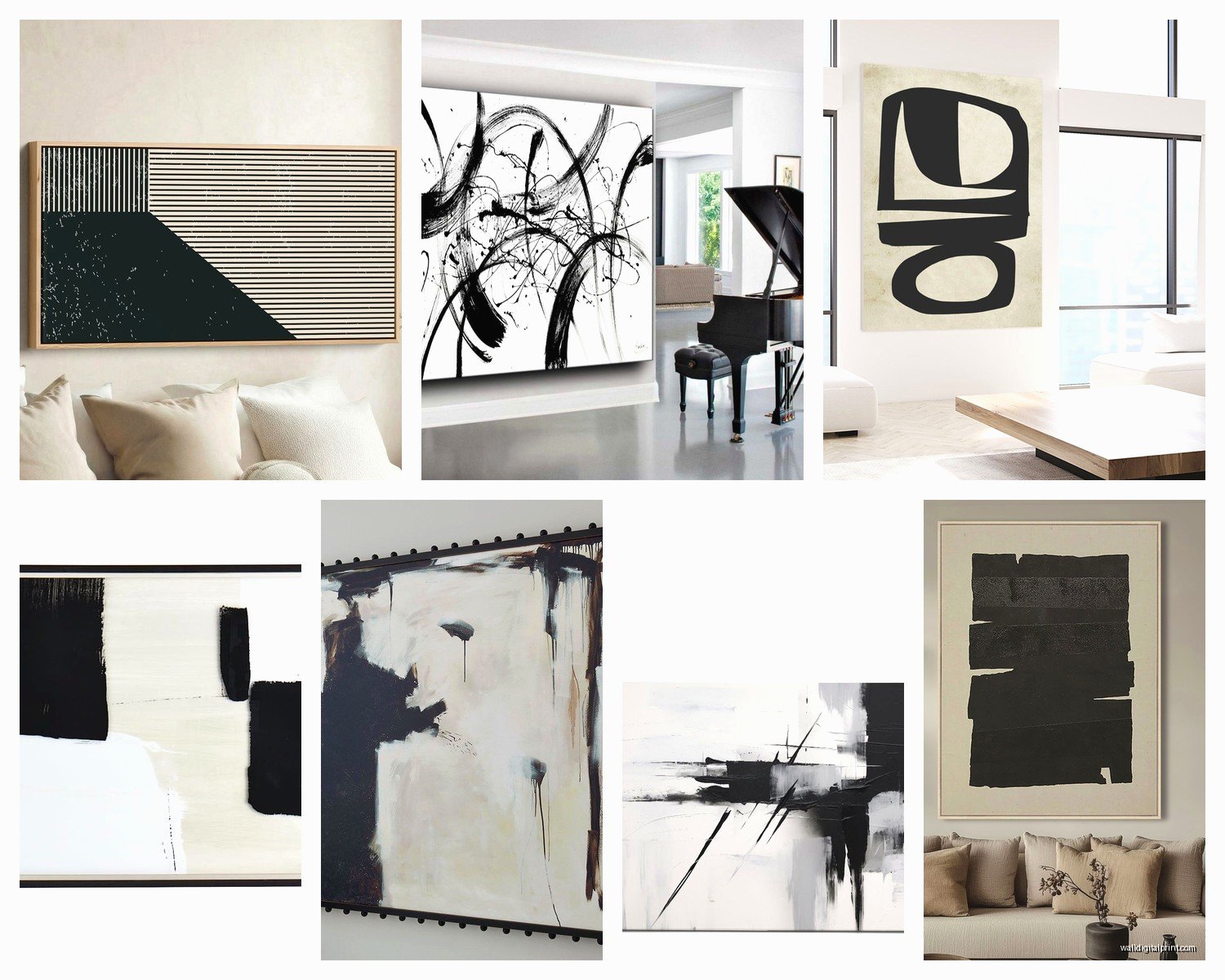
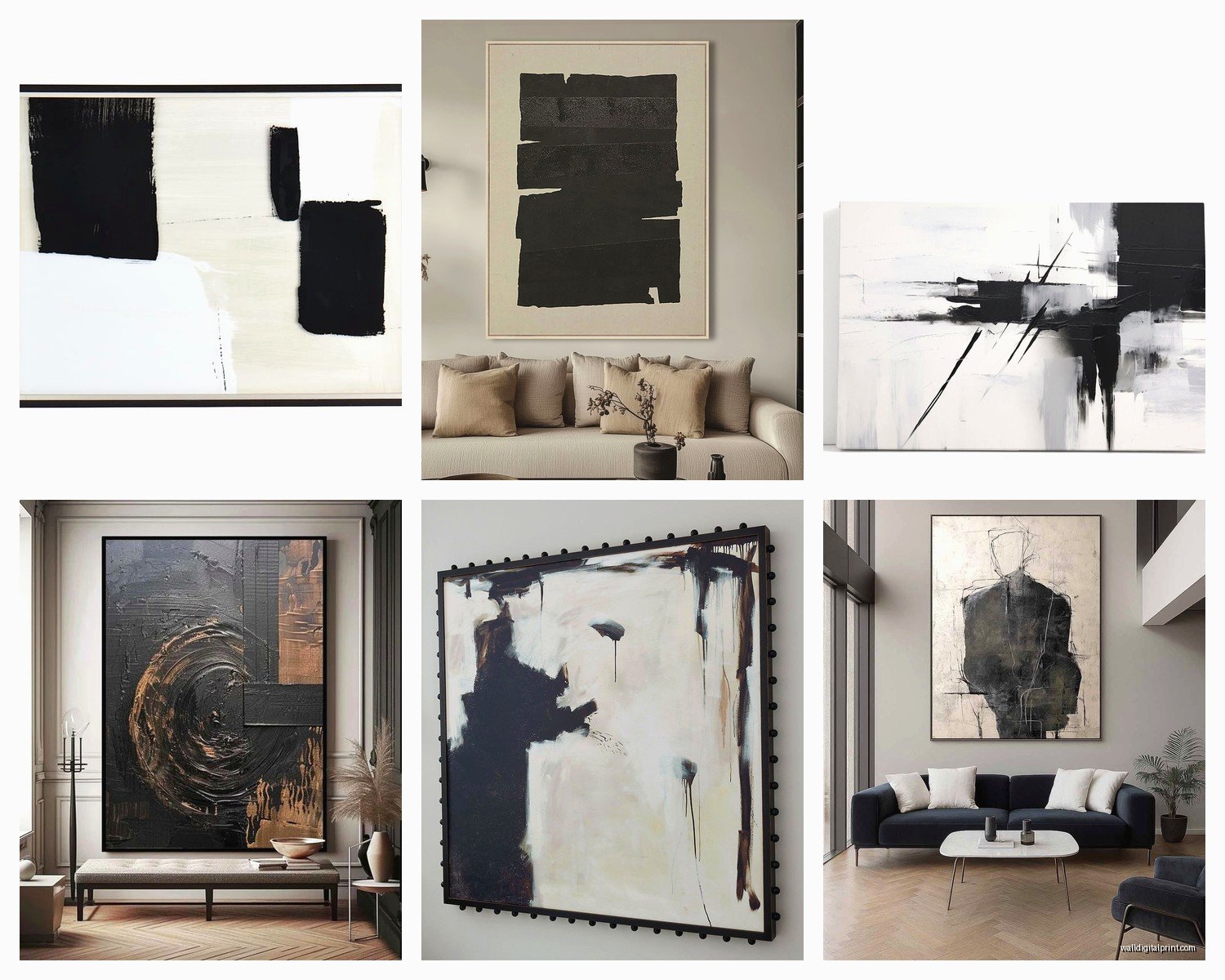
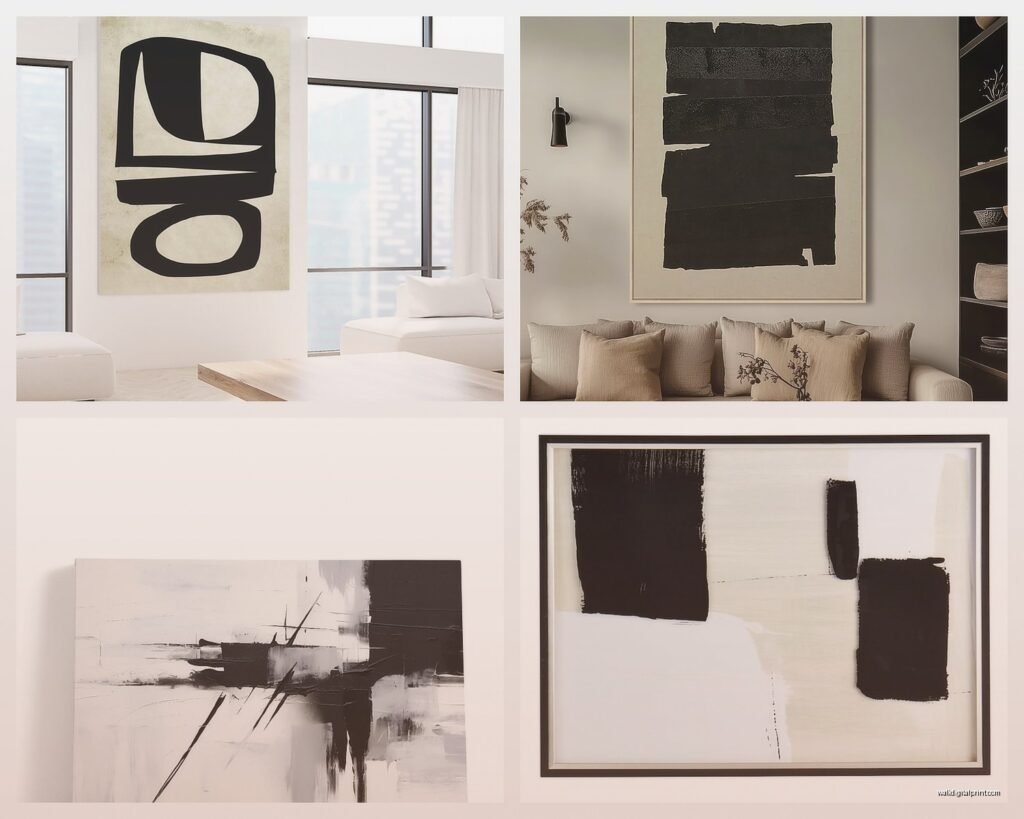
This is gonna sound weird but the best oversized black and white pieces have some kind of texture or movement to them. Flat graphic prints can look like you just enlarged a postcard. I’m obsessed with pieces that have visible brushstrokes or layering or those high-contrast photography prints where you can see grain.
Abstract expressionist stuff works really well at large scale. Think big gestural brushstrokes, ink bleeds, that kind of thing. I have this one piece in my bedroom that’s basically just black paint drips on white and it’s 60×40 and people either love it or think I hung it upside down.
Architectural photography is another winner. Black and white shots of buildings, staircases, those dramatic perspective shots. There’s something about the clean lines that scales up beautifully.
Line drawings have been having a moment and honestly I was skeptical but a client put an 80-inch wide line art piece of a woman’s face in her entryway and it’s stunning. Simple, bold, impossible to ignore.
Framing Decisions That’ll Save Your Sanity
Okay so framing is where this gets expensive fast. For really large pieces you’ve got a few options and I’ve tried them all because my cat knocked over a $300 custom frame job once and I cried.
Floating frames are my favorite for modern spaces. The art sits inside the frame with a gap around it, looks super gallery-like. They’re pricey though, expect $200-400 for anything over 48 inches.
Simple black wood frames work for literally everything. I buy them from Framebridge when I’m feeling fancy or honestly just from Amazon when I’m not. The quality difference exists but for black and white art it’s not as noticeable as with color prints.
Wait I forgot to mention, some people skip frames entirely for that raw edge look. If you’re doing this, make sure you get gallery-wrapped canvas that’s at least 1.5 inches deep or it looks cheap. I did 0.75 inch depth once and it looked like a poster board from the side.
Installation Without Destroying Your Walls
Heavy art is no joke and I’ve had one fall at 3am which is an experience I don’t recommend. Anything over 30 pounds needs wall anchors, not just nails. I use these toggle bolt anchors that you drill into drywall and they hold up to 50 pounds each. Use two for large pieces.
For really massive pieces, I actually call a handyman now. It’s like $80 and worth not having a 6-foot piece of glass and wood crash down. My insurance doesn’t cover “tried to hang it myself” incidents, I checked.
The hanging wire thing… okay so pieces come with wire on the back usually but for heavy oversized art, D-rings are better. They distribute weight more evenly and you can level the piece more easily. I switched all my large pieces to D-rings after one kept going crooked.
Specific Pieces I’ve Actually Bought
So there’s this massive abstract piece from Anthropologie, it’s called “Monochrome Sweep” or something, 60×40 inches. I put it in a client’s living room over a grey sofa and it completely transformed the space. It’s got this weathered texture that photographs really well. Usually around $800 but I’ve seen it on sale.
I bought myself a 72-inch wide triptych from Z Gallerie years ago, three panels of black ink on white. Cost maybe $500 total? Still looks good, hasn’t faded even though it gets afternoon sun. Each panel is 24×48 which made it easier to transport than one massive piece.
There’s a seller on Etsy, ByMURAL, who does custom-sized prints of minimalist photography. I ordered an 80×40 inch print of a misty forest scene in black and white for my own place and it’s honestly my favorite art purchase ever. $280 including shipping, arrived in a tube, I got it mounted on foam board at a print shop for another $60.
Making It Work in Different Rooms
Living rooms are the obvious choice but scale matters so much here. I see people put 40-inch pieces above their sofas and it’s just… sad. Your sofa is probably 84-96 inches wide, your art should be at least 60-75 inches to balance it. I usually do two large pieces side by side or one massive statement piece.
Bedrooms can handle really bold oversized art because you’re lying down looking at it a lot. I have a 60×48 inch abstract above my bed and it doesn’t feel overwhelming, it feels cozy actually? The black and white keeps it from being too much visual noise when you’re trying to sleep.
Dining rooms are underrated for large art. That wall space behind the table is perfect for a dramatic piece. I did a 70-inch wide black and white photograph of Venice architecture in my dining room and it makes the room feel way more sophisticated than it is. The room is only 12×14 feet but the art gives it presence.
Entryways and hallways need to be careful with width because you don’t wanna bump into things but tall vertical pieces work great. I’m talking 30×80 inch pieces that draw the eye up. Makes ceilings feel higher.
What Doesn’t Work
Okay so I’ve made mistakes. Multiple small black and white pieces trying to create a gallery wall doesn’t have the same impact as one large piece. The eye doesn’t know where to land and it just looks cluttered.
Super detailed black and white prints lose their detail at large scale if the resolution isn’t high enough. I bought this intricate botanical print, blew it up to 60 inches, and you could see pixelation from across the room. Make sure you’re getting high-resolution files, at least 300 DPI.
Black frames on black and white art can disappear into the wall if your walls are dark. I did this in a charcoal grey room and the whole piece just vanished. White or natural wood frames pop better on dark walls.
Budget Breakdown Reality Check
If you’re doing this properly, here’s what you’re actually spending. Low end would be like $150 for a print from Desenio, $100 for a basic frame, $50 for professional hanging. That’s $300 minimum for something decent at 40×60 inches.
Mid-range is more like $400-600 for the art itself from places like Minted or Etsy, $200-300 for quality framing, maybe $80 for installation if needed. You’re at $700-1000 total.
High end, you’re looking at original artwork or limited edition prints, $1000-3000 for the piece, custom framing another $500-800. I have clients who spend this and honestly the quality difference is noticeable but not necessary for most people.
Styling Around Large Monochrome Art
The beauty of black and white is you can literally put any color in the room. I’ve paired oversized monochrome pieces with blush pink sofas, emerald green chairs, burnt orange pillows, all of it works. The art acts as a neutral anchor.
Lighting makes a huge difference though. I installed picture lights above my large pieces and it’s such an upgrade. The shadows and highlights in black and white art become way more dramatic with direct lighting. Battery-operated picture lights from Amazon are like $40 and totally worth it.
Don’t put a bunch of stuff on the wall with your oversized art. Let it breathe. I see people add floating shelves or smaller art around a statement piece and it just competes for attention. The whole point of oversized art is that it’s the focal point.
Oh and plants work really well with black and white art. The organic green against the stark monochrome creates this nice balance. I have a fiddle leaf fig next to my 72-inch abstract and everyone comments on how good they look together.
Trends I’m Seeing Right Now
So line art is everywhere, those continuous one-line drawings of faces and bodies. They scale up really well and look expensive even when they’re not. I’m kinda over them personally but clients still request them constantly.
Textured pieces with heavy impasto or mixed media are getting popular. The dimensionality looks incredible at large scale and photographs well which matters for resale if you ever move.
Black and white photography is having a moment again, specifically architectural shots and nature scenes. The stark contrast works beautifully oversized, especially in modern or Scandinavian-style spaces.
Okay I should probably stop here because I could literally talk about this for hours and my coffee’s getting cold. But seriously, if you’re gonna do this, go bigger than you think you need and invest in proper hanging hardware. Those are the two things that’ll make or break the whole project.