Wall Art Guide, Wall Art Tutoriels
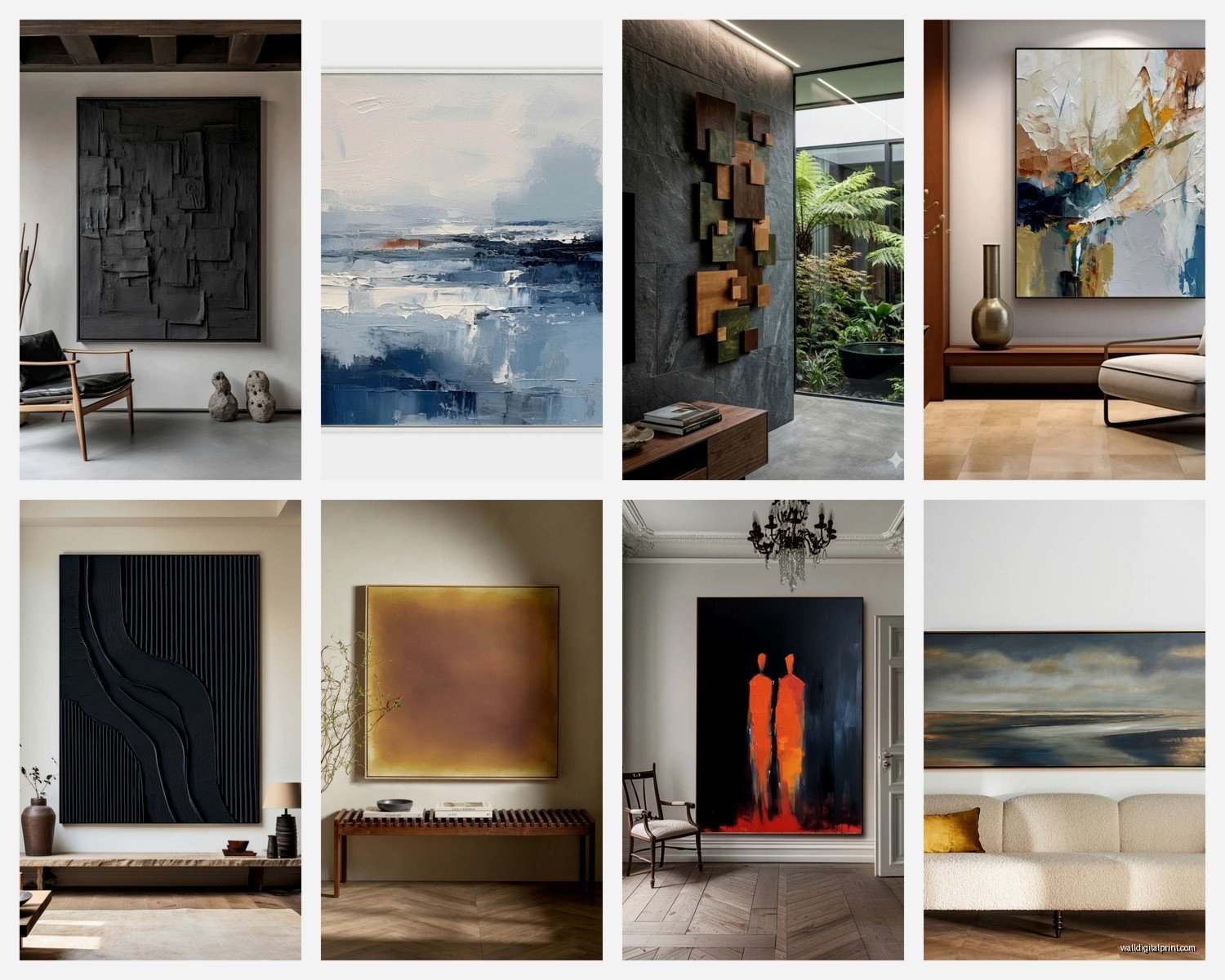
Large Contemporary Wall Art: Oversized Modern Pieces
May
So I’ve been dealing with oversized wall art for like three years now and honestly the biggest mistake everyone makes is thinking bigger automatically means better? My client last month bought this massive 8-foot canvas and we had to return it because her ceiling height was only 9 feet and it just looked…wrong.
Measuring Before You Lose Your Mind
Okay so first thing, and I cannot stress this enough, measure your wall THREE times. Not twice. Three. Because I’ve watched people (including myself, not gonna lie) measure wrong and end up with a piece that’s either hilariously small or you’re basically wallpapering your entire living room with one painting.
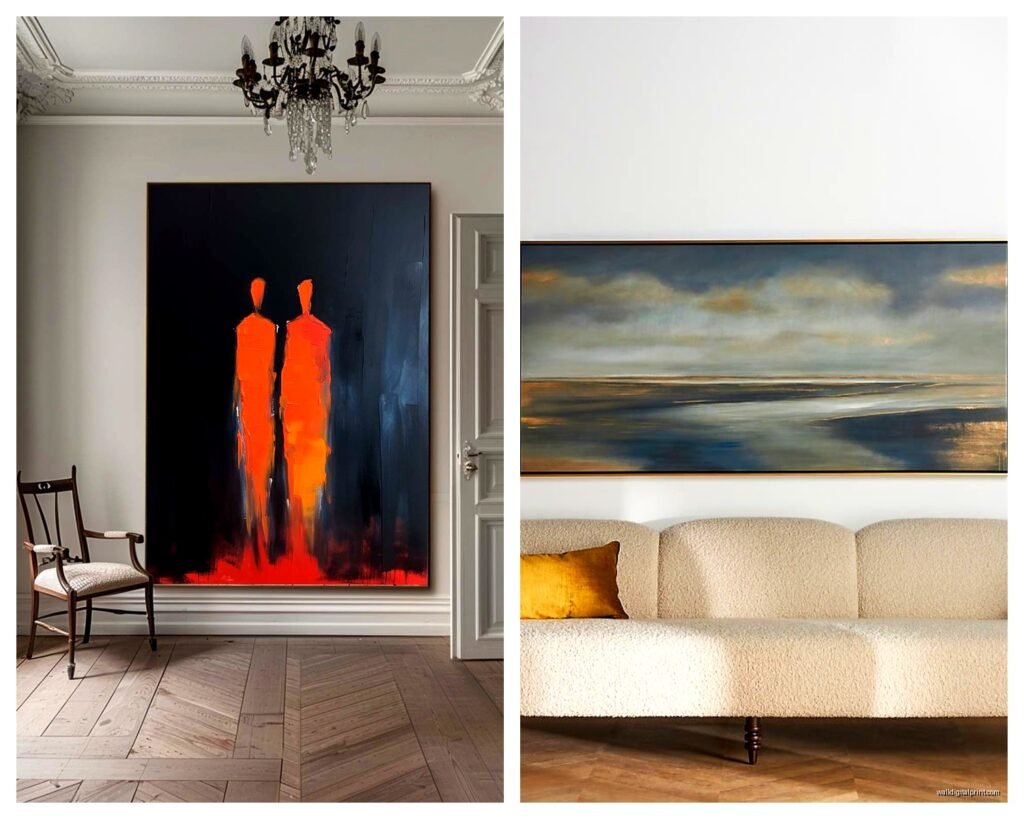
The rule I use is the art should take up about 60-75% of the furniture width below it. So if you’ve got a sofa that’s 90 inches wide, you’re looking at art that’s roughly 54-68 inches across. But this is where it gets tricky with contemporary pieces because a lot of modern artists are doing these intentionally asymmetrical things or diptychs that spread across even more space.
For height, you want the center of the piece at eye level, which is usually 57-60 inches from the floor. Except when you’re hanging above furniture, then you go 6-8 inches above whatever’s sitting there. My dog knocked over a lamp last week while I was measuring and I just…I left it there for two days because I was so annoyed.
The Weight Thing Nobody Talks About
Large contemporary pieces are HEAVY. Like way heavier than you think. I’m talking 40-80 pounds for a 5×6 foot canvas. You absolutely need proper anchoring systems, not just those sad little nails that come in the frame kit.
French cleats are your best friend here. They distribute weight across the wall and you can adjust the piece left or right without making new holes. I use them for anything over 30 pounds. The Z-bar hanging system is another good option, especially for pieces without frames.
Oh and another thing, if you’re renting, check your lease because some landlords are weirdly specific about wall damage. I had a client who had to patch like fifteen holes when she moved because she kept “adjusting” the placement of her abstract triptych.
What Actually Works in Different Spaces
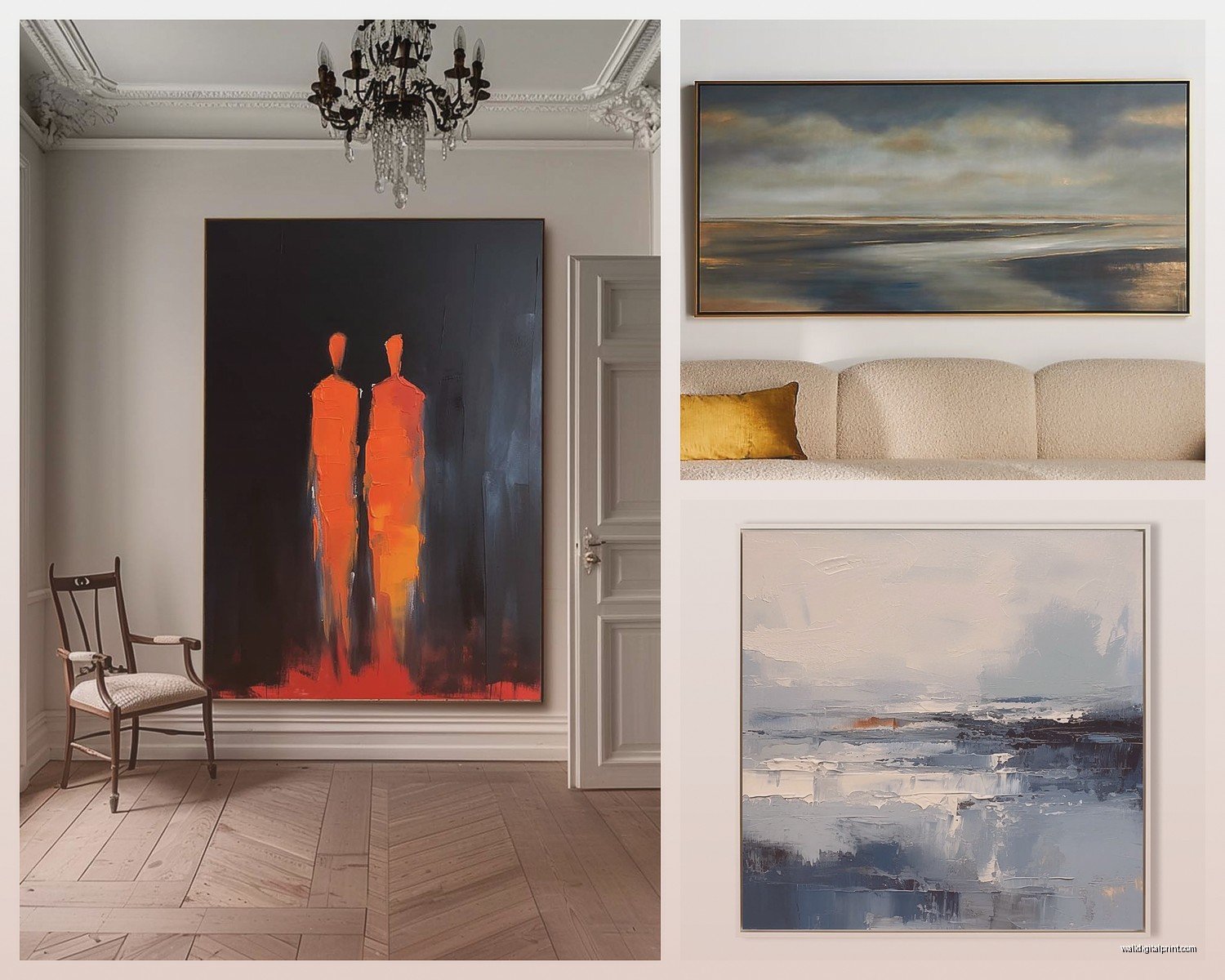
Living rooms can handle the biggest pieces, obviously. I’ve installed 6×8 foot canvases in living rooms and they look incredible when the room is big enough. The key is balancing it with your other furniture. If you’ve got a maximalist space with lots of patterns and textures, go for something more minimal in the art. If your room is pretty neutral, that’s when you can go wild with a colorful abstract piece or something with lots of visual texture.
Bedrooms are trickier than you’d think. You want something calming above the bed usually, but I’ve seen industrial-style pieces work really well in modern bedrooms. The scale should be about two-thirds the width of your bed. So for a king bed that’s 76 inches, you’re looking at roughly 50 inches wide. But I’ve broken this rule successfully when the piece is more vertical than horizontal.
Dining rooms are actually perfect for oversized art because you’re usually not putting furniture against those walls. I installed a 7-foot tall vertical piece in someone’s dining room last month and it completely transformed the space. Just make sure it’s not going to be splattered with food…learned that one the hard way with a client who has three kids under 10.
The Hallway Situation
Long hallways are where people either nail it or completely mess it up. You can go with one massive horizontal piece or create a gallery wall effect with multiple large pieces. I prefer the single large piece approach for modern contemporary work because it creates this dramatic moment when you walk down the hall.
The proportion gets weird in hallways though because they’re narrow. You want to leave at least 8-10 inches of wall space on each side of the piece. So if your hallway is 48 inches wide, your max art width is about 30 inches. But you can go TALL, like really tall, which creates this cool vertical emphasis.
Styles That Actually Work at Large Scale
Abstract expressionism scales up really well. Those big gestural brushstrokes and color fields were literally made to be viewed large. Think Rothko-style color blocks or Jackson Pollock-inspired drip paintings. The key with abstract is making sure the colors work with your existing palette. I usually pull three colors from the piece and make sure at least one of them appears elsewhere in the room.
Minimalist geometric pieces are having a moment right now and they’re actually easier to work with than you’d think. Clean lines, limited color palettes, lots of negative space. These work great in modern or Scandinavian-style interiors. I just hung a 6-foot square piece that was literally just three black lines on white canvas and it looked insanely expensive even though it was only like $800.
Photography at large scale can be stunning but you gotta be careful with the resolution. Pixelation is your enemy. Make sure any photographic print is high-resolution and professionally printed. I use vendors who specialize in large format printing because your regular photo lab is gonna give you something that looks blurry from across the room.
Wait I forgot to mention typography and text-based art. These are super popular right now, especially for home offices or creative spaces. Large-scale quotes or abstract letterforms. Just please don’t do the “Live Laugh Love” thing…I’m begging you.
Texture and Dimension
Okay so funny story, I was watching The Great British Bake Off while researching textured canvases and now I can’t look at impasto paintings without thinking about frosting, but anyway…
Three-dimensional contemporary pieces add so much interest at large scale. We’re talking thick impasto applications, mixed media with actual objects attached, or pieces with significant texture you can see from across the room. These create shadows and depth that change throughout the day as the light shifts.
Wood panel art is another direction that works beautifully large. Reclaimed wood pieces, carved panels, or those geometric wood wall sculptures. They add warmth to modern spaces that can sometimes feel too cold.
Color Decisions That Matter
If your walls are white or light neutral, you can basically do whatever you want color-wise. Bold colors pop, subtle colors create sophistication, black and white creates drama.
With colored walls it gets complicated. I usually recommend either pulling a color directly from the wall color (like a few shades lighter or darker) or going completely contrasting. The middle ground is where things get muddy.
My client yesterday asked about navy art on navy walls and honestly? It can work if there’s enough contrast in value, but it’s risky. I’d rather see navy art on white walls or vice versa.
The Frame or No Frame Debate
Contemporary pieces often look better without frames, especially abstract work or anything meant to feel modern and clean. The gallery-wrapped canvas where the image continues around the edges is super popular for a reason.
But frames can work for certain styles. Photography almost always benefits from a frame, usually something slim and minimal in black, white, or natural wood. Geometric or minimalist pieces sometimes look more finished with a simple float frame.
If you’re spending serious money on the art itself, invest in professional framing. Those ready-made frames from the craft store are fine for smaller pieces but at large scale they look cheap and they’re not structurally sound enough.
Where to Actually Buy This Stuff
Online retailers like Saatchi Art, Artsy, and even Etsy have tons of large contemporary pieces. You can filter by size which is incredibly helpful. The downside is you can’t see it in person before buying, so check the return policy obsessively.
Local galleries and art fairs are where I find the most unique pieces. You can see the texture and colors in person, talk to the artist sometimes, and usually negotiate on price a bit. Plus you’re supporting actual artists which feels good.
I’ve had good luck with West Elm, CB2, and Article for more affordable large-scale art. It’s not original artwork obviously, but the prints are usually high quality and the designs are on-trend.
For budget-friendly options, Society6 and Minted let you print designs in custom sizes. The quality varies depending on what size and material you choose, but I’ve gotten decent pieces from both.
The Custom Route
Commissioning custom work is not as expensive as you think for emerging artists. I’ve connected clients with local artists who created 5×6 foot original abstracts for $1200-2000. You get exactly what you want in terms of size, colors, and style.
Sites like CustomMade or reaching out directly to artists on Instagram works well. Just make sure you see their previous large-scale work because not every artist’s style translates to bigger sizes.
Installation Without Destroying Your Walls
This is gonna sound weird but I always install large art with a friend or partner. Not just because it’s heavy but because you need someone to hold it while you step back and check if it’s level and positioned right.
Use a laser level if you have one. Those bubble levels are fine for small pieces but at large scale being off by even half an inch looks really obvious.
Mark your holes lightly in pencil first. Measure from the hanging hardware on the back of the piece to figure out where your wall anchors need to go. I use painter’s tape to mark the corners of where the piece will sit so I can visualize it before committing.
For drywall, you need wall anchors rated for the weight of your piece. Toggle bolts are great for really heavy work. If you can hit a stud, even better, but large pieces often span multiple studs so you’ll need a combination approach.
Oh and another thing, consider the lighting. Large art needs proper illumination to really shine. Track lighting, picture lights, or even strategically placed floor lamps can make a huge difference in how the piece looks.
Living With Large Art
It takes a few days to adjust to a really big piece. At first it might feel overwhelming or like it dominates the room too much. Give it a week before you decide you hate it. Your eye needs time to adjust to the scale.
Cleaning large canvas pieces is basically just light dusting with a microfiber cloth. Don’t use any liquids or cleaners unless the artist or seller specifically says it’s okay. For framed pieces under glass, regular glass cleaner works fine but be gentle around the frame edges.
The biggest thing I tell people is that large contemporary art should feel like an investment, not just decoration. Choose something you genuinely connect with, not just something that matches your couch. Trends change, you might reupholster that couch, but good art lasts.
And if you’re not ready to commit to a huge expensive piece, start with a large-scale print or poster in a nice frame. Test out the scale and style before dropping thousands on original artwork. I’ve done this in my own place and it’s way less stressful.