Wall Art Guide, Wall Art Tutoriels
Large Wall Art: Oversized Statement Pieces Buyer’s Guide
May
So I’ve been installing oversized wall art for clients for like three years now and honestly the biggest mistakes people make happen before they even order anything. Last week I helped my neighbor return a 6-foot canvas because she didn’t measure the actual wall space between her door frame and the corner and… yeah it was a whole thing.
The Size Thing Everyone Gets Wrong
Okay so first thing, when people say “oversized” they’re usually thinking too small? Like a 40×60 inch piece feels massive in the store but gets it home and suddenly it looks like a postage stamp on that living room wall. The rule I actually use (not the one in magazines) is that your art should take up about 60-75% of your available wall width. So if you’ve got an 8-foot sofa that’s 96 inches, you’re looking at artwork that’s roughly 58-72 inches wide minimum.
But here’s where it gets tricky and I wish someone had told me this when I started… you also gotta measure the HEIGHT of your wall from where the art will hang to the ceiling. I had this client who ordered this gorgeous 7-foot vertical piece for above her console table and we got it hung and there was like 6 inches of space to the ceiling and it just looked… cramped? Claustrophobic? You want at least 12-18 inches of breathing room above large pieces.
Actually Measuring Your Space
Take painter’s tape and map out the dimensions on your wall before you buy anything. I’m serious, this saves so much hassle. My cat keeps trying to attack the tape whenever I do this at home but whatever, it works. You’ll immediately see if that 80-inch wide piece is gonna crowd your doorway or overlap with the light switch.
Also measure your doorways and stairwells if you live in a house with narrow hallways. I’ve seen $2000 pieces that couldn’t physically get up to the second floor bedroom. Most oversized art comes stretched on frames that don’t break down, so you’re moving this giant rectangle through your house.
Materials and What Actually Holds Up
Canvas is still the most popular and honestly for good reason. The stretched canvas pieces are lightweight enough that you’re not gonna need industrial wall anchors. I usually work with pieces that are 1.5 to 2 inches deep on the frame because they have this nice gallery-wrapped look where the image continues around the sides.
But here’s something I discovered kinda by accident… canvas quality varies SO much. The cheap ones from those online print farms? They arrive and the image is like… blurry up close. The ink sits on top of the canvas in this weird plasticky way. You want giclée printing at minimum, which uses archival inks that actually absorb into the canvas fibers.
Metal Prints Are Having a Moment
Okay so metal prints, right? I was skeptical because they sound so industrial but they’re actually incredible for modern spaces. The colors are more vibrant than canvas, they don’t fade, and they’re surprisingly lightweight. The image is infused directly into a coated aluminum panel.
The downside is they’re reflective, so if you’re hanging them across from a window you’re gonna get glare at certain times of day. I learned this the hard way in my own dining room and had to move the whole thing. Also they’re more expensive, usually like 40-50% more than an equivalent canvas.
Acrylic Face Mounting
This is the fancy option where the print is mounted behind a thick sheet of acrylic glass. It has this insane depth and the colors just pop. Museums use this method a lot. But we’re talking serious money here, like $800-2000 for a large piece depending on the acrylic thickness.
And they’re HEAVY. A 60×40 inch acrylic piece can weigh 35-40 pounds easily. You’re definitely hitting studs with that installation, no drywall anchors are gonna cut it.
Where to Actually Buy This Stuff
I’ve ordered from probably two dozen different sources at this point and here’s what I’ve figured out…
Custom Print Services
Places like Mpix, Nations Photo Lab, and Bay Photo do excellent work if you have your own high-resolution image. The key word there is HIGH-RESOLUTION. You need at least 150 DPI at the final print size, preferably 300 DPI. A photo from your phone is not gonna work for a 5-foot print, it’ll look pixelated and terrible.
I use these services mostly for client projects where we’re working with a photographer’s images or we’ve purchased licensing for specific artwork.
Online Art Marketplaces
Saatchi Art and Artfinder connect you directly with artists, and you can filter by size which is super helpful. The quality is generally good because you’re buying from actual artists who care about their output. Prices range wildly from like $600 to $15,000 depending on whether you’re buying prints or originals.
Oh and another thing, a lot of these artists will do commission work if you find someone whose style you like but their existing pieces don’t match your color scheme.
The Big Box Options
Look, I’m gonna be honest… places like HomeGoods, Target, and West Elm have stepped up their oversized art game. You can find 60-inch pieces for $300-500. The quality is fine for most people. Not heirloom quality, but if you’re renting or you like to change your decor every few years, these work great.
I bought a huge abstract piece from West Elm for my guest room two years ago and it still looks good. The canvas is a bit thinner than the custom stuff but for $350 I’m not complaining.
Installation Without Destroying Your Walls or Yourself
This is where people really get into trouble and honestly I’ve made every mistake possible so learn from my pain.
Finding Studs Is Non-Negotiable
Anything over 30 pounds needs to go into studs. Period. I don’t care what the package on those drywall anchors says. My brother ignored this advice and his 50-pound metal print came down at 3am and scared the hell out of everyone.
Get a decent stud finder, the magnetic ones are like $8 and they work. Mark your studs with pencil before you start. If your studs don’t line up with where you want the art centered… you’ve got options. You can use a picture rail hanging system or a French cleat system that distributes weight across multiple studs.
Hanging Hardware That Actually Matters
Most oversized art comes with those little sawtooth hangers or wire and honestly those are inadequate. For pieces over 40 inches, I replace whatever came with it with D-rings positioned about 1/3 down from the top on each side. Then I use braided picture wire (not that plasticky coated stuff) rated for way more weight than the piece actually is.
Or better yet, French cleats. This is a two-part system where one piece of wood mounts to the wall and another attaches to the back of your art, and they interlock. It’s the most secure method and the art sits completely flush against the wall. You can buy French cleat kits online or make them yourself if you’ve got basic tools.
The Height Thing
Standard advice is center the art at 57-60 inches from the floor, which is average eye level. But for oversized pieces especially in rooms with high ceilings, this can look weird. I usually go a bit higher, centering around 62-65 inches in rooms with 10-foot ceilings.
Also consider what’s below the art. Above a sofa, leave 6-8 inches of space between the sofa back and the bottom of the frame. Above a console table, 4-6 inches usually looks right.
Style and Subject Matter
Okay so this is gonna sound weird but the bigger the art, the simpler the composition should be. Really busy, detailed pieces with lots of small elements don’t read well at large scale. You want bold shapes, strong color blocks, or images with clear focal points.
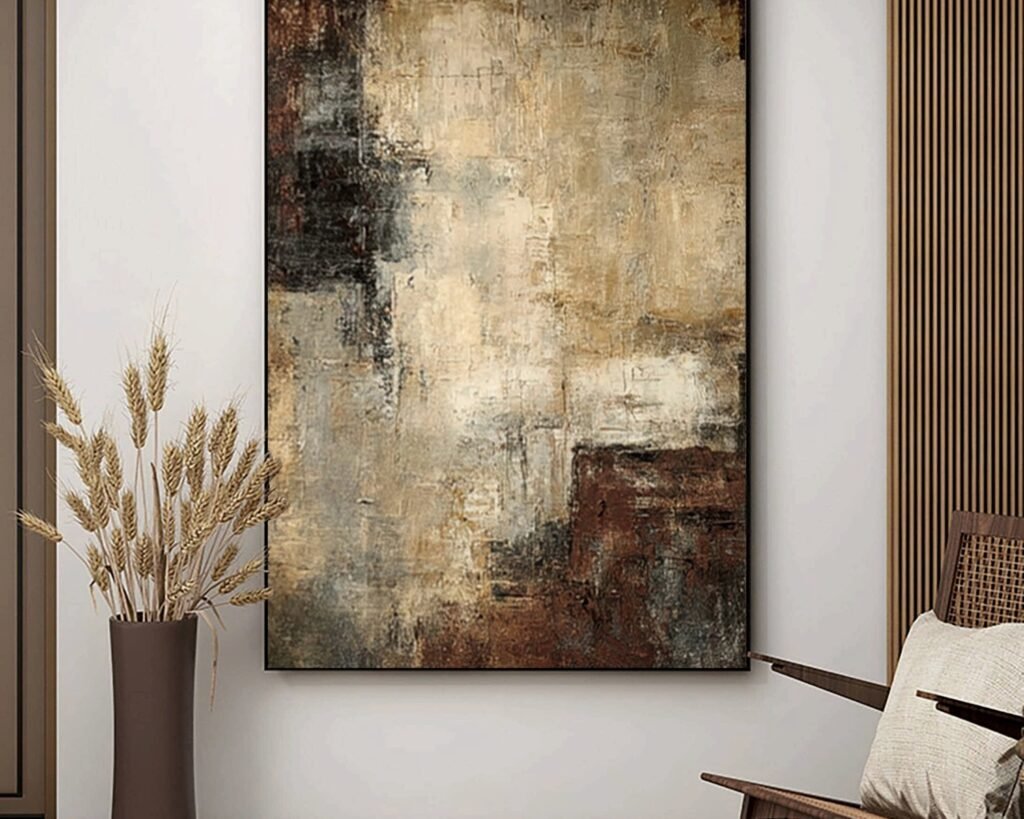
Abstract art is popular for oversized pieces because it’s versatile and the lack of recognizable subject matter means it works in lots of different spaces. But I’m also seeing a lot of oversized photography lately, especially black and white landscapes or architectural shots.
Color Matching Without Making It Boring
You don’t have to match your art to your throw pillows exactly (please don’t do this actually). Pull one or two accent colors from the piece and echo them elsewhere in the room, but the art can and should introduce new colors to your palette.
I just finished a living room where the client had all navy and cream, very safe, and we added this massive abstract piece with rust orange and deep teal and it completely transformed the space. The art became the starting point for adding new accent colors.
What to Avoid
Multi-panel sets (triptychs) seem like a good idea but spacing them correctly is weirdly difficult and if you move you’ve gotta remeasure and reinstall three separate pieces. Unless you really love the specific image, a single large piece is easier.
Those canvas prints of famous paintings like Starry Night or the Klimt kiss… I mean if you love it go for it, but they’re pretty dated at this point. Also anything with inspirational quotes in decorative fonts, that trend peaked around 2015.
Wait I forgot to mention lighting. If you’re spending serious money on oversized art, light it properly. Picture lights that mount to the frame work okay but adjustable track lighting or recessed spotlights are better for really large pieces. You want the light to hit the art at about a 30-degree angle to avoid glare.
Budget Reality Check
Custom canvas prints in the 60×80 inch range usually run $400-800 depending on the service. Artist originals or limited editions at that size start around $1200 and go up from there. Framed pieces add another $300-600 for quality framing at large sizes.
If budget is tight, consider a large-scale print that you frame yourself with a simple float frame. You can find affordable oversized frames at craft stores when they have sales. Or do what I did in my bedroom and mount an unframed canvas print directly to a piece of painted plywood backing for a modern look that cost like $200 total.
The thing is oversized art is an investment in your space and you’re gonna look at it every single day, so it’s worth spending a bit more to get something you actually love rather than settling for whatever fits the budget. Save up for the right piece instead of buying something mediocre just to fill the wall.
Oh and shipping costs are real, budget an extra $100-200 for large pieces because they usually ship freight. I’ve had pieces arrive damaged from cheap shipping so make sure there’s insurance and proper packaging.