Wall Art Guide, Wall Art Tutoriels
Orca Wall Art: Killer Whale Ocean Marine Decor
Jun
So I’ve been totally obsessed with orca wall art lately and honestly it started because a client wanted to do this whole marine theme in their living room but didn’t want it to feel like a kid’s bathroom, you know? Like sophisticated ocean vibes without the cartoon fish situation.
Why Orca Art Actually Works in Adult Spaces
Okay so here’s the thing about killer whale decor – it walks this really interesting line between dramatic and calming. The black and white coloring is already so graphic and modern that it doesn’t automatically scream “beach house” the way dolphin art does. I’ve used orca pieces in everything from minimalist Scandinavian-style bedrooms to moody dark academia offices and it just… works?
The key is treating them like the apex predators they are (sorry, been watching too much nature documentary stuff while I work). You want art that captures that power and grace, not cutesy jumping whales with rainbows or whatever.
Types of Orca Art That Don’t Look Cheesy
Black and white photography prints are gonna be your safest bet if you’re nervous about committing. I found this amazing shot on Etsy – just a single orca breaching with water droplets frozen in time, printed on matte paper. Looks expensive, cost like $45 for a 24×36. The matte finish is important because glossy can look cheap and reflect weird light.
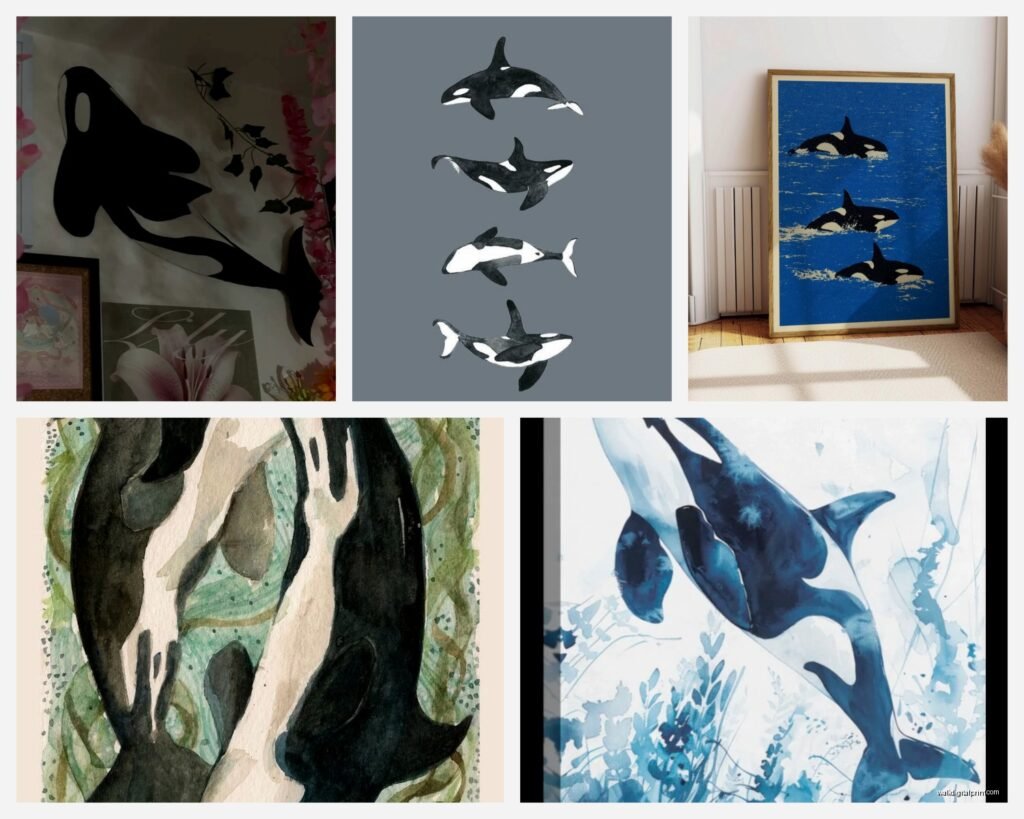
Watercolor abstracts surprised me honestly. There’s this artist who does these flowing, almost ghostly orca silhouettes with blue and gray washes. It’s abstract enough that it feels artistic but you can still tell it’s a killer whale. Works really well in bedrooms or spaces where you want something softer.
Metal wall sculptures – okay wait, I know this sounds like it would be tacky but hear me out. The ones that are just the outline, cut from black metal, especially the geometric/angular interpretations? They’re stunning. I put one in my own hallway and everyone asks about it. Just make sure you’re getting actual metal, not painted plastic that’ll chip.
Canvas prints with texture add dimension without being sculpture-level commitment. Look for ones with visible brushstrokes or layered paint effects. There’s a huge difference between a flat printed canvas and one where you can actually see and feel the texture.
Color Schemes That Actually Make Sense
The obvious choice is black, white, and blue – classic ocean palette. But here’s what I’ve learned from placing like a dozen different orca pieces: you can get way more creative.
Black and white orca art works in literally any color scheme because it’s neutral. I’ve paired it with blush pink and gold (unexpected but gorgeous), with deep emerald greens, with warm terracotta tones. The graphic nature of the whale itself becomes almost like typography on your wall.
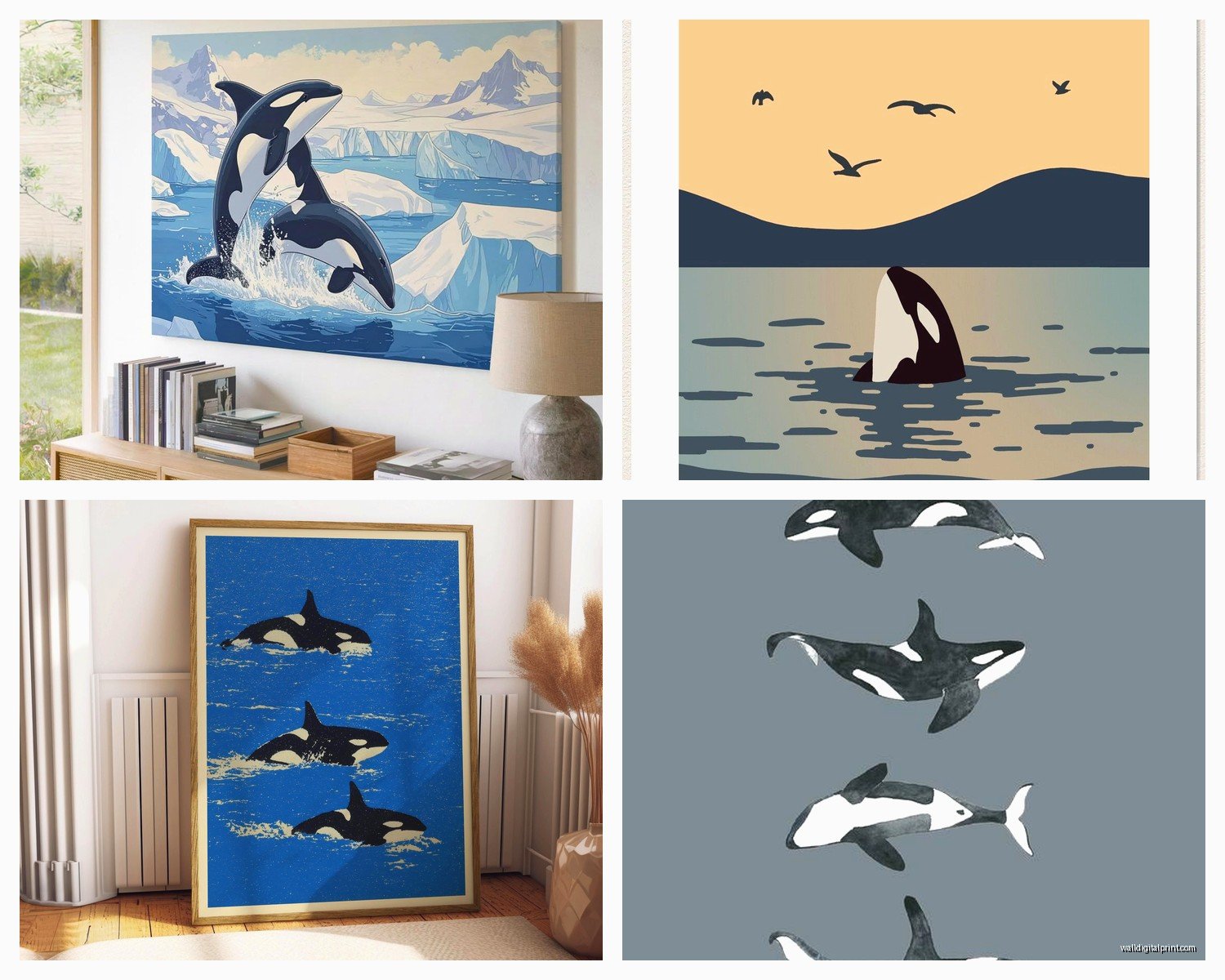
If you’re going full marine theme though, think about your blues carefully. Navy and deep teal feel more sophisticated than bright turquoise. Gray-blue is even better if you want something really contemporary. And don’t sleep on adding unexpected accent colors – I did a whole room with orca art, navy walls, and burnt orange accents and it was *chef’s kiss*.
Where to Actually Find Good Pieces
Etsy is honestly where I find most of my stuff. Search for terms like “minimalist orca print” or “modern killer whale art” – the word “minimalist” really helps filter out the kiddie stuff. Digital downloads are great if you want to print at your own size or you’re on a budget. Just make sure you’re downloading at least 300 DPI if you’re printing anything bigger than 8×10.
Society6 and Redbubble have tons of independent artists. The quality can be hit or miss, so I always read reviews before ordering. But the range of styles is incredible – everything from scientific illustration vibes to trippy psychedelic interpretations.
Local art fairs and galleries, especially in coastal areas, sometimes have amazing original pieces. I found a three-panel orca painting at a small gallery in Seattle that I’m still thinking about months later (didn’t buy it, still kicking myself).
Oh and another thing – don’t overlook vintage marine biology illustrations. You can find old scientific drawings of orcas that have this beautiful aged quality. Frame them in simple black frames and they look so curated and intentional.
Size and Placement Strategy
This is where people mess up constantly. They buy art they love and then just… stick it on a wall without thinking about scale.
Above a sofa: Your art should take up about 2/3 to 3/4 of the sofa width. For a standard 7-foot sofa, you’re looking at a piece that’s 50-60 inches wide, or a gallery wall that fills that space. A single orca breach photo looks amazing here if it’s big enough – don’t go too small or it’ll look like you’re afraid of commitment.
In a bedroom: Above the bed is obvious but also consider a large piece on the wall opposite your bed – it’s what you see when you wake up. I have a client who put a massive orca pod canvas across from her bed and she says it’s like waking up underwater in the best way.
Hallways: Perfect for a series of smaller prints or a gallery wall. I did three 16×20 prints of orcas in different poses – surfacing, tail fluke, dorsal fin – all in matching frames down a narrow hallway. Creates this really cool journey effect.
Bathrooms: Okay yes this is where marine themes can get cliche but if you keep it sophisticated it works. One medium-sized piece above the toilet or a small print near the sink. Keep the frame simple and the art style modern.
Framing Makes or Breaks It
I cannot stress this enough – a $30 print in a $100 frame looks better than a $200 print in a cheap frame.
For orca art specifically, I usually go with:
– Thin black metal frames for modern/minimalist spaces
– Natural wood frames (light oak or walnut) for Scandinavian or coastal vibes
– White frames only if your walls are NOT white (needs contrast)
– No frame at all for canvas prints, but make sure the edges are finished
Matting is optional but adds sophistication. White or off-white mats work for most orca art. I sometimes use black mats for really dramatic black and white photography.
Mixing Orca Art with Other Marine Elements
So you’ve got your killer whale piece – now what? You don’t want your whole room to be an aquarium situation.
The trick is treating the orca as your statement piece and keeping other ocean references subtle. Maybe some coral-colored throw pillows, a coffee table book about marine life, a rope-wrapped vase. You’re suggesting ocean without screaming it.
I mixed orca art with:
– Abstract art in ocean colors (but not explicitly ocean-themed)
– Brass or gold accents (think old nautical instruments)
– Natural textures like jute, linen, raw wood
– Lots of plants (creates that organic feel without being too literal)
What I avoid mixing it with:
– Other specific sea animals (unless you’re going full marine biology collection)
– Anchors, ship wheels, “WELCOME ABOARD” signs (just… no)
– Too much blue (it gets overwhelming fast)
– Anything with text about the beach or ocean
Lighting Your Orca Art
Okay this is gonna sound extra but lighting actually matters. I learned this the hard way when I hung a beautiful orca print in my dining room and it just looked… flat and sad.
Picture lights are ideal if you’re going fancy. Those little brass or black fixtures that mount above the frame. Creates a gallery effect and makes your art look intentional and expensive.
Track lighting or adjustable recessed lights work great too. Angle them to hit the art without creating glare. This is especially important for glass-covered frames.
Natural light is tricky – too much direct sunlight will fade your print over time. If your orca art is getting blasted by afternoon sun, consider UV-protective glass or just hanging it on a different wall.
My cat knocked over a lamp once and I realized the ambient lighting in that corner was actually perfect for the orca canvas – sometimes happy accidents teach you stuff.
Budget Breakdown – What to Actually Spend
Because everyone always wants to know this but nobody wants to ask…
Budget-friendly (under $100 total):
Digital download print: $10-30
Print at local print shop: $20-40
IKEA frame: $15-30
You’re looking at $45-100 for a nice piece
Mid-range ($100-300):
Professional print from artist: $50-150
Quality frame from Frame It Easy or similar: $50-100
Maybe custom matting: $30-50
This is the sweet spot honestly
Investment ($300+):
Original art or limited editions: $200-1000+
Custom framing: $100-300
Gallery-quality materials throughout
I’ve done all three levels and honestly, the mid-range usually gives you the best bang for your buck. You can find incredible art for $100-150 and with the right framing it looks like you spent way more.
Styles for Different Room Vibes
Minimalist/Scandinavian: Clean lined black and white photography, thin black frames, lots of white space around the art. Single orca, simple composition. Maybe one of those cool aerial shots of an orca pod from above.
Modern/Contemporary: Bold graphic prints, metal sculptures, oversized canvases. Think high contrast, dramatic angles, maybe some geometric interpretation of orca forms.
Coastal/Nautical: Watercolors, softer blues and grays, natural wood frames. But keep it sophisticated – think “expensive beach house” not “souvenir shop.”
Industrial/Urban: Raw metal sculptures, black and white photography with gritty texture, reclaimed wood frames. The orca becomes an unexpected element in an otherwise edgy space.
Eclectic/Bohemian: Mix orca art with other nature prints, varied frame styles, layered with other wall decor. The orca print can be part of a larger gallery wall with botanical prints, abstract art, whatever.
Multi-Panel and Gallery Wall Ideas
Triptychs (three-panel sets) of orcas are super popular right now and they work really well above sofas or beds. Make sure the panels are properly spaced – usually 2-3 inches apart looks right.
For a gallery wall incorporating orca art, I usually make it the largest piece and build around it. Maybe your orca print is 24×36 in the center, then surround it with smaller 8×10 and 11×14 prints of complementary subjects – waves, seascapes, abstract ocean colors, marine textures.
Oh wait I forgot to mention – if you’re doing a gallery wall, lay it out on the floor first. Take a picture of your arrangement before you start hammering. Trust me on this, I’ve redone so many gallery walls because I didn’t plan it out.
Avoiding the Kitsch Factor
Look, orcas can definitely tip into cheesy territory if you’re not careful. Here’s what makes it go wrong:
– Too many whales (one statement piece or a curated collection, not every wall)
– Cartoon or overly cute styles (unless that’s genuinely your vibe)
– Mixing with too much other ocean kitsch
– Poor quality prints that look pixelated or washed out
– Frames that don’t match the sophistication level of the art
The way to keep it sophisticated is treating the orca art like you would any other serious artwork. Would you hang a fuzzy photo in a cheap plastic frame? No. Same rules apply here.
Seasonal Switching
Some people like to rotate their art seasonally, and orca pieces actually work year-round but especially well in fall and winter. There’s something about those black and white creatures that feels right when it’s cold outside. In summer, you might want to pull in more colorful ocean pieces and let the orca art be your anchor.
I personally don’t switch mine out because I spent too much time getting the placement right, but my sister swaps her orca print with coral reef art in summer and it keeps things fresh for her.
Okay so that’s basically everything I’ve learned from working with orca art in like… probably 20 different spaces at this point? The main thing is just don’t overthink it – if you love the piece and it makes you think of the ocean or feel calm or whatever, it’s probably gonna work in your space. Just frame it properly and give it the right amount of wall real estate and you’re good to go.