Wall Art Guide, Wall Art Tutoriels
Islamic Calligraphy Wall Art: Arabic Script Muslim Faith
Aug
So I’ve been down this whole Islamic calligraphy rabbit hole for like three months now and honestly it started because a client wanted to incorporate some meaningful Arabic script into their minimalist living room and I was like…okay I need to actually understand this properly before I just start hanging things on walls.
First thing – and I wish someone had told me this earlier – there’s a HUGE difference between decorative Arabic script you find on Etsy and actual traditional Islamic calligraphy. Like, night and day difference. The traditional stuff follows specific rules, uses classical Arabic (which is different from modern Arabic), and usually features verses from the Quran, Hadith, or phrases like “Bismillah” (In the name of God) or “Alhamdulillah” (Praise be to God). The decorative stuff might just be…pretty shapes that kinda look Arabic? So yeah, if you’re buying for someone who actually reads Arabic or cares about the religious significance, you gotta be careful.
Understanding What You’re Actually Buying
The main styles you’ll run into are Thuluth, Naskh, Diwani, and Kufic. Thuluth is that really elegant flowing one with the dramatic curves – it’s what most people picture when they think Islamic calligraphy. Kufic is more geometric and angular, super popular for modern interiors because it reads almost abstract if you don’t know Arabic. I personally love Kufic for contemporary spaces because it doesn’t scream “religious art” to guests who might not be familiar with it, but it carries all the meaning for people who are.
Wait I forgot to mention – always ALWAYS verify what the text actually says. I learned this the hard way when I almost bought this gorgeous piece from a random online seller and my friend who speaks Arabic was like “um that’s not even real words, it’s just decorative loops.” So embarrassing. If the seller can’t tell you exactly what phrase or verse it contains, that’s a red flag.
Where to Actually Buy This Stuff
Okay so after testing like fifteen different sources here’s what I found:
Etsy is honestly hit or miss. There are some incredible artists on there who do custom work – I found this shop called ArtByAisha (not sponsored, just genuinely good) where the artist actually trained in traditional calligraphy and she’ll customize sizes and color schemes. But you also get a lot of print-on-demand shops that just…slap Arabic text on generic canvases. Look for shops that show the artist’s process, have reviews from actual Arabic speakers, and can explain the meaning.
Islamic bookstores – both online and physical – tend to have more authentic pieces but the designs can be pretty traditional. If you want something that fits a modern aesthetic this might not be your first stop, but the quality and accuracy is usually solid.
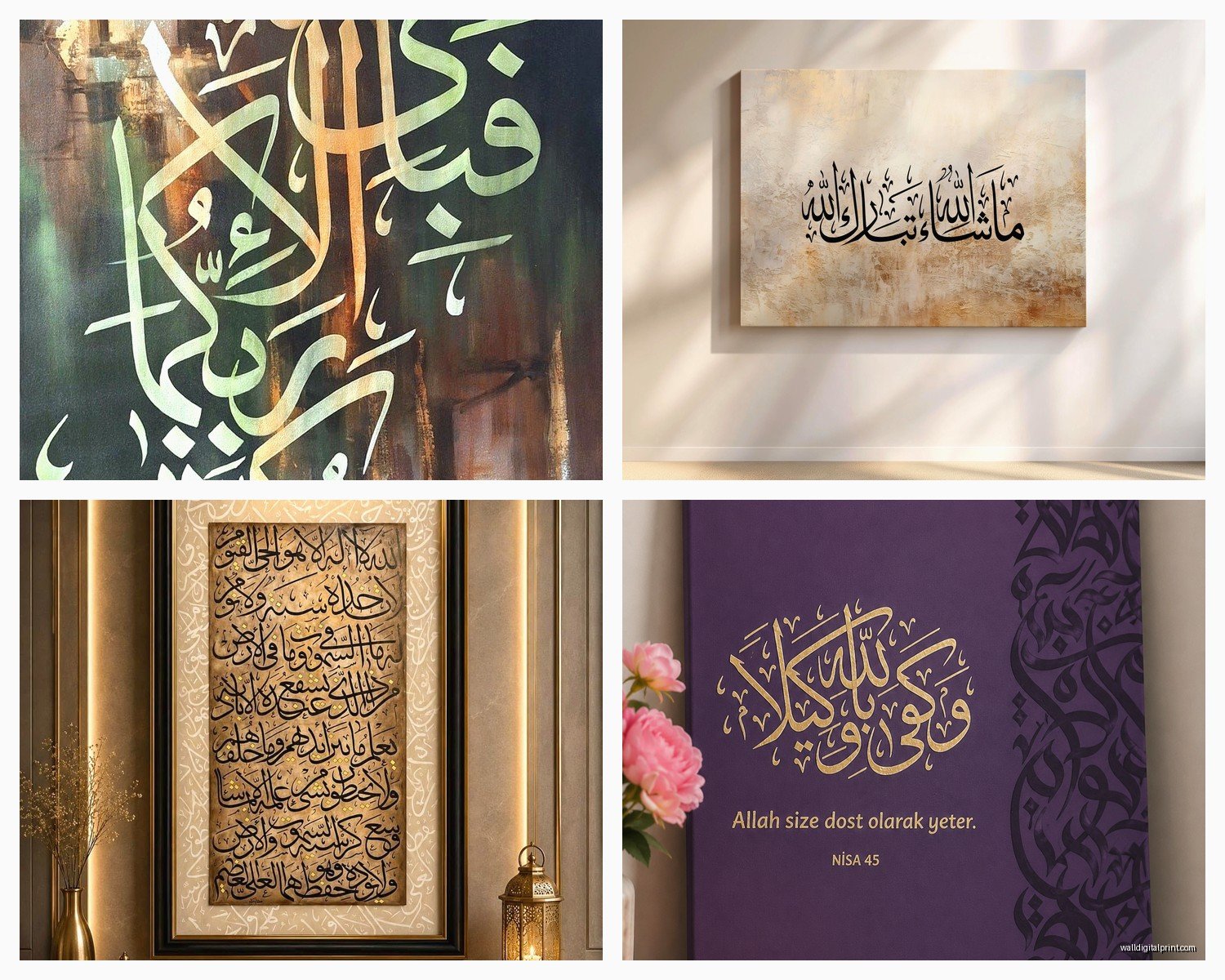
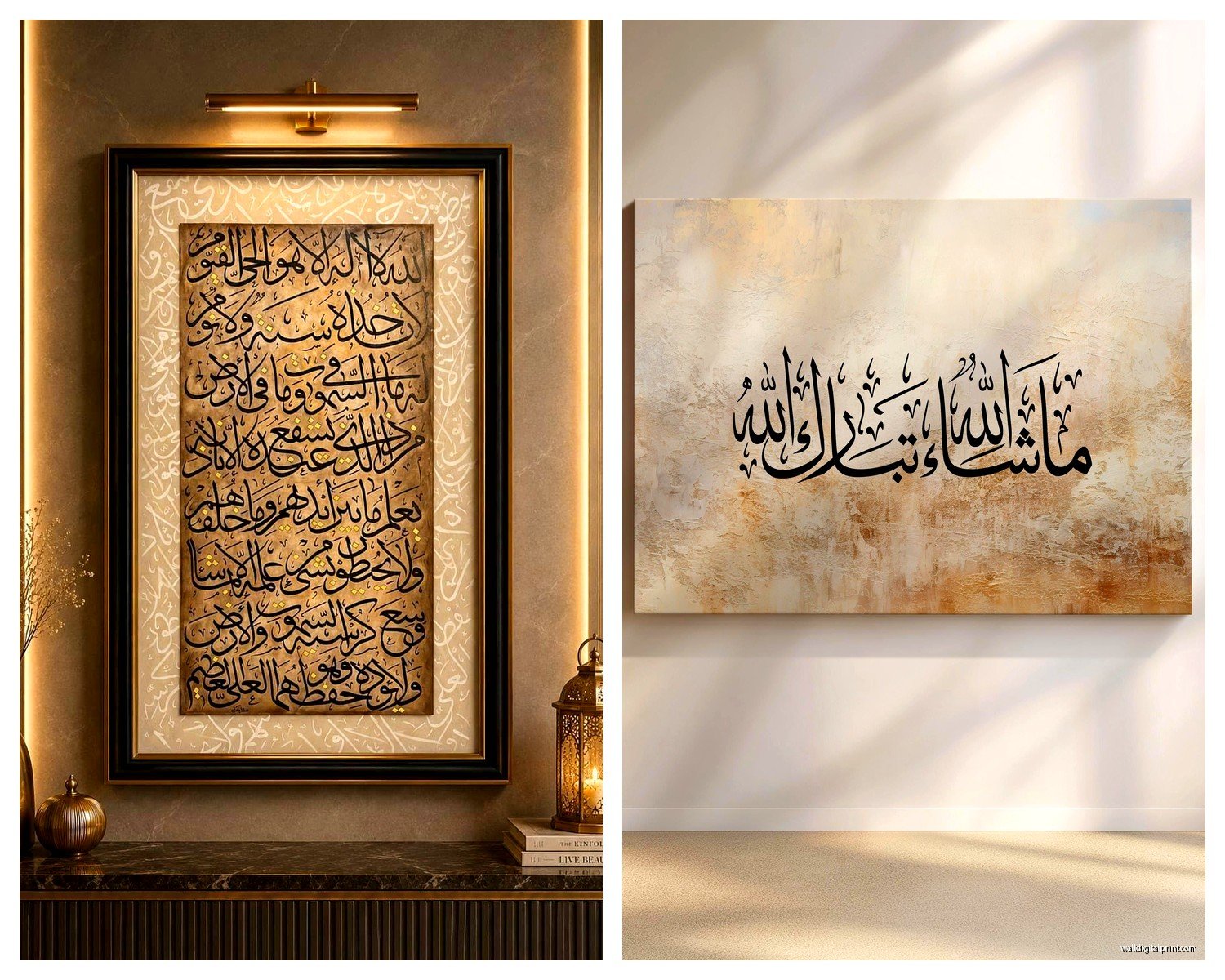
Direct from artists is my favorite route now. Instagram has this whole community of contemporary Islamic calligraphers who do commission work. The prices are higher but you’re getting actual art, not mass production. I worked with an artist in Jordan who created a custom Ayat al-Kursi piece for a client and the detail was just…chef’s kiss.
Print vs Original vs Digital Print
This is gonna sound weird but I actually prefer high-quality digital prints over cheap originals? Like if your budget is $100, you’re better off getting a museum-quality giclee print of a master calligrapher’s work than an “original” from someone who just picked up a calligraphy pen last month. The traditional masters – we’re talking artists who studied for YEARS – their work is reproduced and sold as prints, and honestly those look better than mediocre originals.
Original pieces from established artists start around $500 and go up to thousands. Worth it if you’re really investing in your space, but most people don’t need that. A really good print on premium paper or canvas runs $80-200 depending on size and looks basically identical on the wall.
Sizing and Placement That Actually Works
So here’s what I’ve figured out through trial and error (mostly error):
For above a sofa or bed, you want the piece to be about two-thirds to three-quarters the width of the furniture. Islamic calligraphy often works better going horizontal rather than vertical because of how the script flows. I made the mistake once of hanging a tall vertical piece above a king bed and it just looked…awkward and too skinny.
Entry ways are traditional spots for Bismillah pieces – it’s literally a blessing as you enter. My client has one right by her front door and every time I visit I notice how it sets this intentional calm vibe immediately.
Oh and another thing – these pieces need breathing room. Don’t crowd them with other art. The whole point of calligraphy is the negative space around the letters is part of the design. I see people creating gallery walls with calligraphy mixed in and it usually doesn’t work. Let it stand alone.
Color Schemes and Frames
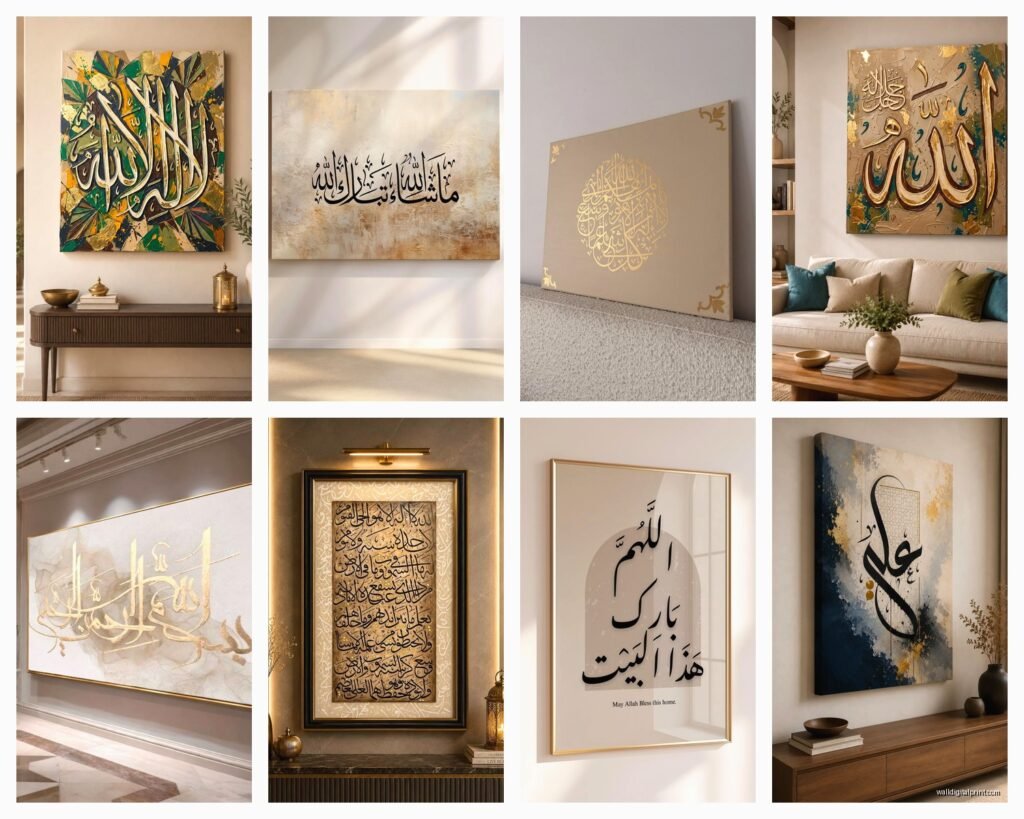
Traditional colors are black on white/cream, gold on black, or gold on deep blue. These are classic for a reason and honestly they go with everything. But contemporary artists are doing really interesting things with color now.
I’ve seen gorgeous pieces in:
- Sage green and gold (perfect for boho spaces)
- Navy and copper (works in masculine interiors)
- Blush pink with grey script (surprisingly sophisticated)
- All white on white with subtle texture (super minimal)
For frames – keep it simple. Black, white, natural wood, or gold. Don’t get ornate baroque frames unless the rest of your space is really traditional. A floating frame (where there’s space between the art and the frame edge) looks really modern and clean with calligraphy.
My cat just knocked over my coffee while I’m writing this ugh…okay where was I.
The Meaning Actually Matters
This isn’t just decorative typography, right? Each phrase carries specific meaning and intention. Here are the most common ones and what they’re typically used for:
Bismillah ar-Rahman ar-Rahim – “In the name of God, the Most Gracious, the Most Merciful” – Usually near entrances or in kitchens. It’s about starting things with intention and blessing.
Ayat al-Kursi – The Throne Verse from the Quran – Often in bedrooms or living rooms, it’s considered protective and one of the most powerful verses.
Alhamdulillah – “Praise be to God” – Expression of gratitude, nice for dining areas or anywhere you want to cultivate thankfulness.
SubhanAllah – “Glory be to God” – Recognition of God’s perfection.
Mashallah – “What God has willed” – Protection against the evil eye, often in children’s rooms.
If you’re not Muslim yourself but appreciate the aesthetic, that’s totally fine, but maybe stick to phrases that are more universal expressions rather than specific Quranic verses? Just my thought. I have non-Muslim clients who love the “Alhamdulillah” pieces because gratitude is universal, but they might feel weird having a full Quran verse if they don’t practice the faith.
Mixing Styles in Your Space
Okay so funny story – I thought you couldn’t mix Islamic calligraphy with other art styles and I was SO wrong. It actually works really well with:
Minimalist/Scandinavian – The clean lines of Kufic script fit perfectly here. Black on white, simple frame, done.
Bohemian – The flowing Thuluth script in warm colors plays beautifully with textiles and plants.
Modern/Contemporary – Abstract interpretations of calligraphy or metallic finishes work great in sleek spaces.
Traditional – Obviously works, but don’t go TOO matchy. If your furniture is ornate, keep the calligraphy piece simple so it doesn’t compete.
What doesn’t really work? Rustic farmhouse. I tried. The aesthetics just clash. Unless you find a really weathered vintage-looking piece maybe, but even then it’s tough.
DIY or Commission Custom Work
If you wanna go the custom route (which I recommend if you have a specific vision), here’s what to know:
Budget $200-500 for a quality commissioned piece from an intermediate artist, more for established names. Timeline is usually 4-8 weeks depending on complexity.
You’ll need to tell them:
- The phrase or verse you want (be specific, Arabic has nuances)
- Preferred calligraphy style
- Size requirements
- Color preferences
- Where it’ll be hung (helps them think about composition)
Most artists will send you a digital mockup before creating the final piece. Don’t skip reviewing this carefully – once it’s made, changes are hard.
The Print-It-Yourself Option
There are digital downloads on Etsy for like $5-15 that you can print yourself at a local print shop. This is super budget-friendly BUT the quality varies wildly. Check reviews specifically mentioning print quality. Some files are low resolution and look pixelated when printed large.
If you go this route, print on premium matte paper or canvas, not regular photo paper. And get it professionally mounted or framed – a good frame elevates even a cheap print.
Caring for Your Calligraphy Art
Keep it out of direct sunlight, especially if it’s got gold leaf or metallic elements. Those fade faster than you’d think. I had a gold-on-black piece in a client’s breakfast nook that got morning sun and after like eight months it started looking dull.
If it’s behind glass, make sure there’s a mat or spacer so the art doesn’t touch the glass directly. Humidity can cause issues otherwise.
Dust the frame regularly but don’t use cleaning products directly on the art. If you need to clean the glass, spray the cloth, not the glass itself.
Common Mistakes I See (and Made Myself)
Hanging it too high – the center of the piece should be at eye level, which is usually 57-60 inches from the floor. Unless you’re putting it above furniture, then different rules.
Choosing a piece that’s too small for the wall – better to go bigger than you think you need. Small calligraphy on a big wall just looks lost.
Not considering the room’s purpose – you probably don’t want intense Quranic verses in a bathroom or laundry room? Think about what feels respectful.
Buying without understanding the text – seriously cannot stress this enough.
Mixing too many different calligraphy styles in one space – pick one or two max, otherwise it gets chaotic.
Price Ranges Reality Check
Just so you know what’s reasonable:
Digital downloads: $5-20
Prints (unframed): $30-150
Framed prints: $80-300
Original small pieces: $200-800
Original statement pieces: $800-5000+
Commission work: $200-2000 depending on artist and size
If someone’s selling “original hand-painted calligraphy” for $25…it’s probably a print or done by someone with minimal training. Not necessarily bad, but know what you’re getting.
My Current Favorites for Different Spaces
For a modern living room I’m obsessed with circular Kufic compositions right now. The symmetry is just *chef’s kiss* and they work as conversation pieces.
For bedrooms the Ayat al-Kursi in soft colors – there’s something calming about having it be the last thing you see before sleeping.
For home offices or creative spaces I like the phrase “Kun Fayakun” which means “Be, and it is” – it’s about manifestation and creation. Very appropriate for a workspace.
Dining rooms or kitchens definitely go with Alhamdulillah or Bismillah – both connect to the act of eating and gratitude for sustenance.
Honestly the biggest thing I’ve learned is to take your time with this. Don’t just impulse buy because something looks pretty on Instagram. Think about what the words mean, whether they resonate with you or the person you’re buying for, and how it’ll actually look in your specific space with your specific lighting and colors.
And if you’re not sure about placement or size, most good sellers will let you return stuff, or you can always start with a smaller piece to test it out. I have like three calligraphy pieces in my own apartment now and I’m probably gonna get more because once you start understanding the artform it’s kinda addictive?