Wall Art Guide, Wall Art Tutoriels
Elephant Stock Wall Art: Photography Marketplace Images
Aug
So I just finished going through like hundreds of elephant stock images for a client’s meditation studio and honestly, the marketplace situation is way more complicated than you’d think. Let me walk you through what actually matters when you’re buying these things.
Finding the Right Marketplace Without Losing Your Mind
Okay so there’s basically three types of places you’re gonna look. First there’s the big generic ones like Shutterstock and Adobe Stock where you’ll find literally thousands of elephant photos but like, 80% of them look exactly the same. Then you’ve got the artsy places like EyeEm or 500px where photographers actually care about composition and lighting. And then there’s the budget options like Depositphotos or Dreamstime which honestly sometimes have hidden gems if you’re willing to scroll forever.
I spent an entire Saturday morning (my dog kept interrupting because she needed to go out every twenty minutes) comparing the same basic “elephant in golden light” photo across five different sites. The price differences were wild. Adobe Stock wanted $79.99 for the extended license while Depositphotos had something nearly identical for $29. But here’s the thing nobody tells you, the resolution and the actual file quality were noticeably different when I zoomed in.
Resolution Actually Matters More Than You Think
You need to think about where this is going. Like are you printing this 16×20 for above a sofa or are you going massive, like 40×60 for a hotel lobby? Most stock sites list dimensions in pixels which is annoying because you gotta convert that to inches at whatever DPI you’re printing at.
Quick math I always use: for a decent print you want 150-300 DPI. So if you’re buying a 6000×4000 pixel image and you want 300 DPI, that’s 20×13 inches max before quality drops. I keep a calculator open whenever I’m shopping because my brain cannot do this math anymore.
The extended licenses usually give you the biggest file sizes. Standard licenses on most sites cap you at like 4000 pixels on the long side which is fine for smaller prints but if you’re going big, you gotta pay more. I learned this the hard way on a project last year where I bought standard licenses for what I thought would be 24×36 prints and they looked pixelated and soft when the printer sent proofs back.
What to Actually Look For in Elephant Images
Okay so this is gonna sound weird but the lighting is EVERYTHING. I’ve rejected so many technically perfect photos because the lighting was flat or boring. You want either dramatic side lighting that shows texture in the elephant’s skin, or that golden hour magic that makes everything look expensive.
The best elephant photos I’ve found have a few things in common:
- Clean backgrounds without distracting elements or other tourists in the shot
- Sharp focus on the elephant’s eye because that’s where people look first
- Interesting angles, not just straight-on shots that look like a textbook
- Natural behavior, not posed or obviously captive situations
- Good negative space if you’re planning to add text or design elements later
The captive vs wild thing is tricky because honestly most stock photos are from sanctuaries or reserves, but you can usually tell if it looks exploitative. My clients increasingly ask about this, they wanna know the elephants weren’t being mistreated for the photo. Some marketplaces are starting to tag ethical photography which helps.
Color Palettes and Interior Matching
Something I wish I’d known earlier, download the preview images and pull them into a mood board with your actual paint colors before buying. I use Canva for this but honestly even just putting them next to each other in a photo editor works.
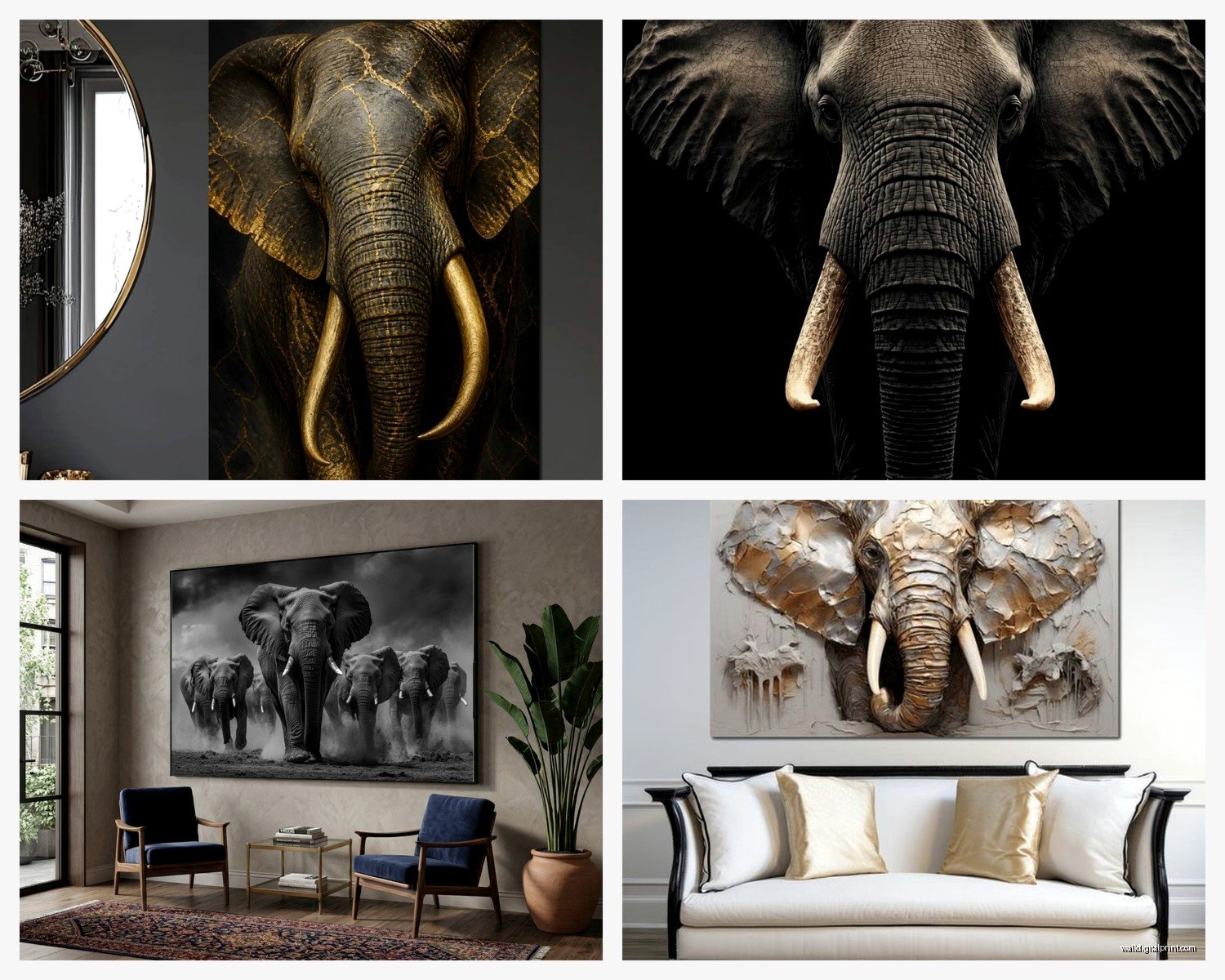
Warm-toned elephant photos (lots of browns, golds, amber light) work with basically any neutral interior but they can clash with cool grays or blue-based color schemes. I had a situation where a client fell in love with this gorgeous sunset elephant photo but their entire living room was decorated in cool grays and whites and it just looked…off. We ended up going with a black and white image instead.
Black and white elephant photography is actually having a moment right now. The dramatic contrast works in modern spaces and you don’t have to worry about color matching at all. Plus they tend to be slightly cheaper on most marketplaces? Not sure why but I’ve noticed that pattern.
Licensing Terms You Actually Need to Read
Okay I know reading license agreements is the worst but you gotta at least skim them because the rules are different everywhere. Most standard licenses let you print one copy for personal use or for a client’s space. But if you’re an interior designer or decorator buying for multiple clients, you technically need a new license for each project.
Extended licenses usually cover:
- Unlimited print runs
- Commercial use in products you’re selling
- Larger file sizes
- Sometimes merchandise rights
I always buy extended if I think I might want to use the image again. It’s more upfront but I’ve definitely reused favorite elephant images across different projects and it’s already paid for.
One thing that confused me forever, editorial use vs commercial use. Editorial means you can use it in like a blog post or magazine article but NOT to sell a product or service. Commercial means you can use it for advertising, products, whatever. For wall art in someone’s home or office, you usually need commercial rights even though it feels like it should be editorial.
The Weird Restrictions Nobody Mentions
Some marketplaces have random rules like you can’t print more than 500,000 copies (which like, okay I wasn’t planning to) or you can’t use the image as your company logo or trademark. Makes sense but it’s in the fine print.
Also watch out for model releases if there are people in the background of the elephant photo. Most stock sites require them but I’ve seen a few sketchy sites that don’t verify this and you could potentially get in legal trouble if someone recognizes themselves and complains.
My Actual Favorite Sources Right Now
Adobe Stock has the best search filters hands down. You can narrow by color, orientation, number of people, whether the image has space for copy, all kinds of stuff. Their AI search has gotten really good too, you can search “elephant walking toward camera in dust” and it actually understands that.
Unsplash and Pexels are free which is amazing but the selection is limited and you’ll see the same images EVERYWHERE. I used an Unsplash elephant photo for a client two years ago and now I see it in like every meditation app and wellness blog. If uniqueness matters, worth paying for stock.
Shutterstock has volume, like they have everything, but the interface drives me crazy. Their pricing is confusing with the credit packs and subscriptions and I always feel like I’m not getting the best deal. But they do have this reverse image search feature where you can upload a photo you like and find similar ones which is super helpful.
For really high-end projects I go to Getty Images or Alamy. Way more expensive but the quality is consistently excellent and you’re less likely to see the same image in a dentist’s office and a yoga studio and a hotel lobby. Getty also has a lot of editorial content from professional wildlife photographers that’s just stunning.
Wait I Forgot to Mention Subscription vs On-Demand
If you’re buying stock images regularly, subscriptions can save you so much money. Adobe Stock has a 10 images per month plan for like $29.99 which is way cheaper than buying individually. But you gotta use all your downloads each month or you lose them (some plans let you roll over but not all).
I had a subscription for a year and honestly I felt pressured to download images I didn’t really need just to use up my credits. Now I just buy on-demand when I have a specific project. It costs more per image but I’m not wasting money on stuff I’ll never use.
Technical File Stuff That Matters for Printing
Always download the highest resolution available even if you think you won’t need it. Storage is cheap and you never know when a client will decide they actually want to go bigger.
File format matters too. JPEG is fine for most printing but if you’re doing any editing or compositing, get TIFF files if the marketplace offers them. They’re huge file sizes but they don’t have compression artifacts.
Color space is something printers care about way more than I ever expected. RGB is what you see on screens, CMYK is for printing. Most stock images come in RGB so you’ll need to convert for print, or your printer will do it but then you might get color shifts. I always ask my printer what they prefer before I buy.
Oh and another thing, check if the image has been sharpened already. Some stock photographers over-sharpen their images which looks okay at screen size but weird when printed large. You can usually tell by zooming way in and looking for halos around edges.
Editing Stock Images Without Making Them Look Cheap
Just because you bought a stock image doesn’t mean you have to use it exactly as-is. I almost always do some light editing. Basic stuff like adjusting exposure, bumping contrast, maybe warming up or cooling down the color temperature to match the room better.
Cropping is your friend. Sometimes the photographer left way too much empty space or there’s a distracting element at the edge you can crop out. A lot of elephant photos work better as vertical crops than the original horizontal orientation.
If you’re putting text over the image for like a inspirational quote or whatever (which is very popular right now), add a subtle gradient overlay or darken/lighten areas so the text is readable. Nothing worse than spending money on a photo and then covering up the best part with text that’s hard to read anyway.
Printing Options That Actually Work
Okay so you’ve bought your elephant image, now what. You’ve got a few options and they’re all gonna give you different results.
Local print shops can be great because you can see paper samples and talk to actual humans. But they’re usually more expensive. I use a local printer for high-end projects where the client wants museum-quality prints with custom framing.
Online services like Printique (used to be AdoramaPix) or Nations Photo Lab are my go-to for most projects. Good quality, reasonable prices, tons of size options. You upload your file, they ship it to you in like a week. I’ve never had quality issues with either of them.
Canvas prints are super popular but honestly I’m kinda over them? They were everywhere five years ago and now they feel dated. If you do go canvas, make sure your image has enough resolution because the texture of canvas can make lower resolution images look even worse.
Metal prints are having a moment and they actually look incredible with elephant photography. The colors are super vibrant and the surface has this depth that makes the image pop. They’re pricey though, like twice what a regular print costs.
Framing Thoughts
This probably deserves its own whole thing but quick thoughts. Black frames are safe and work with almost everything. Natural wood frames are trendy right now, especially light oak or walnut. White frames can look really clean and modern but they show dust and fingerprints like crazy.
I usually go frameless with a float mount for contemporary spaces. The image is mounted on a backing board with a slight gap between the image and the wall which creates this nice shadow effect. Very gallery-like.
Mat boards can either make or break the whole thing. Too wide and the mat overwhelms the image, too narrow and it looks cramped. I typically go with 2-3 inches on all sides for smaller prints, 3-4 inches for larger ones. White and cream are classic but don’t sleep on black mats for dramatic elephant photos.
Avoiding the Same Images Everyone Else Has
This is tricky because the most popular images are popular for a reason, they’re good. But if uniqueness matters, you gotta dig deeper. Don’t just look at the first page of search results. I usually scroll through at least 5-10 pages before I start seeing less common images.
Try different search terms. Instead of just “elephant” try “elephant portrait” or “elephant texture” or “elephant family” or “baby elephant.” Adding descriptive words narrows the results but in a good way.
Look at individual photographer portfolios. When you find an elephant image you like, click on the photographer’s name and see what else they’ve shot. Often they’ll have a whole series of elephant photos and you might find something even better that doesn’t show up in general searches.
Regional marketplaces sometimes have different content. Like there are African stock photo sites that have elephant images you won’t find on the big American marketplaces. Same with Asian marketplaces for Asian elephant photography.
Alright I think that’s everything I learned from way too many hours comparing elephant stock photos. My cat just knocked over my coffee so I gotta go deal with that but hopefully this helps you find something perfect without spending forever on it.