Wall Art Guide, Wall Art Tutoriels
Celtic Wall Art: Irish Knot Cross Gaelic Heritage
Aug
So I got super into Celtic wall art last year when I was staging this townhouse that needed something with “roots” but not in a cheesy Hobby Lobby way, and honestly the whole Irish knot cross thing has been my obsession ever since. Like I’m talking spent-three-hours-down-a-rabbit-hole level obsessed.
First Thing About Choosing Celtic Wall Art
Okay so the biggest mistake everyone makes is buying the first shiny thing they see on Etsy with a trinity knot slapped on it. I did this. Twice. The problem is that Celtic art has actual meanings and if you’re gonna put it on your wall, you should probably know what you’re displaying, right?
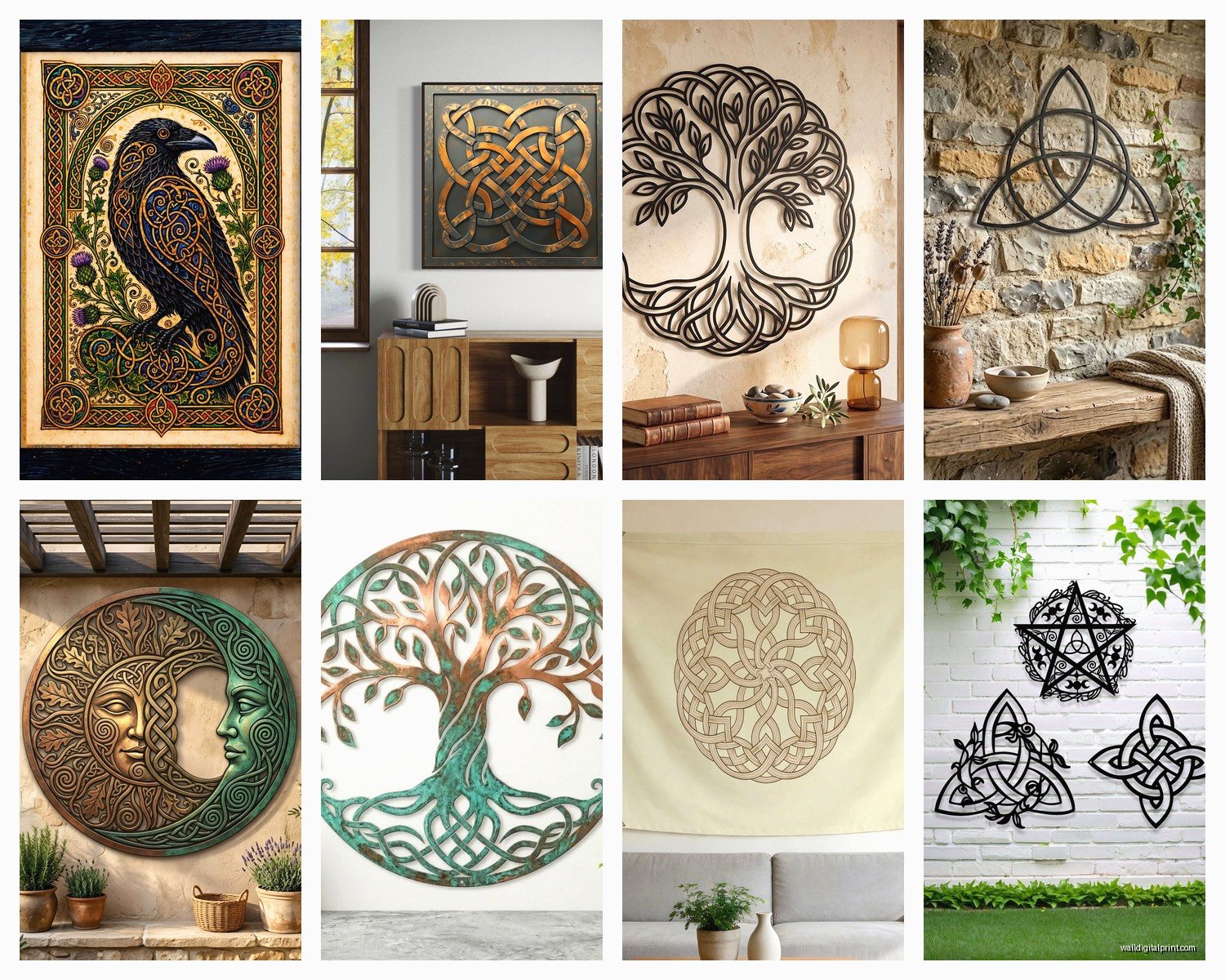
The Irish knot crosses are different from just regular Celtic knots because they combine the traditional Christian cross with pre-Christian Celtic knotwork. The unbroken lines represent eternity, interconnectedness, all that stuff. But here’s what actually matters for decorating: they come in like a million different styles and materials and you gotta figure out what works with your actual space.
Wood vs Metal vs Stone
I’ve worked with all three and here’s the real talk. Wood pieces are gorgeous and warm but they photograph dark unless you have really good lighting. Had a client put this beautiful carved oak Celtic cross in her hallway and it just disappeared into the wall because the lighting was terrible. We ended up adding a picture light above it which looked kinda museum-y but worked.
Metal ones are usually my go-to. Bronze finish or wrought iron give you that authentic Irish cottage vibe without being too rustic. The ones from Irish artisans on Etsy are honestly better quality than the mass-produced stuff from HomeGoods, and yeah they cost more but the detail work is insane. I found this maker in Galway who does these oxidized copper pieces and the patina develops over time which is actually really cool if you’re into that lived-in look.
Stone or resin-stone pieces are heavy. Like really heavy. Make sure you’re mounting them properly because I watched a plaster Celtic cross pull right out of drywall once and it was… not great. You need proper anchors, toggle bolts if you’re not hitting studs.
Size and Placement Because Everyone Gets This Wrong
Oh and another thing, people always buy too small. A 6-inch Celtic cross on a 12-foot wall looks sad and lonely. I learned this the hard way in my own living room actually. The rule I use now is that your wall art should take up about 2/3 to 3/4 of the available wall space width-wise.
For Celtic crosses specifically, they look best when they’re either:
- A large statement piece centered above a fireplace or sofa
- Part of a gallery wall with other Irish heritage items like old maps or family crests
- In an entrance hallway where they can be a focal point
- Above a console table with some height variation
The gallery wall thing is tricky though because Celtic knotwork is so intricate that if you put it next to busy patterns or too many other detailed pieces, everything competes for attention. I usually pair a Celtic cross with simpler elements, maybe some black and white family photos or solid color matted prints.
Colors That Actually Work
This is gonna sound weird but Celtic wall art looks best against colors you wouldn’t expect. Everyone thinks they need to put it against forest green or deep burgundy to get that “Irish pub” vibe, but honestly? It pops really beautifully against:
- Soft grays and greiges
- Warm cream or ivory
- Deep navy blue
- Even charcoal or black if the piece is light-colored
I did this whole bedroom last spring where we put a whitewashed wood Celtic cross against a slate blue wall and it was stunning. The client was worried it wouldn’t feel “Irish enough” but the contrast made the knotwork detail really stand out.
Where to Actually Buy Quality Pieces
Okay so funny story, I bought my first Celtic cross from Amazon and it arrived looking like it was made in someone’s garage with a Dremel tool and zero quality control. The “bronze” was literally spray paint. So here’s where I actually shop now:
Etsy has legit Irish artisans but you gotta read reviews carefully. Look for shops based in Ireland, check if they show progress photos of their work, read through customer photos not just the listing photos. I have like three shops bookmarked that I buy from regularly.
The Irish Heritage Gift Shop online is pricey but everything is authentic and they have certificates of authenticity for the handmade stuff. Worth it if you want investment pieces.
Local Celtic festivals or Irish cultural centers often have artisans selling their work. The prices are usually better than online because there’s no shipping costs built in, plus you can see the quality in person. I found this amazing blacksmith at a festival who makes custom Celtic crosses and his Instagram is just *chef’s kiss*.
What to Look for Quality-Wise
When you’re looking at Celtic knotwork, the lines should be clean and continuous. Sloppy knotwork has gaps or uneven lines and it just looks cheap even from across the room. The weaving pattern should be mathematically correct, like the overs and unders should alternate consistently.
For crosses specifically, check that the arms are symmetrical. I’ve seen so many where one arm is slightly longer or the center circle is off-center and once you notice it you can’t unsee it.
If it’s carved wood, run your hand over it if possible. The depth should be consistent and there shouldn’t be rough spots or splinters. If it’s metal, check the finish on the back too because quality makers finish all sides even though you won’t see them.
Installation Tips Nobody Tells You
Wait I forgot to mention this earlier but it’s important. Celtic crosses often have an irregular weight distribution because of the design. The center might be heavier, or if there’s a lot of knotwork detail on one side it throws off the balance.
Use two hanging points instead of one whenever possible. Those sawtooth hangers that come attached to frames are basically useless for anything over 5 pounds. I use D-rings positioned about 1/3 down from the top on each side, then hang on two nails or screws. It keeps everything level and secure.
For really heavy pieces, those heavy-duty picture hangers rated for like 50+ pounds are your friend. The ones with multiple nails that go in at angles. My cat knocked over a vase last week that hit the wall next to a Celtic cross I’d hung with those and the cross didn’t even budge.
Grouping Multiple Pieces
If you wanna do a whole Celtic heritage wall situation, here’s what works. Start with your largest piece, usually the cross, and position it first. Then work outward with smaller complementary items.
I did this arrangement last month that turned out really well:
- Large Irish knot cross in the center
- Smaller trinity knot piece on one side
- Framed Gaelic blessing print on the other
- Two small Celtic spiral symbols on the bottom corners
Keep about 2-3 inches of space between pieces. Too close and it looks cluttered, too far and they don’t read as a cohesive group.
Mixing Old and New
One thing I love doing is mixing actual antique or vintage Celtic pieces with modern interpretations. Like I found this old carved wooden cross at an estate sale that had obviously been in someone’s family forever, all beat up and weathered. Paired it with a sleek modern metal interpretation of the same design and the contrast was really striking.
You can find vintage Celtic pieces at:
- Estate sales in areas with Irish populations
- Online auctions
- Antique shops especially in the Northeast US or obviously in Ireland
- Sometimes even thrift stores though that’s rare
Just be aware that truly old pieces might be fragile. I had one that the wood was so dry it was cracking, and I had to treat it with wood conditioner before hanging it. Also old pieces might have religious significance to previous owners so there’s something kinda nice about honoring that history.
DIY Options If You’re Crafty
Okay so if you’re into DIY, Celtic knotwork is actually really satisfying to make but also incredibly frustrating. I tried wood burning a Celtic cross pattern once while watching that show about the pottery competition and let me tell you, one wrong move and the whole continuous line thing falls apart.
But there are easier approaches. You can buy unfinished wooden crosses and paint Celtic knot patterns on them with metallic paint pens. Stencils exist for the basic patterns. Or if you’re really ambitious, wood carving kits with Celtic patterns included.
The resin casting thing is popular right now too. You can buy silicone molds of Celtic crosses and knots, mix up some resin, add metallic powders or dyes, and create custom pieces. Haven’t tried it myself but I’ve seen some beautiful results from people who know what they’re doing.
Modern Interpretations
Not everything has to be traditional. Some of the coolest Celtic wall art I’ve seen lately is modern artists riffing on traditional patterns. Like geometric minimalist versions of Celtic knots, or crosses made from reclaimed materials with just a hint of knotwork detail.
There’s this one artist who does line drawings of Celtic crosses using single continuous copper wire and they’re absolutely gorgeous, super modern but still honoring the traditional symbolism. Those kinds of pieces work really well in contemporary spaces where a traditional carved cross might feel out of place.
Lighting Makes or Breaks It
This is something I harp on with clients all the time. Celtic knotwork is all about the detail and shadow and depth, so lighting is crucial. Natural light is beautiful but inconsistent. I almost always recommend adding dedicated lighting to important pieces.
Picture lights are the obvious choice but they can look formal. Track lighting or adjustable can lights work if you already have them. Even a well-placed table lamp that casts light upward can work for pieces hung lower on the wall.
The goal is to create shadows in the carved or raised areas so the pattern really pops. Flat front lighting washes everything out. You want light coming from an angle, preferably from above at about 30 degrees.
Caring for Different Materials
Wood pieces need dusting regularly because the carved grooves trap dust like crazy. I use a soft paintbrush to get into the details, then wipe with a barely damp cloth. Every few months treat with wood polish or conditioner depending on the finish.
Metal pieces develop patina over time which some people love and some hate. If you want to maintain the original finish, you’ll need to polish occasionally with appropriate metal cleaner. Bronze and copper cleaners are different from silver cleaners so make sure you’re using the right stuff.
Stone or resin just needs dusting really. Sometimes a damp cloth if they get grimy but that’s about it.
Oh and keep everything out of direct sunlight if possible because it fades finishes and can dry out wood to the point of cracking. Learned that one the hard way with a piece in a west-facing window.
The whole Celtic heritage thing in home decor can go really right or really wrong depending on execution. But when you find the right piece and place it thoughtfully, there’s something about that ancient symbolism that adds genuine depth to a space. Way better than generic mass-produced wall art that could be in anyone’s house.