Wall Art Guide, Wall Art Tutoriels
Large Christian Wall Art for Living Room: Oversized Faith Main Space
Oct
So I’ve been dealing with oversized Christian wall art for years now and honestly, the living room is where people mess up the most. They either go too small and it looks like an afterthought, or they pick something that’s technically big but has zero visual weight and just…disappears against the wall.
First thing – measure your wall space before you do anything else. I learned this the hard way when I ordered this gorgeous 48×36 canvas of Psalm 46:5 for a client and it showed up looking like a postage stamp on their massive living room wall. You want your art to take up roughly 60-75% of the available wall space. So if you’ve got a blank wall that’s 8 feet wide, you’re looking at art that’s somewhere between 58-72 inches wide. Don’t be scared of going bigger – I promise it’ll look more intentional.
The height thing is where it gets tricky. Hang the center of your artwork at 57-60 inches from the floor, which is standard gallery height. But here’s what nobody tells you – if you’re hanging above a sofa, ignore that rule. You want 6-8 inches between the top of your couch and the bottom of the frame. My dog knocked over my coffee trying to help me measure this last week so now I just use painter’s tape to mock it up first.
Materials and Quality Stuff You Actually Need to Know
Canvas prints are gonna be your most common option and they’re fine for most situations. The stretched canvas ones come ready to hang which is nice, but check the depth – 0.75 inches looks cheap and flimsy once it’s on the wall. Go for 1.5 inch depth minimum. I worked with this one vendor who kept sending 0.75 inch canvases and they just looked…flat. Like something you’d buy at a grocery store.
Wood signs are having a moment right now. The rustic farmhouse aesthetic with scripture verses on reclaimed wood or that printed-to-look-like-wood thing. They photograph really well for Instagram but in person, you gotta make sure the wood grain isn’t so busy that it competes with the text. I saw this Jeremiah 29:11 piece last month that was beautiful in the listing photo but the wood pattern was so intense you could barely read the verse.
Metal prints are surprisingly good for modern or industrial spaces. The colors pop differently on metal – more vibrant, almost backlit looking. There’s this Etsy shop that does minimalist Christian designs on brushed aluminum and they’re stunning in contemporary homes. Not traditional at all but if your living room has clean lines and neutral colors, metal might be your answer.
What Actually Works Design-Wise
Typography-based art is the easiest to scale up without looking weird. A single verse in beautiful lettering can fill a huge space without feeling cluttered. I’m obsessed with pieces that use one powerful phrase – “Be Still” or “It Is Well” – in oversized letters. Simple, readable from across the room, makes a statement.
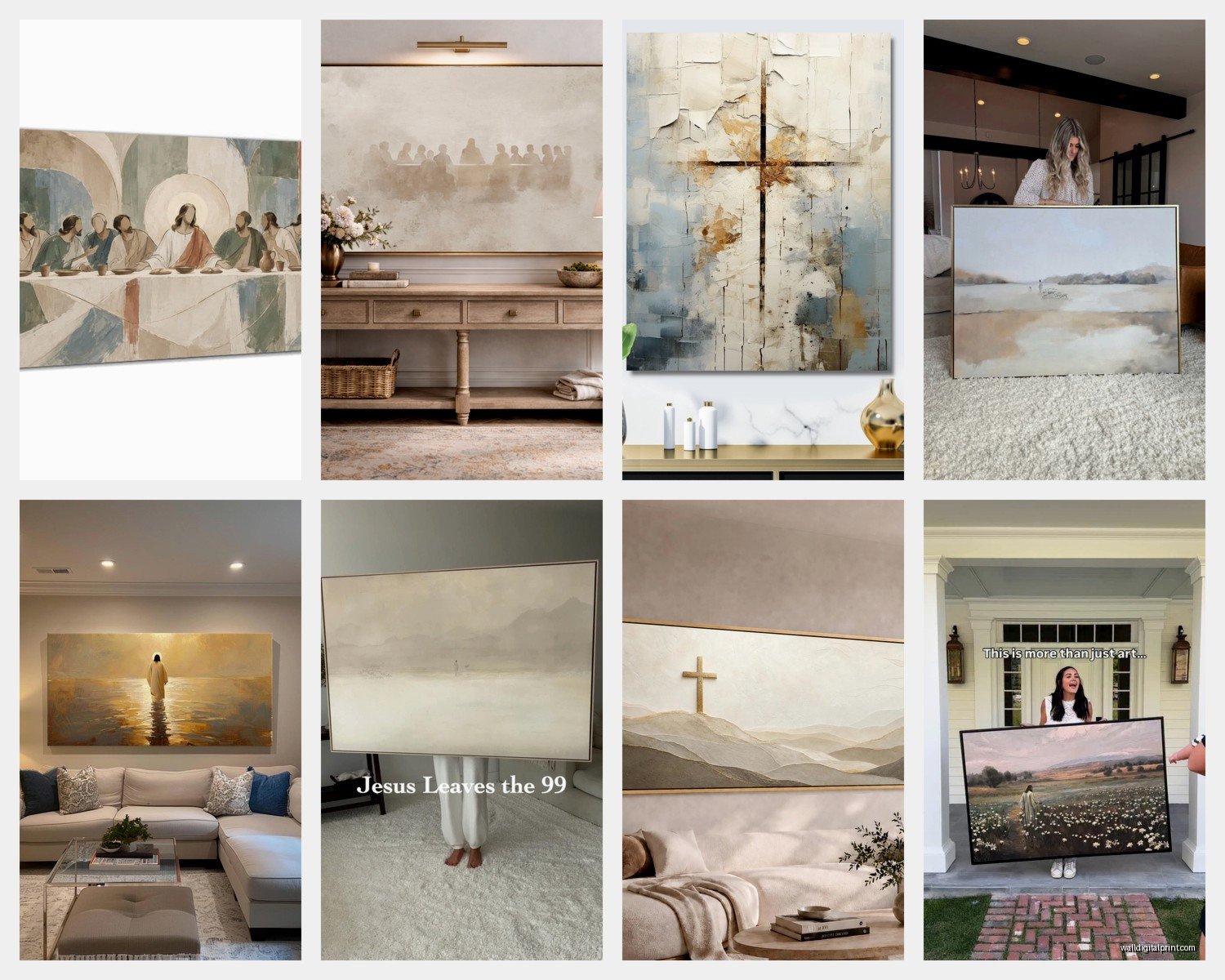
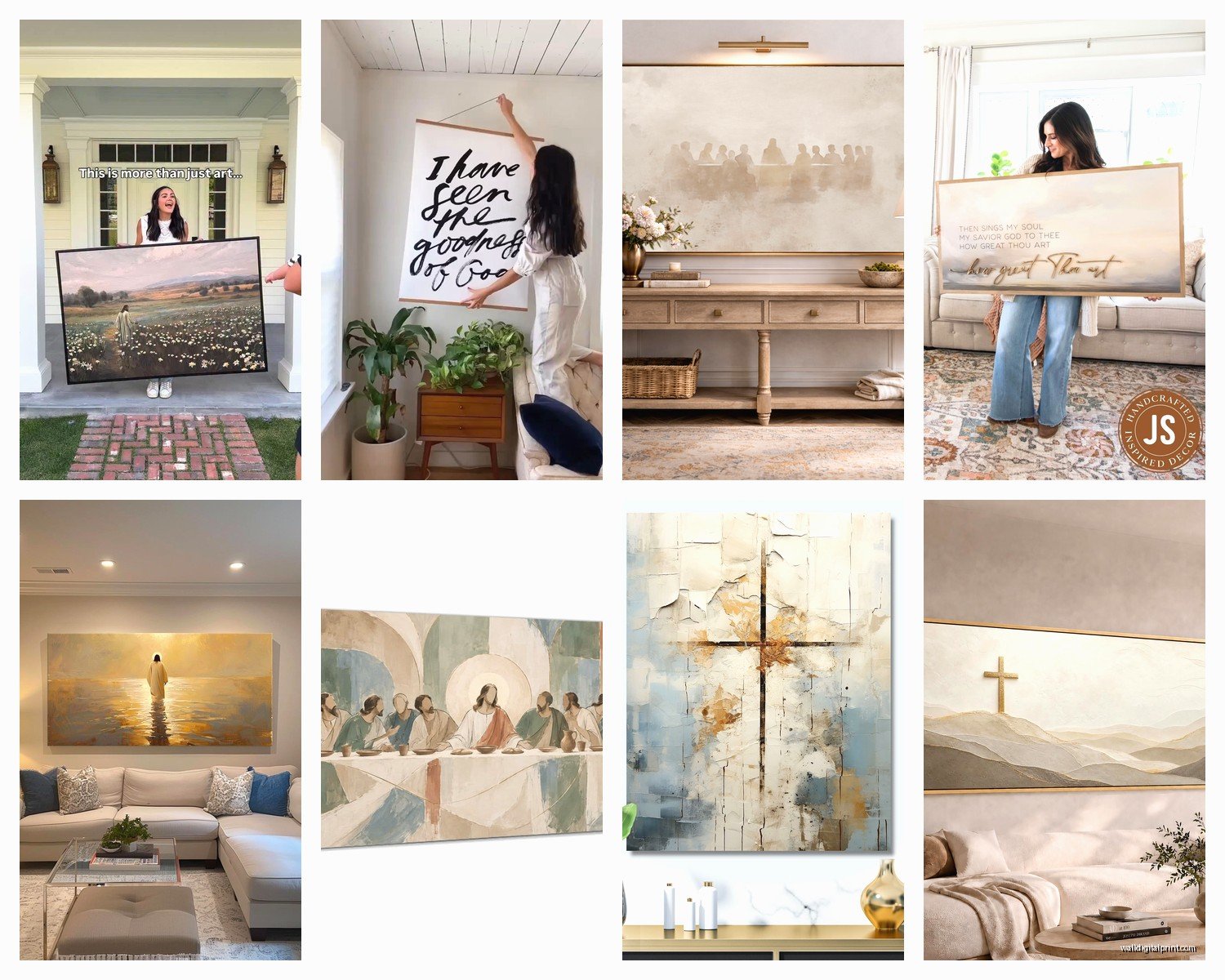
Abstract Christian art is harder to pull off but when it works, it WORKS. Think crosses made from brushstrokes, doves suggested through color and movement, that kind of thing. The problem is a lot of abstract religious art reads as generic hotel art unless the artist really knows what they’re doing. I always tell people – if you have to explain what it represents, it’s not working hard enough.
Landscape scenes with scripture are safe but can feel a bit…expected? Mountains with Psalm 121, beaches with footprints poems (okay technically not scripture but you know what I mean). They’re fine. They’re pretty. They just don’t usually have the impact that a more focused design has. That said, I styled a living room last year with this massive 60×40 photo of an olive grove with “I am the vine” text overlaid and it was actually stunning because the photography was professional quality.
Color Coordination That Doesn’t Make You Crazy
Your oversized art is gonna be a focal point whether you want it to be or not, so it needs to work with your existing color scheme. Here’s what I do – pull 2-3 colors that are already in your living room and make sure they appear somewhere in the artwork.
Black and white Christian art is foolproof. Works with literally everything, never goes out of style, reads as sophisticated. I probably recommend black and white pieces 60% of the time just because they’re so versatile. White background with black text, black background with white text, charcoal sketches of biblical scenes – all good options.
If you’re adding color, warm neutrals (beige, cream, soft brown) with black text is your safest bet. Plays well with most furniture. Navy blue has been really popular lately for Christian wall art and it looks great in traditional or nautical-themed spaces.
Oh and another thing – watch out for those trendy color combos that’ll look dated in two years. That teal and coral combo that was everywhere in 2018? Already looks tired. Stick with classic color combinations unless you’re planning to switch out your art regularly.
Where to Actually Buy This Stuff
Etsy is where I source probably 40% of my Christian wall art. You can find independent artists doing custom sizes, which is crucial for oversized pieces. Search terms that work: “large scripture canvas”, “oversized Bible verse wall art”, “Christian wall decor 48×36” (or whatever size you need). Read the reviews and check if they show photos of the actual product in someone’s home, not just the mockup.
Amazon has more options than you’d think, especially if you need something fast. The quality is hit or miss though. I always check if the seller has multiple product photos from different angles and real customer photos in the reviews. Prime shipping is nice when you’re working on a deadline.
Kirklands and Hobby Lobby have decent in-store selections of large Christian pieces if you wanna see them in person before buying. Hobby Lobby especially – their wall art section is massive and they run 50% off sales constantly. Just don’t pay full price there, wait for the sale.
There are Christian-specific online retailers like DaySpring and Carpentree that do quality oversized pieces. Bit more expensive but the designs are usually more sophisticated than what you find on Amazon. Less of the “Live Laugh Love but make it Jesus” vibe.
Custom Options When Nothing Else Works
Sometimes you’ve got a specific verse or a weird wall size and you just gotta go custom. Shutterfly, Costco Photo Center, and CanvasDiscount all do custom canvas prints where you can upload your own design. If you’re not a designer, hire someone on Fiverr for like $20-30 to create a layout with your verse in a nice font.
I had this client who wanted her grandmother’s handwritten favorite verse turned into wall art and we photographed it, cleaned it up in Photoshop (okay my assistant did, I can barely crop photos), and had it printed at 40×30. Cost maybe $150 total and it’s the most meaningful piece in her house.
Local print shops can do metal, acrylic, or wood prints if you want something beyond basic canvas. Call around and ask to see samples in person because the quality varies wildly.
Installation Stuff Nobody Talks About
Heavy art needs proper hanging hardware, period. Those little sawtooth hangers that come attached to cheap frames? They will fail. I’ve seen it happen mid-dinner party and it’s not cute.
For anything over 20 pounds, use heavy-duty wall anchors if you’re going into drywall. The screw-in anchors that look like giant screws with coarse threads are my go-to. If you can hit a stud, even better – use 2-3 inch wood screws straight into the stud.
Wire hanging systems are worth it for oversized pieces. The wire distributes weight across two hanging points instead of one. Make sure the wire is rated for more weight than your piece actually weighs.
French cleats are the most secure option for really heavy art (over 40 pounds). It’s a two-part system where one piece mounts to the wall and one attaches to the back of your art, and they interlock. Sounds complicated but it’s actually pretty straightforward and you can adjust the positioning easily.
Wait I forgot to mention – if you’re hanging multiple pieces to create a gallery wall effect, lay them out on the floor first. Take a photo from above. Live with that photo on your phone for a day or two and see if you still like the arrangement. I cannot tell you how many times I’ve started hammering nails only to realize the layout looked better in my head than in reality.
Specific Pieces That Work Well Oversized
The Lord’s Prayer in elegant script on a single large canvas – always looks impressive and it’s meaningful without being too on-the-nose.
Large wooden crosses, like 36-48 inches tall, mounted directly to the wall. More dimensional than flat art, casts interesting shadows.
Psalms 23 is probably the most popular verse for oversized art and honestly it works. Long enough to fill space, universally recognized, comforting message for a living room.
Maps of biblical locations done in vintage style. Jerusalem, the Holy Land, Paul’s missionary journeys. These read as sophisticated and educational, not just decorative.
The Beatitudes formatted as a list with beautiful typography. Takes up vertical space nicely if you’ve got a tall narrow wall.
This is gonna sound weird but minimalist line art of praying hands or doves can look really striking when blown up huge. There’s something about the simplicity at large scale that’s impactful.
Mistakes I See All the Time
Hanging art too high – people think higher is better but then it floats near the ceiling and looks disconnected from the furniture.
Choosing art that matches the wall color too closely. You need contrast or it just disappears.
Buying multiple medium pieces when one large piece would’ve looked better. More isn’t always more.
Forgetting about lighting. Oversized art needs either good natural light or dedicated picture lighting to actually be visible at night.
Getting so focused on the message that they ignore whether the design actually looks good. I love Jesus too but that doesn’t mean every scripture verse slapped on a canvas in Papyrus font deserves wall space in my living room.
Anyway, that’s most of what I’ve learned from years of doing this. Start with measurements, pick something that works with your existing style, install it properly, and don’t overthink it. The whole point is to create a space that reflects your faith in a way that feels authentic to you, not to match some Pinterest board perfectly.