
Wall Art Guide, Wall Art Tutoriels
Large Christian Wall Art: Oversized Religious Faith Designs
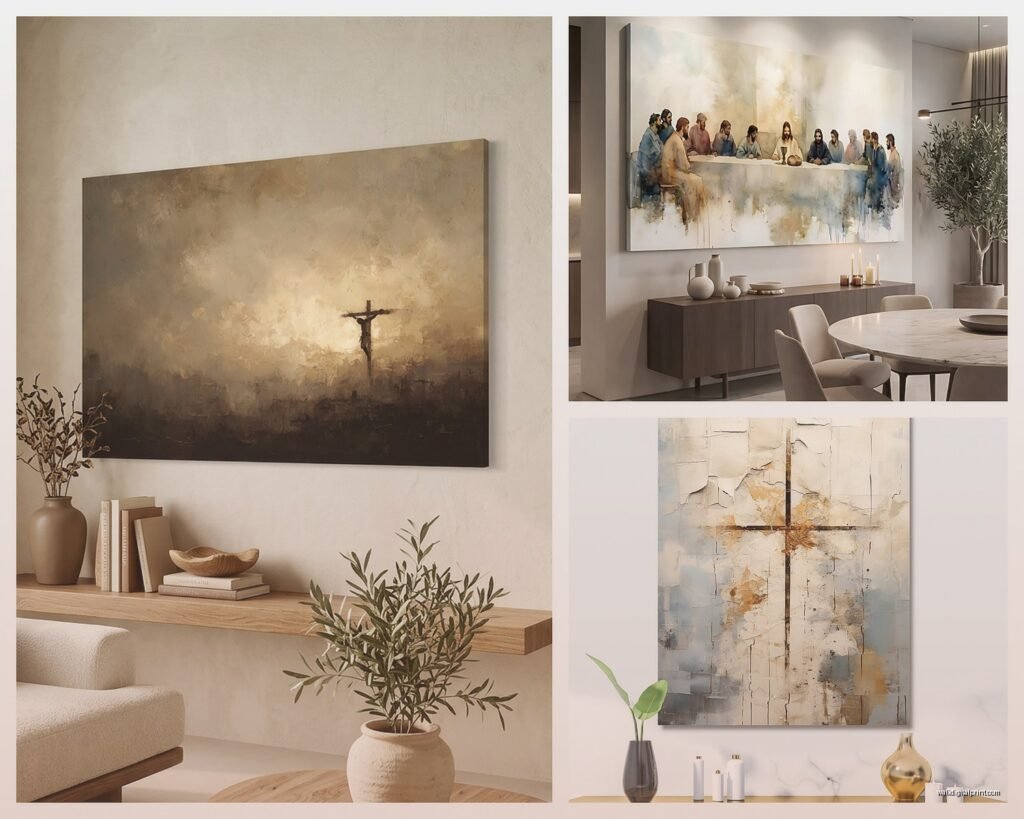
Jul
So I’ve been doing this whole large Christian wall art thing for clients for like three years now and honestly it’s become this whole separate category in my brain because the scale changes EVERYTHING about how you approach it.
Why Size Actually Matters More Than You Think
Okay so first thing – when we’re talking “large” I mean anything over 36 inches in any direction. That’s when it stops being a decorative accent and becomes like, an architectural feature? My client last month wanted this huge cross piece for their living room and kept saying “I want it big” but didn’t realize that big means you’re basically choosing a focal point for the entire room. You can’t just slap a 5-foot canvas anywhere and call it done.
The thing about oversized religious art is it carries this weight – literally and figuratively. I learned this the hard way when I ordered a massive Last Supper reproduction for my own dining room (don’t judge, I was going through a phase) and it arrived and I’m like…where are my studs, do I need anchors rated for what, 40 pounds?
Finding the Right Style Without Looking Like a Church
This is gonna sound weird but the biggest mistake people make is picking art that looks TOO churchy for a home. Like there’s a difference between creating a worship space in your home and making your living room look like a vestibule.
Here’s what actually works:

- Minimalist crosses – just clean lines, maybe wood or metal, oversized but not ornate
- Scripture verses in modern typography – I’m obsessed with the ones that use like, 48-inch letters in a simple sans-serif
- Abstract representations – think symbolism rather than literal depictions
- Vintage-style prints blown up huge – there’s something about aged religious imagery at scale that feels more art gallery than Sunday school
I had this couple who wanted Proverbs 3:5-6 and we did it in this gorgeous charcoal gray on a white-washed wood background, 72 inches wide. It dominated their entryway but in this really sophisticated way? Not like…vacation Bible school vibes at all.
Materials That Don’t Fall Off Your Wall at 2am
Oh and another thing – material choice is HUGE and nobody talks about this enough.
Canvas is everyone’s first thought but here’s the deal – large canvas pieces can look cheap if they’re not done right. The stretched canvas needs to be thick enough (like 1.5 inches minimum) or it just looks like a poster from college. I usually steer people toward gallery-wrapped edges so you don’t need a frame, which saves money you can put into the actual print quality.
Wood signs are having this massive moment right now. The farmhouse aesthetic crossed over into Christian decor and now everyone wants distressed wood with white lettering. They’re lighter than you’d think for their size, which is great for installation. My favorite source does custom cuts up to 8 feet long – absolutely ridiculous but also kinda amazing?
Metal art is where I’ve been leaning lately though. Especially for crosses or geometric designs. It’s durable, it’s got this industrial-modern thing happening, and if you get powder-coated pieces they can handle humidity which matters if you’re thinking bathroom or kitchen placement. Plus metal doesn’t warp, which canvas totally can in the wrong conditions.
The Installation Reality Check
Okay so funny story – I installed a 60-inch metal cross for a client and used regular drywall anchors because I was being lazy and didn’t wanna find studs. Three weeks later I get this panicked call because it’s literally pulling away from the wall. Had to go back, do it properly with toggle bolts into studs, and learned my lesson about taking shortcuts with heavy pieces.
For anything over 30 pounds you absolutely need:
- A stud finder that actually works (not the cheap ones)
- Heavy-duty wall anchors rated for at least 2x the weight
- A level because eyeballing it at this scale makes everything look drunk
- A second person because trying to hold a 5-foot canvas while marking mounting points is how you drop $400 worth of art
Also pro tip – mock it up with paper first. I use painter’s tape and kraft paper to create a template at full size before putting any holes in walls. Sounds extra but I’ve saved myself so many times from realizing something was too big/small/wrong position after already mounting hardware.
Where to Actually Buy This Stuff
So everyone always asks where I source from and honestly it’s all over the place depending on budget and style.
Etsy is like my secret weapon for custom pieces. There are these shops that do personalized scripture art at massive sizes and they’re way cheaper than you’d think. I’m talking $200-300 for something that would cost $800 retail. You gotta vet the reviews though because quality varies wildly. Look for shops that show detail shots and have clear production times.
Hobby Lobby (I know, I know) actually has decent large canvas options when they do their 50% off sales. Their religious section is hit or miss but I’ve found some surprisingly modern pieces. Just avoid anything too glittery or with that weird 3D embellishment thing happening.
wait I forgot to mention – Wayfair has this whole Christian wall art category now and their oversized options have gotten way better. Free shipping over $35 which matters when you’re ordering something 6 feet tall. Returns can be annoying with large items though so really zoom in on those product photos.
For high-end stuff there’s this company called Carpentree that does museum-quality religious art on wood. Not cheap but the craftsmanship is insane. I used them for a lawyer’s office once – needed something impressive and professional and their pieces deliver.
Custom vs. Ready-Made
This is where people get stuck. Custom gives you exactly what you want but you’re looking at 4-6 week lead times minimum and prices start around $300 for anything truly large. Ready-made you can have it next week but you’re limited to what exists.
My general rule – go custom if you have a specific verse or design in mind that you can’t find anywhere. Go ready-made if you’re flexible and want it done faster. I’ve done both and honestly? Some of my favorite installations have been ready-made pieces that just happened to be perfect.
Making It Work in Different Rooms
Living rooms are the obvious choice but lemme tell you where large Christian art actually makes the biggest impact – dining rooms. Something about gathering space and breaking bread and all that…a huge scripture piece about gratitude or fellowship just WORKS there. Plus dining rooms often have that one big empty wall that’s begging for something substantial.
Bedrooms are tricky with oversized pieces. You don’t want something so visually heavy that it disrupts sleep vibes? I usually go more subtle here – maybe a large minimalist cross or a single word like “Grace” or “Peace” in huge letters. My own bedroom has this 48-inch “Be Still” piece and it’s calming without being overwhelming.
Entryways and hallways are actually perfect for tall vertical pieces. Nobody really talks about this but a 6-foot vertical canvas or wood sign in an entryway makes a statement without taking up floor space. I did a narrow 18×72 inch piece with Psalm 23 for a client’s hallway and it totally transformed the space.
Color Considerations at Scale
This is gonna sound obvious but bright colors become REALLY bright when they’re huge. That red cross that looked bold in the 12×12 thumbnail? At 48 inches it’s gonna dominate everything in the room.
I’ve learned to push people toward:
- Neutrals with one accent color max
- Black and white which feels classic and doesn’t compete with existing decor
- Natural wood tones that warm up a space without screaming
- Soft grays and taupes for something modern but not cold
The only time I go bold with color on large pieces is when the room is super neutral to begin with. Like all-white walls, minimal furniture – then yeah, a navy blue scripture piece or a rust-colored cross can be that perfect pop.
The Multi-Panel Option Nobody Thinks About
Oh and another thing – instead of one massive piece, consider a multi-panel setup. Like three 24×36 panels that together create one large display. It’s easier to hang (smaller individual pieces), easier to level, and you can play with spacing to customize the overall dimensions.
I did this with the Beatitudes once – each blessing on its own panel, nine panels total creating this huge grid. Way more visual interest than one solid piece would’ve been. Plus if you move you can reconfigure the layout for a different wall size.
Lighting Makes or Breaks It
Something I wish I’d known earlier – large art needs proper lighting or it just becomes this dark void on your wall. Especially with darker pieces or anything behind glass that creates glare.
Picture lights are the move for really special pieces. Yeah they’re an extra expense but mounting a light directly above a large canvas makes it look gallery-quality. There are battery-operated ones now so you don’t even need an outlet nearby.
Track lighting works if you’re doing a whole wall of art. And honestly just a well-placed floor lamp can do wonders if you angle it right. My cat knocked over my picture light last year (Mochi is a menace) and I temporarily used a floor lamp aimed at my entryway cross and it actually looked pretty good.
Budget Real Talk
Okay so let’s talk money because this stuff can get expensive fast. A quality large-format Christian art piece ranges from like $150 on the low end to $2000+ for custom or gallery pieces.
Here’s where you can save money:
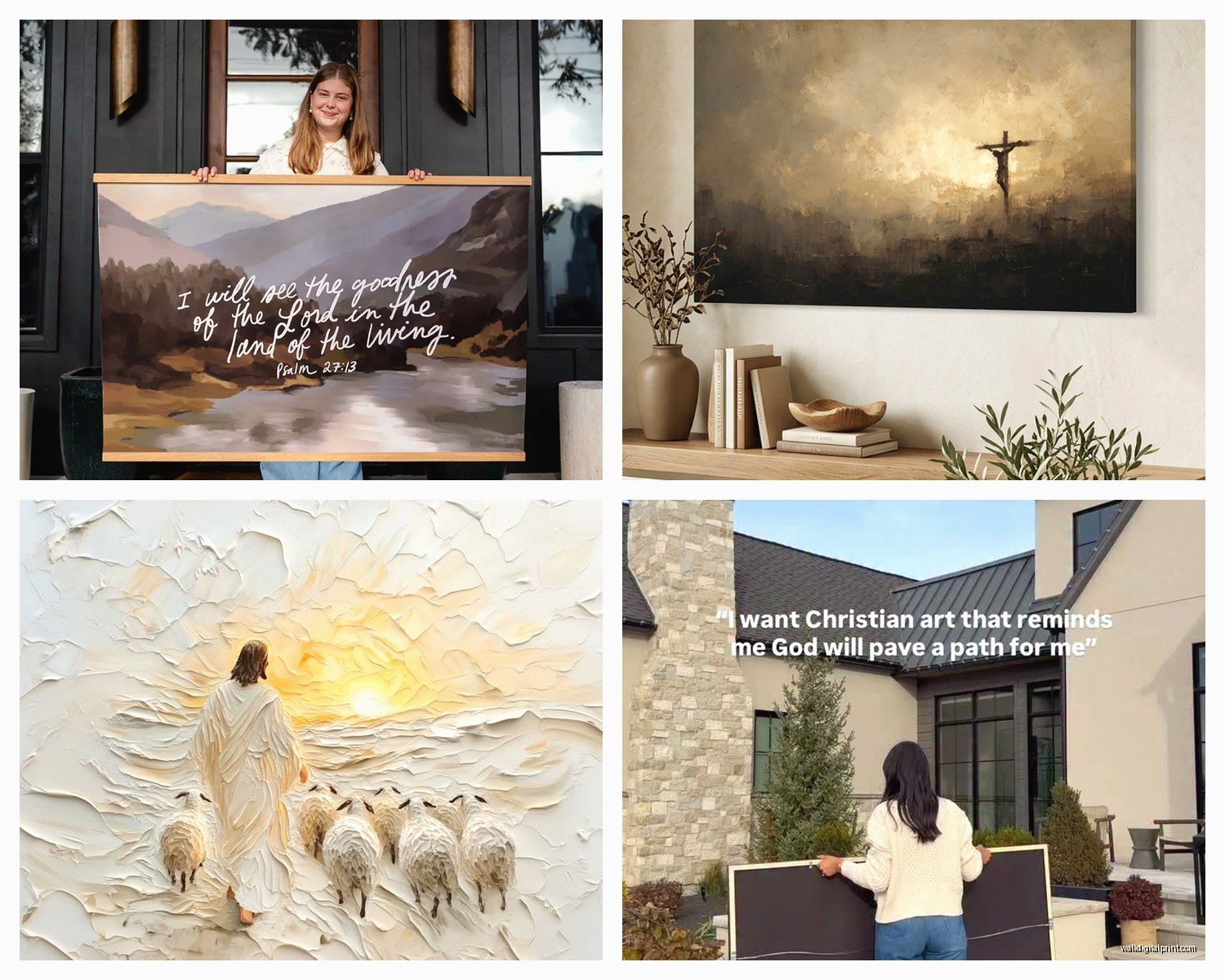
- Buy during sales – Christian bookstores do massive sales around Easter and Christmas
- Check Facebook Marketplace – people move and can’t take their oversized art, I’ve found incredible deals
- DIY if you’re crafty – get a large canvas from Michaels, paint it a base color, use vinyl letters for scripture
- Go with prints instead of original art – obvious but a high-quality print of a famous religious painting is way cheaper than commissioned work
The one place I don’t recommend cheating is installation hardware. Spending $30 on proper mounting equipment is worth it to protect your $300 art piece.
Maintenance Nobody Warns You About
Large pieces collect dust like crazy. Canvas especially. I dust mine monthly with a microfiber cloth and do a deeper clean twice a year. Wood pieces need occasional conditioning if they’re in direct sunlight – learned that when my dining room piece started looking dried out.
Metal is the easiest – just wipe it down. Glass-covered pieces need glass cleaner obviously but watch out for streaks at this scale because they’re super noticeable.
And please for the love of all things holy don’t hang anything valuable in direct harsh sunlight. UV damage is real and watching a beautiful piece fade over a year because it’s in a south-facing window with no treatment is just sad.
When It’s Too Much
Real talk – sometimes people go too big and it’s just…wrong. If your art is wider than your couch, it’s probably too big for over the couch. If it touches the ceiling or floor when mounted at eye level, reconsider. If you have to stand across the room to see the whole thing comfortably, maybe size down.
I had to talk a client out of an 8-foot cross for their small living room last month and it was awkward but necessary. Scale matters and sometimes the piece you love is just not right for your space. Better to find something that fits properly than force something that overwhelms the room.
But when you get it right? When that perfect oversized piece clicks into place and suddenly the whole room makes sense and feels intentional and worshipful without being over the top? That’s the good stuff right there. That’s why I keep doing this even when clients change their minds seventeen times about which verse they want.
