Wall Art Guide, Wall Art Tutoriels
Large Scale Wall Art: Grand Oversized Monumental Pieces

Aug
So I’ve been obsessing over large scale wall art lately because honestly, nothing transforms a space quite like one massive piece instead of a gallery wall of tiny frames, and I gotta tell you what I’ve learned from totally screwing up my first few attempts.
Why Size Actually Matters More Than You Think
Okay so here’s the thing nobody tells you – most people go way too small. Like I had this client last month who bought what she thought was a “large” piece and it was 30×40 inches for a wall that was literally 12 feet wide and it looked like a postage stamp. The rule I use now is measure your wall width and go for art that’s at least 2/3 to 3/4 of that width. So if you’ve got an 8-foot wall, you’re looking at something in the 5-6 foot range minimum.
I learned this the hard way in my own living room where I hung a 36-inch piece above my sofa and my sister came over and was like “is that temporary?” which… ouch but she wasn’t wrong.
The Actual Measurements That Work
For above a sofa or console table, you want the art to be roughly 2/3 the width of the furniture piece. Above a king bed, I usually go for something 60-70 inches wide. Dining rooms can handle truly massive pieces – like 6-8 feet wide – because there’s usually lots of wall space and you’re viewing from a distance.
Oh and another thing, consider your ceiling height. Standard 8-foot ceilings can handle art up to about 60 inches tall before it starts feeling overwhelming. But if you’ve got 10-12 foot ceilings, you can go absolutely wild. I have one client with a 9-foot tall piece in her entryway and it’s stunning.
What to Actually Buy and Where
This is gonna sound weird but I’ve found my best oversized pieces in the most random places. Yes, there’s the obvious – Artfully Walls, Minted, Saatchi Art – but hear me out on some alternatives.
Canvas Prints
I use CanvasPop and Printique a lot. You upload your own image or buy from their artists, and they’ll print it massive. Like genuinely huge. I did an 80×60 inch abstract piece for $600 which is insane compared to what galleries charge. The quality is solid if you go with their premium options. Just make sure your image resolution is high enough – they’ll tell you if it’s gonna look pixelated.
Original Art from Actual Artists
Okay so Saatchi Art is where I’ve bought probably six pieces now. You can filter by size which is amazing, and I’ve gotten 72-inch pieces for under $2000. The shipping is usually included which matters because shipping large art is stupidly expensive otherwise. I bought this incredible abstract piece last year from an artist in Portland and the whole transaction was smooth.
Artsy is more high-end but if you’re willing to spend $5k-15k, the curation is really good. Just be prepared for gallery-level pricing.
The Budget Options That Don’t Look Budget
Wait I forgot to mention – IKEA actually has some surprisingly large pieces now. Their PJÄTTERYD series goes up to 78 inches and costs like $200. It’s printed on canvas with a frame backing. Does it look like fine art? No. Does it fill a wall beautifully if you choose the right image? Absolutely.
Society6 lets you print designs on huge canvases. Quality is hit or miss depending on the artist’s file resolution, but I’ve had good luck with their larger pieces. Just read the reviews for that specific print.
Target’s Project 62 line sometimes has oversized options. I grabbed a 60×40 inch piece there for $180 that’s still hanging in my guest room three years later.
The Installation Part That Everyone Underestimates
This is where I see people panic and honestly, valid. A 6-foot canvas is heavy and awkward and you will need help.
Hanging Hardware That Won’t Fail You
Forget those little sawtooth hangers. For anything over 30 pounds, I use heavy-duty D-rings or wire hanging systems. My go-to is installing two D-rings about 1/3 down from the top of the frame, then using braided wire rated for way more than the actual weight.
For really massive pieces – like over 50 pounds – I’ve started using French cleats. They’re these interlocking pieces where one mounts to the wall and one to the art. Super secure and you can adjust positioning more easily. You can buy them at hardware stores or make them yourself if you’re handy.
Finding the Studs (This Sounds Basic But)
Use an actual stud finder, not the knock-on-the-wall method. Large art needs to go into studs, period. If your studs don’t line up with where you want the art, you’ll need to use a mounting board or toggle bolts rated for drywall. I use Toggler SnapToggle bolts and they’ve never failed me, but honestly studs are better if possible.
My cat knocked over my stud finder last week so I had to borrow my neighbor’s and it reminded me I should probably buy a backup because these things disappear constantly.
Framing Large Pieces Without Going Broke
Custom framing for oversized art is where your budget goes to die. I’m talking $800-2000 for a single frame. So here’s what actually works.
Canvas Wraps Don’t Need Frames
Gallery-wrapped canvas (where the image continues around the edges) looks completely fine unframed. I actually prefer this look for modern and contemporary pieces. Just make sure the sides are finished nicely when you order.
DIY Frame Kits
American Frame sells sectional frames where you buy the sides separately and assemble them. For a 60×40 inch piece, you’re looking at maybe $200-400 versus $1500 custom. The quality is legit good – I’ve used them probably a dozen times.
Framebridge goes up to 60 inches and includes shipping both ways. You send them your art, they frame it, send it back. Usually around $400-700 for large pieces which is reasonable.
The Floating Frame Trick
For canvas pieces, those floating frames from Amazon (yes really) work great. Brands like US Art Supply make them in large sizes. They’re basically a wooden frame that sits slightly behind the canvas creating a shadow gap. Looks expensive, costs like $60-150 depending on size.
Choosing What Actually Works in Your Space
Okay so funny story – I once bought this gorgeous 6-foot abstract painting with tons of navy blue and then got it home and realized my entire room was warm-toned with terracotta and it looked absolutely terrible. Returned it and learned to actually think about color first.
Color Coordination Without Being Boring
You don’t need to match your art to your throw pillows like some matchy-matchy catalog, but there should be some color relationship. I usually pull 1-2 colors from the room and make sure they appear somewhere in the piece. Or I go the opposite route – use the art to introduce a completely new accent color and then echo it elsewhere in small doses.
Black and white or neutral art is the safe choice and honestly sometimes that’s the right move, especially if your room already has a lot going on.
Style and Subject Matter
Large scale florals can be gorgeous but they read very traditional. Abstracts work in basically any space. Landscapes need the right room – they can feel dated if you’re not careful with the style.
Photography blown up huge is having a moment. I did a 72-inch black and white architectural shot in a minimalist dining room last month and it’s *chef’s kiss*.
Textural pieces – think thick paint, mixed media, anything with dimension – add so much interest when they’re large. The texture becomes part of the impact.
Making It Work With Your Actual Life
Nobody talks about the practical stuff like how do you clean a 6-foot canvas (very gently with a microfiber cloth, don’t use any cleaners) or what happens when you move (I’ve moved three times with large art and it’s a whole thing – keep the original packaging if possible, otherwise invest in corner protectors and lots of bubble wrap).
Placement Height
The center of the artwork should be at eye level, which is typically 57-60 inches from the floor. But for really tall pieces, this might mean the top is way up there. That’s fine. What looks weird is when large art is hung too high – it floats away from the furniture and feels disconnected.
If you’re hanging above furniture, leave 6-12 inches between the furniture and the bottom of the frame. More than 12 inches and it starts looking like they’re not related to each other.
Lighting Considerations
Large art needs proper lighting or it just becomes a dark blob on your wall, especially in the evening. I use picture lights for some pieces – the LED ones from Cocoweb are pricey but they’re dimmable and don’t get hot. Track lighting or adjustable can lights work too if you’re doing a remodel anyway.
Avoid direct sunlight on any art you care about. UV rays will fade it over time. I learned this when a print I loved got noticeably lighter on one side after two years near a west-facing window.
What to Avoid (Lessons from My Mistakes)
Don’t buy art online without checking the return policy. Shipping large pieces back is expensive and sometimes not even possible.
Don’t hang large art in a room where the scale is wrong. Like a 6-foot piece in a tiny powder room is gonna feel oppressive. I know there are no rules in design but trust me on this one.
Don’t cheap out on hanging hardware. A $15 difference in wall anchors is not worth your art crashing down at 3am.
And honestly don’t overthink it to the point where you never actually buy anything. I have this problem where I’ll compare options for weeks and then the piece I wanted sells. Sometimes you just gotta commit.
The Actually Affordable Route
If you’re working with a tight budget, here’s what I’d do: Find a high-resolution image you love – could be your own photography, something from Unsplash (check the license), or buy a digital download from Etsy for like $10-30. Then upload it to a print-on-demand service. I’ve used Nations Photo Lab and Mpix for this and gotten 60-inch prints for under $200 including shipping.
Frame it yourself with those sectional kits I mentioned, or just mount it on foam board for a temporary solution while you save for proper framing.
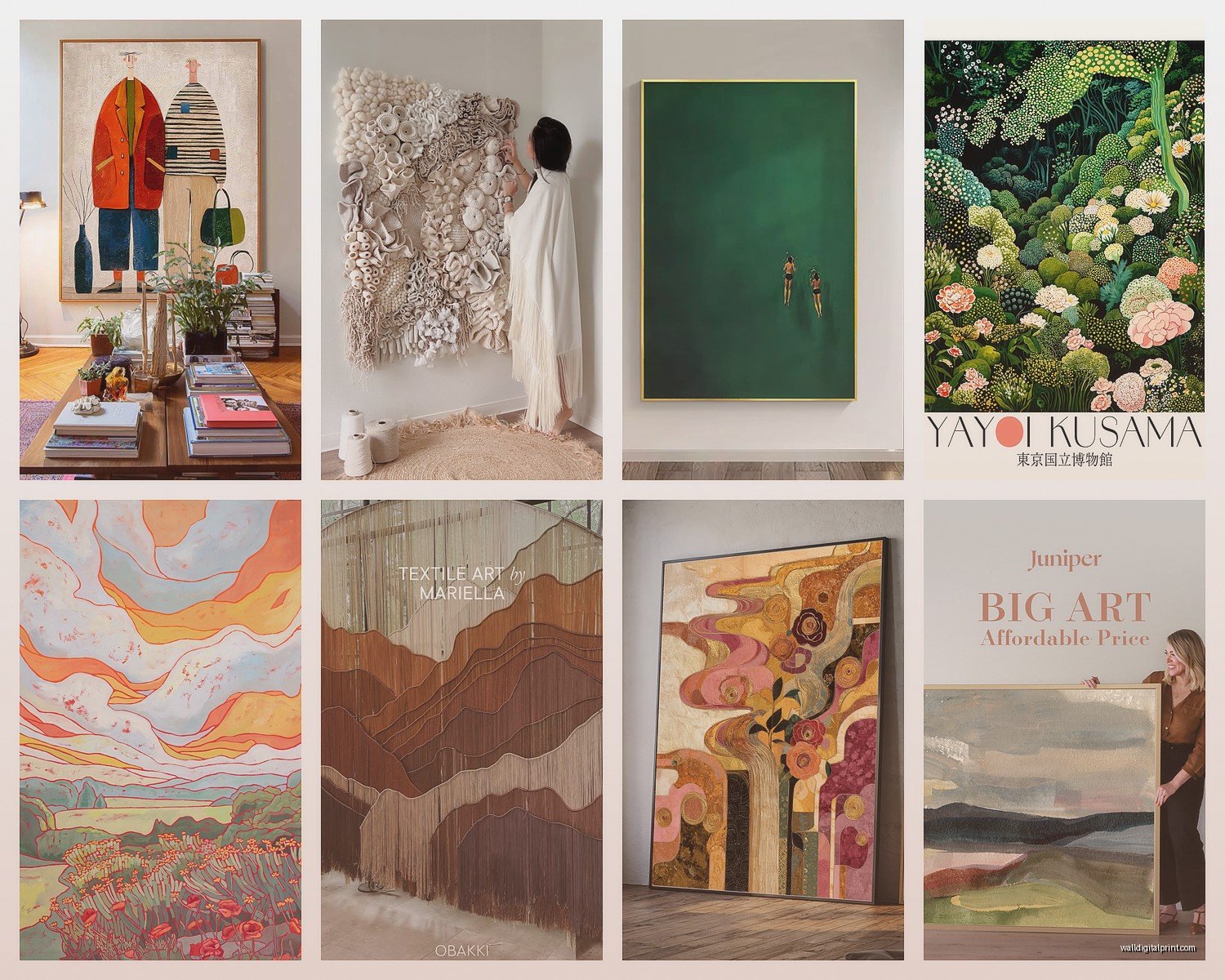
Another option is textile art – huge tapestries or woven pieces. Society6 and Deny Designs do these in massive sizes for $150-300. They’re lightweight which makes hanging easier, and they add texture and warmth.
Oh and thrift stores occasionally have large art. It’s rare but I’ve found a few gems. Estate sales too, especially in older homes where people had the wall space and actually used it.
Just keep measuring everything twice because returning a 72-inch canvas is nobody’s idea of a good time, and make sure you’ve got someone to help with installation because I tried to hang a 60-inch piece by myself once and nearly put it through the drywall.