Wall Art Guide, Wall Art Tutoriels
Pink and Orange Wall Art: Warm Sunset Tropical Combo
Mar
So I’ve been working with pink and orange wall art for like three years now and honestly it’s one of those combos that either makes a room feel like a vacation or like… a child’s birthday party went wrong, there’s really no middle ground here.
The thing about pink and orange together is they’re both warm but they fight each other if you don’t get the ratios right. I learned this the hard way when I bought this massive abstract piece for a client’s living room and it just screamed at everything else in the space. Had to return it, which was a whole thing because the gallery owner gave me this look like I didn’t know what I was doing.
Getting the Temperature Right First
Okay so here’s what actually matters—you gotta figure out if you want coral-leaning or tropical-leaning because those are your two main directions. Coral is when your pink has more salmon in it and your orange is softer, almost peachy. Tropical is when you go full hot pink with tangerine orange. I keep swatches of both palettes in my phone now because clients will send me pictures and ask which category something falls into.
For coral vibes you want:
- Blush pink to salmon pink range
- Peach, apricot, or muted tangerine for your orange
- Cream or soft white backgrounds work better than stark white
- Gold or natural wood frames, skip black frames entirely
For tropical vibes:
- Hot pink, magenta, or fuchsia
- True orange, mandarin, or even red-orange
- White backgrounds are fine, actually work better
- White frames, natural wood, or even lucite if you’re feeling it
The coral direction is way easier to live with long-term. I put tropical pink-orange in my own apartment once and had to change it out after like eight months because it was just… too much energy? But my friend Sarah has had a tropical palm leaf print in hot pink and orange in her bedroom for two years and loves it, so maybe I’m just getting old.
Size and Placement Strategy
This is gonna sound weird but pink and orange art needs more breathing room than other color combos. I don’t know why exactly but I think it’s because they’re both so warm that they radiate outward more? Anyway, if you’re doing a gallery wall, space things at least 3-4 inches apart instead of the usual 2-3.
For a single statement piece, here’s what I’ve found actually works:
- Over a sofa: go at least 2/3 the width of the sofa, but with pink and orange I actually prefer going bigger, like 3/4 width
- In a bedroom: don’t put it directly over the bed unless you want to dream in those colors, I’m serious, put it on the wall opposite or adjacent
- Dining room: this combo is amazing here because it makes people feel hungry and social, there’s studies on this
- Bathrooms: smaller prints work great, especially if you have white fixtures
I had a client who insisted on putting a huge pink and orange sunset photograph above their bed and then complained about feeling restless at night. Moved it to above their dresser on the opposite wall and suddenly no problem. Colors affect your nervous system more than people think.
What to Actually Buy
Okay so you’re probably wondering about specific types of art. Let me break down what I’ve tested that actually looks good and doesn’t read as cheap:
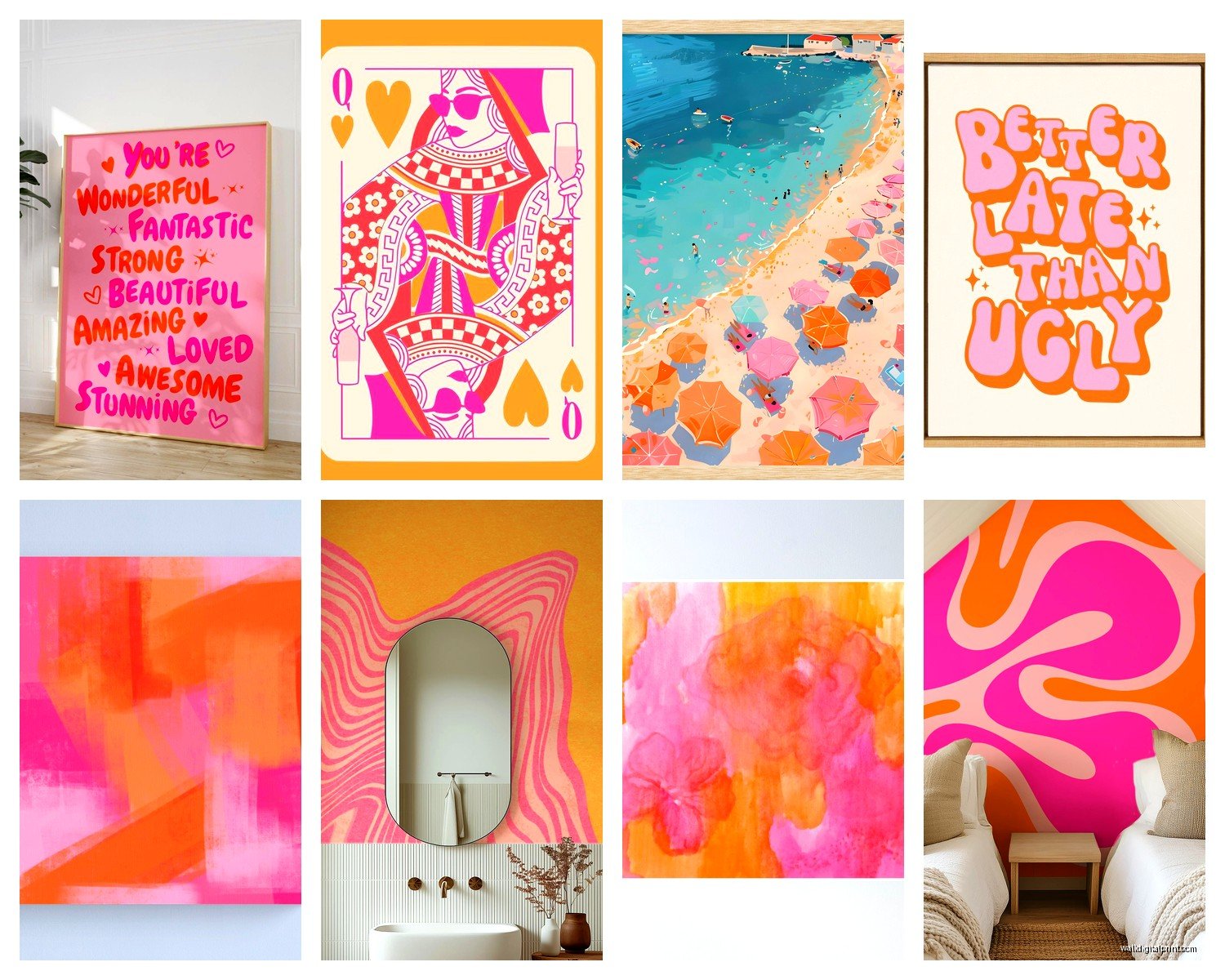
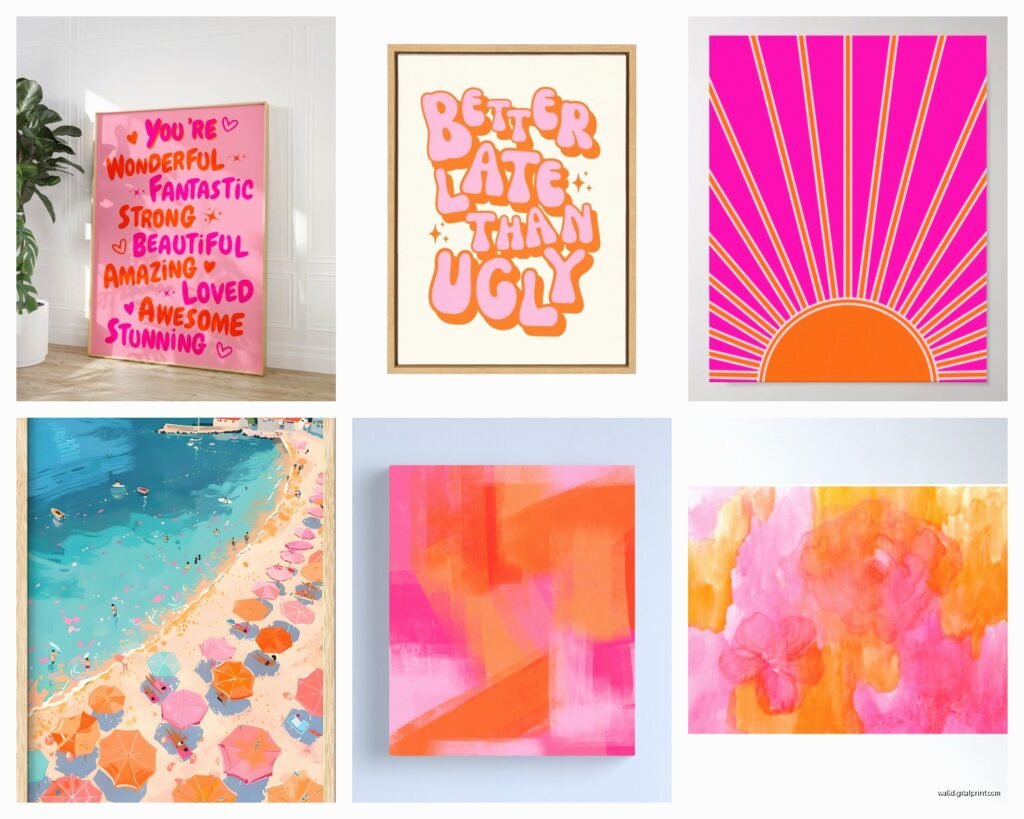
Abstract sunsets are the obvious choice but they can be really hit or miss. Look for ones where the colors blend into each other rather than sitting in distinct blocks. The gradient effect is what makes it feel expensive. I found this one print on Etsy last month that had like seven shades transitioning from coral to orange to pink and it looked custom even though it was $40.
Tropical leaves and florals work if you keep the actual imagery simple. Palm fronds in a pink-to-orange gradient? Yes. Complicated hibiscus flowers with a million details? Gonna look busy and dated in a year. The simpler the silhouette the better.
Line art in these colors is having a moment right now. Single-line drawings of faces, bodies, landscapes but printed in pink and orange instead of black. These are great because the colors don’t overwhelm since there’s so much negative space.
Photography is tricky because you need actual sunset shots or citrus close-ups or something that naturally contains these colors. Don’t buy a regular photo that’s been filtered to pink and orange, it always looks artificial. I saw someone try to pass off a pink-filtered photo of Venice as “tropical themed” and it just looked wrong.
wait I forgot to mention—vintage travel posters in these colors are actually amazing if you can find them. There were all these mid-century posters for Miami and California that used coral and orange and they have this cool retro vibe that makes the color combo feel intentional instead of trendy.
The Frame Situation
This matters more than you think. I’ve seen great art completely ruined by the wrong frame.
Natural wood frames are your safest bet. Light oak, maple, or bamboo all work. They warm up the colors without competing. I bought a set of three matching bamboo frames from Target for like $25 each and they make even cheap prints look curated.
White frames work for tropical-leaning art but can make coral-leaning stuff look washed out. If you’re going white, make sure it’s a warm white, not cool/blue white.
Black frames? No. Just no. They’re too harsh against these colors and create this jarring contrast that pulls focus away from the art itself. I’ve tried to make it work so many times and it never does.
Gold frames can work but only if they’re the right gold—you want brushed or matte gold, not shiny brass. And only for coral-leaning pieces, never tropical.
Oh and another thing, if you’re doing a gallery wall with multiple pieces, you don’t have to match the frames exactly but keep them in the same finish family. All natural woods in different tones looks intentional, mixing gold and white and black looks like you grabbed random stuff from different rooms.
Balancing with Your Existing Space
Okay so you probably already have furniture and stuff and you’re wondering if pink and orange art will work. Here’s my quick compatibility guide based on what I’ve actually seen work:
Gray walls or furniture: Perfect, actually. Gray neutralizes the warmth and makes the art pop without overwhelming. This is probably the easiest combo.
Beige/cream/tan: Works great with coral-leaning art, can feel too warm with tropical unless you have some cool-toned accessories to balance it.
Navy or dark blue: Amazing contrast, this is like a designer secret. The cool blue makes the warm colors feel more sophisticated.
Green: Depends on the green. Sage green? Yes. Dark forest green? Yes. Bright grass green? Absolutely not, it’ll fight.
White everything: You can go either direction but tropical probably looks better since it creates a stronger contrast.
Lots of wood tones: Coral-leaning is better here, tropical can feel disjointed.
I had this situation last month where a client had this gorgeous charcoal gray sectional and cream walls and we added three pink-orange abstract prints and it completely transformed the room from boring to interesting without being weird about it. Sometimes I send her pictures of her own living room because it turned out so good.
The Third Color Rule
This is something I figured out kind of by accident but it’s been a game-changer. Pink and orange art almost always needs a third color in the room to anchor it. Not in the art itself necessarily, but somewhere in the space.
Best anchoring colors:
- White (duh, but it counts)
- Cream or ivory
- Sage green or eucalyptus
- Teal or turquoise (surprisingly good)
- Warm gray or greige
- Natural tan or camel
What doesn’t work as an anchor:
- Red or burgundy (too much warm)
- Purple (fights with pink)
- Yellow (overwhelms the orange)
- Brown that’s too dark or red-toned
The anchor color should take up more visual space than the pink and orange combined. So if your art is pink and orange, your sofa, rug, or walls should be the anchor color. This keeps the warm colors from taking over.
Lighting Makes or Breaks It
Okay this is probably the most important thing I’ll tell you—you gotta think about your lighting before you commit to pink and orange art. These colors change dramatically based on light.
In natural daylight they look vibrant and energizing. In warm incandescent light they can get muddy or too orange. In cool LED light they can look harsh or artificial.
My apartment gets amazing afternoon light so the pink-orange art I had looked incredible from like 3-6pm but then at night with my lamps it looked completely different, kind of flat? I ended up switching to daylight LED bulbs and it helped a lot.
If your room has northern exposure (cooler light), go for pieces with more pink than orange. Southern exposure (warmer light), balance them equally or lean more orange. East or west exposure, you’re gonna see both versions depending on time of day so pick pieces that look good in both.
Picture lights or accent lighting can really help if you’re serious about making the art look good. I installed two small LED picture lights above a client’s pink-orange triptych and it completely changed how the colors read, made them glow instead of just sit there.
Mixing Patterns and Textures
So like you might have other stuff going on in the room—patterned pillows, textured throws, whatever. Here’s what I’ve learned about mixing:
Keep patterns in the rest of the room simple if your art is busy. If you have a detailed floral print in pink and orange, your pillows should be solid colors or subtle textures.
If your art is simple (like a color block or minimal line drawing), you can go more bold with patterns elsewhere. Geometric pillows, textured rugs, whatever.
Metallics work surprisingly well with this color combo. Copper especially, but also rose gold and brushed brass. I found these copper planters at HomeGoods that I put in every room that has pink-orange art now.
My cat knocked over one of those planters last week and broke it so now I’m down to three but anyway—
Textures like linen, cotton, jute, and natural fibers all complement pink and orange better than synthetic or shiny materials. Something about the organic texture makes the colors feel more sophisticated.
Common Mistakes I See All the Time
Going too matchy-matchy with accessories. If your art has pink and orange, you don’t need pink and orange pillows and pink and orange vases and pink and orange everything. Pick one accent color from the art and use that sparingly in accessories.
Putting pink-orange art in rooms with cool-toned color schemes. It just fights. Unless that’s specifically the look you want (contrast can be cool), it usually just feels off.
Buying art that’s too small. These colors need scale to work properly. A tiny 8×10 pink and orange print on a big wall just looks sad and lost.
Not considering the undertones. Some pinks have blue undertones, some have yellow. Same with orange. If your pink is cool-toned and your orange is warm-toned they’re gonna fight even though they’re technically the same color family.
Changing your mind too quickly. I’ve definitely bought art, hung it up, decided I hated it within 24 hours, and then two weeks later realized it was actually perfect. Give it at least a week before you decide it doesn’t work.
Budget Options That Don’t Look Cheap
You don’t need to spend a fortune to make this work. Here’s where I actually shop:
Etsy for digital downloads that I print at FedEx or Costco (way cheaper than buying prints)
Society6 when they have sales, which is like constantly
Target’s Opalhouse line has some good options
HomeGoods if you’re patient and check regularly
Even Amazon has decent options if you read reviews carefully
I found three abstract prints on Etsy for $12 each, printed them at Costco for $15 each, got frames at Michael’s with a 40% off coupon for $20 each, so like $140 total for a three-piece gallery wall that everyone thinks I spent way more on.
The trick is getting high-resolution files if you’re printing yourself. At least 300 DPI, bigger is better. A blurry print in beautiful colors is still a blurry print.
Oh and funny story, I was watching The Great British Baking Show while I was arranging that gallery wall and I had to pause it like six times to step back and look at the spacing. Paul Hollywood was judging somebody’s showstopper and I was judging my own wall arrangement.
Seasonal Considerations
One thing I’ve noticed is pink and orange art can feel different depending on the season. In summer it feels perfect and beachy and right. In winter it can feel… I dunno, like you’re trying too hard to pretend it’s not cold outside?
Some people swap their art seasonally and some think that’s ridiculous. I’m somewhere in the middle. I have one client who rotates to cooler-toned art in winter and warm tones in summer. I have another who keeps her pink-orange sunset photo up year-round and just changes her pillows and throws seasonally.
If you want to keep it up year-round, lean more coral than tropical. The softer tones work better in winter months. And maybe add some warmer textures around it—chunky knit throws, velvet pillows, stuff that makes the space feel cozy even with the summery colors.
I personally keep my coral-pink and peach artwork up all year but I have a bright tropical piece that I only display May through September. It just feels right that way.
The sunset combo really does work though, like if you get the balance right it adds this warmth and energy that’s hard to get with other color combinations. Just gotta actually think about your specific space instead of buying something because it looked good in someone’s Instagram photo.