
Wall Art Guide, Wall Art Tutoriels
Large Wall Art for Bedroom: Oversized Sleep Space Decor
May
So I’ve been obsessing over large wall art for bedrooms lately because honestly, it’s the one thing that can make your sleep space look like you actually tried without doing a complete renovation. Like last month I helped my sister pick out this massive canvas for above her bed and the transformation was ridiculous.
Here’s what I’ve learned from way too many hours staring at walls and measuring things with my tape measure while my dog judges me from the doorway.
Size Actually Matters More Than You Think
Okay so the biggest mistake I see—and I made this myself in my guest room—is going too small. If you’re putting art above your bed, you want it to be at least two-thirds the width of your headboard. I know that sounds huge but trust me. Anything smaller just looks like it’s floating awkwardly and you’ll always feel like something’s off.
For a king bed, you’re looking at something around 60-70 inches wide minimum. Queen bed, aim for 50-60 inches. And yeah, these dimensions scared me at first too because walking into a frame shop and pointing at something that size feels insane.
But here’s the thing—your bedroom wall is probably bigger than you think when it’s empty. Our brains are weird about scale. What looks massive leaning against the wall at the store will look totally normal once it’s up.
I actually use painter’s tape to map out the size on the wall before buying. Sounds dorky but it saved me from returning a $400 piece that would’ve been too small. Just stick the tape up in the dimensions you’re considering and live with it for a day or two.
What Type of Art Actually Works
This is where it gets fun because bedroom art is different from like, living room art. You’re gonna be staring at this thing before you fall asleep and when you wake up, so it needs to not be chaotic.
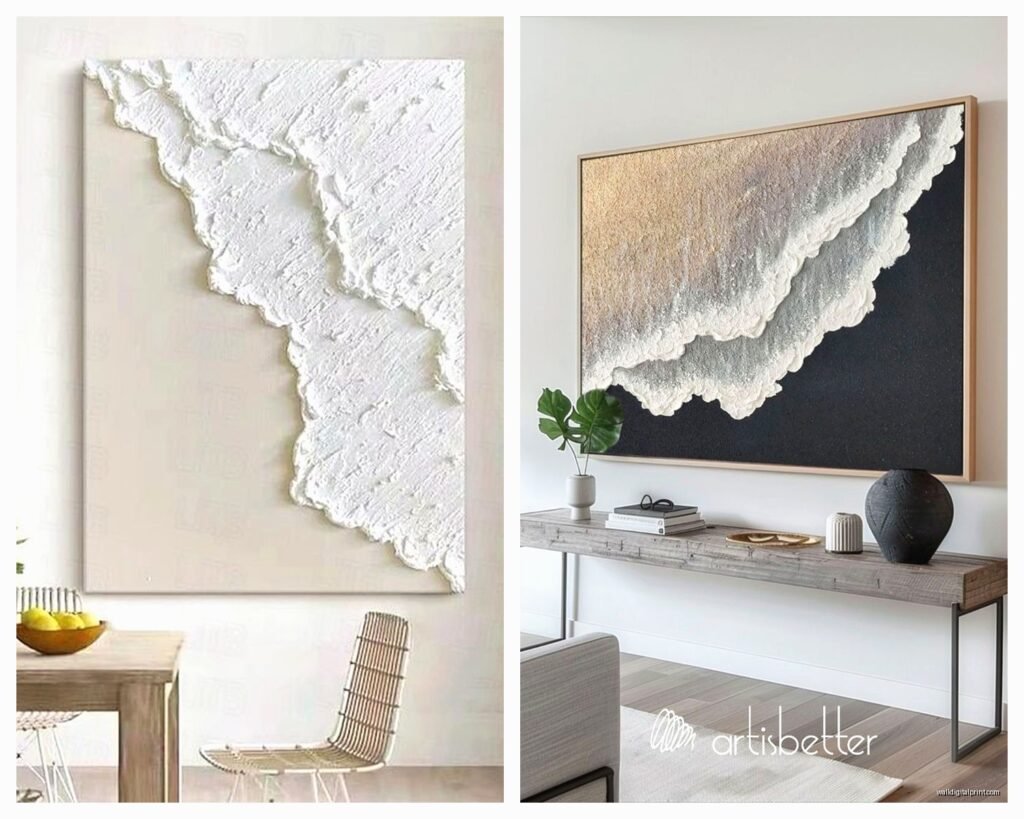
Abstract pieces are honestly the easiest route. Big sweeping brushstrokes, muted colors, nothing too literal. I’ve got this massive abstract thing above my bed that’s basically just cream and sage green with some gold leaf, and it works because it’s interesting without being demanding. You don’t want something that your brain has to “figure out” at 11pm when you’re trying to wind down.
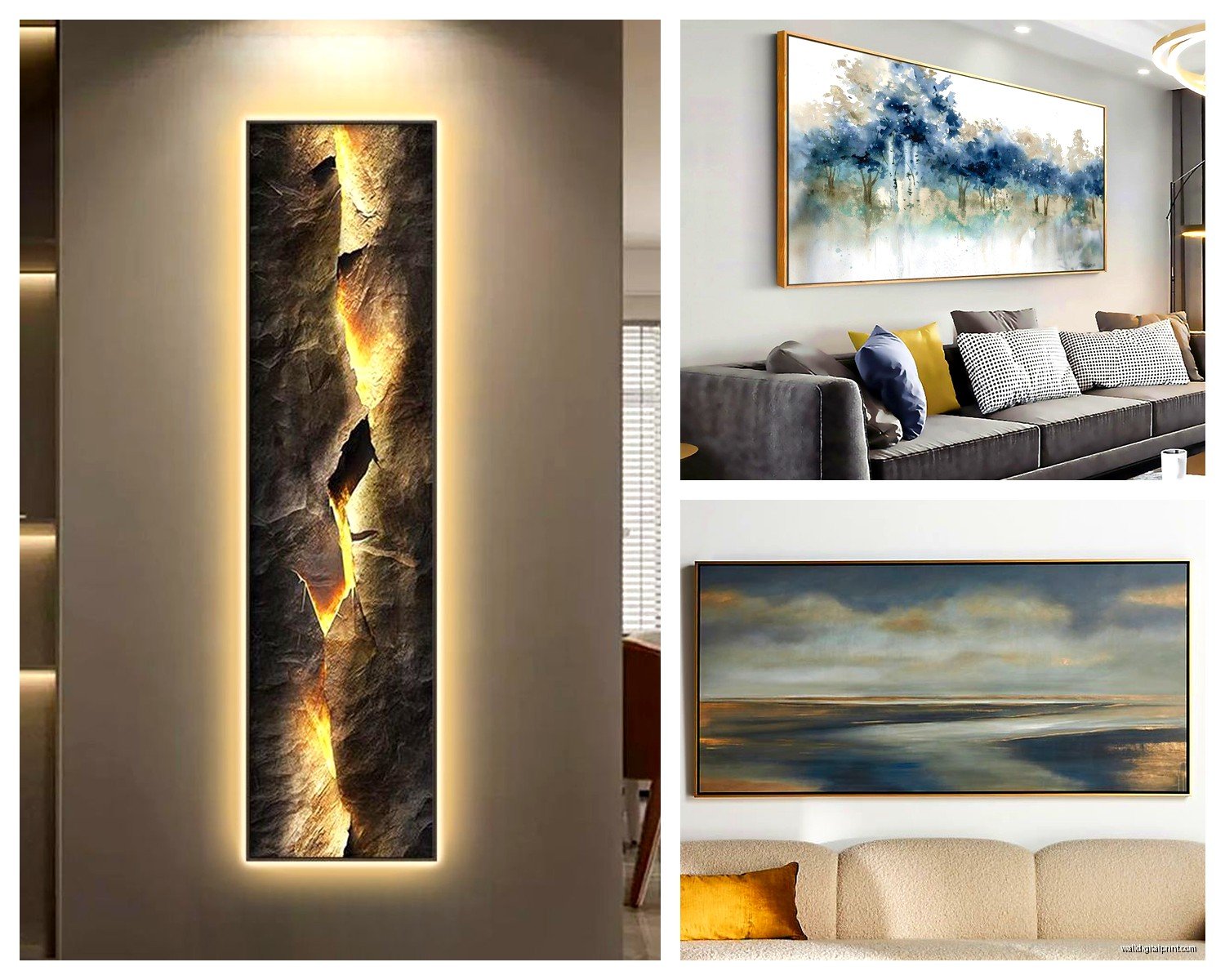
Landscape photography works really well too. I helped a client do this huge black and white desert landscape and it made their bedroom feel like a boutique hotel. The key is going for something with depth—mountains, seascapes, forests. Flat landscapes can feel boring at that scale.
Botanical prints are having a moment and I’m here for it. Oversized leaves, ferns, that whole thing. But you gotta go actually oversized. Those small botanical prints in a gallery wall are cute for a hallway but for bedroom impact, you want one massive leaf that’s like 4 feet tall.
What I’d avoid: anything too personal or specific in terms of portraits or photos of people. I dunno, it’s just weird having faces staring at you while you sleep? Also avoid anything super red or aggressive orange. Those colors are stimulating and bedrooms should be calmer.
Canvas vs Framed vs Other Options
Oh and another thing—the format matters way more than I thought it would.
Canvas prints are probably the most affordable way to go large. They’re lightweight which is good if you’re worried about your wall situation, and they have that gallery-wrapped edge that looks finished without a frame. I got a 60×40 inch canvas from this online print place for like $200 and it’s held up great. The colors haven’t faded even though I have a window nearby.
The downside is they can look kinda cheap if the print quality isn’t good. You want a thick canvas, at least 1.5 inch depth on the frame bars.
Framed prints look more expensive and polished but holy hell they get pricey at large sizes. Custom framing a 5-foot piece can easily run $600-800. But if you’ve got the budget, the difference is noticeable. That glass or acrylic front protects the art and the frame adds this weight and intentionality.
I’ve been experimenting with framed textiles lately too. Like you can frame a vintage rug or tapestry and it adds so much texture. Did this in a client’s bedroom last fall and everyone asks about it. You need a deep shadowbox frame though, which adds to the cost.
Metal prints are this thing I discovered kind of by accident when I was at an art fair. They print the image directly onto aluminum and it’s got this subtle sheen that’s really cool. Super modern looking. They’re durable and lightweight but definitely have a contemporary vibe that won’t work in every bedroom style.
The Tapestry Route
Wait I forgot to mention tapestries because they’re actually genius for renters or commitment-phobes. You can get massive woven tapestries for pretty cheap—I’m talking like $50-100 for something that’s 80 inches wide. Hang it with a curtain rod or even just thumbtacks if you’re not precious about it.
The texture thing is real. Flat art on a flat wall can feel one-dimensional, but a textile adds this layer of coziness. Just make sure it’s actually a nice tapestry and not one of those thin printed ones from the college dorm section.
Color Coordination Without Being Matchy-Matchy
So here’s where people get stuck. You don’t want your art to match your bedding exactly because that looks catalogue-staged and kinda soulless. But you also don’t want it to clash.
I usually pull one or two colors from the art and echo them in smaller doses around the room. Like if your art has some navy in it, maybe your throw pillows or a blanket picks up that navy. But your walls might be white or cream, your bedding might be gray, and that’s fine.
Actually the best bedroom art situations I’ve seen have some contrast. Light walls with darker art, or if you’re brave, dark walls with lighter art. The contrast creates depth.
My own bedroom has pretty neutral everything—white walls, gray bedding, light wood furniture—and then the art above my bed has these pops of terracotta and deep blue. It’s the only place those colors appear and it works because of that.
Hanging the Damn Thing
Okay so funny story, I once hung a 6-foot canvas by myself and it fell off the wall at 3am. Scared me half to death and put a dent in my floor. Don’t be me.
For anything over 30 pounds, you need proper wall anchors or studs. Period. Those little nail hangers aren’t gonna cut it. I use these heavy-duty picture hangers rated for like 50-75 pounds and I always use two of them spaced apart for large pieces.
Height-wise, the center of your art should be at eye level, which is usually around 57-60 inches from the floor. But above a bed, you’re gonna go a bit lower because you want it to relate to the headboard. I usually leave 6-8 inches between the top of the headboard and the bottom of the art.

If you don’t have a headboard, you can go lower—maybe 10-12 inches above the mattress top. Just make sure you can still sit up in bed without hitting your head on the frame corners.
Get a level. Like a real one, not just the app on your phone (though I definitely use my phone app as backup). Nothing looks worse than a massive piece of art that’s slightly tilted.
Budget-Friendly Options That Don’t Look Cheap
Because I know not everyone has $800 to drop on bedroom art. I certainly didn’t when I was starting out.
Print-on-demand sites are your friend. Places like Printful or even Etsy shops that do large-scale printing can give you gallery-quality prints for a fraction of custom art prices. You upload an image (make sure it’s high resolution—at least 150dpi at the size you want to print) and they ship you the canvas or print.
Thrift stores and estate sales are hit or miss but when you hit, it’s amazing. I found this huge vintage landscape painting at an estate sale for $45 and it’s probably worth ten times that. The frame alone was worth it. You gotta be willing to dig and go regularly though.
DIY abstract art is actually pretty forgiving at large scales. I made a 48×36 inch abstract piece for my guest room using acrylic paints and a big canvas from the craft store. Total cost was maybe $60 and it took me one Saturday afternoon while watching reality TV. The key is using a limited color palette and not overthinking it. Big gestural strokes look intentional.
Oversized photo prints from your own photography can work if you’ve got a decent camera or even a good phone camera. I printed a photo I took on vacation as a 40×60 inch canvas and people always think it’s professional. Just make sure the original image is sharp and well-composed.
Style-Specific Suggestions
If you’re going minimalist/Scandinavian, think line drawings, black and white photography, or very simple abstracts. One large piece in black, white, and maybe one muted accent color. Clean lines, lots of negative space in the composition.
For boho/eclectic bedrooms, you can get away with more color and pattern. Oversized macrame wall hangings, colorful abstracts, vintage textiles. Layer it with string lights or plants nearby.
Modern traditional or transitional styles look good with classic landscape paintings, botanical illustrations, or sophisticated abstracts with gold or silver accents. Think museum gift shop vibes but sized up dramatically.
Industrial/loft style bedrooms can handle edgier stuff—black and white architectural photography, abstract metal art, even a large vintage map or blueprint.
The Diptych or Triptych Option
Oh wait, this is gonna sound weird but sometimes one massive piece feels like too much commitment or won’t fit your wall properly. Two or three large panels side by side can give you that oversized impact while being more flexible.
I did this in a bedroom with weird window placement where one giant piece wouldn’t have worked. Got three 24×36 inch canvases with a coordinating abstract design and hung them with about 3 inches between each panel. Still reads as one large installation but way more adaptable.
You can find these sold as sets or you can create your own by having one image split across multiple canvases. Just make sure the spacing is consistent and they’re hung at exactly the same height or it’ll look sloppy.
What About the Other Walls
Once you’ve got your statement piece above the bed, you gotta think about balance in the room. You don’t want every wall competing for attention.
I usually keep the other walls pretty minimal—maybe a small piece above a dresser or some floating shelves with objects. The wall opposite your bed (the one you see when lying down) can handle something interesting but keep it smaller scale.
Or honestly, leave some walls blank. Not every surface needs art. Sometimes a beautiful wall color or interesting architectural feature is enough.
Lighting Considerations
This is something I didn’t think about until I installed picture lights in a client’s bedroom and wow, what a difference. If you’ve invested in a really beautiful large piece, lighting it properly makes it feel even more intentional and gallery-like.
You can do picture lights that mount directly above the frame, or if you have ceiling fixtures, just make sure they’re positioned to light the wall where your art hangs. Dimmable lighting is clutch in bedrooms anyway because you want options.
Avoid hanging art where direct sunlight hits it for hours every day. UV rays will fade prints and canvases over time. I learned this the hard way with a piece in my old apartment—the colors totally washed out after a year of afternoon sun exposure.
Making It Feel Cohesive
The last thing I’ll say is that your large wall art should feel like it belongs in your bedroom’s overall vibe, but it can also be the thing that defines that vibe. Like if everything else in your room is pretty neutral and safe, your art can be the personality.
I’ve got a friend who has the most boring beige bedroom but this incredible oversized abstract with all these deep jewel tones above her bed, and suddenly the whole room feels luxurious and intentional instead of just… beige.
Don’t stress too much about getting it perfect on the first try. I’ve switched out bedroom art multiple times and it’s fine. That’s the nice thing about art—it’s not permanent like paint or new furniture. You can always change it when your style evolves or you get bored.
Just start with proper measurements, pick something you actually like looking at, and hang it securely. The rest is just details.
