Wall Art Guide, Wall Art Tutoriels
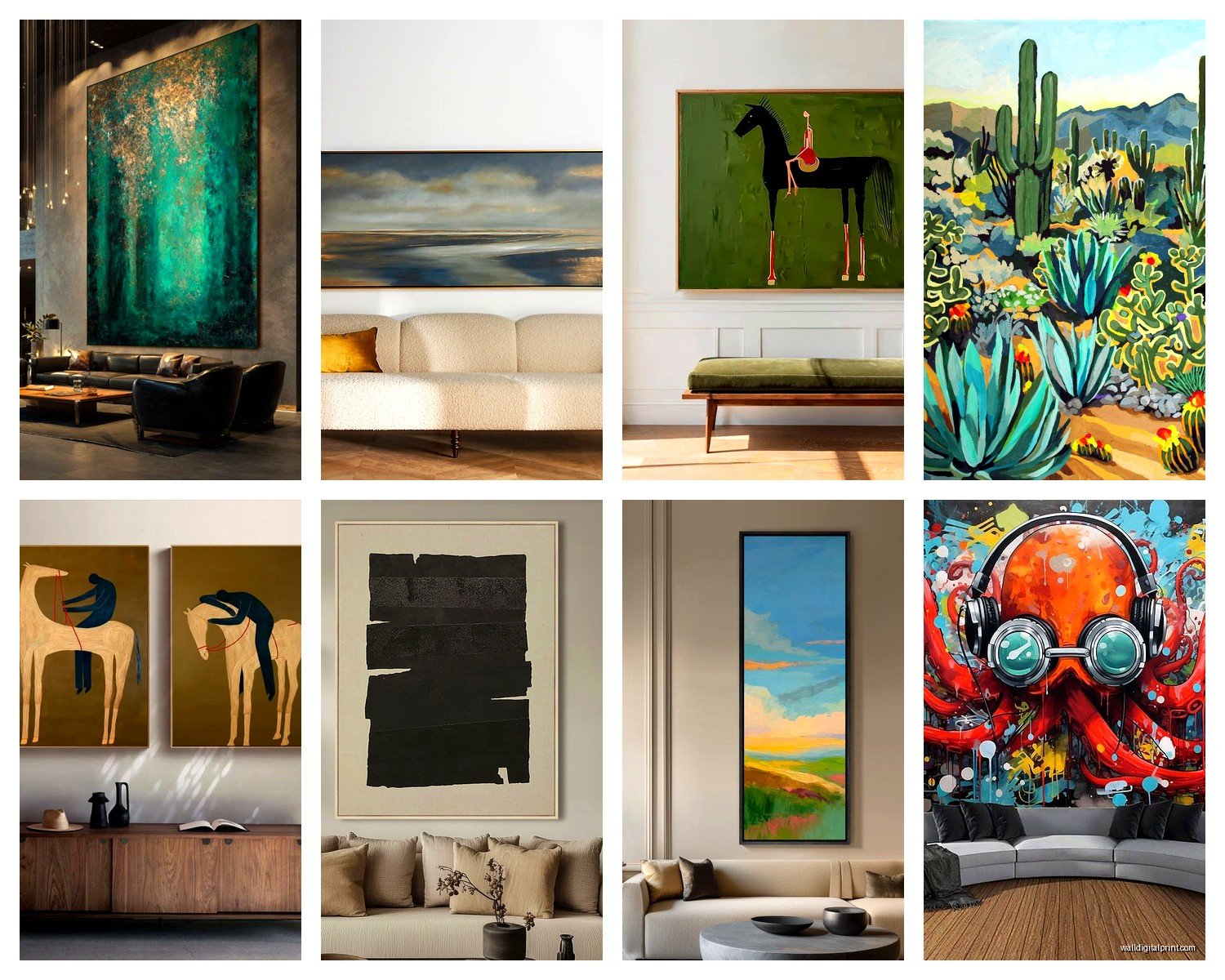
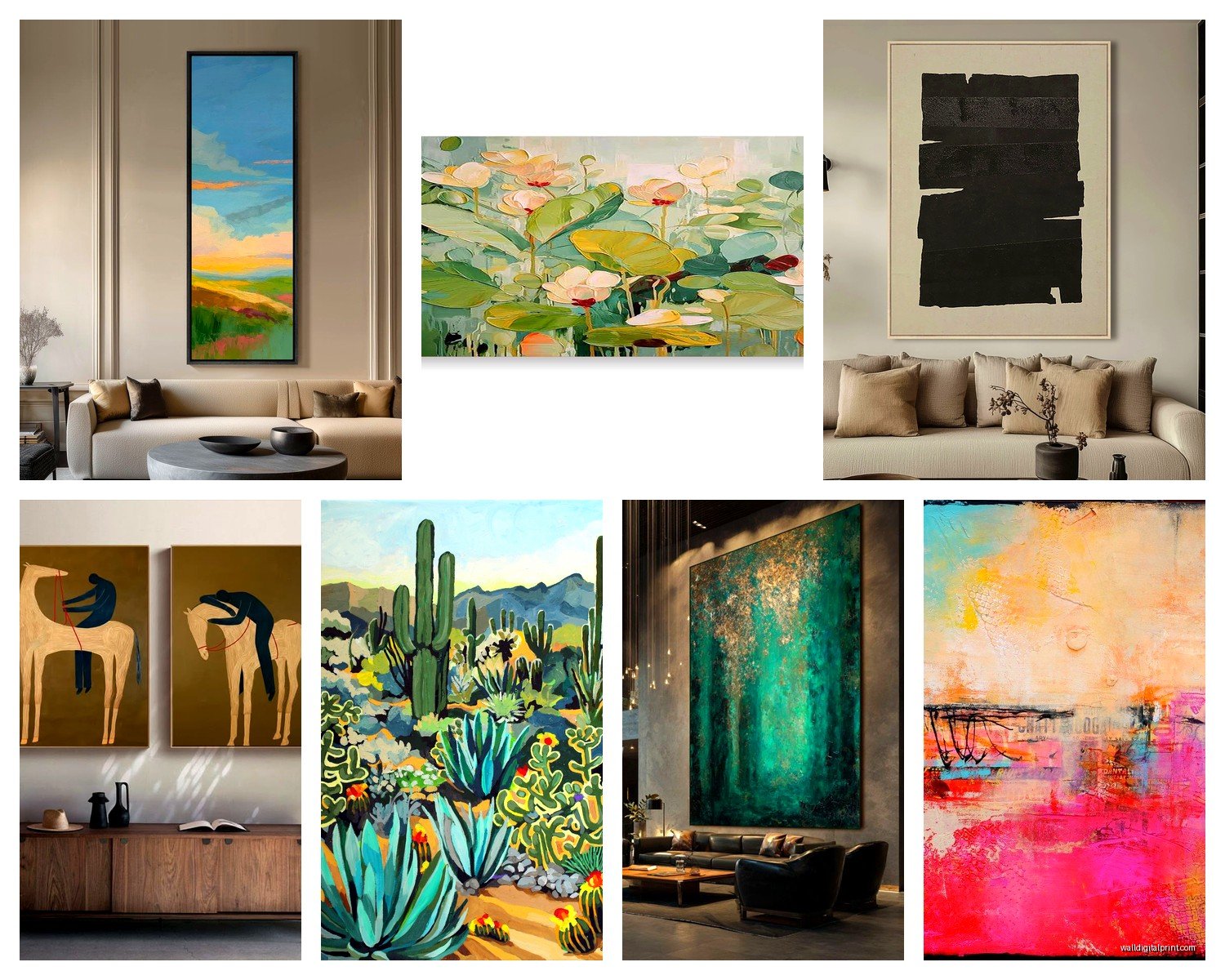
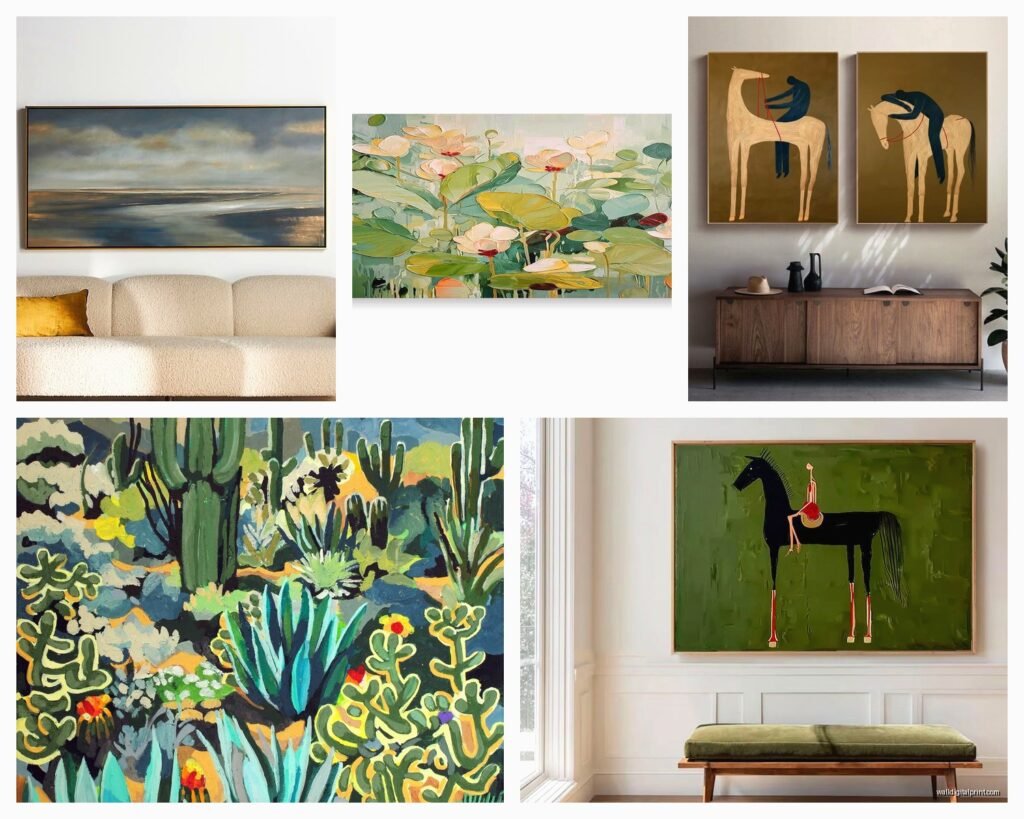
Giant Wall Art: Extra Large Statement Pieces
May
So I’ve been installing these massive wall pieces for like three years now and honestly the biggest mistake everyone makes is thinking bigger automatically means better. Like my friend Sara bought this 8-foot canvas and it completely swallowed her living room because she didn’t measure the visual weight against her ceiling height and it was just… sad.
What Actually Counts as Giant Wall Art
Okay so we’re talking pieces that are minimum 40 inches on the shortest side. Usually I’m working with stuff that’s 60×80 inches or larger. Sometimes triptychs that span 10 feet total. The key thing is these pieces need to anchor an entire wall, not just fill a spot above your couch.
The Math Nobody Tells You About
Your wall art should take up roughly 60-75% of the furniture width below it. So if you’ve got an 8-foot sofa, you’re looking at something between 58-72 inches wide. But here’s where it gets tricky with giant pieces because you also gotta account for ceiling height. I learned this the hard way in a client’s townhouse where we hung a 6-foot tall piece and it looked cramped because her ceilings were only 8 feet.
The rule I actually use: leave at least 18-24 inches between the top of your art and the ceiling. More if your ceilings are super high. My own living room has 10-foot ceilings and I still left 30 inches because otherwise it felt like the art was trying to escape through the roof.
Types of Giant Art That Actually Work
Canvas Prints
These are gonna be your most affordable option for going big. I’ve ordered from places like CanvasOnDemand and ElephantStock, and the quality varies wildly based on what you pay. Under $300 for a huge piece usually means you’re getting thin canvas that shows the frame edges through the front, which looks cheap.
What I tell people: budget at least $400-600 for a quality 60×80 inch canvas. The backing should be solid, the stretcher bars need to be at least 1.5 inches deep (2 inches is better), and the canvas should have some tooth to it.
Oh and another thing, get the gallery wrap style where the image continues around the edges. The museum wrap where it’s just white edges makes large pieces look unfinished.
Framed Prints and Posters
This gets expensive fast because framing large pieces is no joke. I just got a quote for framing a 48×72 inch print and they wanted $800 just for the frame. Custom framing for giant art typically runs $600-1200.
The workaround: Framebridge and Level Frames do large format stuff for less. I used Level Frames for a client last month, 50×70 inch print with a simple black frame, came to like $425 total. Took forever to arrive though, maybe 5 weeks?
If you’re going the poster route, make sure it’s actually archival quality. Those $50 giant prints from Amazon look fine initially but they fade within a year if they’re near any natural light.
Tapestries and Textile Art
Okay this is gonna sound weird but I’ve been using tapestries way more lately because they’re easier to hang (no heavy frames), they add texture, and honestly they’re cheaper. Society6 and Urban Outfitters have massive tapestries for like $80-150.
The catch is they look college dorm-y if you just tack them up. I use a wooden curtain rod with finials and hang them properly like a textile installation. Makes them look intentional. My cat destroyed one by climbing it though, so maybe don’t do this if you have pets who think fabric = climbing wall.
Multi Panel Art
Triptychs or even 5-panel sets can create massive impact without the logistical nightmare of hanging one giant piece. I did a three-panel set in my bedroom, each panel is 30×60 inches, spaced 3 inches apart, total span is about 8 feet.
The spacing between panels matters more than you’d think. Too close (less than 2 inches) and it looks like you couldn’t afford one big piece. Too far (more than 6 inches) and they read as separate artworks instead of one statement.
Where to Actually Buy This Stuff
Minted does oversized art prints up to 54×54 inches, their quality is solid and they have this thing where artists vote on designs so there’s some curation happening. Prices range $200-600 depending on size and framing.
Artfully Walls is where I go when clients have bigger budgets. They do custom sizing and the printing quality is chef’s kiss. Expect to pay $400-1000+ but it looks like actual art gallery quality.
Etsy is hit or miss but I’ve found some amazing large-scale abstract digital downloads that I print through a local print shop. You can get a massive file for $40-80 and then control your own printing and framing. Just make sure the resolution is actually high enough, you need at least 150 DPI for large format.
Saatchi Art for original pieces if you wanna invest. Giant original paintings start around $2000 and go up to… well, a lot. I bought a 5-foot abstract piece there two years ago for $3200 and it’s honestly the best money I’ve spent on my apartment.
Wait I forgot to mention West Elm and CB2 do large-scale wall art that’s actually decent quality. It’s very of-the-moment trendy but if you’re not trying to have something totally unique, they have 60×80 inch pieces for $400-800.
The Hanging Process Is Gonna Stress You Out
Okay so funny story, I once tried to hang a 70×90 inch canvas by myself and dropped it down the stairs. Now I always get help, always.
What You Actually Need
- A good stud finder because you MUST hit studs for anything over 30 pounds
- Heavy duty picture hanging hooks rated for at least 50 pounds
- A level that’s at least 24 inches long
- Painter’s tape for marking
- A second person, seriously don’t be a hero
The method I use: measure the wall width and mark the center with painter’s tape. Measure your art width and mark where the edges will fall. Then figure out where the hanging hardware is on the back of your piece and calculate the placement accordingly.
For giant pieces, I almost always use two hanging points instead of one center point because it prevents tilting and distributes weight better. If your art has D-rings on the back, you want heavy-gauge wire connecting them, not that thin picture wire that comes in the little packet.
Height Placement
The “center of the art at 57 inches” rule kinda breaks down with giant pieces. Instead, I measure so the bottom of the art is 8-10 inches above the furniture below it. For a big piece with no furniture below, I go with bottom edge at 6-12 inches above the baseboard depending on ceiling height.
In my dining room I hung a 6-foot wide piece and the bottom is only 6 inches from the sideboard because the piece needed to feel grounded. Rules are more like guidelines anyway.
What Actually Looks Good vs What Instagram Told You Looks Good
Everyone wants that massive abstract with bold colors but here’s the thing, giant art in intense colors will dominate your entire room. Like it becomes THE thing your room is about.
I’ve had better luck with large-scale pieces that have more neutral bases with pops of color. Or going super minimal with giant black and white photography. Last year I installed this 8-foot wide black and white landscape photo in a client’s living room and it was dramatic without screaming for attention.
Subject Matter at Scale
Faces and people get weird when they’re huge unless you’re going for that Andy Warhol vibe. Abstracts, landscapes, geometric patterns, botanicals all scale up nicely.
Text-based art is tricky at giant sizes. I did a 5-foot piece with a single word and it felt more graphic design than art. Not bad, just very specific vibe.
The Money Conversation Nobody Wants to Have
You can absolutely do giant wall art on a budget but you gotta be strategic. My priority list:
- Get the size right first, quality second if money’s tight
- A large affordable piece beats a small expensive piece for impact
- DIY framing with pre-made large frames from Michael’s or Hobby Lobby (use those 50% off coupons)
- Print your own from digital downloads if you have access to a large format printer
I spent $90 on a digital abstract download and $180 printing it at FedEx on their engineering printer, then another $200 on a basic frame from Frame Warehouse. Total cost $470 for a 48×72 inch framed piece that looks like I spent $1500.
The cheap route that actually works: engineers prints (those blueprint printers) on bond paper, then mount it yourself on foam core with spray adhesive. I’ve done this for staging projects and from 6 feet away you can’t tell it’s not a real print. Costs like $60 for a 40×60 inch piece.
Common Problems I’m Always Fixing
The piece is too small for the wall. This happens constantly. People get nervous about going big and then it looks like a postage stamp. When in doubt, size up.
Wrong orientation for the space. Horizontal pieces work above sofas and beds. Vertical pieces work in hallways, next to doorways, in narrow wall sections. I know this seems obvious but I’ve seen so many vertical pieces crammed above couches looking awkward.
The colors fight with the room. Your giant art doesn’t need to match your throw pillows but it shouldn’t clash either. I usually pull at least one color from the existing room palette into the art selection.
It’s hung too high. This is the most common mistake. People default to hanging everything at the same height and giant pieces need to sit lower to feel anchored.
Alternatives If You’re Not Ready to Commit
Removable wallpaper in a large mural design gives you that giant statement without permanent mounting. I used a Photowall mural in a rental, it was like 10 feet wide and came down clean when I moved.
Large mirrors can provide the same visual weight as art. I have a 6-foot round mirror that creates just as much impact as a giant painting would.
Gallery walls with multiple smaller pieces can fill the same space, though that’s kind of the opposite of a statement piece… but if you’re scared of giant art it’s a stepping stone.
Okay so the main thing is just go bigger than feels comfortable because these pieces need breathing room around them to work. My living room piece looked insane when I first hung it, like way too big, and now three months later I wish I’d gone even larger. Your eye adjusts and then you wonder why you were so cautious.