Wall Art Guide, Wall Art Tutoriels
Modern Metal Wall Art: Contemporary Steel Sculptures
May
So I’ve been totally obsessed with metal wall art lately and honestly it started because this client had this massive blank wall in their loft and I was like… what do we even do with 15 feet of concrete. Anyway, here’s everything I figured out about contemporary steel sculptures because I’ve made basically every mistake you can make.
The Weight Thing Nobody Talks About
Okay so first thing – these pieces are HEAVY. Like way heavier than you think. I ordered this gorgeous geometric steel piece from an artist in Portland and when it arrived I literally couldn’t lift it by myself. My neighbor had to help me and she’s like 60 and probably judged me the entire time. You gotta check the weight before ordering because your wall might not support it without proper anchoring.
For anything over 30 pounds you need wall anchors, not just regular screws. I use toggle bolts for drywall and they’ve never failed me. The ones rated for 50+ pounds. Home Depot has them. But if you’re mounting on brick or concrete you’ll need masonry anchors and honestly just pay someone unless you already own a hammer drill because they’re like $80 and you’ll use it once.
Finishes and Patinas Actually Matter
The finish is where it gets interesting. Raw steel will rust – which some people love that industrial weathered look. I had a client who specifically wanted the rust patina for their restaurant and we mounted these abstract steel panels outside and they developed this gorgeous orange-brown color over like 6 months. But inside your home, unless you’re going for that specific vibe, you want something sealed.
Powder-coated steel is your friend. It’s durable, comes in any color, doesn’t chip easily. I’ve got a matte black powder-coated piece in my own apartment that I’ve had for 3 years and it still looks brand new. The other option is clear-coated steel which keeps that metallic silver look but prevents oxidation.
Oh and stainless steel is basically indestructible but it’s pricier. Like significantly pricier. We’re talking 40-50% more than regular steel. But for bathrooms or anywhere with humidity? Worth it.
Brushed vs Polished
Brushed steel has this subtle texture that catches light really nicely without being too reflective. Polished is mirror-like and honestly can be a bit much in smaller spaces. I learned this the hard way with a polished piece in a bedroom – every morning the sun would hit it and basically blind whoever was trying to sleep. Had to move it to a hallway.
Scale Is Everything and Also Confusing
Here’s where everyone messes up including me. You see a piece online, it looks perfect, you order it, it arrives and it’s either comically small or takes over the entire wall like some kind of metal monster.
For above a sofa you want something that’s roughly 2/3 the width of the sofa. So if your sofa is 84 inches, you’re looking at around 55-60 inches of art. Can go a bit smaller if it’s really detailed or has a lot of visual weight but don’t go bigger or it’ll look like it’s about to fall on someone’s head.
I use this trick where I cut out paper templates the actual size and tape them to the wall. Sounds ridiculous but it works. My cat destroyed one of them once while I was trying to photograph it for a client presentation which was… not helpful.
Styles That Actually Work in Real Homes
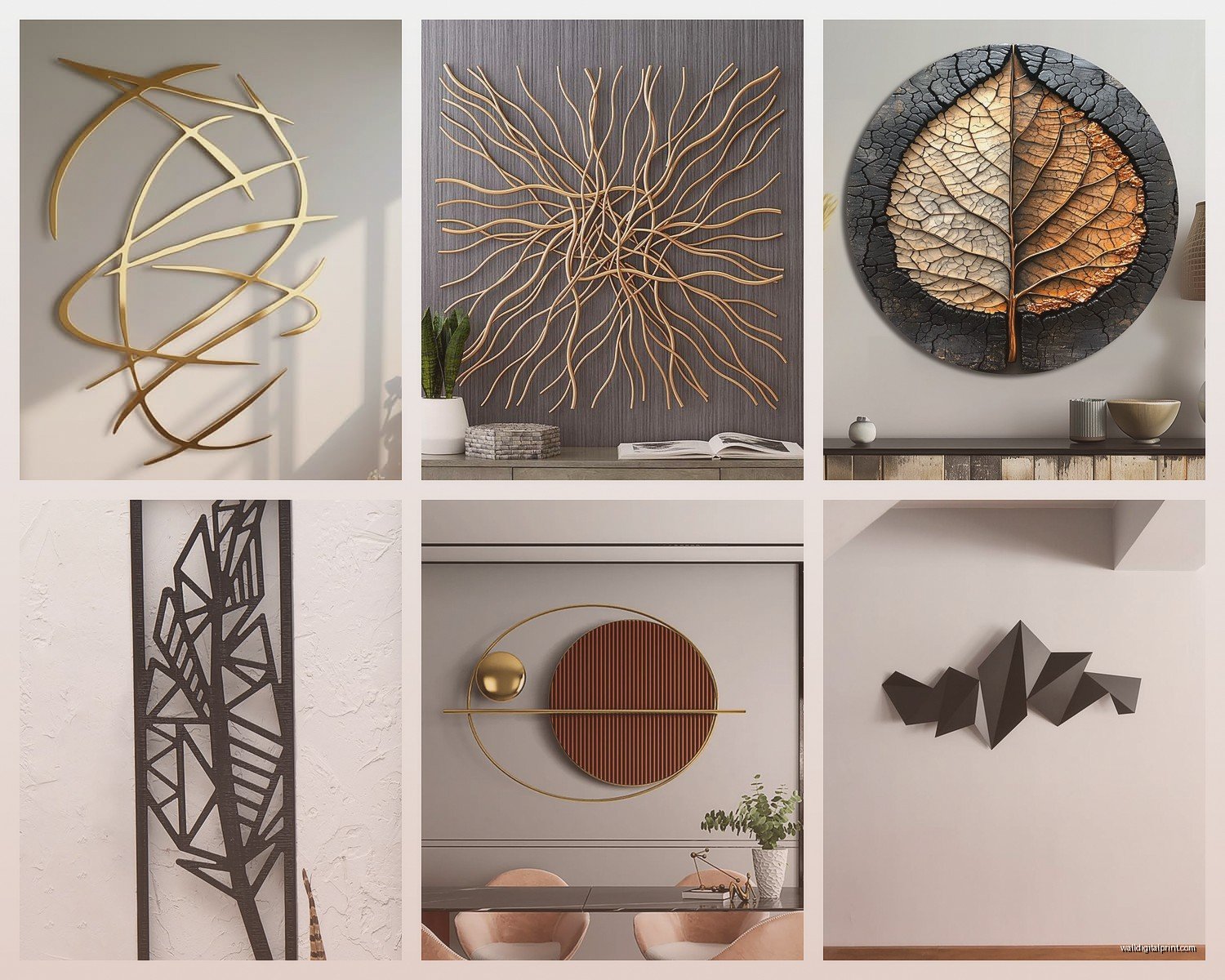
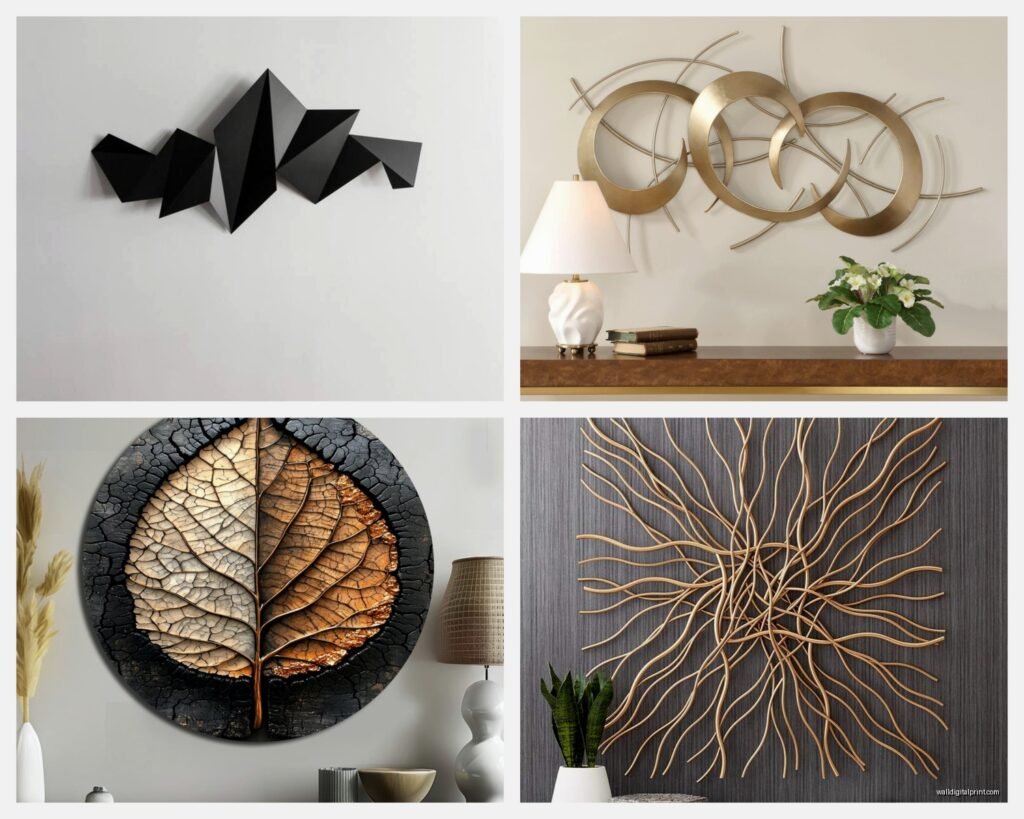
Geometric abstracts are huge right now. Think overlapping circles, angular lines, that whole mid-century modern revival thing. They work in basically any space that’s not super traditional. I’ve installed them in minimalist spaces, industrial lofts, even slightly bohemian rooms if you balance them with softer textures.
There’s this artist on Etsy – I think the shop is called something like MetalTreeStudios or maybe MetalTreeDesigns – anyway they do these tree silhouettes that are laser-cut and they’re actually not cheesy? I was skeptical but put one in a client’s dining room and it’s stunning. The negative space is what makes it work.
Sculptural vs Flat
3D sculptural pieces that come off the wall are where it gets really interesting. They cast shadows that change throughout the day which adds this whole other dimension. But you need at least 3-4 inches of clearance from the wall for the effect to work. I’ve seen people mount them flush and it completely defeats the purpose.
Wait I forgot to mention – if you’re renting, some landlords get weird about the mounting holes. I’ve had good luck with those heavy-duty picture hanging strips for smaller pieces under 10 pounds, but anything substantial needs proper mounting and you’ll have to patch holes when you move. Just factor that in.
Where to Actually Find Good Pieces
Etsy has a ton of artists making custom stuff. I’ve ordered from probably 15 different sellers at this point. The quality varies wildly though. Always read reviews and check if they show actual installation photos not just the piece laying on a table.
Local metal fabricators are underrated. Most cities have them and they usually do custom work. I worked with a guy who normally makes railings and staircases but he started doing wall art on the side and his prices were like half what you’d pay from a gallery. His welding skills were obviously professional level so the quality was perfect.
Price Ranges Because This Varies A LOT
You can find small pieces (under 24 inches) for $100-200 on sites like Wayfair or Amazon but honestly the quality is usually meh. Thin metal, basic designs, sometimes the powder coating is uneven.
Mid-range is $300-800 for something in the 36-48 inch range from independent artists. This is the sweet spot I think. You’re getting actual craftsmanship, unique designs, proper thickness steel.
High-end gallery pieces or large installations can easily hit $2000-5000+. I curated a collection for a corporate office once and one piece was $8000 but it was like 8 feet tall and insanely detailed laser-cut work. Worth it for that context but not realistic for most homes.
Installation Tips From Someone Who’s Done This Too Many Times
Level is crucial. Sounds obvious but I’ve seen so many crooked installations including one I did myself at 11pm when I was tired and didn’t double-check. Use a good level. Take your time.
For heavy pieces I mark the spots, drill pilot holes, and install the anchors before even trying to lift the art. Have someone help you hold it in place while you mark where the hanging hardware hits the wall. My partner has helped me with this more times than they’d probably like to admit.
Oh and another thing – consider the hanging hardware that comes with the piece. Sometimes it’s garbage. I replace it pretty often with D-rings or heavy-duty wire rated for the actual weight. You can get hanging kits at any hardware store for like $10.
Mixing Metals and Materials
This is gonna sound weird but metal wall art looks amazing next to natural materials. Wood, plants, linen textiles. The contrast between industrial and organic is chef’s kiss. I did a living room recently with a large steel abstract piece next to floor-to-ceiling sheer curtains and a bunch of fiddle leaf figs and it was perfect.
You can also layer metal pieces with other art. Like a steel sculpture with some canvas paintings nearby. Just make sure there’s a unifying element – could be color, could be the level of abstraction, could be scale. Something that ties it together so it doesn’t look random.
Lighting Makes or Breaks It
Uplighting or downlighting metal sculptures creates incredible shadow play. I installed picture lights above a few pieces and the way they highlight the texture and dimension… yeah. Game changer.
Natural light is trickier because it changes so much throughout the day. I actually kinda love this though. A piece that looks one way in morning light and completely different at sunset keeps things interesting.
Just avoid direct harsh sunlight on anything with a patina or special finish because it can fade or degrade over time. Learned this from a conservator friend who was like “why would you put that there” when she saw a piece I’d mounted near a west-facing window.
Maintenance Is Easier Than You Think
Dust them like any other art. Microfiber cloth, maybe a tiny bit of water if needed. For powder-coated pieces you can use gentle all-purpose cleaner but test it on a small area first.
If you have raw or weathered steel that you want to preserve the patina on, there are clear sealers you can apply. I use a matte clear coat spray meant for metal. Do it outside or in a really well-ventilated area because the fumes are intense.
Stainless steel you can use stainless steel cleaner on but honestly water and a soft cloth works fine for most situations.
Common Mistakes I See All The Time
Mounting too high. The center of the piece should be around 57-60 inches from the floor which is average eye level. I see so many pieces mounted like 6 feet up and you’re just staring at the bottom of them.
Choosing pieces that are too matchy-matchy with the room. Like an all-gray room with gray metal art. You need some contrast or visual interest. Even if you love monochrome, play with different textures and finishes.
Not considering the wall color. Dark steel on a dark wall disappears. Light steel on white can look washed out. Think about contrast or go for a finish that has some color variation.
Buying pieces that are too literal or themed for adults. Like unless you’re doing a specific nautical room, the anchor sculpture probably isn’t it. Abstract or geometric tends to have more longevity and sophistication.
Custom Work Is More Accessible Than You’d Think
I’ve commissioned probably a dozen custom pieces at this point. You send the artist your wall dimensions, maybe a photo of the space, tell them your color preferences and budget. Most artists I’ve worked with send sketches or renderings before they start cutting metal.
Turnaround is usually 3-6 weeks depending on complexity. And honestly the price difference between custom and pre-made isn’t always huge. Sometimes it’s only like $100-150 more to get exactly what you want versus settling for something close.
There’s an artist in Nashville I work with sometimes who does these amazing layered pieces where different depths create this shadow effect and she’s super responsive and easy to work with. Found her through Instagram actually which is where I discover a lot of artists now.
Outdoor vs Indoor Pieces
If you’re putting metal art outside you absolutely need weather-resistant finishes. Powder coating works but even better is hot-dip galvanizing for long-term durability. Corten steel is designed to rust in a controlled way and actually looks incredible in gardens or on exterior walls.
I helped a client install outdoor pieces on their covered patio and we went with powder-coated aluminum because it’s lighter than steel and doesn’t rust. Three years later they still look perfect. Just make sure anything outdoor is rated for that and sealed properly.
The mounting is different too – you need rust-resistant hardware. Stainless steel screws and anchors. Regular stuff will corrode and your art will literally fall off the wall eventually.
Trending Styles Right Now
Minimalist line art that’s basically one continuous wire or steel rod bent into shapes. Very Picasso-esque. These are everywhere on Pinterest and they can look really elegant if done well.
Organic forms – leaves, branches, flowing abstract shapes. Less geometric than the mid-century stuff, more natural and fluid.
Mixed media where steel is combined with wood or resin or other materials. These sculptural pieces add a lot of visual interest and work well as statement pieces.
Typography and words cut from metal. Can be cheesy but I’ve seen some really beautiful ones, especially in modern fonts with interesting finishes.
Honestly just avoid anything that was trendy in like 2010 – the super ornate scrollwork stuff or those metal flowers that were in every HomeGoods. We’ve moved past that aesthetic.
Okay I think that covers most of what I’ve learned through trial and error and probably too much money spent on metal art. The main thing is just to really consider the scale and weight before ordering because returning a 40-pound steel sculpture is not fun, trust me on this one.