Wall Art Guide, Wall Art Tutoriels
Sea Wall Art: Ocean Life & Underwater Photography
Jun
So I’ve been totally obsessed with ocean wall art lately and honestly it started because this client wanted their beach house redone but then I fell down this whole rabbit hole of underwater photography and now half my Pinterest boards are just… fish and coral and moody ocean scenes.
The Different Types You’re Actually Gonna Find
Okay so first thing – sea wall art isn’t just one thing. There’s like several categories and they give completely different vibes. You’ve got your classic beach sunset stuff which honestly I’m gonna skip because that’s not what we’re talking about here. We want the GOOD stuff.
Underwater photography is probably what you’re thinking of. This is actual photos taken beneath the surface – could be anything from sea turtles to those insane coral reef shots to like, a single jellyfish floating in dark water. The jellyfish ones are having a MOMENT right now btw. I’ve specified probably six different jellyfish prints in the last three months alone.
Then there’s ocean life illustrations which can be vintage scientific drawings (think those old botanical print vibes but make it octopus), or modern graphic interpretations. The vintage ones are chef’s kiss for a library or study situation.
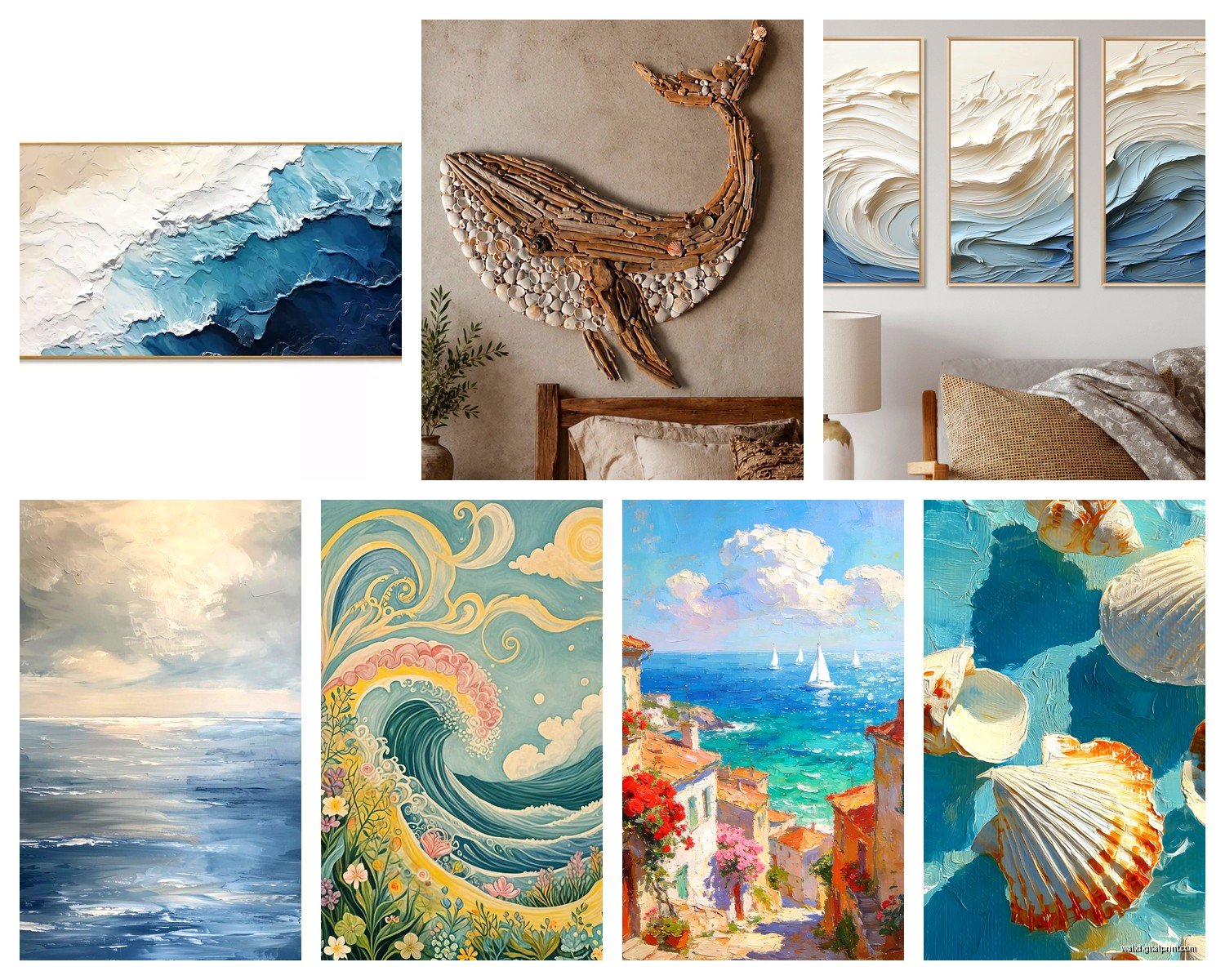
And abstract ocean art – this is waves, water textures, those aerial shots of ocean meeting sand that look like abstract paintings. My friend Sarah has one in her hallway and people always think it’s an expensive original painting but nope, it’s a photograph of Australian coastline from a helicopter.
What Actually Works in Real Spaces
Here’s what I’ve learned from actually hanging this stuff in like 30+ rooms… size matters SO much more than you think. Everyone wants to go small and safe but that’s usually wrong? A tiny 16×20 ocean print on a big wall just looks scared. You want something that makes a statement.
For above a sofa you’re looking at minimum 40 inches wide, honestly bigger if your couch is standard size. I did a client’s living room last month with this massive 60×40 whale photograph and it completely transformed the room. Before that they had three small frames grouped together and it just looked… cluttered and unintentional.
Bedrooms though – bedrooms can handle something more intimate. Like a close-up of coral or a single seahorse. You’re viewing it from bed mostly so the relationship is different. I have this gorgeous macro shot of sea anemones in my own bedroom and it’s only 24×36 but it works because you’re seeing it from like 10 feet away while lying down.
The Color Thing Nobody Talks About
Okay so this is gonna sound weird but you gotta think about whether you want BLUE blue or varied tones. Most ocean photography is obviously blue-dominant but the shade matters enormously.
Deep navy and dark teal photographs work in rooms with warm wood tones and leather furniture – creates this rich contrast that feels expensive. I’m talking dark moody underwater scenes, deep ocean stuff.
Bright turquoise and aqua prints need rooms that can handle that energy. White walls, light floors, maybe some natural fiber textures. Otherwise it’s too much. My sister ignored this advice and got this incredibly vibrant tropical fish print for her dining room which has burgundy curtains and cherry furniture and… yeah it lasted two weeks before she changed it.
And then there’s the greyed-out ocean tones – stormy seas, overcast water, those aerial shots where the ocean looks almost silver. These are the most versatile actually? They read as sophisticated and work with almost any color scheme. Less beachy, more art gallery.
Where to Actually Buy This Stuff
So I’ve ordered from basically everywhere at this point because I’m constantly sourcing for clients and also have zero self-control when it comes to my own walls.
For actual underwater photography prints, there are photographers who specialize in this and sell directly. The quality is obviously better because it’s coming straight from the source. You’re paying more though – expect $200-800 depending on size. But the detail… oh man the detail is insane. You can see individual scales on fish and the colors are so much richer than mass-market prints.
I’ve also had good luck with society6 and minted for mid-range options. The print quality is solid, lots of artists upload their ocean photography there, and you can get different size options. Usually $80-300 range depending on what size and framing you choose. My cat knocked over my coffee while I was ordering from Society6 last week and I accidentally bought two prints instead of one, so now I have matching jellyfish art in two rooms which actually kinda works?
Etsy is hit or miss honestly. There are some incredible underwater photographers selling there but you gotta dig through a lot of heavily filtered, over-saturated stuff that looks good as a thumbnail but arrives looking artificial. Read the reviews, check if they show actual photos of the print in someone’s home.
The Frame Situation
Do not sleep on framing. A $50 print in a $200 frame looks like a $500 piece of art. A $500 print in a cheap frame looks like a college dorm poster.
For ocean photography I usually go with simple frames – either thin black metal (modern, clean, lets the image dominate) or natural wood (warmer, more coastal without being beachy-tacky). White frames can work but they need to be substantial, not flimsy.
Float mounting is gorgeous for underwater photography especially. This is where the print appears to float inside the frame with space around it. Creates this really elegant presentation and honestly makes people think you spent way more than you did. Most frame shops can do this, costs maybe $50-100 extra depending on size.
I had a client who insisted on this ornate gold baroque frame for a sea turtle photograph and I tried to talk her out of it but she was ADAMANT and… it actually worked? Sometimes breaking the rules works but you gotta commit fully. Half-hearted baroque is just confusing.
Mixing Ocean Pieces Together
If you want multiple ocean pieces in one space – which can look amazing – you need a strategy or it becomes a weird aquarium waiting room vibe.
Option one: same subject, different compositions. Like three jellyfish photos in different poses/lighting. Cohesive but not boring.
Option two: color story approach. All pieces share a color palette even if subjects differ. Maybe one coral close-up, one wide reef shot, one tropical fish – but they all have that same turquoise-and-gold thing happening.
Option three: mix photography with illustration. An underwater photograph paired with a vintage octopus scientific drawing. The different mediums actually make them work together better than two photographs would because there’s clear intentional contrast.
What doesn’t work – and I’ve seen this fail multiple times – is random ocean subjects with different color temperatures and styles all grouped together. Like a bright cartoony fish next to a moody black-and-white wave photo next to a realistic sea turtle painting. Your eye doesn’t know where to land and it feels chaotic.
Specific Pieces That Actually Sell Well When I Show Them
Okay so based on what clients consistently respond to and what I keep seeing work…
Jellyfish in dark water – especially if there’s like one or two jellies with dramatic lighting. These photograph almost alien-like and work in modern spaces really well. Not too beachy, more mysterious and elegant.
Sea turtles – but specifically ones that are shot from interesting angles. Not straight-on “hi I’m a turtle” shots. Like from below looking up toward the surface, or a close-up of just the face and flippers. There’s this one photographer whose turtle images I’ve used probably five times… I should probably get a commission at this point.
Coral macro photography – the super close-up detailed shots where coral looks almost like an alien landscape. These are stunning in person and work great in smaller spaces because there’s so much detail to discover. My dentist has one in the exam room and honestly it’s very calming to stare at while someone’s scraping your teeth.
Whale photography – specifically humpback whales underwater. There’s something about the scale and grace of them that translates really well to large prints. Best in spaces with high ceilings though because whales need visual room to breathe if that makes sense.
Schools of fish – but only if they’re shot well. The ones where the fish create patterns or the lighting creates drama. Not just “here’s some fish swimming around.”
The Lighting Thing You’re Probably Not Thinking About
Oh and another thing – lighting matters SO much with ocean photography and nobody thinks about this until the print is already hung and they’re disappointed.
Underwater photos have a lot of subtle color gradations and details that get lost in dim lighting. You need either good natural light or dedicated picture lighting. I’ve installed battery-operated picture lights above ocean prints and it’s honestly transformative. Suddenly you can see all the detail in the coral or the way light filters through the water.
Also be careful with direct sunlight. UV rays will fade any print over time but ocean photography especially – those blues and greens are vulnerable. I learned this the hard way with a print in my own kitchen that was hit by afternoon sun… after a year it looked washed out and sad. Now I’m religious about UV-protective glass or keeping prints out of direct sun paths.
Common Mistakes I See All the Time
Hanging ocean art in bathrooms without thinking about humidity. Unless it’s properly sealed and framed, moisture is gonna warp the print. Use acrylic instead of glass, make sure it’s sealed well. Or honestly just go with a different art choice for high-humidity bathrooms unless you’ve got good ventilation.
Choosing super busy coral reef scenes for small walls. These need space to be appreciated. On a small wall they just look cluttered and overwhelming. Save the wide reef panoramas for larger walls and go with simpler compositions for smaller spaces.
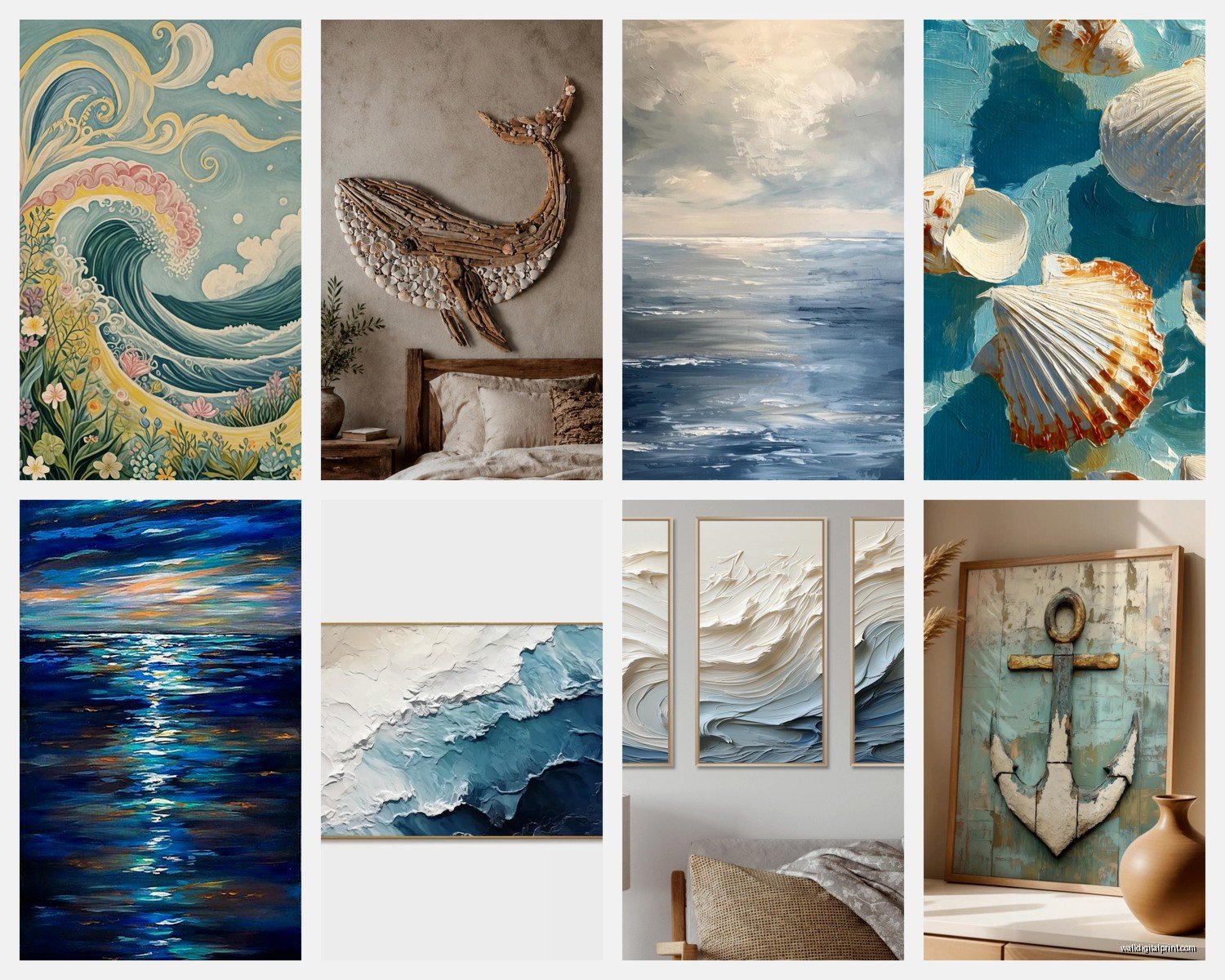
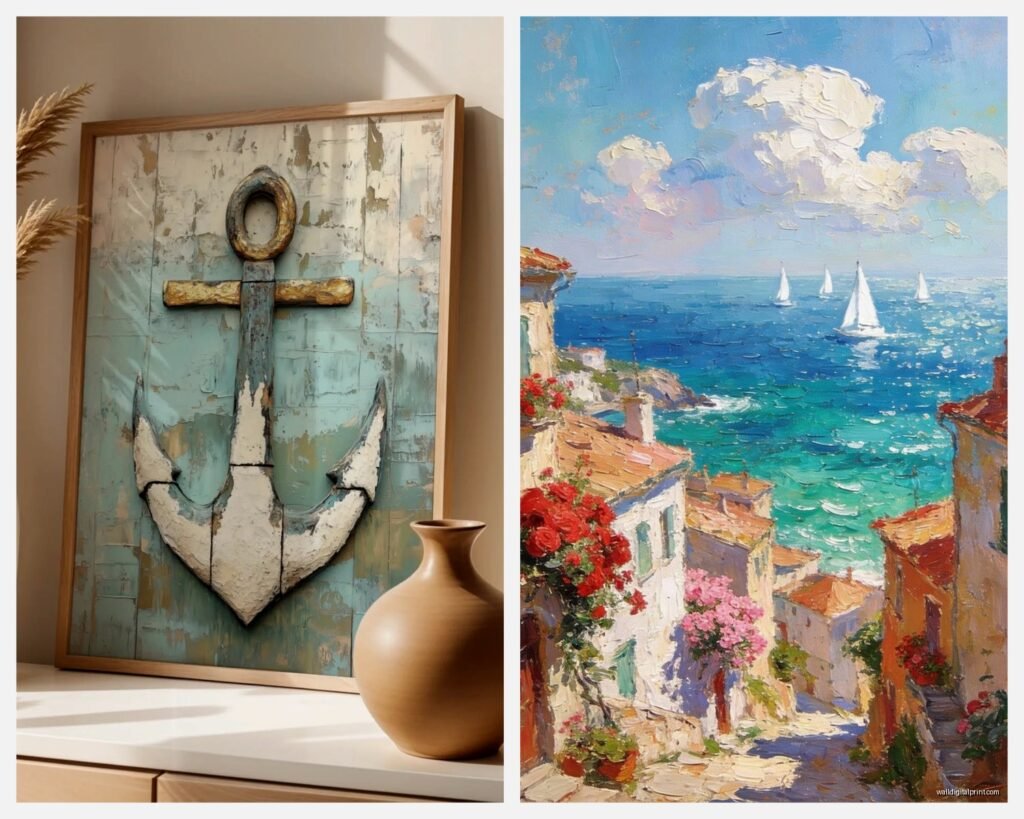
Matching the art too literally to the room theme. Like… you don’t need a fish print in a room with fish pillows and fish lamps and anchor decorations. That’s overkill. The ocean art should be the statement, keep everything else more neutral. I had a client who wanted to do a whole nautical theme and I talked her into keeping the furniture and accessories simple and letting one large underwater photograph be the ocean reference. Looks so much more sophisticated.
Getting the wrong finish. Matte prints work better for photography with a lot of detail because there’s no glare. Glossy can work for graphic or illustrated ocean art but on detailed photography the glare makes it hard to see everything. I default to matte like 90% of the time.
Rooms Where This Works Best
Living rooms obviously – this is your main showcase space so go big and dramatic. A large-scale underwater scene or whale photography makes an incredible focal point.
Bedrooms work great because ocean imagery is inherently calming. I tend to go for quieter pieces here – single subjects, softer colors, nothing too energetic.
Home offices are underrated for ocean art? There’s something about underwater scenes that helps with focus. Maybe it’s the blue tones or the sense of depth and quiet. I have a client who’s a therapist and uses gentle ocean photography in her office and patients always comment on it.
Dining rooms can handle something more dramatic or unusual. This is where I’d do like, a large octopus illustration or a really moody deep-sea photograph. You’re not spending hours staring at it like in a bedroom, so it can be more visually intense.
Hallways are perfect for a series of smaller ocean prints. Like four or five coordinating pieces in a gallery wall arrangement. Gives you something interesting to look at in a transitional space.
The Weird Trend I’m Seeing Right Now
Okay so this is random but I’m seeing a lot of people mixing ocean life art with desert landscapes or other natural environments in the same space and… it works? Like someone will have a huge wave photograph and then across the room there’s mountain photography. At first I thought it was too disconnected but there’s something about the shared “nature as art” theme that ties it together. Still figuring out exactly what makes this work versus when it doesn’t.
Also bioluminescent ocean photography is having a moment. Those shots of glowing plankton or deep-sea creatures that produce light. They’re dramatic and unusual and work really well in modern spaces. Harder to find good quality ones though.
Wait I forgot to mention – if you’re ordering custom prints, communicate with the printer about paper type. For ocean photography I usually recommend premium luster or metallic paper. Metallic especially can make water look incredibly dimensional and the colors pop without looking fake. Standard matte is fine but you’re missing out on some of that depth.
The key with all of this is just… don’t overthink it too much? If you see an ocean photograph that makes you feel something, that’s probably the right one. I can give you all these technical guidelines but ultimately the piece you’re gonna love living with is the one that resonates with you. Just make sure you size it right and frame it properly and you’re like 80% of the way there.
Also maybe don’t order anything after 10pm when you’re tired because that’s when questionable decisions happen. Speaking from experience obviously.