Wall Art Guide, Wall Art Tutoriels
Tree Ring Wall Art: Wood Growth Ring Natural Designs
Jul
So I’ve been obsessed with tree ring wall art for like the past year and honestly it started because a client wanted “something natural but not the usual botanical prints” and I fell down this whole rabbit hole of wood slice designs and growth ring patterns.
What Actually Works on Your Wall
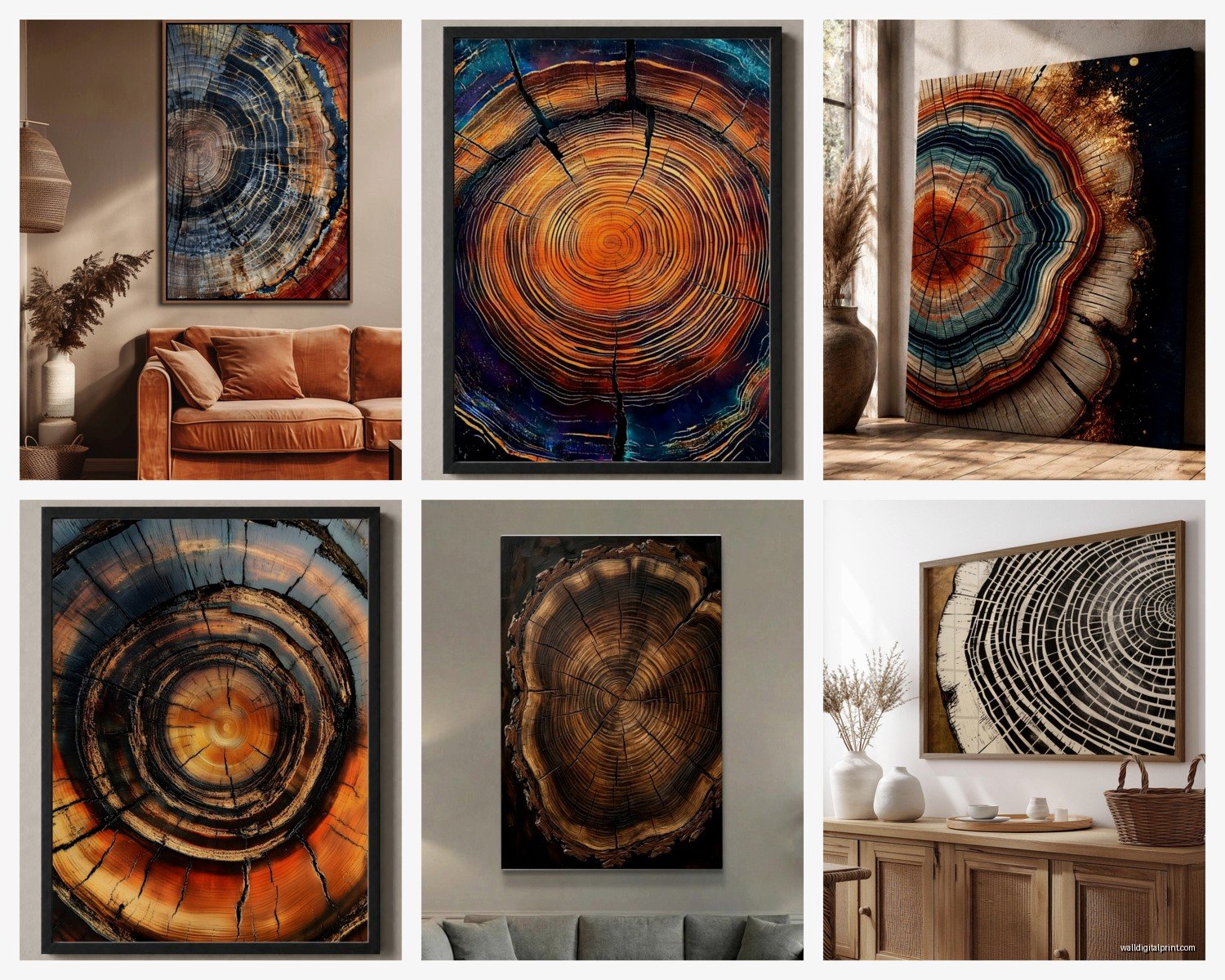
Okay so there’s basically three categories you’re gonna see. There’s actual wood slices (like literal cross-sections of trees), printed/painted interpretations of tree rings, and then metal or mixed media pieces that mimic the pattern. I’ve tested all of them in different spaces and they each have their weird quirks.
The real wood slices are gorgeous but here’s the thing nobody tells you – they crack. Like, they will crack. Doesn’t matter if you seal them or not, wood moves. I had this beautiful 18-inch walnut slice in my own living room and within six months there was a split right through the middle. Still looks cool actually, adds character, but if you’re a perfectionist it’s gonna drive you nuts. You want these for casual spaces – mudrooms, covered patios, kids’ rooms where a little weathering is fine.
Size and Scale Nobody Talks About
The biggest mistake I see is going too small. A 10-inch wood slice on a big wall looks like you forgot to finish decorating. I learned this the hard way in a client’s dining room and we had to redo the whole gallery wall situation. For a statement piece, you want minimum 24 inches diameter. If you’re doing a cluster, mix sizes but your largest should still be in that 20-24 inch range.
Oh and another thing – thickness matters more than you’d think. Thin slices (under 1 inch) look kinda cheap and craft-project-y. The good ones are 1.5 to 3 inches thick. They have presence, they cast shadows, they feel substantial when you walk past them.
The Printed and Painted Options
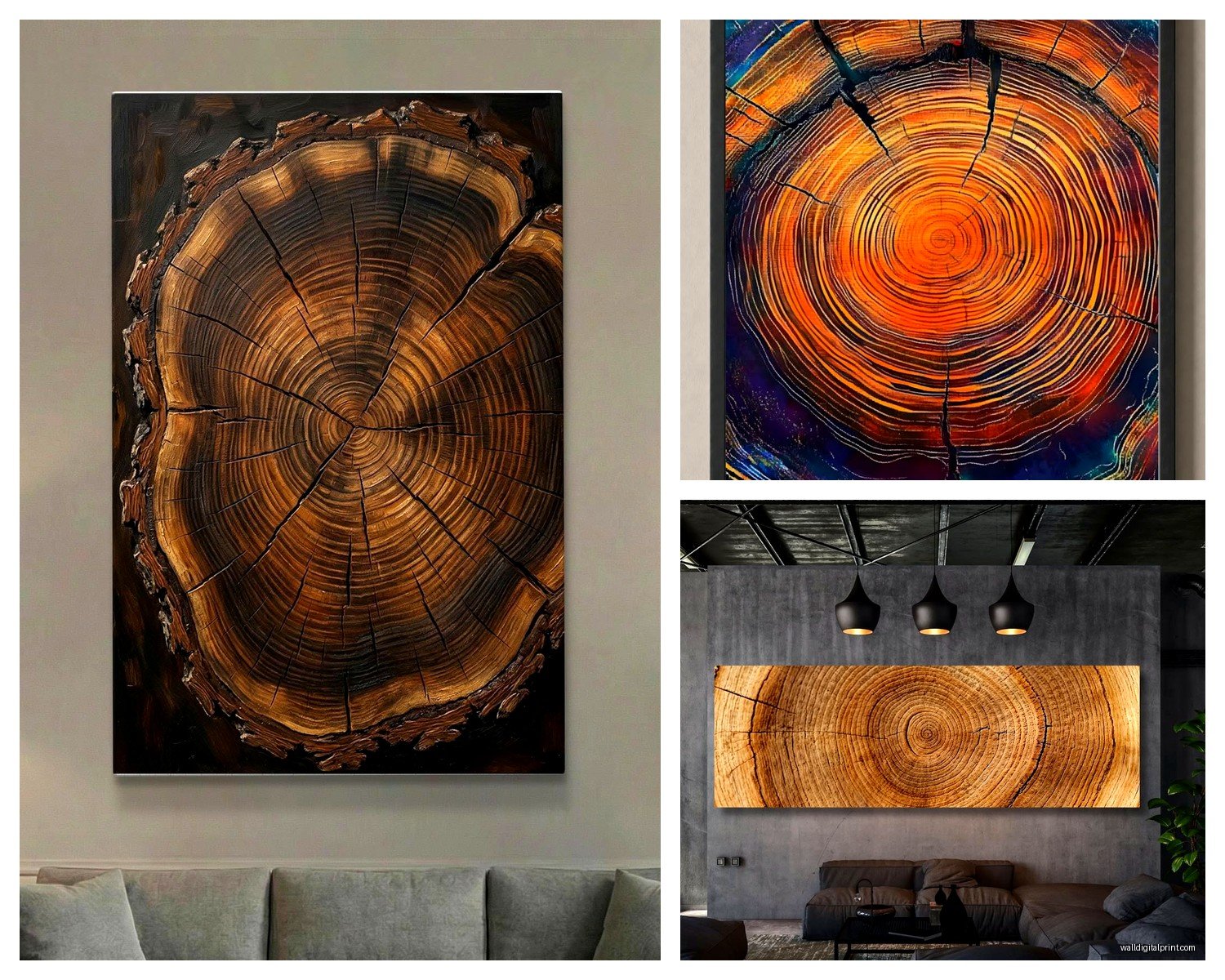
So if you don’t wanna deal with actual wood doing its wood thing, there’s tons of canvas and paper prints now. I actually prefer these for bedrooms because they’re lighter and you don’t have to worry about them falling on your head in an earthquake (I’m in California, this is a real consideration lol).
The best ones I’ve found use metallic inks – gold or copper accents on the rings. There’s this Etsy seller, can’t remember the name right now but it’s something like “Nordic Forest Prints,” and they do these minimalist interpretations where it’s just black rings on cream with tiny gold details. Hung one in a client’s home office and it photographs SO well on Zoom calls.
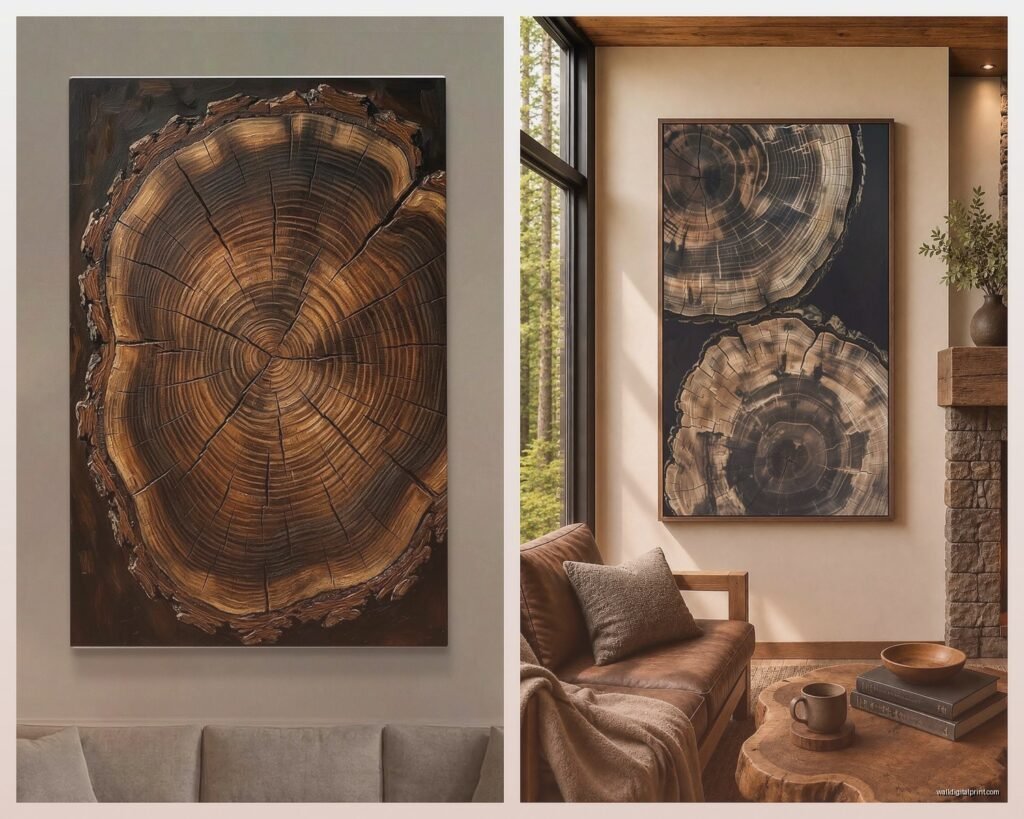
Wait I forgot to mention – you gotta think about the tree species if you’re going with real wood. Walnut has those gorgeous dark browns with lighter sapwood. Oak has really dramatic grain patterns. Cedar is reddish. Maple is super light and subtle. I keep a reference photo on my phone now because clients always ask “which wood should I get” and honestly it depends on your existing color scheme.
Installation Real Talk
Okay so hanging these is not like hanging a regular frame. Real wood slices are HEAVY. My dog freaked out when I dropped one while measuring and honestly same, it’s like 15 pounds of solid wood. You need:
- Heavy duty wall anchors if you’re not hitting a stud
- A level because the slices aren’t perfectly round so eyeballing it will fail
- Sometimes two people because balancing a big slice while you mark holes is impossible alone
- Picture hanging wire rated for at least 50 lbs even if your piece is lighter
Most wood slices come with a sawtooth hanger already attached and I hate those things. They’re never centered properly on irregular wood shapes. I remove them and install D-rings on both sides with wire stretched between. Way more stable.
For the lighter printed versions, regular picture hanging strips work great. I use the Command ones that hold 16 lbs for anything canvas-based. Just make sure your wall is actually clean – I wiped down a wall with a damp cloth once, didn’t let it fully dry, and the whole thing slid down the wall two hours later. Very embarrassing during a client walkthrough.
Styling These Things So They Don’t Look Random
This is gonna sound weird but tree ring art works best when you DON’T try to make it matchy-matchy with other nature stuff. Like, don’t put it next to your botanical prints and driftwood collection. It becomes too theme-y, too “I shop exclusively at HomeGoods.”
I pair them with:
- Modern abstract art – the organic rings contrast really well with geometric shapes
- Black and white photography
- Minimalist line drawings
- Vintage maps (weird combo but trust me)
- Nothing – seriously, one big piece on a blank wall is powerful
The tree rings themselves are the nature element, so everything else can be urban or contemporary or whatever. I did this whole wall in a client’s entryway with a massive oak slice surrounded by architectural drawings of buildings. Shouldn’t work but it really does.
Color Schemes That Actually Make Sense
If you’re going with natural unstained wood, it pulls warm. So your wall color matters. I’ve had the best luck with:
- Soft whites with warm undertones (not stark white, looks too clinical)
- Warm grays – like greige territory
- Deep charcoal or navy for drama
- Sage green but only if the wood has reddish tones, otherwise it’s too matchy
Cool-toned grays make the wood look dirty somehow. Can’t explain it but I’ve seen it happen multiple times.
Oh and if you’re buying stained pieces, which some sellers offer, go darker than you think. Light stains on wood slices just look unfinished. Either keep it completely natural or go dark walnut or ebony.
Where to Actually Buy These
Etsy is honestly your best bet for real wood slices. Sellers usually source locally and you can message them about specific species and sizes. I’ve ordered from like six different shops and the quality is pretty consistent. Look for sellers who show the bark edge – that’s usually a sign they’re working with quality cuts.
For printed versions, Society6 and Minted both have good options. The quality on Society6 is hit or miss depending on the artist, but their return policy is solid. Minted is more expensive but the printing is consistently good.
There’s also this random brand on Amazon called “Scandinavian Woods” or something that does laser-cut wooden wall art in tree ring patterns. Not actual slices, but thin wood veneer cut into the ring shape. I used one in a kid’s room and it’s held up great for two years, no cracking issues because it’s so thin.
The DIY Route If You’re Into That
My client canceled last month so I spent an afternoon trying to make my own and okay, it’s possible but kinda a pain. You need:
- Access to fresh-cut wood (found a tree service on Craigslist)
- Somewhere to dry the slices for literally 6-12 months
- Sandpaper in multiple grits
- Sealant – I used polyurethane
- Patience you probably don’t have
The drying part is what kills most DIY attempts. You can’t rush it or the wood cracks even worse. I’m still waiting on mine to dry fully, it’s been eight months. Probably should’ve just bought one.
If you wanna go the painted route DIY, that’s way easier. Get a canvas, find a reference photo of real tree rings, and paint concentric circles. Use a compass or trace different sized plates. Add some irregularities because perfect circles look fake. I did this as a demo for a workshop and it took maybe two hours. Use acrylic paint, layer different browns and tans, add some black for depth.
Maintenance and Long-term Stuff
Real wood needs dusting like any other surface. I use a microfiber cloth, nothing wet. Every year or so I wipe them down with furniture polish – the orange oil kind, not Pledge which leaves residue.
The bark edge will shed a little. Just vacuum under it occasionally. Some people remove the bark entirely but I think that’s half the charm.
If you get cracks (you will), you can fill them with wood filler tinted to match, or just embrace it. I’m team embrace-it because trying to color-match wood filler to the exact grain pattern is impossible and looks worse than the crack.
Printed versions basically need nothing. Don’t hang them in direct sunlight though – I watched a beautiful print fade over two summers in a west-facing room. UV-protective glass helps if you’re framing them.
Rooms Where These Work Best
I’ve literally used tree ring art everywhere but some spaces are more natural fits:
Living rooms – obvious choice, usually where people have the most wall space for statement pieces
Home offices – there’s something about the rings that feels contemplative without being distracting. Had a writer client who swears it helps with focus
Bedrooms – the organic shapes are calming, just go for lighter woods so it doesn’t feel too heavy
Bathrooms – okay hear me out, a small sealed wood slice in a powder room is unexpectedly cool. Just make sure ventilation is good
Kitchens – works in modern kitchens as part of a gallery wall, less so in traditional spaces
Kids’ rooms – great for teaching moments about nature and tree age, plus durable
Combining Multiple Pieces
Gallery walls with tree rings are tricky because the shapes are so organic. I usually do odd numbers – three or five pieces. Arrange them in a loose triangle or organic cluster, not a grid.
Mix sizes but not too drastically – your smallest shouldn’t be less than half the diameter of your largest. And leave more space between them than you would with regular frames. Like 6-8 inches minimum. They need breathing room.
This is probably controversial but I sometimes mix real wood with printed interpretations in the same display. The texture variety is interesting and the printed ones fill space without the weight. Just did this in a stairwell where we couldn’t mount anything too heavy on the upper sections.
Trends I’m Seeing Right Now
Resin-filled pieces are having a moment. Someone takes a wood slice, fills the cracks and natural gaps with colored resin (usually blue or green), and it’s very extra but clients love it. Not my personal style but I can’t deny they’re eye-catching.
Also seeing more painted rings on unconventional surfaces – metal, reclaimed wood, even ceramic tiles. There’s a cool artist who does tree rings on old vinyl records which sounds gimmicky but actually looks amazing in a music room.
The minimalist black and white interpretations are sticking around. Clean, modern, less rustic than the full-color wood versions. Good for people who like the concept but live in contemporary spaces.
Wait I should mention – there’s gonna be a sustainability question at some point. Real wood slices often come from trees that were already being cut down for other reasons – land clearing, storm damage, disease. Reputable sellers will tell you the source. If sustainability is important to you, ask before buying or just go with printed versions.
Anyway I’m gonna stop here because I could honestly talk about this forever but you probably have enough to make a decision now. The TLDR is: go bigger than you think, real wood will crack and that’s okay, hang it with proper hardware, and don’t overthink the styling. These pieces are pretty forgiving once they’re up.