Wall Art Guide, Wall Art Tutoriels
Round Wall Art for Living Room: Circular Main Space Designs
Nov
So I’ve been obsessing over round wall art lately because honestly, my living room felt so… boxy? Like everything was just rectangles and straight lines and it was making me twitchy. Started playing around with circular pieces and wow, the difference is actually insane.
Why Round Art Actually Works in Living Rooms
Okay so here’s the thing about circles – they soften everything. I had this client last month who had this gorgeous modern living room but it felt cold, you know? All hard edges. We added three round pieces in different sizes above her sectional and suddenly the whole space felt approachable. It’s something about how your eye moves around a circle versus getting stuck in corners.
The psychology is kinda cool too. Circles create this sense of movement and flow that rectangular art just doesn’t. Plus they’re having a HUGE moment right now, which means there’s actually good stuff available that won’t cost you a kidney.
Sizing This Thing Out (Don’t Overthink It But Also Don’t Mess It Up)
Alright so sizing is where everyone panics. I spent like three hours last Tuesday moving paper plates around my wall trying to figure this out for my own place – my cat thought I’d lost it completely.
For above a sofa, you want your round piece (or grouping) to take up about two-thirds to three-quarters of the sofa width. So if your couch is 84 inches, you’re looking at roughly 56-63 inches of art. You can do this with:
- One massive round piece (30-40 inches diameter)
- Multiple smaller circles clustered together
- A large center piece with smaller satellites around it
Single large pieces work best in minimalist spaces. I’m talking like 36-48 inch diameter rounds – they make a STATEMENT. But if your living room has a lot going on already, a gallery wall of smaller circles (12-20 inches each) feels less overwhelming.
The Height Thing Nobody Talks About
Hang the center of your art at 57-60 inches from the floor. That’s like… standard eye level. But if you’re doing it above furniture, the bottom of the frame should sit 6-10 inches above the back of the sofa. I learned this the hard way when I hung a beautiful 32-inch round mirror too high and it just floated there awkwardly for two weeks before I finally got the ladder back out.
Material Options That Actually Matter
Oh and another thing – the material changes everything about how the piece reads in your space.
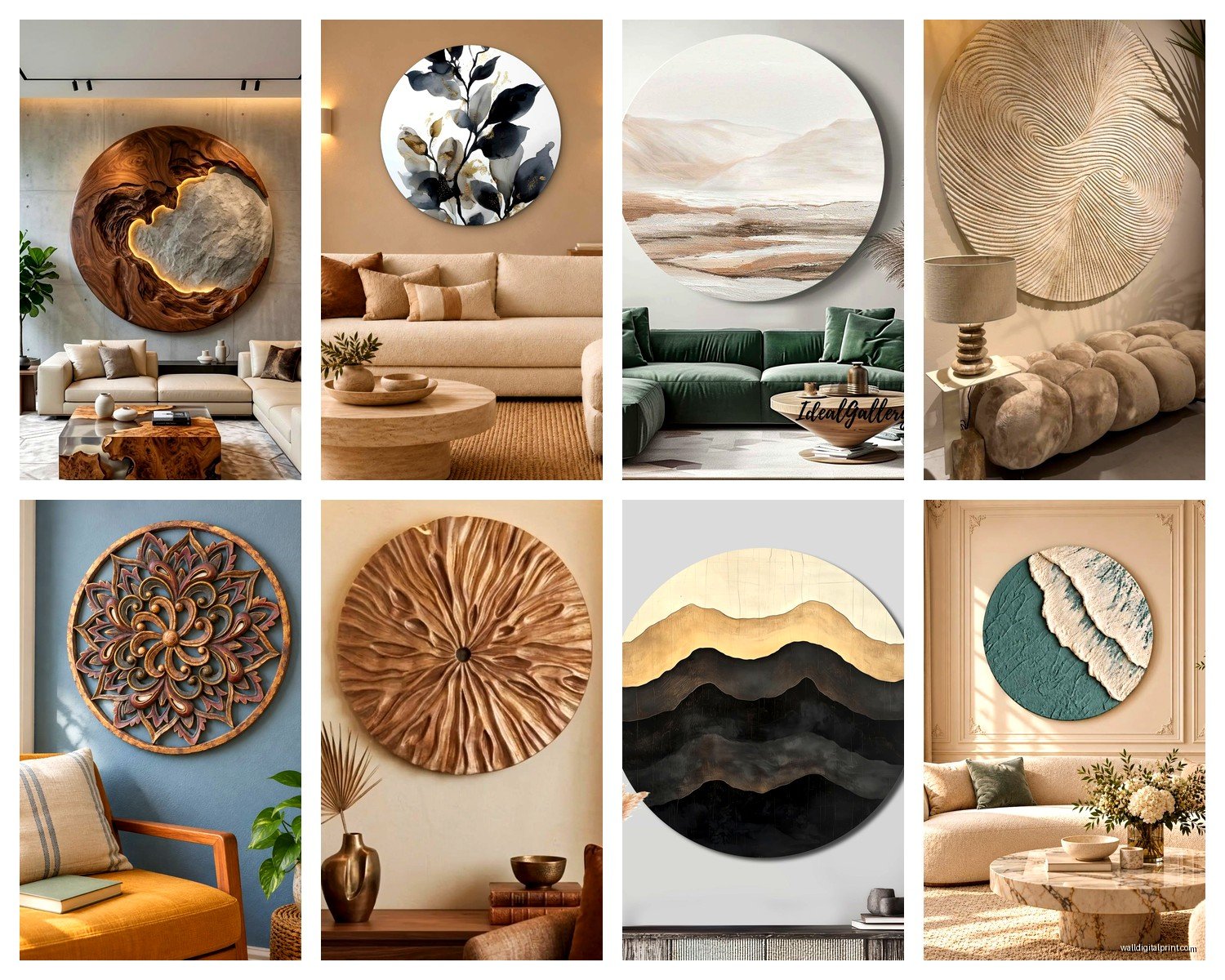
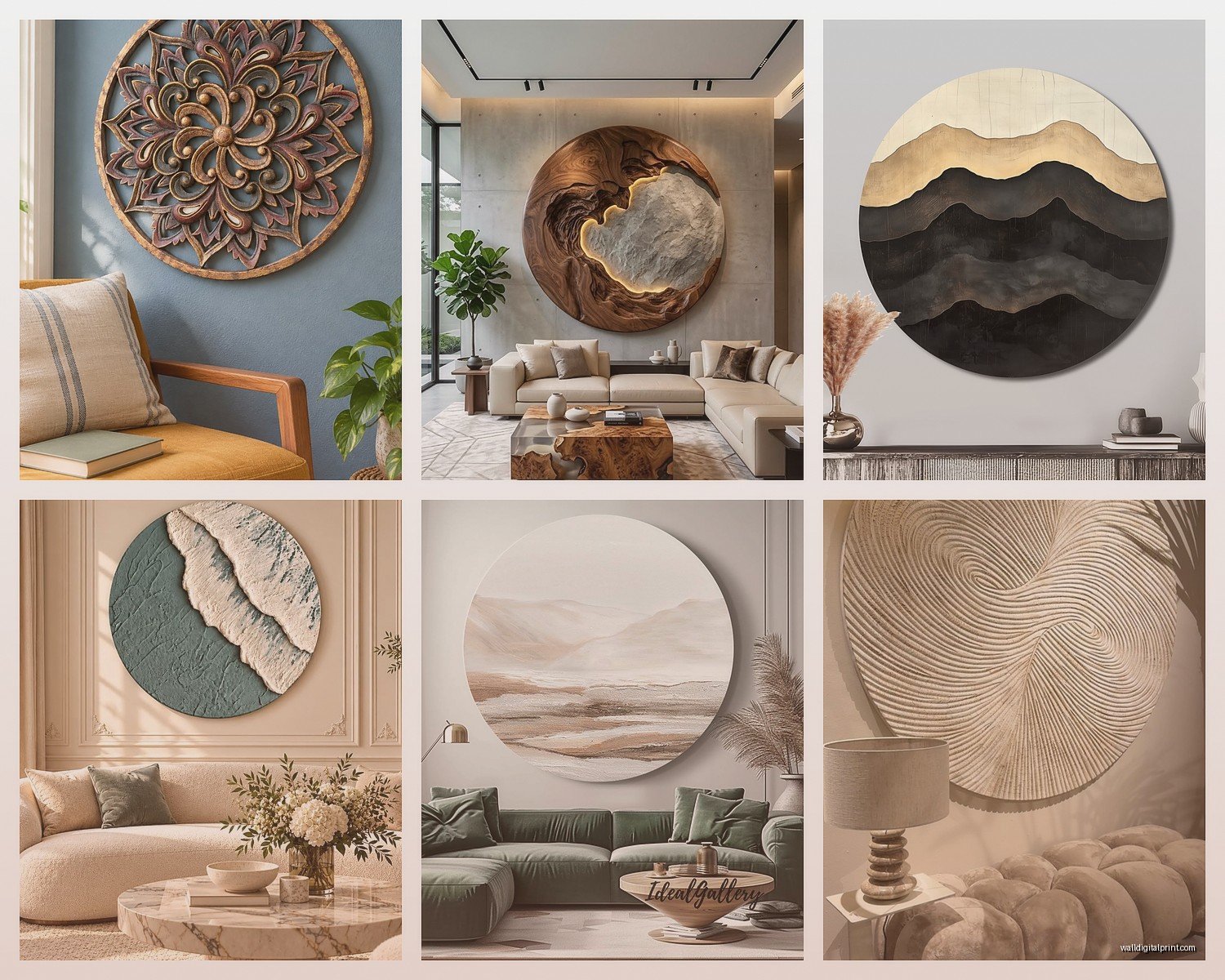
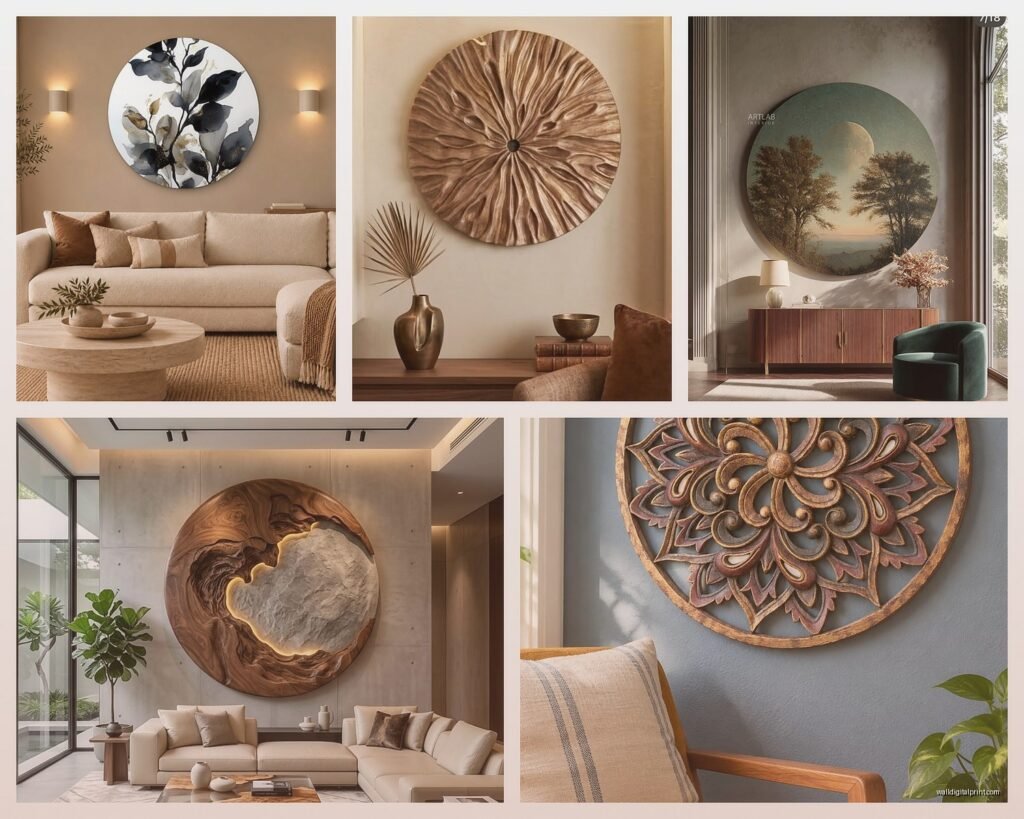
Wood rounds are having their moment. I’m seeing a lot of carved wood mandalas and those thin plywood pieces with geometric cutouts. They add texture without color, which is perfect if you’re working with a neutral palette. West Elm has some decent ones but honestly I found better prices at local artisan markets.
Metal circles feel more industrial-glam. I used a brushed brass circular piece in a client’s space last month and it reflected light in this really subtle way that made the whole room feel bigger. The catch is they show fingerprints like crazy if you have kids.
Canvas rounds are the most versatile because you can literally find any design. Abstract, landscape cropped into a circle, whatever. Just make sure the canvas is actually wrapped around a circular frame and not just a square canvas with rounded corners printed on it – I’ve seen some cheap versions that do this and it looks… not great.
Rattan and woven pieces bring in that organic texture everyone’s obsessed with. Baskets as art, basically. They work really well in bohemian or coastal spaces but can feel out of place in super modern rooms.
Color Coordination Without Making It Match-Matchy
So this is gonna sound weird but I actually don’t match my round art to my exact room colors anymore. I pull one or two accent colors and let the art introduce something new.
Like, I have this teal velvet sofa (don’t ask, I went through a phase) and instead of getting teal art, I went with a large circular abstract in rust, cream, and just a touch of teal. It ties in without being boring.
The rule I follow: your round art should contain at least ONE color that appears elsewhere in the room, but it shouldn’t be a perfect match. Pull from your throw pillows, rug, or even a smaller decor item. This creates cohesion without that weird hotel-room-set feeling.
Monochrome Circles Are Your Safety Net
If you’re nervous about color, black and white circular photography is like… foolproof. Architecture shots cropped into circles, black and white botanicals, line drawings. They work with literally everything and you can swap out your colorful accessories seasonally without the art clashing.
Layout Ideas I’ve Actually Tested
Wait I forgot to mention – layout is where you can get really creative or really safe, depending on your vibe.
The Symmetric Triangle: Three same-size circles in a triangle formation. Super balanced, works great in traditional spaces. I did this with 20-inch rounds in navy blue abstracts and it looked expensive for like $200 total.
The Asymmetric Cluster: This is my favorite. One large circle (maybe 30 inches) with 2-4 smaller ones (10-16 inches) scattered around it. It feels collected and interesting. The trick is keeping the spacing consistent – about 2-4 inches between each piece.
The Linear Flow: Five to seven small circles (8-12 inches) in a horizontal line. This works REALLY well above a long low console or credenza. It’s unexpected because people assume round art needs to be in a cluster.
The Solo Statement: Just one big beautiful round piece. 40+ inches. Centered. Done. This is for when the art itself is interesting enough to stand alone – like a heavily textured piece or something with a lot of detail.
I tested all of these in my own living room over the course of like three months (yeah, I have a problem) and the asymmetric cluster got the most compliments from people who came over.
Where to Actually Buy This Stuff
Okay so real talk about sources because I’ve wasted money in all the wrong places.
Etsy is goldmine for unique round art. Search “circular canvas art” or “round wall decor” and filter by your size and color. I’ve found incredible pieces from independent artists for $80-200. Just read reviews because shipping can be sketchy.
Society6 lets you put almost any design on a round canvas. The quality is decent for the price – I wouldn’t call it heirloom quality but it looks good from normal viewing distance.
Pottery Barn and West Elm if you want to see it in person first. Their round mirrors dressed up as art are actually pretty cool, and they go on sale frequently.
Anthropologie has interesting textural round pieces – the woven and rattan ones I mentioned. Pricey but unique.
Target surprisingly has upped their game. The Threshold and Project 62 lines have simple round pieces that work great in multiples. I bought four 16-inch rounds from there for a gallery wall and spent under $150.
Local art fairs and markets – this is where I find the stuff that people actually compliment. One-of-a-kind pieces that don’t look like everyone else’s living room.
DIY If You’re Feeling Ambitious
I made my own round art once during a particularly ambitious weekend. Bought a 24-inch round canvas from the craft store ($18), some acrylic paints, and just went abstract. It’s actually still hanging in my reading nook and people assume I paid way more for it than I did. There’s something cool about having a perfectly sized custom piece.
You can also frame fabric or wallpaper samples in round frames. Spoonflower has amazing designs and you can order just a yard.
Mixing Round Art with Other Shapes
Oh and another thing – you don’t have to go ALL circles. In fact, sometimes that’s too much. I like mixing one or two round pieces into a gallery wall that’s mostly rectangular. It breaks up the grid in this really satisfying way.
The ratio I use: if you have 9 pieces total, make 2-3 of them circular. Any more than that and it starts feeling theme-y rather than curated.
Also round mirrors count as round art, just saying. I have this 28-inch round mirror with a brass frame mixed into my gallery wall and it adds depth plus reflects light from the window. Two functions, one piece.
Common Mistakes I’ve Made So You Don’t Have To
Going too small. Seriously, round art needs to be bigger than you think to have impact. A 12-inch circle on a big blank wall just looks lost. Size up.
Hanging multiple rounds in a perfect grid. It feels forced. Circles are organic shapes – let them have some asymmetry and breathing room.
Forgetting about the frame or edge. Some round canvases have really thick edges that become part of the design. Others are meant to float in a frame. Know which you’re getting before you buy.
Matching the art too perfectly to one pillow or something. It ends up looking like you tried too hard. Pull colors loosely instead.
The Lighting Situation
This is gonna sound extra but lighting makes such a difference with round art. I added a picture light above my large circular piece and it went from “nice” to “wow is that from a gallery?”
If you can’t do picture lights, just make sure there’s ambient lighting that hits the wall. Round art in a dark corner is sad round art.
Style-Specific Approaches
Modern/Minimalist: One large circle in black, white, or a single bold color. Clean lines, simple subject matter. Think geometric abstracts or minimalist photography.
Bohemian: Layered rattan circles, woven wall hangings in round shapes, macramé dreamcatchers. Mix sizes and textures freely.
Traditional: Ornate round mirrors, classic art in circular frames, symmetrical arrangements. Go for formal balance.
Coastal: Round driftwood pieces, circular rope art, ocean photography cropped into circles. Natural materials are your friend here.
Industrial: Metal rounds, gears or mechanical-looking circular pieces, black and white urban photography in round frames.
I decorated a loft apartment last year that was super industrial and we used three metal circular pieces with cutout designs – they looked like oversized gears and the client loved how they played with the exposed brick.
Seasonal Swapping
One thing I love about smaller round pieces – they’re easy to swap seasonally. I have a rotation going where I switch out two 18-inch rounds on my gallery wall depending on the season. Fall gets warm abstracts in rust and gold, spring gets botanical prints, summer gets coastal vibes. The larger pieces stay but those two changeouts keep it feeling fresh.
Okay so I think that covers most of what I’ve learned through trial and error (mostly error, let’s be honest). The main thing is don’t be scared of going bigger than feels comfortable – round art needs presence to work. And have fun with it? Like it’s just art, you can always move it if it doesn’t work.
My dog is currently barking at a delivery person so I gotta go, but seriously, round art changed my living room game. Just start with one piece and see how it feels.