Wall Art Guide, Wall Art Tutoriels
Astronomy Wall Art: Stars Planets Telescope Science Decor
Oct
So I’ve been absolutely obsessed with astronomy wall art lately and honestly it started because a client wanted to turn their spare bedroom into this whole stargazing vibe without actually going outside in the cold. Which, mood.
The thing about astronomy decor is there’s SO much out there and like half of it looks amazing online but then shows up looking like a middle school science poster. I’ve tested probably 30 different pieces at this point between my own space and client projects and here’s what actually works.
First Thing About Print Quality Nobody Tells You
Okay so the biggest issue with planet prints and star maps is they look incredible on your phone screen at 2am when you’re scrolling Etsy, but then you get this washed out thing that’s basically just gray blobs. The resolution matters SO much more than with regular art because you’re dealing with deep blacks and these tiny pinpoint stars.
I learned this the hard way with a Hubble telescope print I ordered. Looked stunning in the preview, arrived looking like someone printed it at a FedEx on the draft setting. Now I only buy astronomy prints that are minimum 300 DPI and I actually message sellers to confirm before ordering. Most legit ones will tell you straight up.
Canvas prints are tricky for space stuff because the texture can mess with the detail. I’ve had better luck with metal prints for anything with a lot of stars or planetary detail. There’s this company that does aluminum prints and the way the light reflects off the surface actually makes nebulas look more dimensional? My cat knocked one off the wall last month and it didn’t even dent, just scared us both half to death.
The Whole Star Map Personalization Thing
Star maps are everywhere right now. You know the ones where you put in a date and location and it shows what the sky looked like that night. I’ve bought like six of these for clients doing nurseries or anniversary gifts.
Here’s what matters: make sure the company actually uses accurate astronomical data. Some of them just randomly scatter stars and hope you won’t notice. The Greater Skies ones are legit, I’ve compared them against actual star charts. Also Night Sky and Under Lucky Stars are solid.
But also don’t stress too much about perfection because unless you’re buying it for an actual astronomer, most people won’t know if Orion is tilted three degrees wrong. I ordered one for my sister’s wedding and spent an hour agonizing over whether to use the ceremony time or reception time and she didn’t even notice I’d included the coordinates.
The customization options get overwhelming. Do you want constellations labeled? Just dots? Lines connecting them? I usually go with constellation lines included because otherwise it’s just random dots and kinda hard to read as “sky” versus “abstract speckles.”
Framing These Things
Oh and another thing, framing matters more than you’d think. Black frames are the obvious choice and yeah they work great, but I’ve also done natural wood frames with deeper space prints and it makes them feel less science-classroom and more sophisticated.
For multiple pieces, like if you’re doing all the planets in a row, keep the frames identical. I did a solar system setup for a client’s kid and we used these thin black metal frames from IKEA (the SILVERHÖJDEN ones I think?) and just lined them up in order. Cost maybe $60 total for nine frames and looked way more expensive.
Actual Telescope Photography Prints
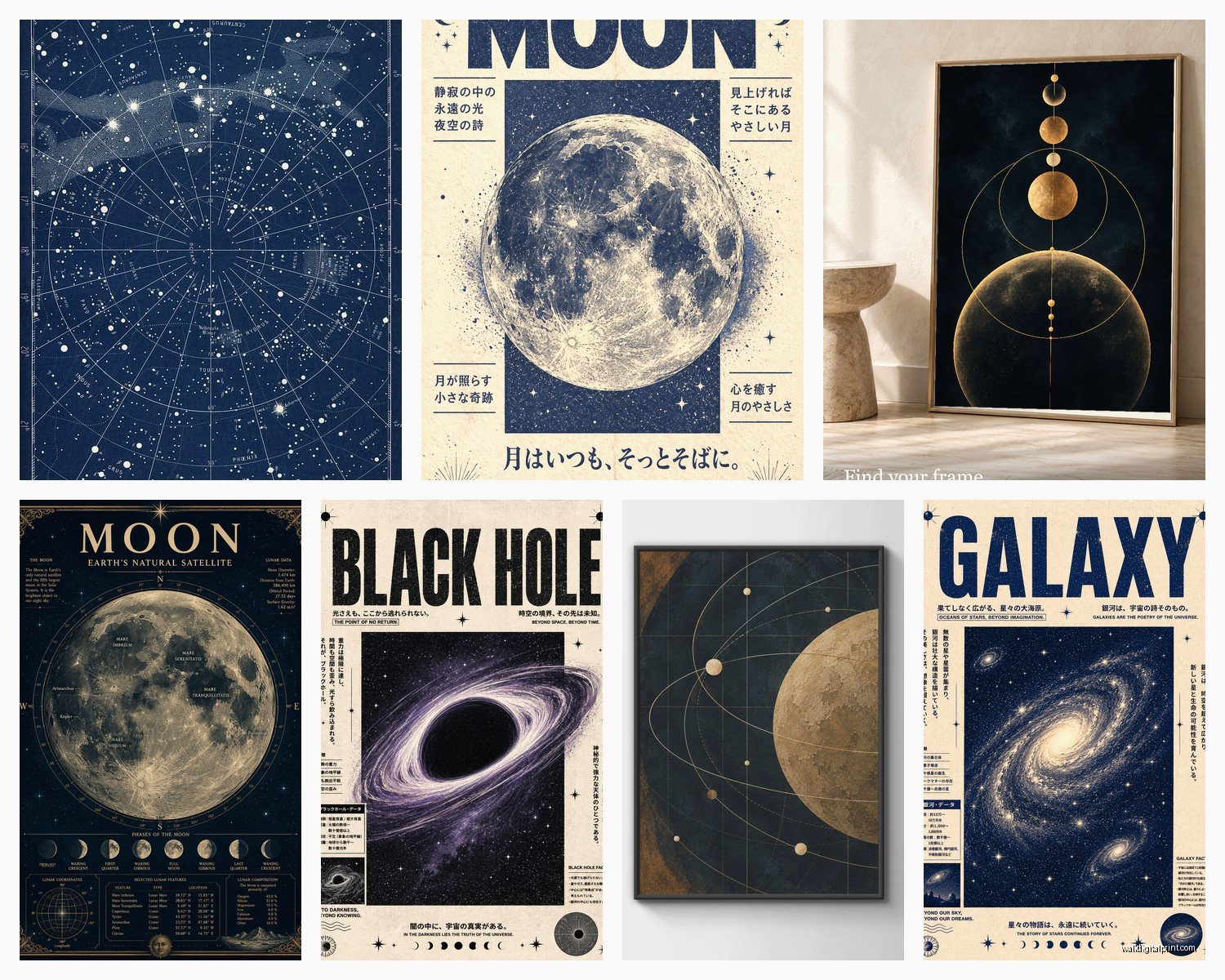
This is gonna sound weird but some of my favorite astronomy art isn’t the colorful Hubble stuff everyone uses. It’s the vintage telescope drawings from like the 1800s. There’s something about those hand-drawn moon maps and planet sketches that feels more interesting than another Pillars of Creation print.
You can find public domain telescope drawings from old astronomy books and get them printed yourself. I use the Biodiversity Heritage Library and NASA’s image archives. Completely free, just download and take the file to a print shop. Did this for my own office with these gorgeous moon phase illustrations from a 1920s astronomy textbook.
But if you want actual modern telescope photography, NASA’s website has thousands of images you can download in high resolution for free. Like actually free free, not “free with watermark” or “free for personal use only.” Public domain. I’ve printed stuff straight from their archives and it’s incredible quality.
The James Webb telescope images that came out recently are absolutely stunning for prints. Those deep field images with thousands of galaxies? Unreal. Just make sure you’re downloading the full resolution version, not the web-optimized one.
Planet Prints and What Actually Looks Good
Everyone wants Jupiter or Saturn because they’re the pretty ones. And yeah, they’re gorgeous, but I’ve found that moon prints get more reaction from people visiting. Something about the familiarity mixed with seeing all that detail.
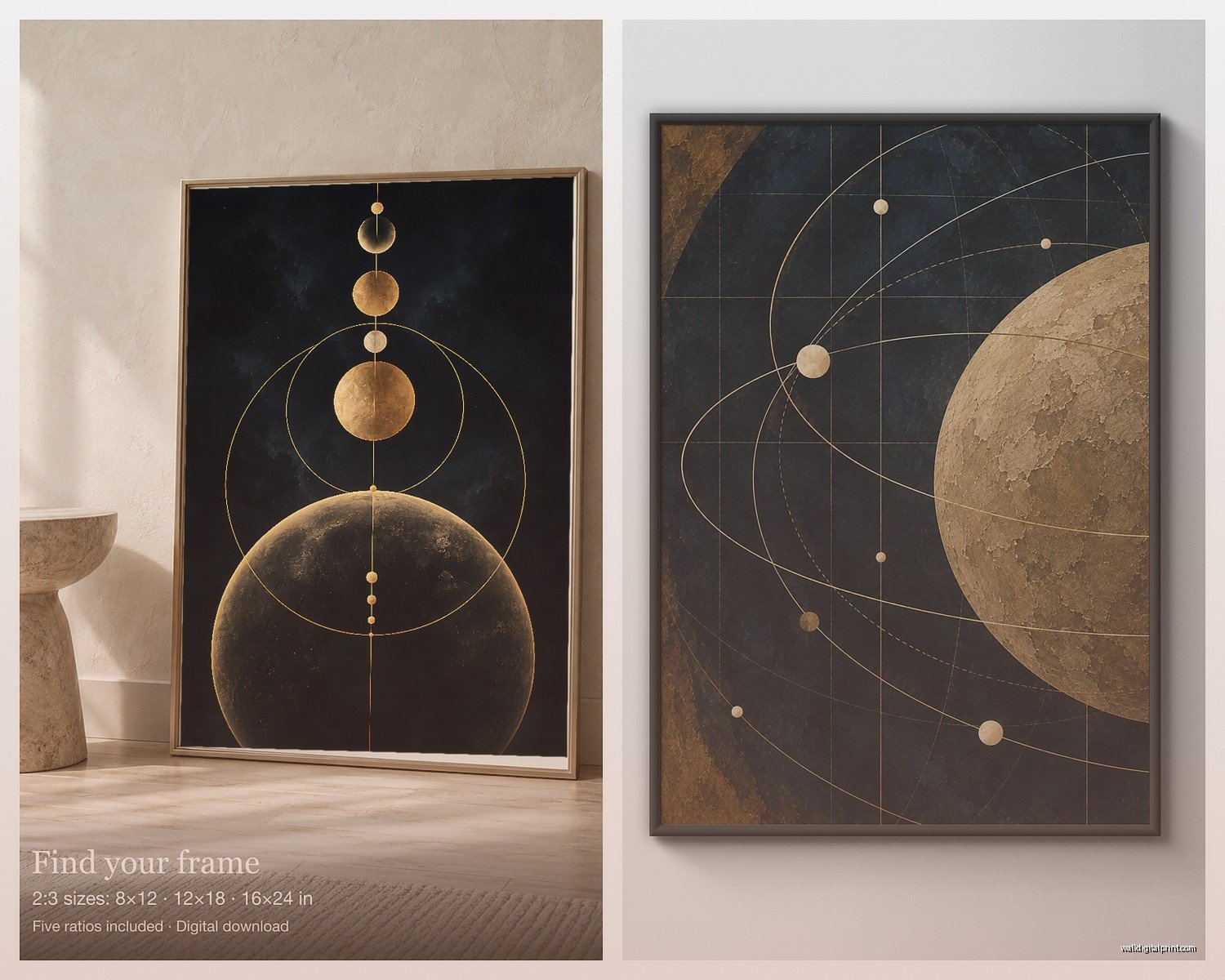
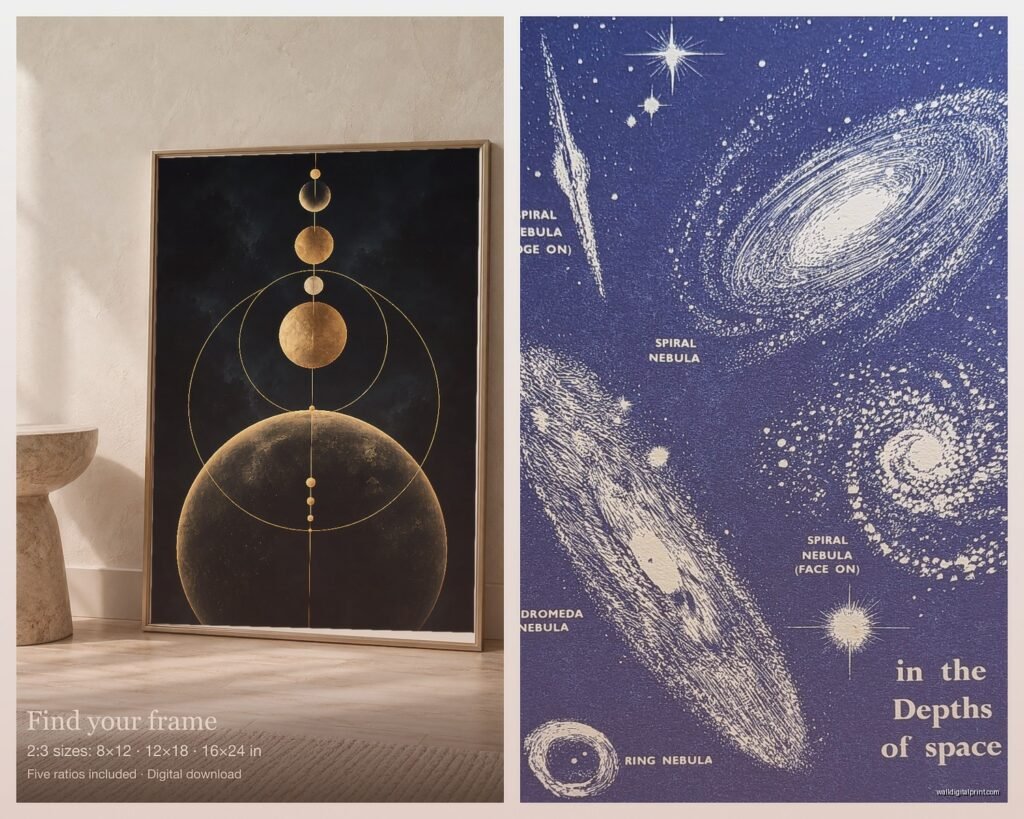
There are these minimalist planet prints where it’s just clean circles of each planet against black backgrounds. Very modern, very simple. I thought they’d be boring but I used a set in a client’s home office and they’re sophisticated without being too science-y. The brand was Kurzgesagt I think? They do infographic-style space art.
For kids rooms though, you can go more colorful and illustrated. Not everything has to be photographically accurate. I did a nursery last year with these watercolor-style planet prints that were scientifically wrong but artistically beautiful and that was the right call for a two-year-old’s room.
Size and Scale Issues
Okay so funny story, I ordered a “large” moon print without checking dimensions and it showed up the size of a dinner plate. My own fault but now I’m obsessive about measurements.
For astronomy art, I actually think bigger is better up to a point. A 16×20 minimum for a focal piece, 24×36 if you’ve got the wall space. Small astronomy prints just don’t have the impact. The whole point is to feel immersed in space, and a tiny Saturn isn’t doing that.
But I’ve also seen people go too big with busy nebula images and it’s overwhelming. Like you’ve got this massive explosion of pink and purple taking up an entire wall and it’s just too much visual noise. For really colorful pieces, maybe cap it at 30×40.
Wait I forgot to mention constellation art. This is different from star maps. It’s artistic interpretations of constellations, sometimes with the mythology illustrated. I’m weirdly picky about these because a lot of them are too cutesy or too literal. The best ones I’ve found are minimalist line drawings with just the stars and constellation lines, maybe a tiny illustration of what it represents.
The Whole Galaxy Tapestry Debate
Tapestries are cheap and easy but here’s my honest take: they usually look cheap and easy. Those printed fabric galaxy tapestries you see everywhere on Amazon for $15? They’re fine for a dorm room or temporary situation but the colors fade fast and they wrinkle weird.
If you’re gonna do fabric, get an actual quality one. There are artists who print on proper tapestry material with better dyes. Still not as sharp as a framed print but way better than the cheap ones.
I have used the budget tapestries as temporary solutions while waiting for custom pieces to arrive, so they have their place. Just know what you’re getting.
Creating a Gallery Wall With Space Themes
This is where it gets fun. You can mix different types of astronomy art and it actually works really well. I did a gallery wall that combined vintage telescope drawings, modern NASA photos, a star map, and a simple moon phase chart. Different styles but cohesive theme.
The trick is keeping your color palette consistent even if the styles vary. Stick with mostly black and white or mostly cool tones. Don’t mix warm orangey Mars prints with cool blue nebulas unless you really know what you’re doing.
Spacing matters more with astronomy stuff than regular art because a lot of these pieces have black backgrounds. If you hang them too close together, they kind of blob into one big dark rectangle. I go slightly wider spacing than I would with normal gallery walls.
Mixing in 3D Elements
Okay this might be extra but adding some dimensional elements makes it feel less flat. I’ve hung actual small telescopes on shelves near astronomy prints, or those hanging glass planets, or even just a small globe. It gives the wall more depth.
Shadow boxes with meteorite fragments are cool if you’re really into it. I found one on Etsy with an actual tiny meteorite piece and information about where it was found. Expensive but made the whole wall feel more curated.
Lighting These Pieces
This is huge and people forget about it. Astronomy art needs the right lighting or it disappears into darkness or gets washed out by glare.
For dark space prints with deep blacks, you want directed lighting that doesn’t create glare. Picture lights or track lighting aimed at an angle. Regular overhead lighting often creates this weird reflection off the glass.
I’ve also experimented with backlighting for certain pieces. There are LED strips you can put behind frames that create this glow effect. Works especially well with moon prints or single planet images. Makes them feel like they’re actually glowing. My client did this in his basement home theater and honestly it’s maybe my favorite project I’ve done.
Where to Actually Buy This Stuff
Etsy is obvious but quality varies wildly. I filter by reviews and actually read them, especially looking for comments about print quality and shipping packaging. Lots of sellers don’t package prints properly and they arrive bent.
Society6 and Redbubble have tons of options from independent artists. The quality is pretty consistent since it’s printed through their service. I’ve ordered probably 20 things from Society6 and only had one issue.
For high-end stuff, there are galleries that specialize in space photography. Pricey but museum quality. I’m talking like $500+ for a print, but if you’ve got the budget and want something really special.
Don’t sleep on museum shops either. The Smithsonian Air and Space Museum shop has great stuff, same with planetarium gift shops. Often better quality than random online sellers.
DIY Options That Don’t Look DIY
If you’re crafty or on a budget, printing your own can work. Find public domain images, take them to a local print shop, get them printed on good paper or canvas. Frame them properly and nobody will know you didn’t buy a $200 piece.
I did this for my own apartment with some vintage Mars maps and spent maybe $40 total for three large framed prints. Just gotta use high-resolution source images and a decent printer.
Some FedEx locations have surprisingly good large format printers. I’ve used them in a pinch and been happy with results for the price.
What Doesn’t Work
LED light-up prints of space scenes mostly look tacky. I’ve tried them thinking they’d be cool and they just look cheap. The LEDs are too bright and unnatural.
Glitter or metallic space prints for adult spaces. Just no. Kids rooms, fine, go wild, but for grown-up spaces they look like they came from a mall kiosk in 2003.
Those huge decals that turn your whole ceiling into a starfield. I wanted to love these but they never look realistic and they’re a pain to apply evenly. Saw someone try it on a vaulted ceiling and it was a disaster. If you want ceiling stars, get a projector.
Really busy collage-style prints with like 47 different space images crammed together. Too chaotic. Your eye doesn’t know where to look.
Matching Your Room’s Vibe
Modern minimalist spaces do best with clean, simple astronomy art. Single planet prints, constellation line drawings, black and white moon phases. Keep it restrained.
If your style is more eclectic or bohemian, you can go colorful with nebulas and galaxies. Mix in those illustrated constellation pieces.
Traditional or classic decor actually works great with vintage astronomy prints. Those old telescope drawings and antique star charts fit perfectly with traditional furniture.
I did a client’s mid-century modern living room with a huge black and white moon print and it was perfect. The clean lines of MCM furniture work really well with the geometric nature of planets and moons.
Just don’t force it if space themes don’t match your overall aesthetic. Not every room needs astronomy art even if you love space. I’ve talked clients out of it when it just wasn’t gonna work with their existing style.
Anyway that’s basically everything I’ve learned from way too much time thinking about space art. The main things are just check your print quality, size it right for your wall, and don’t overthink the whole thing unless you’re decorating for an astrophysicist who’ll fact-check your constellation positions.