Wall Art Guide, Wall Art Tutoriels
Eclectic Wall Art: Mixed Style Bohemian Diverse Collection
Nov
So I’ve been curating eclectic wall art collections for like seven years now and honestly the whole “mixed style bohemian” thing sounds way more complicated than it actually is, but also people get it wrong all the time because they think it just means throwing random stuff on a wall and calling it a day.
First thing you gotta understand is that eclectic doesn’t mean chaotic. I learned this the hard way when I tried to style my first client’s living room and it looked like a thrift store exploded. There’s this underlying thread that needs to connect everything even when the pieces themselves look totally different. For me, that thread is usually either a color palette, a mood, or a repeated shape that shows up in different ways.
Starting With Your Anchor Piece
Okay so you need one piece that’s gonna be your anchor. This is usually the biggest or the boldest thing you’re hanging. I always tell people to pick this first before buying anything else because everything else will reference back to it somehow. Could be a large abstract painting, a vintage textile hanging, an oversized macramé piece, whatever speaks to you. My cat literally knocked over my coffee while I was writing this but anyway.
The anchor piece should be something you genuinely love, not something you buy just because it’s trendy. I made that mistake with a geometric print everyone was buying in 2019 and I got so sick of looking at it within like three months. Your anchor sets the tone for the entire collection.
Size Matters More Than You Think
Your anchor should take up roughly one-third to one-half of your wall space if you’re doing a gallery wall situation. If it’s going solo on a wall, different rules apply but we’re talking collections here. I usually go for something that’s at least 30×40 inches for a standard living room wall, but I’ve gone smaller in tight spaces like hallways.
Building Your Supporting Cast
Once you have your anchor, you’re gonna build around it with 4-8 additional pieces depending on your wall size. This is where the eclectic part really comes in. You want variety in:
- Medium (prints, paintings, photographs, textiles, objects)
- Frame styles (wood, metal, no frame, ornate, minimal)
- Subject matter (abstract, figurative, landscapes, typography)
- Era or style (vintage, contemporary, folk art)
- Texture (smooth prints, woven pieces, three-dimensional objects)
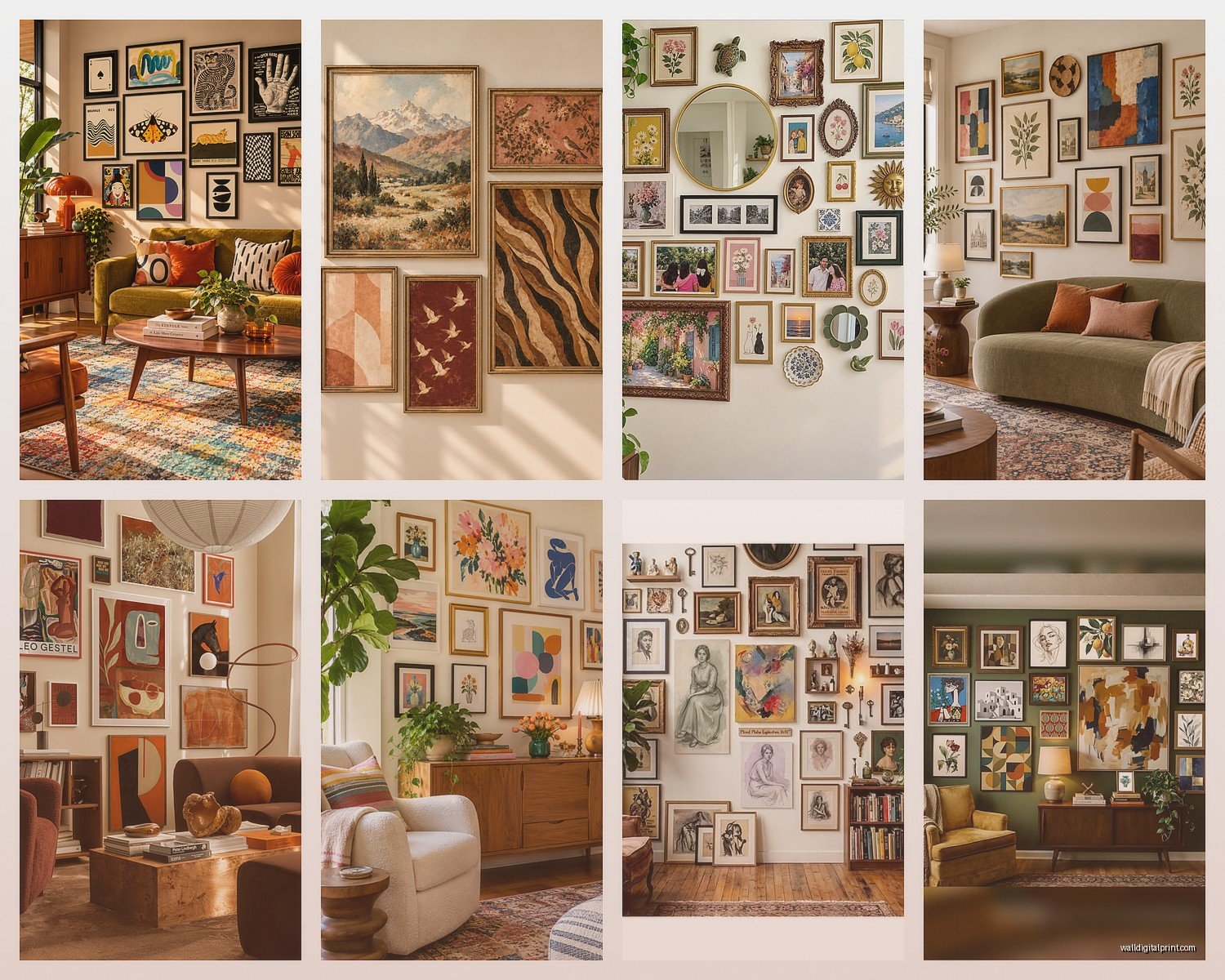
But here’s the thing that’s gonna sound weird but trust me on this… you also need some repetition. If everything is different, your eye doesn’t know where to land and it just feels messy. So maybe you repeat a color across three different pieces, or you use the same frame style on two pieces even though the art inside is completely different, or you have a theme like “all the pieces have some element of nature” even though one’s a photo and another’s an abstract watercolor.
The Color Palette Thing Everyone Gets Wrong
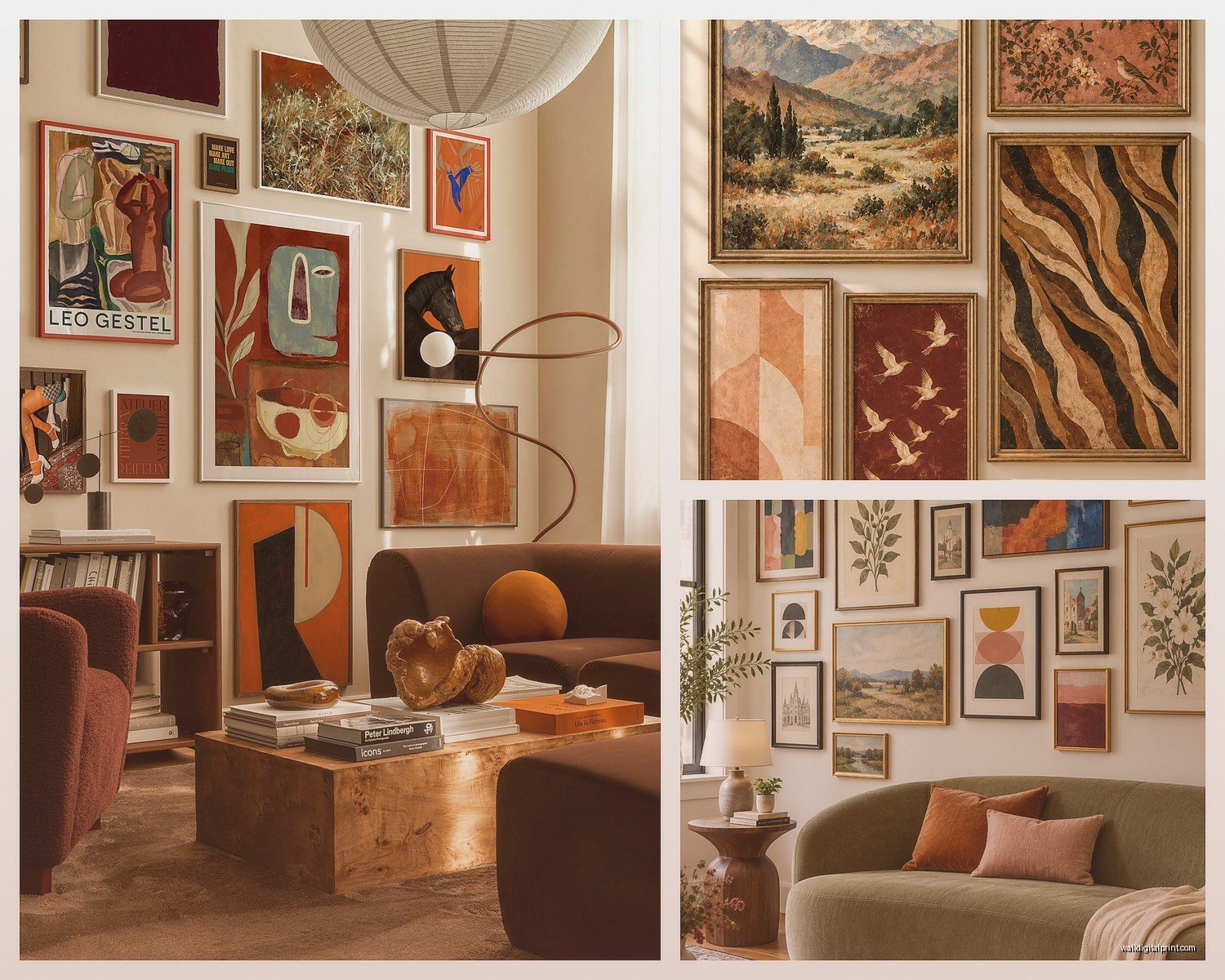
People think bohemian means rainbows and every color ever. It can, but it usually looks better when you stick to like 4-6 main colors that show up in different intensities across your pieces. I’m obsessed with terracotta, dusty pink, sage green, cream, and navy right now, so I’ll pull pieces that hit some combination of those colors even if the styles are wildly different.
You can have one or two pieces that introduce a pop of something unexpected, like a bright yellow or a deep purple, but use that sparingly. I’ve got this vintage botanical print that has this one orange flower and it’s the only orange in my entire collection and it just… works because it’s surprising but not overwhelming.
Where to Actually Find This Stuff
Okay so funny story, I used to only shop at typical art stores and everything looked so matchy-matchy. Now I pull from like eight different sources and it’s made all the difference.
Thrift stores and estate sales are obviously great for vintage pieces and weird unexpected finds. I found this amazing needlepoint of a lion that someone’s grandmother probably made in the 70s and it’s one of my favorite pieces. Cost me $8. You’re not gonna find stuff like that at West Elm.
Etsy is incredible for printable art and also for original pieces from independent artists. I probably source 40% of my collection pieces from Etsy. Just make sure you’re reading reviews because quality varies wildly. Some sellers are printing on like regular printer paper and charging $30 which is ridiculous.
Local art fairs and markets give you access to original work and you can actually talk to the artists about custom sizing or colors. I’ve commissioned three pieces this way and they’re always the ones people ask about.
Society6, Minted, Artfully Walls for when you need something specific in a specific size. They’re more expensive than printables but the quality is consistent and they have good return policies which matters when you’re trying to match something to an existing collection.
Vintage shops and antique malls for textile pieces, old maps, pressed botanicals, weird stuff your grandparents would’ve had. This is where you find the pieces with actual history and texture.
Frame Strategy That Won’t Make You Go Broke
Frames are expensive and this is where people either give up or spend like $800 without meaning to. Here’s what I do and it’s gonna save you so much money.
Mix expensive custom frames with cheap ones strategically. Your anchor piece and maybe one or two other prominent pieces should have really nice frames. Everything else can be IKEA or thrifted or even those frames from HomeGoods that are like $20. When they’re all hanging together, people genuinely can’t tell which frames cost $200 and which cost $15.
I keep maybe three different frame finishes in my collections max. Like right now I’m doing natural wood, matte black, and brass. That’s it. Even though the frame styles vary (some chunky, some thin, some ornate), those three finishes create cohesion.
Also you don’t have to frame everything. Some of my favorite gallery walls include unframed canvas pieces, tapestries hanging from a dowel rod, or prints just clipped to the wall with brass clips. Mixing framed and unframed adds to that bohemian eclectic vibe.
The Matting Debate
White or cream matting is your friend when you’re mixing different art styles. It creates breathing room and makes disparate pieces feel more connected. But you don’t need it on everything, maybe just on 50-60% of your pieces. The photographs and prints benefit from matting more than paintings or textiles do.
Actually Hanging This Stuff Without Losing Your Mind
Wait I forgot to mention this earlier but before you hammer a single nail, lay everything out on the floor in the arrangement you’re thinking. Take a photo from above. Live with that photo for a day or two. I can’t tell you how many times I’ve changed my mind after sleeping on it.
The classic advice is to keep 2-3 inches between pieces but honestly I vary that depending on the vibe. Sometimes I go tighter (1.5 inches) for a more curated collected-over-time look, sometimes I go wider (4-5 inches) for a more airy bohemian feel.
Start with your anchor piece and hang that first. Then work outward from there. I use painter’s tape to mark where the other pieces will go before I start making holes in the wall. Sounds tedious but it’s way less tedious than patching fifteen extra holes because you eyeballed it.
Height and Eye Level
The center of your arrangement should be at eye level, which is usually around 57-60 inches from the floor. But if you’re putting this above a sofa or console, different rules. You want the bottom of your lowest piece to be 6-10 inches above the furniture.
I’m watching this show about art forgers right now and it’s making me paranoid about authenticity but that’s not really relevant here.
Adding Dimension and Texture
This is what separates okay eclectic collections from really good ones. You need some three-dimensional elements. Not everything should be flat against the wall.
- Woven wall hangings or macramé
- Floating shelves with small objects or plants
- Plates or decorative bowls hung on the wall
- Shadow boxes with found objects
- Small mirrors mixed in
- Dried flowers or pampas grass in wall-mounted vases
I usually include 1-2 dimensional pieces per every 6-8 flat pieces. More than that and it starts competing with itself. Less and it feels too flat and one-dimensional.
The Stuff That Doesn’t Work
Gonna be real with you about what I’ve tried that totally failed. Mass-produced “boho” wall art sets from Amazon where everything is too coordinated. They’re marketed as eclectic but they’re not, they’re just matching sets with slightly different designs and they look boring.
Also trying to force a piece into your collection just because it fits the color scheme but you don’t actually like it. That energy comes through somehow and the whole arrangement feels off.
Too many words or typography pieces. One or two is great, more than that and it feels like you’re living in a motivational poster store. I learned this from a client who wanted like five different quote prints and I had to gently redirect her.
Rotating and Evolving Your Collection
Oh and another thing, your collection doesn’t have to be permanent. I swap pieces out seasonally or when I find something new I’m excited about. This keeps it feeling fresh and also means you don’t have to commit to everything forever. I have a storage system where I keep pieces I’m not currently displaying and I rotate things in and out every few months.
Some people think this is extra but it’s actually practical because you get more mileage out of each piece and your space doesn’t get stale.
Budget Real Talk
You can absolutely do this on a budget, it just takes more time. My first eclectic wall took me like six months to complete because I was thrifting and waiting for sales and printing my own stuff. But it cost maybe $200 total for a wall that would’ve cost $1500+ if I’d bought everything retail.
Printable art that you download and print at a local print shop is your best friend. You can get museum-quality prints for like $15-30 depending on size. Frame them yourself in thrifted or IKEA frames and you’ve got custom art for under $50 per piece.
Where to Splurge vs Save
Splurge on your anchor piece and one or two original artworks if you can. These give your collection authenticity and soul. Save on the supporting pieces, the smaller prints, the decorative elements. Nobody’s gonna inspect those closely enough to know whether you paid $200 or $20.
Also splurge on proper hanging hardware. Those cheap plastic anchors that come with frames are garbage. Get actual wall anchors or picture hanging strips rated for the weight you’re hanging. I’ve had pieces fall at 2am and it’s terrifying and also you gotta patch the wall and rehang everything.
Making It Feel Cohesive
This is the hardest part honestly. You want enough variety to be interesting but enough similarity to feel intentional. I use this rule where every piece should relate to at least two other pieces in some way. Maybe it shares a color with one piece and a style with another, or shares subject matter with one and a frame finish with another.
Step back from your wall every time you add a piece and take a photo. Photos show you things your eye misses when you’re standing right there. I’ve caught so many balance issues this way, like when all my warm-toned pieces were clustered on one side and it felt weighted wrong.
The overall shape of your arrangement matters too. You can go symmetrical, asymmetrical, grid-based, organic… I tend toward asymmetrical organic shapes because they feel more collected and less designed, but I’ve done grids that look amazing too.
Anyway I think that covers most of it? The main thing is just to trust your eye and not overthink it. If you love all the individual pieces and they share some common threads, it’s gonna work out. Start small, add slowly, and don’t be afraid to rearrange until it feels right.