Wall Art Guide, Wall Art Tutoriels
Lounge Room Wall Art: Casual Living Space Decor
May
So I’ve been styling lounge rooms for like eight years now and wall art is honestly where most people totally overthink things or just… give up and leave their walls blank for months. Which, fair enough, because it’s weirdly hard to get right in a casual living space.
The thing about lounge room art versus like, a formal living room, is that you actually want it to feel lived-in and not too precious. I learned this the hard way when I put this gorgeous abstract piece in my own lounge and then felt stressed every time someone put their feet up on the couch because what if they knocked into it or whatever. Total fail.
Start With What You Actually Do In There
Okay so before you buy anything, think about how you use the space. Are you binge-watching Netflix in there? Gaming? Do your kids sprawl all over the floor? My brother has this lounge where they basically live and the last thing he needed was delicate photography prints that would stress everyone out.
For casual spaces I usually go with:
- Prints instead of originals (you can get museum-quality prints now that look incredible)
- Framed pieces rather than canvas wraps because they feel more intentional but still relaxed
- Nothing too massive that dominates the room… unless that’s specifically the vibe you want
- Art that can handle being mostly ignored tbh, which sounds weird but you’re not gonna stand there contemplating it daily
The Gallery Wall Thing Everyone Tries
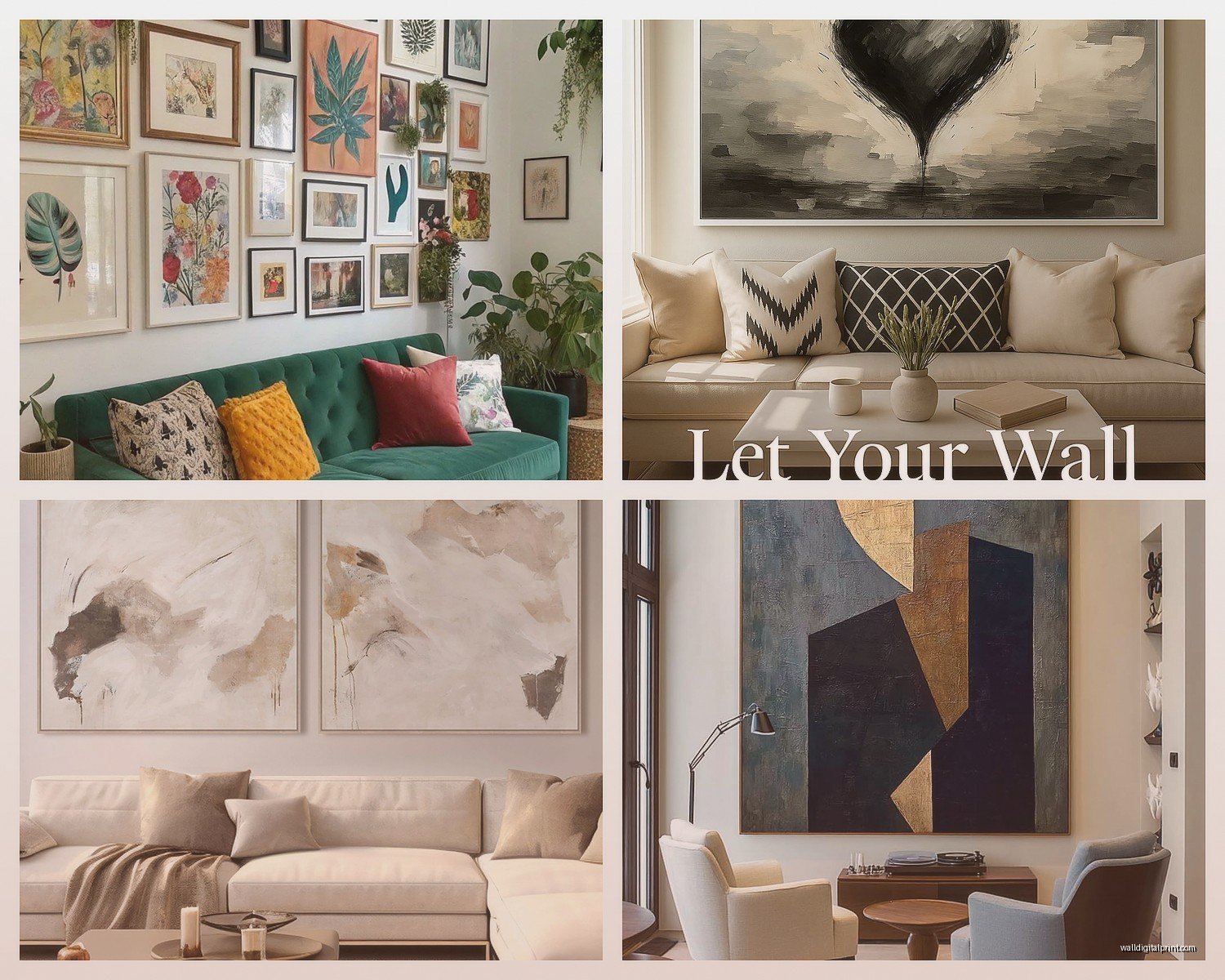
Look, gallery walls are everywhere on Pinterest and yeah they can look amazing but they’re also kind of a pain. I’ve installed probably fifty of them for clients and here’s what actually works:
Get your layout figured out on the floor first. Trace your frames on kraft paper, tape them to the wall, live with it for a day or two. I know that sounds excessive but I once spent three hours hanging a gallery wall only to realize it made the whole room feel cramped.
For a lounge room specifically, I’d say keep it to 4-6 pieces max. More than that starts feeling cluttered in a casual space where you want to relax. And mix your frame sizes but keep the frames themselves consistent – all black, all natural wood, all white. Mixing frame colors in a lounge makes it feel chaotic rather than casual.
Oh and another thing, hang them lower than you think. The center of your arrangement should be around 57-60 inches from the floor, which is lower than most people go. This makes the room feel cozier.
My Go-To Gallery Wall Formula
One large piece (16×20 or 18×24), two medium (11×14), and two or three small ones (8×10 or 5×7). Arrange them so the large one is slightly off-center, not smack in the middle. That asymmetry reads as more relaxed.
I use these 3M picture hanging strips for anything under 8 pounds now because I got so tired of patching nail holes. They actually hold really well and you can reposition them once if you mess up.
Statement Pieces That Don’t Feel Stuffy
Sometimes you just want one big piece of art instead of a whole situation. For lounges, I’m really into oversized photography prints right now – like landscape stuff or architectural photos. There’s something about a huge black and white photo of a coastline or a desert that feels substantial but not formal.
Abstract art works too but here’s the thing… it needs to have some kind of texture or depth to it. Flat, simple abstracts can read as “I bought this at HomeGoods” (no shade to HomeGoods, I shop there all the time). But something with visible brushstrokes or layered colors feels more intentional.
My client last month wanted art for above her sectional and we ended up with this 48×36 print of sand dunes in Morocco. Cost like $200 framed from one of those online print shops and it completely made the room. The key was that it had enough visual interest to anchor the space but the neutral tones didn’t compete with her colorful throw pillows and stuff.
Where To Actually Buy This Stuff
Okay so this is gonna sound weird but I find most of my lounge room art on Etsy. The vintage photography section especially. You can get actual prints from the 60s and 70s for reasonable prices and they have this authentic casual vibe that you can’t really fake.
Minted is good for contemporary prints and they do sales constantly. Wait I forgot to mention – never buy art at full price unless you’re getting it from an actual artist you want to support. Sign up for emails, wait for the 20% off.
Society6 has independent artists and you can get the same design as a framed print, canvas, tapestry, whatever. Quality is hit or miss though. I’ve ordered from them maybe fifteen times and twice the colors were way off from what I saw online.
For budget-friendly stuff, honestly IKEA’s art selection is better than people think. Their BJÖRKSTA series has some genuinely nice photography prints and the frames are solid. My own lounge has two of their prints and guests always ask where I got them.
Local artists on Instagram is where I’ve been finding really unique pieces lately. Search hashtags for your city + art or illustration. A lot of artists will sell prints of their work for like $50-150 and you get something nobody else has. Plus you can commission custom sizes sometimes.
Color Coordination Without Being Matchy-Matchy
This is where people get really in their heads about it. You don’t need your art to match your throw pillows exactly but it should feel like it belongs in the same room.
What I do: pull 2-3 colors from your existing furniture and textiles, then look for art that incorporates at least one of those colors. It doesn’t have to be the dominant color in the piece. Like if you have a rust-colored couch, art with even just hints of warm orange tones will feel cohesive.
Or go completely neutral with your art and let your furniture be the color. Black and white photography, sepia prints, charcoal drawings – these work in basically any lounge room and you can change up your decor without the art suddenly looking wrong.
My dog just knocked over my coffee so gonna keep this section short but yeah, don’t stress too much about perfect color matching. As long as the overall vibe is consistent you’re good.
Practical Hanging Tips Nobody Tells You
Use a level. I know everyone says this but seriously, eyeballing it never works as well as you think it will. I keep a small level in my bag specifically for this.
For heavy pieces, find the studs. Those hollow wall anchors are fine for lightweight stuff but anything over 15 pounds should go into a stud. I use a stud finder app on my phone and it’s honestly pretty accurate.
The whole “hang art at eye level” thing is basically useless advice because everyone’s height is different. The 57-inch rule I mentioned earlier is better – measure 57 inches from the floor to where the center of your art should be, mark it, then measure up from there to figure out where your nail goes based on the hanging hardware.
Oh and if you’re hanging something above a couch, leave 6-10 inches between the top of the couch and the bottom of the frame. Too high and it looks like it’s floating, too low and it’s gonna get knocked by people’s heads.
The Template Trick
Cut paper templates the exact size of your frames before you hang anything. Tape them up, sit on your couch, look at them from different angles. Move them around. This saves so many headaches and wall holes.
Mixing Art Styles In A Casual Space
One thing I love about lounge rooms is you can be more eclectic than in formal spaces. Mix photography with illustrations with abstract pieces. The casualness of the room makes it work.
But there still needs to be something tying it together. Could be:
- Similar frame styles
- A consistent color palette across the pieces
- All vintage or all contemporary
- Similar subjects (all nature photos, all geometric patterns, all portraits)
I have this client who mixed botanical prints with abstract watercolors with vintage travel posters and it works because everything has this soft, muted color scheme. None of the pieces are super saturated or bright so they all feel related even though they’re totally different styles.
Art For Different Lounge Layouts
If your TV is the focal point (which, let’s be real, it usually is in a lounge), don’t try to compete with it. Put art on the adjacent walls or behind the seating area. I tried to do a gallery wall around a TV once and it just looked cluttered and distracted from both the art and the TV.
For lounges with a fireplace, that’s your natural art spot – above the mantel. Keep it proportional though. The art should be about 2/3 to 3/4 the width of the fireplace. And if you have a TV above the fireplace (I know, not ideal but sometimes that’s what works), maybe skip art in that area entirely and focus on other walls.
L-shaped sectionals are great because you have that long wall behind them that’s perfect for art. This is where a large horizontal piece or a gallery wall really shines.
Open concept spaces are trickier because your lounge flows into other areas. The art needs to work with the whole space, not just the lounge section. I usually go more neutral and minimal in these situations.
Unconventional Art Ideas
Okay so funny story, I was watching this show about textile artists the other night and it reminded me that art doesn’t have to be prints and paintings. For casual lounges, consider:
Woven wall hangings: These add texture and warmth without being too formal. Macramé had its moment but there are more contemporary woven pieces now that don’t feel boho.
Floating shelves with art objects: Small sculptures, interesting books standing up, pottery. This gives you the visual interest of art but it’s more flexible and casual.
Large-scale maps: Vintage maps or contemporary illustrated maps can be really cool in a lounge, especially if you’re into travel. Frame them or get them mounted on board.
Textile art or framed fabric: I’ve framed vintage scarves, interesting fabric remnants, even a cool band t-shirt for a client’s music room/lounge situation.
Personal photography: Your own travel photos or family pictures blown up large can work if they’re good quality and thoughtfully framed. Not like, casual snapshots, but photos you’d actually want to look at as art.
Lighting Your Art
This makes a bigger difference than people realize. Art looks completely different depending on lighting and in a lounge where you’re probably using the space at night, you need to think about this.
Picture lights are a bit formal for most lounges but they work if you have one statement piece you want to highlight. The battery-operated ones are easy to install.
What I do more often is just make sure there’s ambient lighting that illuminates the wall where your art is. Floor lamps angled toward the wall, wall sconces, even LED strip lights hidden behind furniture can work.
Natural light is obviously great but be careful with direct sunlight on your art. It’ll fade over time, especially prints and photography. UV-protective glass helps but it’s expensive. Easier to just not hang valuable art where sun hits it directly.
When To Break The Rules
Look, all this advice is just… guidelines. I’ve seen lounges where someone hung art way too high and it somehow worked because the ceilings were really tall. Or all tiny pieces clustered together when conventional wisdom says go bigger. Or clashing colors that shouldn’t work but totally did.
The whole point of a lounge room is that it’s casual and comfortable. If you love something and it makes you happy when you look at it, hang it up. You can always move it later. I’ve rearranged my own lounge art like four times and it’s fine.
The biggest mistake isn’t hanging things “wrong,” it’s not hanging anything at all because you’re waiting for the perfect piece or the perfect arrangement. Just start somewhere. Get some art up. Live with it. Adjust as you go.
And honestly if you hate it after a week, the holes are small and easy to patch. Nobody’s gonna judge your spackle skills in a casual lounge room.