Wall Art Guide, Wall Art Tutoriels
Samurai Wall Art: Japanese Warrior Martial Arts Decor
Jul
So I’ve been completely obsessed with samurai wall art lately and honestly it started because this client wanted to do a whole martial arts themed office and I went down this rabbit hole that lasted like three weeks. Now half my Pinterest boards are just Japanese warrior stuff and my partner keeps asking why I’m watching samurai movies at midnight but anyway.
Understanding What Actually Works on Your Walls
The thing about samurai art is there’s this massive range from like, cheap poster prints that look terrible in person to museum-quality stuff that costs more than my car. You gotta figure out where you land on that spectrum before you start buying things randomly.
I learned this the hard way with a client who bought three different samurai pieces from Amazon and they all arrived looking super pixelated and the colors were completely off from the website photos. We ended up keeping one and returning two, which was a whole thing.
Canvas vs Metal vs Paper Prints
Okay so canvas is probably what you’re thinking of first. It’s that stretched fabric look, usually comes ready to hang. The texture hides some printing imperfections which is nice if you’re going budget-friendly. But here’s what nobody tells you – cheap canvas prints fade SO fast if they’re near windows. I had one in my own living room that went from deep blacks to grayish-brown in like eight months because of afternoon sun.
Metal prints though… these have become my favorite for samurai art specifically. The colors stay vibrant, they’re easy to clean (important if you’re putting them in a dojo or workout space), and there’s this slight sheen that makes the armor details really pop. They’re more expensive but worth it if you’re doing a feature wall. I used aluminum prints for a martial arts studio last year and they still look perfect.
Paper prints are tricky because you need to frame them properly. But if you’re going for authentic Japanese woodblock style artwork, paper is actually the way to go because that’s the traditional medium. Just invest in UV-protective glass or you’ll be sad in a year.
Choosing Your Samurai Aesthetic
This is where it gets fun but also overwhelming. There’s basically three main directions you can go and they create totally different vibes.
Traditional Woodblock Style
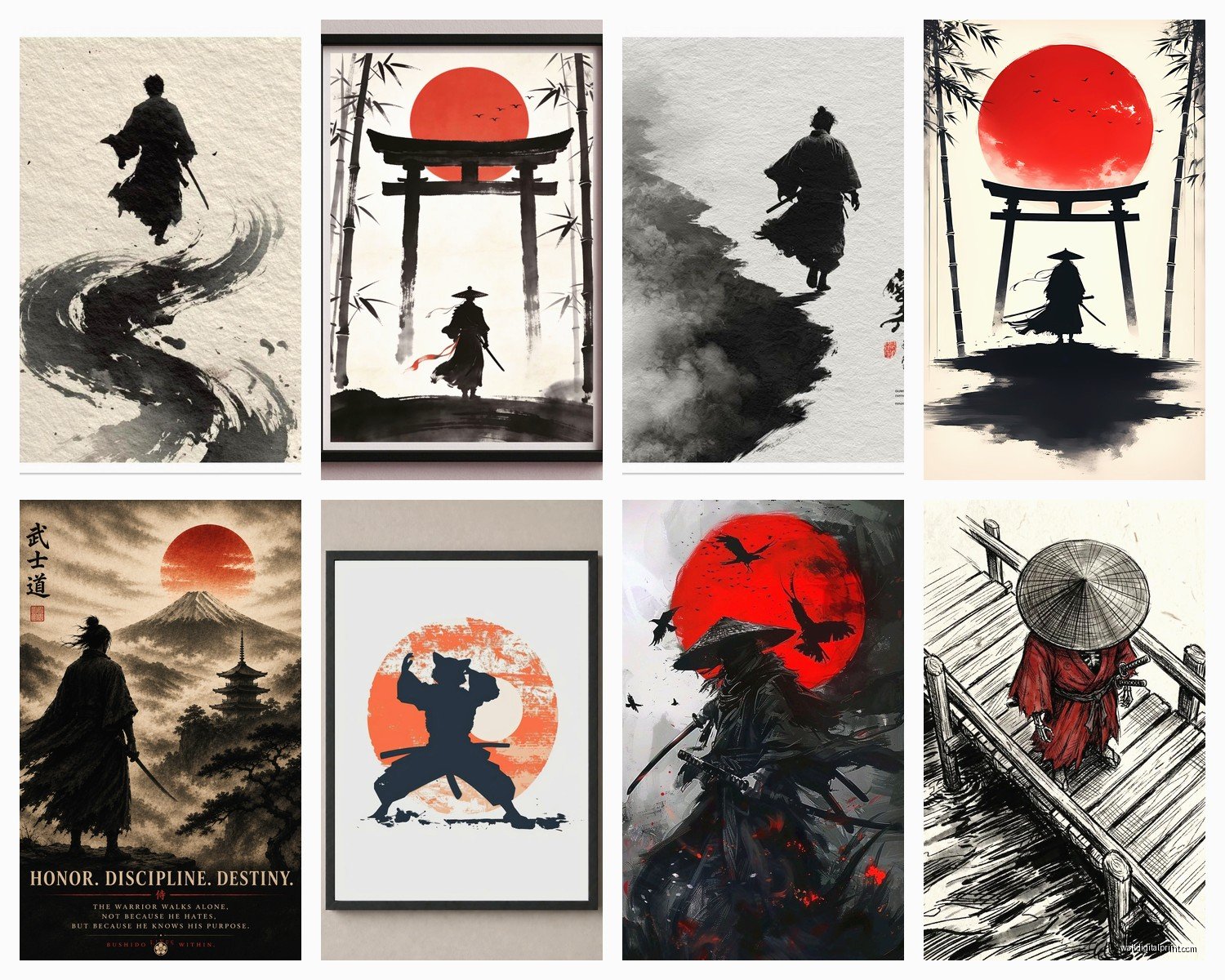
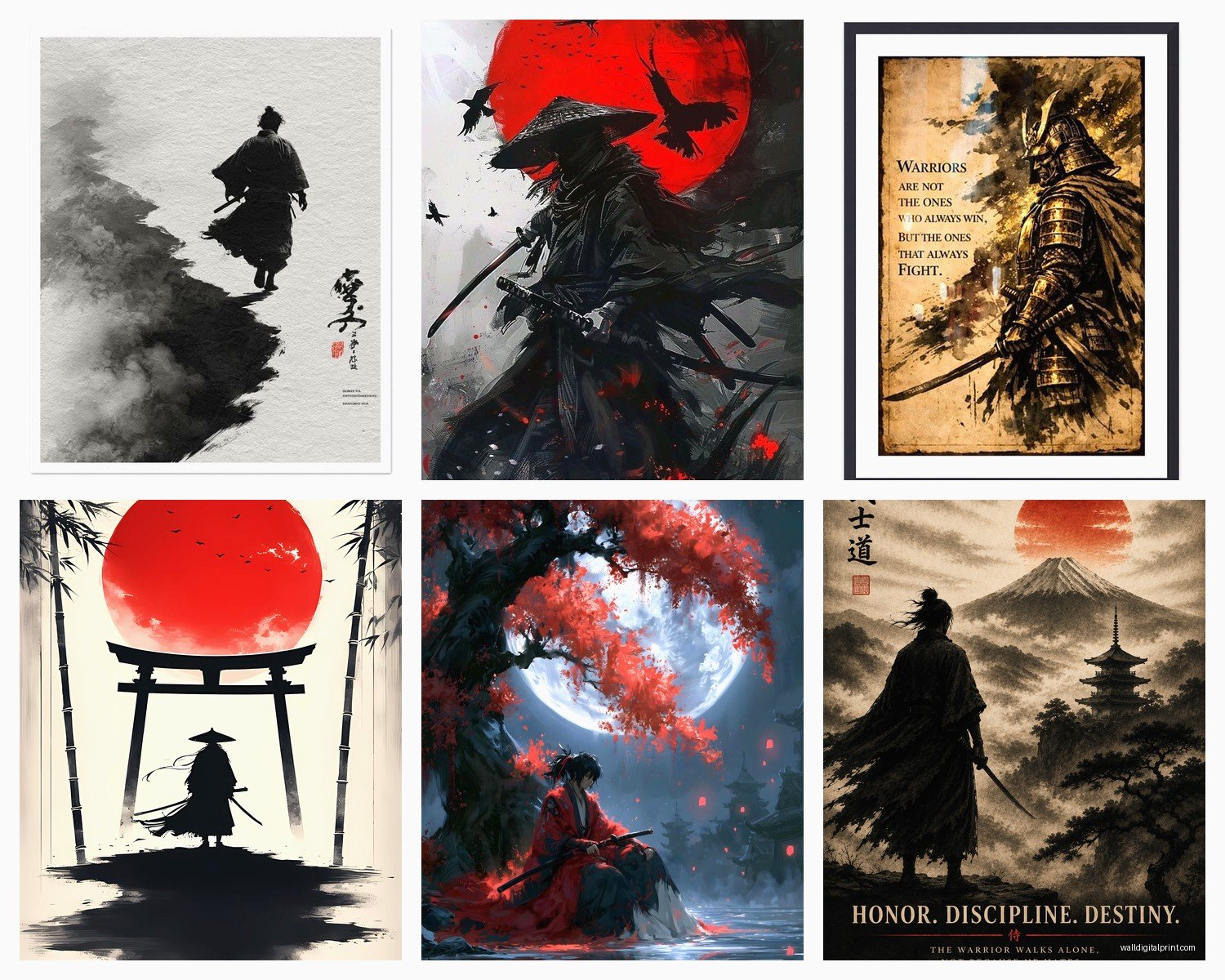
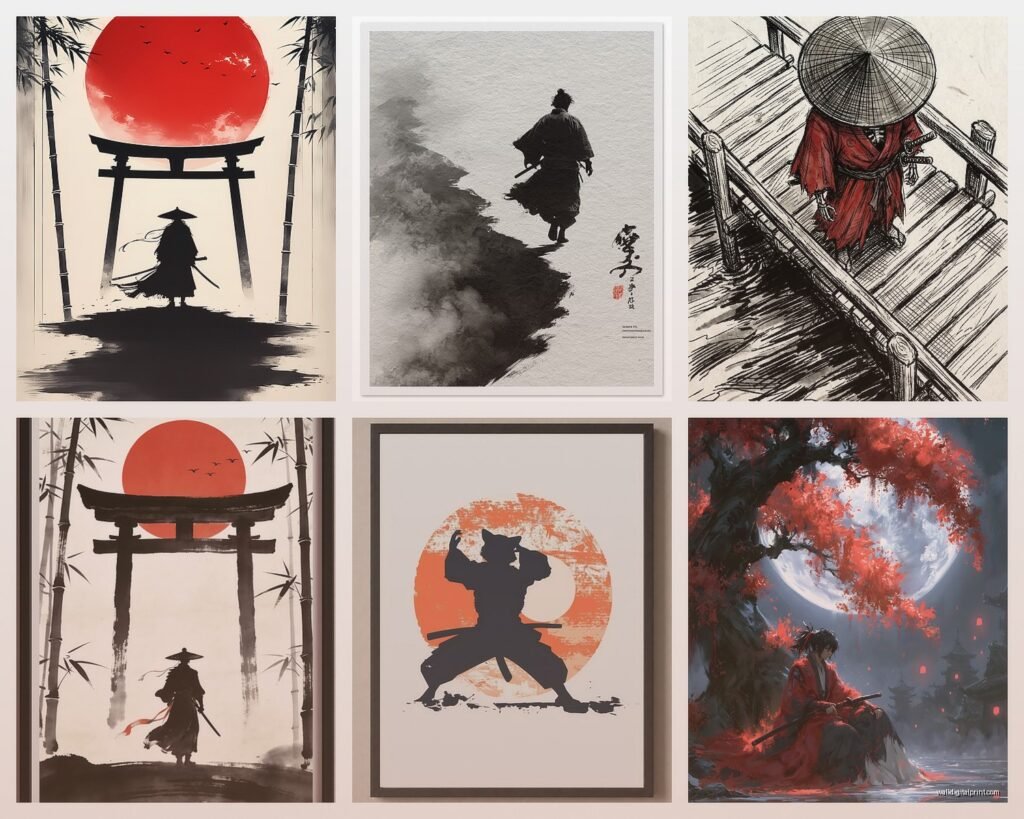
Think Hokusai and Kuniyoshi – those classic Japanese prints with the bold outlines and limited color palettes. These work amazingly well in spaces that are minimalist or have other Japanese elements. I did a whole reading nook with woodblock samurai prints and it looked so clean with simple furniture.
The reproduction quality matters SO much here. You want crisp lines, not blurry edges. I usually recommend looking for giclée prints if you’re going reproduction route, which just means high-quality inkjet printing basically. Prices range from like $40 for a small print to $300+ for larger museum reproductions.
Modern Graphic Interpretations
This is the stylized stuff – vector art, minimalist designs, sometimes with geometric elements or modern color schemes. My favorite find was this Etsy shop that does samurai silhouettes with gold foil accents and they’re stunning in person. These work great in contemporary spaces or home offices.
The cool thing about modern interpretations is they can bridge different decor styles. I put a minimalist samurai helmet print in a Scandinavian-style bedroom and it totally worked because the clean lines matched the aesthetic.
Photorealistic and Dramatic
The intense, almost movie-poster style stuff with dramatic lighting and detailed armor. These make serious statement pieces but you gotta be careful because they can overwhelm a space real fast. One large piece as a focal point works better than multiple pieces competing for attention.
I made this mistake in my own office where I hung three different dramatic samurai battle scenes and it was just… too much. Ended up moving two to other rooms and the space felt way more balanced.
Size and Placement Strategy
Okay so this is gonna sound obvious but I see people mess this up constantly – measure your wall before you start shopping. I use painters tape to map out where art will go because my spatial reasoning is apparently terrible and things always look different in my head.
For samurai art specifically, here’s what’s worked in different spaces:
Above a couch or bed you want something that’s roughly two-thirds the width of the furniture. So if your couch is 90 inches, you’re looking at a single piece around 60 inches wide OR a gallery wall arrangement that spans that width.
In a home gym or dojo situation, bigger is usually better. Those spaces tend to have higher ceilings and you’re viewing from a distance while working out. I did 48×36 inch metal prints in a martial arts studio and they felt appropriately sized.
Narrow walls like hallways work great with vertical samurai portraits – the warrior standing in full armor, that kind of thing. I found this amazing triptych set that goes vertically and it’s perfect for tight spaces.
The Gallery Wall Approach
If you can’t decide on one piece (relatable), a gallery wall of smaller samurai prints can look really cohesive. Mix different sizes but keep a consistent style – like all woodblock prints or all modern interpretations. Don’t mix styles unless you really know what you’re doing because it gets messy fast.
I usually do a 3×3 grid for symmetrical spaces or an asymmetrical cluster for more casual rooms. There are templates online but honestly I just arrange everything on the floor first, take a photo, and use that as my guide when hanging.
Color Coordination Actually Matters
This is where I see people struggle because samurai art often has very specific color palettes – lots of blacks, reds, golds, and deep blues. You don’t need to redecorate your whole room but there should be some color conversation happening.
If your space is mostly neutrals (grays, whites, beiges), almost any samurai art will work because those colors act as a blank canvas. This is the easiest scenario.
If you’ve got a lot of color already, pull one accent color from the art and make sure it appears elsewhere in the room. Like if your samurai print has red accents, add red throw pillows or a red vase somewhere. It sounds basic but it makes everything feel intentional instead of random.
My living room has warm wood tones and I specifically chose samurai prints with gold and warm brown tones rather than cool blues and grays. The difference was huge – the art felt like it belonged instead of fighting with the space.
Framing and Mounting Options
Oh and another thing – the frame can make or break the whole look. I’ve seen gorgeous prints ruined by cheap frames from Target (no shade to Target but their frames are hit or miss).
For traditional woodblock prints, simple black frames work perfectly. Don’t overthink it. I like frames with a small mat border because it gives the art breathing room.
Modern graphic pieces often look better with floated frames or even frameless mounting. There’s this acrylic mounting technique where the print is sandwiched between clear acrylic and it looks super sleek and contemporary.
If you’re doing canvas, you might not need a frame at all. Gallery-wrapped canvases where the image continues around the sides look clean and modern. Just make sure the edges are printed, not white or black blank space.
Metal prints usually come with mounting hardware already attached which is nice. They float off the wall slightly and create this cool shadow effect.
Where to Actually Buy This Stuff
Alright so I’ve bought samurai art from probably two dozen different places at this point and here’s what I’ve learned.
Etsy is great for unique pieces and supporting independent artists. Search terms that work well: “samurai wall art,” “Japanese warrior print,” “bushido art.” Read reviews carefully and look at customer photos because seller photos are always more flattering.
Society6 and Redbubble have tons of options and they print on demand in various sizes. Quality is decent, not amazing but totally fine for most spaces. The advantage is you can get the same design on different materials – canvas, metal, framed print, whatever.
For authentic Japanese woodblock reproductions, I go to museum shops. The Met, Boston Museum of Fine Arts, and British Museum all have online shops with high-quality prints. More expensive but the quality difference is noticeable.
Amazon is hit or miss honestly. There’s some good stuff but also a lot of dropshipped junk. If you go this route, only buy things with actual customer photos in the reviews and check the return policy.
Displate does metal posters and they have a whole samurai collection. I haven’t personally used them but a colleague swears by them for her teenage son’s room.
Custom Printing Route
If you find an image you love online (make sure it’s high resolution and you have rights to use it), places like Nations Photo Lab or Mpix do custom printing on various materials. I’ve done this a few times when clients had specific requests.
You need files that are at least 300 DPI at the size you want to print. This is important – a image that looks fine on your phone will print blurry at poster size if the resolution is too low.
Mixing Samurai Art with Other Decor Styles
Wait I forgot to mention – you don’t need a full Japanese-themed room for samurai art to work. I’ve successfully mixed it with industrial, modern farmhouse, minimalist, and even mid-century styles.
The key is treating it as an art choice rather than a theme. Like you wouldn’t worry about having Italian Renaissance art in a modern space, same logic applies.
In my industrial-style office I have exposed brick and metal furniture, and a large black and white samurai print fits perfectly because the high contrast and strong composition matches the room’s vibe.
For spaces with natural wood and plants, samurai art with earth tones and natural scenes (warriors in forests or mountains) creates a nice bridge between traditional and contemporary.
Lighting Your Samurai Art Properly
This is gonna sound extra but lighting makes such a difference. I installed picture lights above two samurai prints in a home office and they went from looking flat to having actual depth and drama.
If picture lights aren’t your thing (they’re kinda pricey and require installation), even just positioning existing lighting to hit the art helps. Track lighting or adjustable can lights work great.
Avoid direct sunlight like I mentioned before. If your art is getting sun exposure, either move it or invest in UV-protective glass or coating. I learned this the expensive way.
Grouping Themes and Creating Narrative
Something I’ve been experimenting with lately is creating story moments with multiple pieces. Like instead of random samurai images, choosing pieces that show different aspects of warrior life – training, meditation, battle, honor.
I did this in a meditation room where we had three prints showing the progression from chaos (battle scene) to contemplation (warrior sitting) to peace (empty armor). It created this journey around the room that people actually commented on.
Or you can group by artistic style, time period, or specific warriors if you’re into the historical aspect. There’s something cool about having a collection that feels curated rather than just “here’s some samurai stuff.”
Maintenance and Long-term Care
Canvas prints just need occasional dusting with a soft cloth. Don’t use cleaning products because they can damage the print surface.
Metal prints you can actually wipe down with a damp cloth which is clutch if you’re in a gym environment where there’s dust and sweat in the air.
Framed prints behind glass need glass cleaner obviously but spray it on the cloth, not directly on the glass because liquid can seep behind the frame and damage the print. Found this out when I ruined a $150 print by being careless.
Check your hanging hardware every year or so, especially for heavier pieces. I had a metal print fall at 3am once and it scared the crap out of me and my dog who still side-eyes that wall.
Okay I think that covers most of what I’ve learned through way too many samurai art projects. The main thing is don’t overthink it too much – if a piece speaks to you and fits your space reasonably well, it’s probably gonna work. I’ve seen people agonize over decisions for months when their first instinct was usually right.
Just start with one good piece and build from there if you want. You don’t need a whole collection immediately. My own samurai art situation started with one print I impulse bought and now I have like seven pieces scattered around my house and office, and honestly each one makes me happy when I see it, which is kind of the whole point anyway.