Wall Art Guide, Wall Art Tutoriels
Boho Abstract Wall Art: Eclectic Modern Bohemian Designs
May
So I’ve been absolutely obsessed with boho abstract wall art lately and honestly it’s been taking over my apartment in the best way possible. Like, I started with one piece above my couch and now there’s probably eight different abstract pieces scattered around and my cat keeps staring at the one with the orange swirls like it personally offended her.
The thing about boho abstract art is that it’s way more forgiving than people think? You don’t need to match everything perfectly and actually it looks better when you don’t. I had this client last month who was SO stressed about finding the “perfect” piece and I was like… that’s not really how bohemian design works, you know?
Starting With Your Color Story
Okay so first thing – and I cannot stress this enough – look at what colors are already happening in your space. Not what you WISH was happening, but what’s actually there right now. I made this mistake in my bedroom where I bought this gorgeous teal and rust abstract piece because I loved it in the store, but my bedding is all blush and cream and it just… sat there looking weird for like three weeks before I moved it to the hallway.
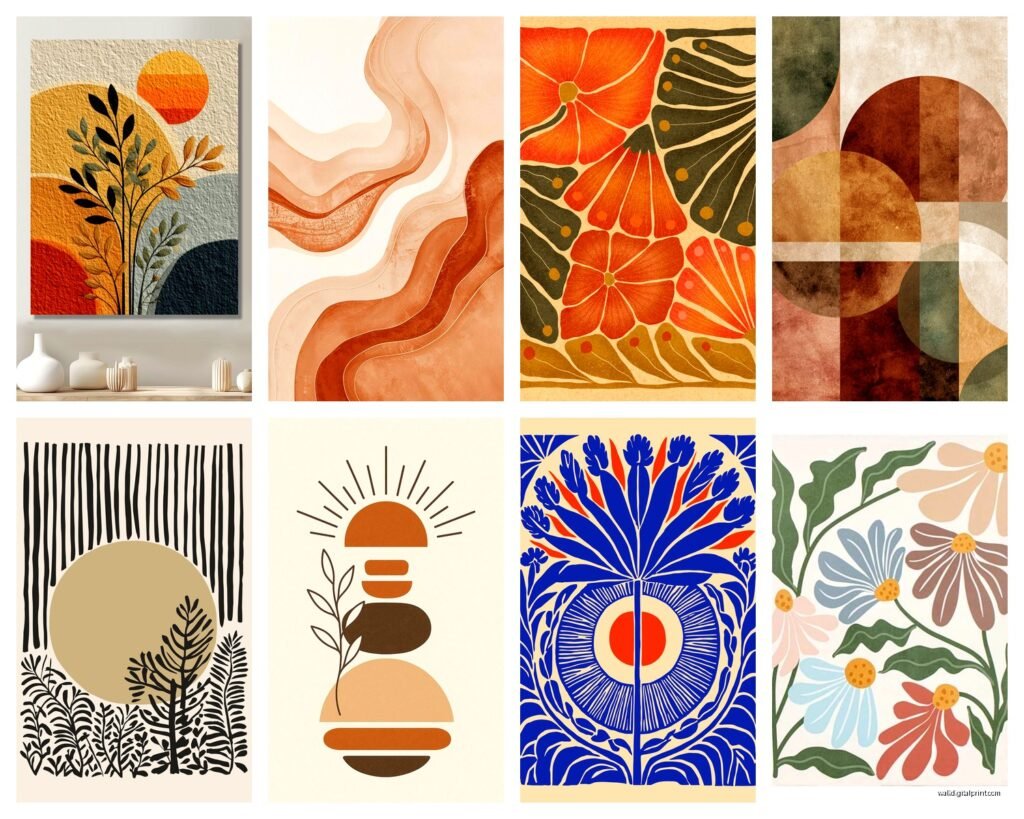
Boho abstract pieces usually come in a few color families:
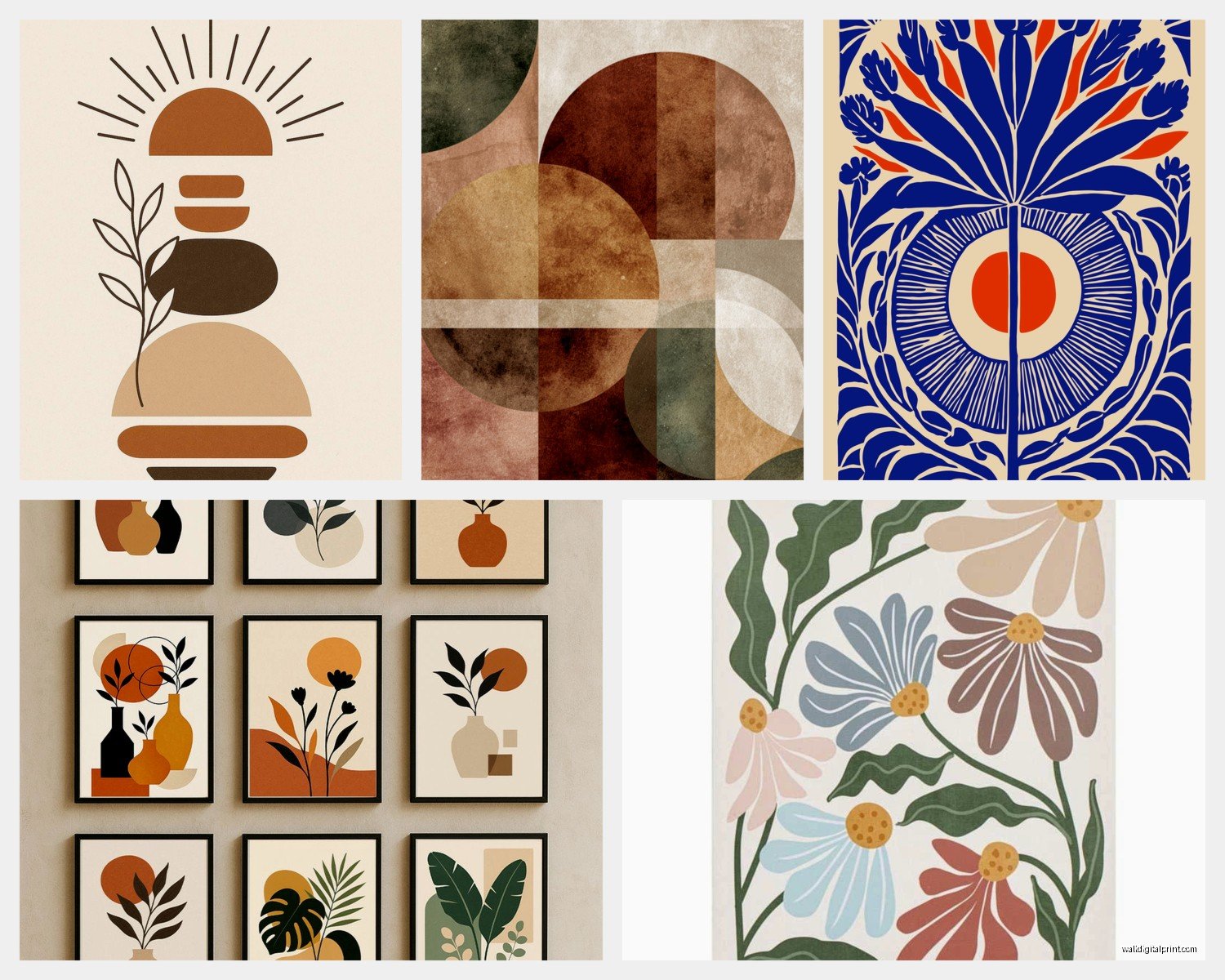
- Earthy terracotta, ochre, burnt orange with cream and brown
- Desert vibes with sage, dusty pink, sand tones
- Jewel tones like deep teal, mustard, burgundy
- Neutral with just black, white, beige and maybe one pop color
The earthy ones are honestly the easiest to work with because they go with literally everything. I have this one canvas that’s mostly cream with terracotta brushstrokes and some gold leaf accents, and it’s been in three different rooms because it just WORKS everywhere.
Size Actually Matters More Than You Think
This is gonna sound obvious but I see people mess this up constantly – measure your wall space before you fall in love with a piece. I’m guilty of this too, there’s a 6-foot canvas sitting in my storage unit right now because I got excited at an estate sale and didn’t think about the fact that my ceilings are only 8 feet tall and it would look insane.
For above a couch or bed, you want the art to be roughly 2/3 to 3/4 the width of the furniture. So if your couch is 6 feet wide, you’re looking at art that’s about 4 to 4.5 feet across. You can do this with one large piece or a gallery wall situation, which I’ll get to in a second because gallery walls are their own whole thing.
The Gallery Wall Approach
Wait I forgot to mention – if you’re doing multiple pieces together, odd numbers look better. Three pieces, five pieces, seven if you have a massive wall. I don’t know why this is a design rule but it’s true and I’ve tested it extensively because my client canceled last Tuesday so I spent an hour just rearranging my own hallway trying even vs odd numbers.
For a boho abstract gallery wall you want:
- Different sizes that still feel balanced
- Mix of framed and unframed if possible
- Some pieces with heavy texture, some flat
- Colors that share at least 2-3 tones in common
The trick is to lay everything out on the floor first in the exact arrangement. Take a picture with your phone. Then when you’re hanging stuff you can reference the photo and you won’t end up with weird spacing like I did the first time (had to fill seventeen nail holes, it was a whole thing).
Framing Choices That Don’t Suck
Okay so framing for boho abstract stuff is weirdly specific. You don’t want anything too formal or matchy-matchy. Natural wood frames are your best friend – light oak, walnut, even driftwood-style frames if you can find them. I get most of mine from this framing place downtown but honestly Target has stepped up their frame game recently.
Floating frames are really good for canvas pieces because they give it this modern edge that keeps the boho vibe from looking too hippie-ish, if that makes sense? Like it stays eclectic but doesn’t veer into “my aunt’s house in 1978” territory.
You can also do some pieces with no frame at all, especially if they’re on canvas with painted edges. Mixing framed and unframed in the same space is very boho and takes away that “I bought everything as a set” look that you’re trying to avoid.
Texture Is Everything
This is where boho abstract art really shines compared to regular abstract art. You want pieces with actual physical texture – thick brushstrokes, palette knife work, mixed media with fabric or paper, anything that catches light differently throughout the day.
I have this one piece in my living room that has these chunky impasto swirls and depending on whether it’s morning or evening, it looks like a completely different painting. My friend came over last week and was like “wait did you get new art?” and nope, just different lighting.
Look for:
- Impasto technique (thick paint application)
- Gold or copper leaf accents
- Mixed media with fabric, rope, or natural fibers
- Layered painting where you can see previous colors peeking through
- Textured canvas or paper as the base
The texture thing also helps if you’re buying affordable prints instead of originals, because it adds dimension that makes them feel more expensive and handmade.
Where To Actually Buy This Stuff
So Etsy is obviously the goldmine for boho abstract art. I probably spend way too much time scrolling through Etsy at night (usually while watching whatever’s on Netflix, currently rewatching The Great British Baking Show for the millionth time). Search for “boho abstract print” or “modern bohemian wall art” and you’ll find tons of digital downloads you can print yourself.
The digital download route is honestly genius if you’re on a budget. You pay like $5-15 for the file, then print it at a local print shop or online. The quality is gonna be way better than printing at home unless you have a really good printer. I use a local place that does large format prints on heavyweight matte paper and it’s like $30-40 for a big print.
Other places I actually buy from:
- Local art markets and craft fairs – you can negotiate sometimes
- Society6 for prints on different materials
- Minted during their sales
- Instagram artists directly (usually cheaper than through a platform)
- Estate sales if you wanna hunt for vintage abstract pieces
Oh and another thing – thrift stores sometimes have abstract art that you can frame differently or even paint over parts of if you’re feeling crafty. I found this old abstract painting that had good bones but ugly colors, painted over just the background in cream, and now it’s one of my favorite pieces.
Mixing Abstract With Other Boho Elements
Your abstract art shouldn’t exist in a vacuum, it needs to play nice with all your other boho stuff. This is where it gets fun because you’re layering different textures and styles.
Pair your abstract pieces with:
- Macramé wall hangings (but not right next to each other, give them space)
- Woven baskets on the wall
- Mirrors with natural wood or rattan frames
- Textile art like vintage rugs hung as tapestries
- Dried flowers or pampas grass
- Floating shelves with plants and small objects
The key is balance. If you have a really busy abstract piece with lots of colors and movement, keep the stuff around it more minimal. If your abstract is mostly neutral, you can go crazier with colorful textiles and accessories nearby.
The Whole “Original vs Print” Debate
Look, I’m gonna be real with you – most people cannot tell the difference between a high-quality print and an original painting when it’s on your wall. I’ve had original pieces and prints hanging side by side and guests never know which is which unless I tell them.
That said, there’s something nice about supporting artists and having an original if you can afford it. I try to buy at least one original piece per year from a local artist, usually in the $200-400 range. The rest are prints and I have zero shame about that.
If you’re buying originals, ask about payment plans. Lots of artists on Etsy and Instagram offer them. I got a gorgeous 3-foot abstract piece by paying $100 a month for four months and it was way more manageable than dropping $400 at once.
Placement Strategy That Actually Works
Okay so you’ve got your art, now where does it go? The obvious spots are above the sofa and bed, but there are so many other places that people forget about.
Try these spots:
- Above a console table in your entryway
- In the bathroom (yes really, it makes it feel fancy)
- On the wall at the top of your stairs
- Above your desk in a home office
- In a hallway gallery wall situation
- Leaning against the wall on a shelf or mantel
That last one is super boho actually – just leaning art instead of hanging it. It’s more casual and you can switch pieces out easily. I have a big abstract canvas leaning on my bedroom dresser and I change it out every few months when I get bored.
The general hanging height rule is 57 inches from the floor to the center of the artwork, which is apparently average eye level. But honestly I just eyeball it and adjust until it looks right. Sometimes rules are meant to be broken, especially in bohemian spaces.
Lighting Makes Or Breaks It
This is gonna sound weird but lighting is like 50% of whether your abstract art looks good or just kinda sits there doing nothing. Natural light is obviously ideal, but if you’re hanging art on a wall without windows, you gotta think about artificial lighting.
Picture lights are expensive but they make everything look gallery-quality. I have one on my favorite piece and it’s dramatic in the best way. But you can also just angle a floor lamp toward the wall or use wall sconces on either side.
Avoid hanging art directly across from a bright window because the glare will wash it out during the day. I learned this the hard way with a piece that looked amazing at night and completely disappeared during daytime.
Color Blocking and Layering
One technique I love for boho abstract art is color blocking where the abstract piece echoes colors in your textiles. So like if you have rust-colored pillows, find abstract art with rust tones. If your rug has sage green, pull that into your wall art.
You’re basically creating these little color moments throughout the room that tie everything together without being too matchy. It’s subtle but it makes the space feel intentional instead of random.
Layering is another boho move – hanging smaller pieces in front of or slightly overlapping larger pieces. It creates depth and that collected-over-time vibe. You can even layer a small abstract print in front of a mirror or a larger neutral piece.
I’ve got this whole situation above my dining table where there’s a big neutral abstract canvas, a smaller colorful one overlapping the bottom corner, and a macramé hanging off to the side. It shouldn’t work but it totally does.
DIY Abstract Art If You’re Brave
Not gonna lie, making your own boho abstract art is easier than you’d think if you’re not precious about it. Get a canvas, some acrylic paints in your colors, maybe some gold leaf, and just go for it. The boho aesthetic is forgiving because it’s supposed to look handmade and imperfect.
I made one using a palette knife and it’s honestly one of my favorite pieces now. Cost like $30 in supplies versus the $200 I would’ve spent buying something similar. There are tons of YouTube tutorials if you need guidance.
Just remember that abstract means you literally can’t mess it up. If you hate what you painted, add another layer. Keep going until you like it or paint over the whole thing in cream and start fresh.
Look, at the end of the day boho abstract wall art is about creating a space that feels collected and personal, not decorated from a catalog. Mix high and low, old and new, expensive and cheap. That’s the whole point.