Wall Art Guide, Wall Art Tutoriels
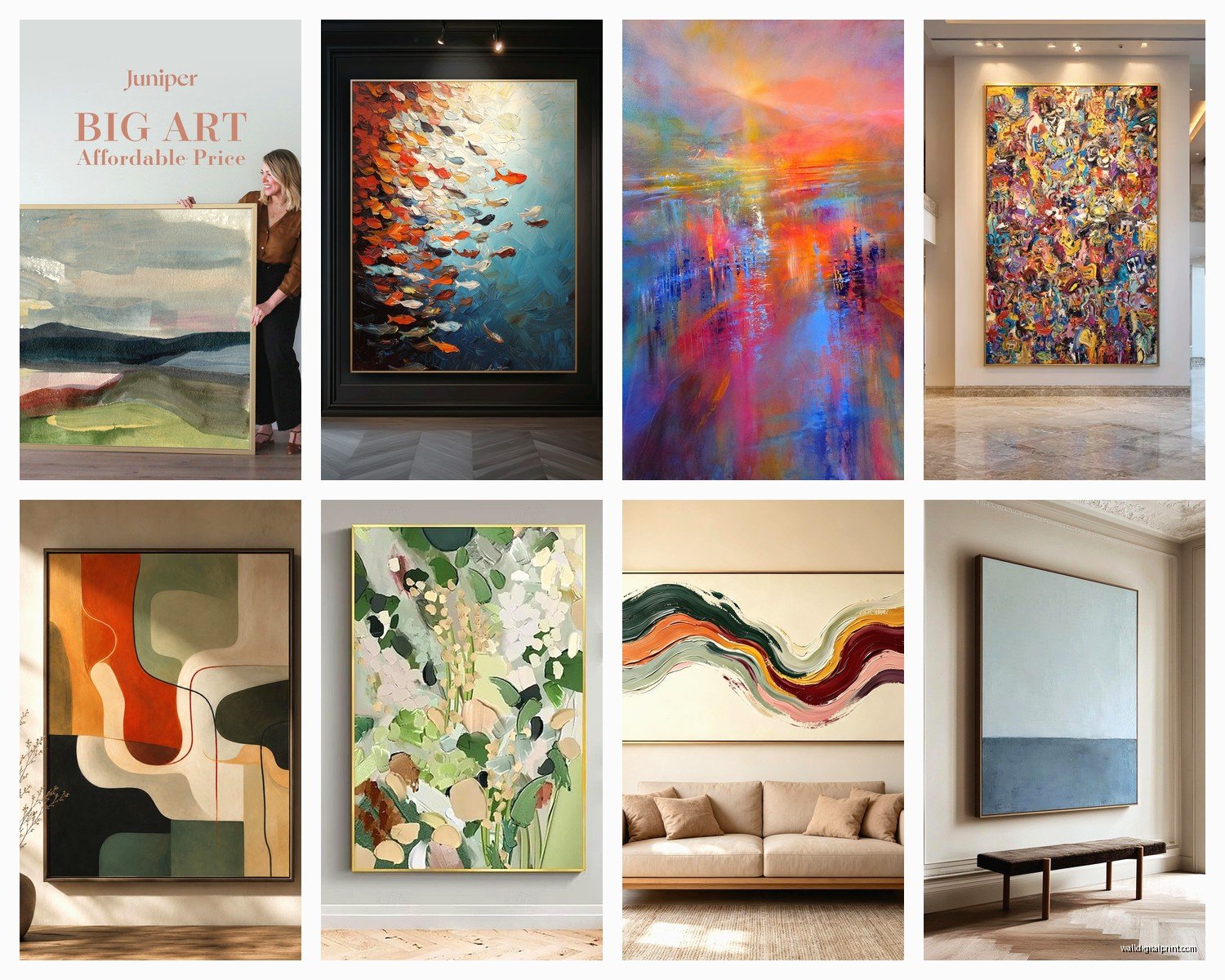
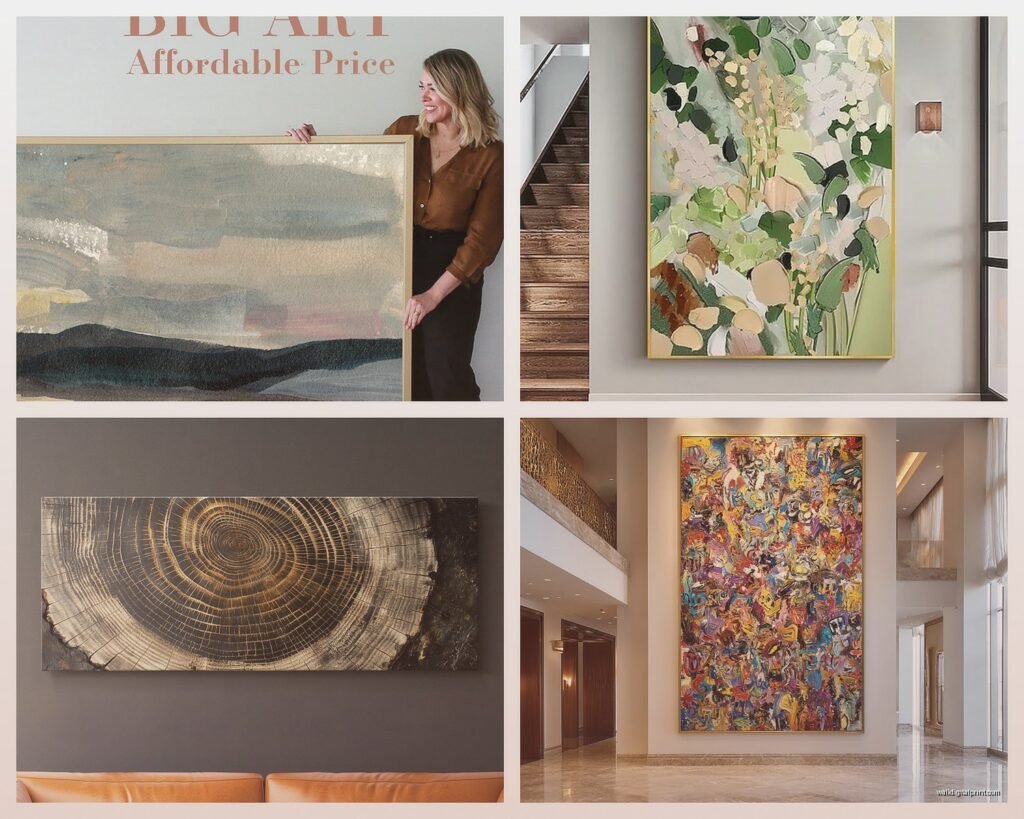
Big Abstract Wall Art: Large-Scale Modern Paintings
Jun
So I just got back from hanging this massive 6-foot abstract piece in a client’s living room and honestly my arms are still sore but like, it completely transformed the space and now I’m kinda obsessed with talking about oversized art because the rules are SO different from regular-sized pieces.
The Size Thing Nobody Tells You About
Okay first thing – when we say “large-scale” we’re talking at least 40 inches on one side, but honestly the sweet spot is 48-72 inches. I made this mistake in my own loft three years ago where I bought what I thought was a “big” painting at 36 inches and it looked like a postage stamp on my 14-foot wall. Had to donate it and start over which… not cheap.
The rule I use now is measure your wall width and go for art that’s about 60-75% of your furniture width below it. So if you’ve got an 8-foot sofa, you’re looking at something in the 60-72 inch range minimum. But also this depends on ceiling height and I’m gonna get to that in a sec because it gets weird.
Where to Actually Find These Without Selling a Kidney
Saatchi Art is where I’ve sourced probably 40% of my large abstract pieces. Their filtering system actually works unlike some sites where “large” means 20 inches apparently. You can sort by size and they have this emerging artist category where pieces are like $800-2000 instead of $8000. I found this incredible artist from Barcelona last month who does these gestural black and white pieces that look expensive but were under $1500 for a 60×48.
Etsy is hit or miss but there are shops that do custom sizes. The shop “LDawningScott” does really good large-scale textured abstracts and you can request custom colors. Takes like 6 weeks though so don’t do this if you need it fast.
Oh and another thing – local art school graduate shows. I’m serious. These artists are talented, need to sell work, and their prices haven’t hit the gallery markup yet. I got a 5-foot canvas for $600 at a UCLA grad show that would easily be $3K in a gallery.
The Printing Route
If you find an image you love but it’s not available big enough, printing on canvas is legit now. Mpix does canvas prints up to 54 inches and the quality is actually good – I’ve compared them side by side with original paintings and unless you’re standing right up close, you can’t really tell. Cost is like $300-400 for a huge print versus thousands for original art.
But here’s the thing with prints – you gotta frame them or do a gallery wrap. The thin canvas stapled prints look cheap at large scale. Spend the extra $150 on a floater frame and it looks intentional.
Colors and How Not to Mess This Up
This is gonna sound weird but I actually take paint swatches from Home Depot when I’m shopping for large art. Like I’ll grab the actual paint chips of my wall colors, sofa fabric, whatever, and look at art with them in my hand. Photos on your phone lie about color SO much.
For abstract work specifically, I usually go one of two ways:
Neutrals with one accent color – think blacks, whites, grays, tans with maybe a rust or navy moment. This works in like 90% of spaces and won’t feel dated in three years.
Full color chaos – but only if your room is otherwise pretty neutral. I did a client’s dining room last year with this insane multi-colored abstract that had like turquoise, coral, yellow, and pink, but literally everything else in the room was white, natural wood, and black. The painting became the whole vibe.
What doesn’t work is medium color paintings in medium color rooms. Everything just mushes together and you lose the impact. My cat actually walked into a canvas I was leaning against the wall last week because he didn’t see it – that’s how much beige-on-beige doesn’t work.
Hanging These Monsters
Okay so this is where it gets real. A 48×60 canvas weighs like 20-40 pounds depending on if it’s got heavy texture or not. You absolutely cannot use those command strips or whatever. Don’t even try.
Here’s my system:
- Find two studs if possible – they’re usually 16 inches apart
- Use heavy duty picture hanging hooks rated for at least 50 pounds EACH
- If you can’t hit studs, use toggle bolts in drywall – the kind that open behind the wall
- Hang it 57-60 inches to the center of the painting from the floor – this is museum standard and actually works
But wait I forgot to mention – if you’re hanging over furniture, the bottom of the frame should be 6-8 inches above the furniture top. I see people hang art way too high all the time and it floats weird.
Also gonna need: a level (the long one, at least 24 inches), a stud finder that actually works (I like the Zircon), and honestly a second person because trying to hold a 60-inch canvas level while marking holes is how you end up with a hole collection in your wall.
The Wire Situation
Most large canvases come with wire on the back but sometimes it’s not heavy duty enough. I replace it with braided picture wire rated for like 100 pounds. Costs $8 at any hardware store and takes five minutes. Use D-rings on the back frame and string the wire between them with about 3-4 inches of slack.
Some gallery-wrapped canvases have those sawtooth hangers on the back which are USELESS for anything over 30 inches. Ignore them completely and add your own D-rings and wire.
Room-Specific Stuff That Matters
Living rooms: Above the sofa is obvious but make sure you’re leaving enough space on either side. I usually do like 10-12 inches of breathing room on each side. If your painting is narrower than your sofa, you can do a diptych or triptych situation where you hang multiple large pieces with 3-4 inches between them.
Bedrooms: Over the bed is the move but keep it to 60-70% of the bed width. A king bed is 76 inches so you’re looking at like 48-54 inch art. I did a 72-inch piece over a king once and it was… a lot. Looked like the painting was eating the bed.
Dining rooms: You’ve got more flexibility here because people aren’t sitting right under it. I go big here – like 60-80 inches if the wall allows. Just make sure if you hang it horizontally above a table, it doesn’t extend past the table edges.
Entryways: If you’ve got a two-story entry, this is where you can do drama. I’m talking 6-8 feet tall. But measure carefully because you need like 7-8 feet of clear wall space at minimum.
Lighting Makes or Breaks This
You can have the most amazing abstract piece and if it’s in a dark corner it’s gonna look like a dark blob. I always add picture lights or track lighting for large pieces.
Picture lights mount to the top of the frame and shine down. They’re like $80-150 and plug in or can be hardwired. The Cocoweb LED picture lights are good – they don’t get hot and the color temperature is adjustable.
Or if you’re renovating or have track lighting already, aim at least two spotlights at the art from about 30 degrees off center. Creates dimension and brings out the texture.
Natural light is tricky – you want some but not direct sunlight because it’ll fade the colors over time. I use UV-protective glass or acrylic if a piece is gonna get hit with afternoon sun.
Framing Decisions
Most large abstracts look best either unframed (gallery wrap where the canvas wraps around the sides) or in a floater frame. The floater frame makes it look like the canvas is floating inside the frame with a gap all around – super contemporary and clean.
If you’re doing a traditional frame, keep it simple. A thin black or natural wood frame in like 1-2 inch width. Anything ornate at large scale looks weird unless you’re going full traditional which… probably not if you’re buying abstract art.
Custom framing for large pieces is expensive though – expect $400-800 depending on size. Sometimes I find pieces at discount framers during their sales or I’ve used Framebridge online for simpler frames and it’s been fine.
Textures and What Actually Reads From a Distance
This is something I learned by screwing it up – heavy texture is GOOD for large scale. Like those pieces with thick impasto or mixed media where you can see brush strokes from across the room. At that size, flat color can look like a poster even if it’s original art.
I’m watching this restoration show right now and they’re talking about how texture creates depth and honestly it’s so true for big abstracts. The shadows from heavy paint catch light differently throughout the day and keep the piece interesting.
If you’re going with a print, look for ones that replicate texture or add a gel medium overlay. Some printing services offer this and it makes a huge difference.
The Commitment Issue
Okay real talk – large art is an investment and it’s semi-permanent because once you hang it and patch the holes, you’re kinda committed. So before you buy:
- Live with it in the space if possible – lean it against the wall for a few days
- Look at it morning and night because lighting changes everything
- Take a photo of it in place and look at the photo – sometimes things you don’t notice in person jump out in photos
- Make sure you actually like it, not just like the idea of having big art
I had a client who bought this $3000 abstract because she thought she “should” have statement art and she ended up hating it after two months. We switched it out but that’s expensive trial and error.
Budget Real Talk
You can do large-scale abstract art at basically any budget:
Under $500: Prints, Etsy artists, DIY (yeah you can paint your own abstract if you’re brave), discount sites during sales
$500-2000: Saatchi Art emerging artists, local artists, smaller galleries, art fairs
$2000-5000: Established artists, better galleries, custom commissions
Over $5000: Known artists, investment pieces, major galleries
I usually tell people to spend what feels comfortable but also remember this is probably the focal point of your room so it’s worth stretching a bit if you find something you love.
Mistakes I See All the Time
Hanging multiple small pieces to fill a large wall instead of one big piece – just looks cluttered at that scale
Choosing art that matches your decor exactly – it should complement, not match
Going too safe – if you’re buying large abstract art, commit to something with personality
Not considering the room’s function – super chaotic art in a bedroom where you’re trying to relax might not be it
Forgetting about doorways and sight lines – make sure the art is visible from main entry points
Oh and one more thing – if you have textured walls, make sure the canvas sits flush or use spacers. I’ve had pieces hang crooked because they were catching on wall texture and it drove me insane until I figured it out.
The whole point of large-scale abstract art is impact and creating a moment in your space. It should make you feel something when you walk in the room, even if that feeling is just “wow that’s cool” or whatever. Don’t overthink it too much but also don’t just buy the first oversized thing you see because returns on big art are… complicated.