Wall Art Guide, Wall Art Tutoriels
Hindu Wall Art: Religious Deity & Temple Artwork
Jun
So I’ve been diving deep into Hindu wall art lately because honestly, a client asked me to help style their meditation room and I went down this whole rabbit hole of temple artwork and deity pieces, and wow there’s so much more to this than just picking something pretty.
First thing – you gotta understand that this isn’t just decorative art. Like, you can’t just slap up a Ganesha print next to your ironic poster collection. These pieces carry actual spiritual significance, and if you’re displaying them, there’s some basic respect guidelines you need to know. I learned this the hard way when I positioned a Lakshmi painting too low on a wall and my client’s mom literally gasped when she walked in.
Placement Rules That Actually Matter
Okay so the biggest thing is height and direction. Deity artwork should never be placed below waist level – ideally it’s at eye level or higher. I usually aim for about 5.5 to 6 feet from the floor to the center of the piece. North or east-facing walls are traditionally preferred, though northeast is like the sweet spot if you’re being really traditional about it.
And here’s something I didn’t know initially – you shouldn’t place these in bedrooms or bathrooms. Like ever. The puja room, living room, or dedicated meditation space is where these belong. My friend Sara put a beautiful Krishna painting in her guest bedroom and her Indian neighbor gently mentioned it was… not ideal. She moved it to her entryway and honestly it looks so much better there anyway.
Choosing the Right Deity for Your Space
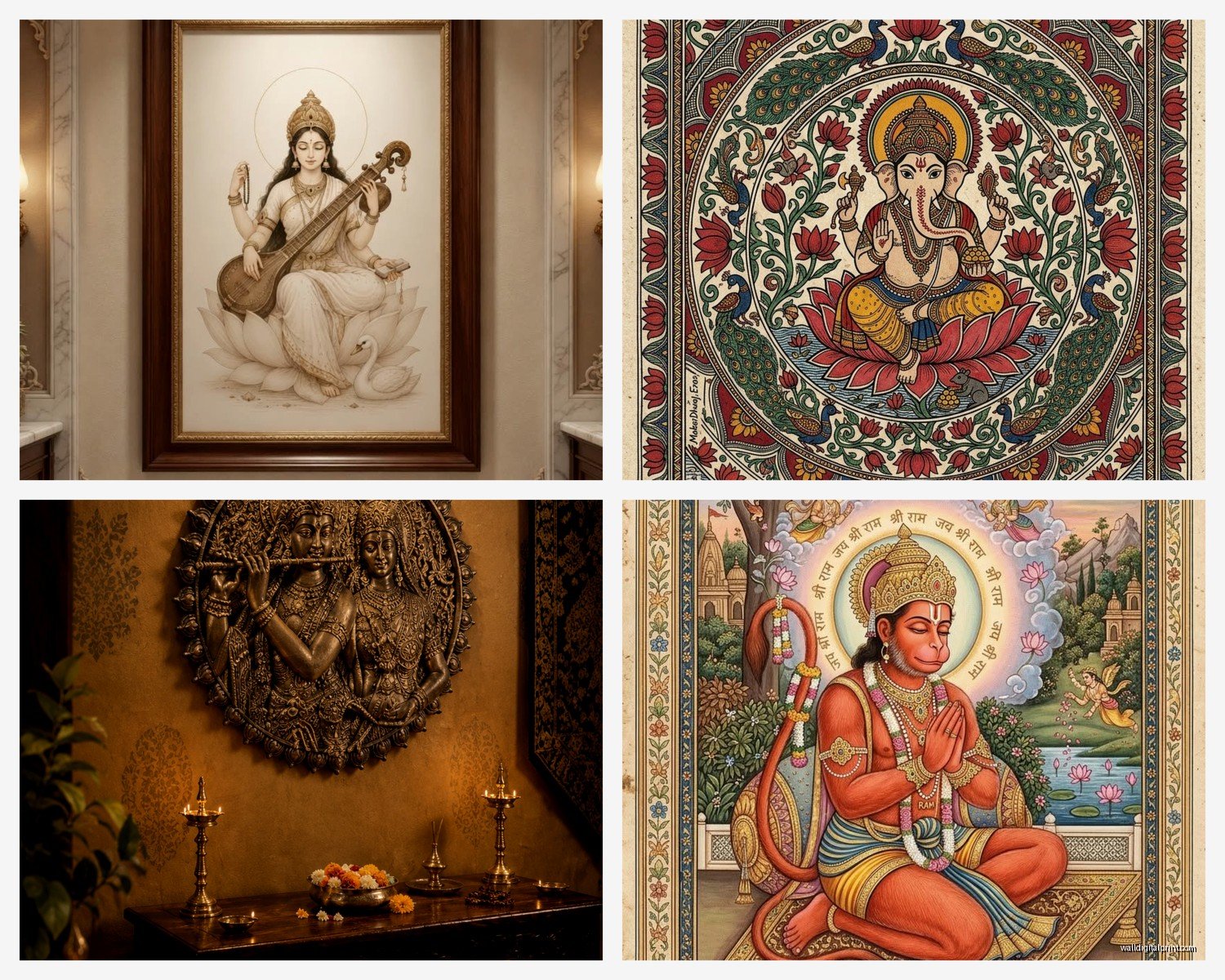
This is where it gets interesting because different deities represent different energies and purposes. Ganesha is probably the most popular for homes – he’s the remover of obstacles, so people love him near entrances or in home offices. I have a small bronze Ganesha piece in my own workspace and whether it’s psychological or not, I swear my projects go smoother.
Lakshmi is all about prosperity and abundance, so she’s perfect for living rooms or near your home’s entrance. The artwork usually shows her with lotus flowers and gold coins, very ornate and colorful. I styled a client’s foyer with a large Lakshmi canvas and paired it with brass accents and deep jewel tones – looked incredible.
Saraswati if you’ve got students in the house or you’re in creative fields. She’s the goddess of knowledge and arts. I’ve got her in my studio space because, well, seemed appropriate for someone who curates art for a living.
Shiva and Krishna Artwork
Shiva pieces tend to be more dramatic – you’ll see him in meditation poses or as Nataraja doing the cosmic dance. These work really well in meditation rooms or yoga spaces. The energy is more intense, more transformative. I find the Nataraja sculptures especially striking, though they’re usually bronze or metal rather than wall art.
Krishna artwork is often playful and colorful, lots of blues and peacock feathers. These pieces bring a lighter, more joyful energy. Great for family spaces or anywhere you want that uplifting vibe.
Art Styles to Consider
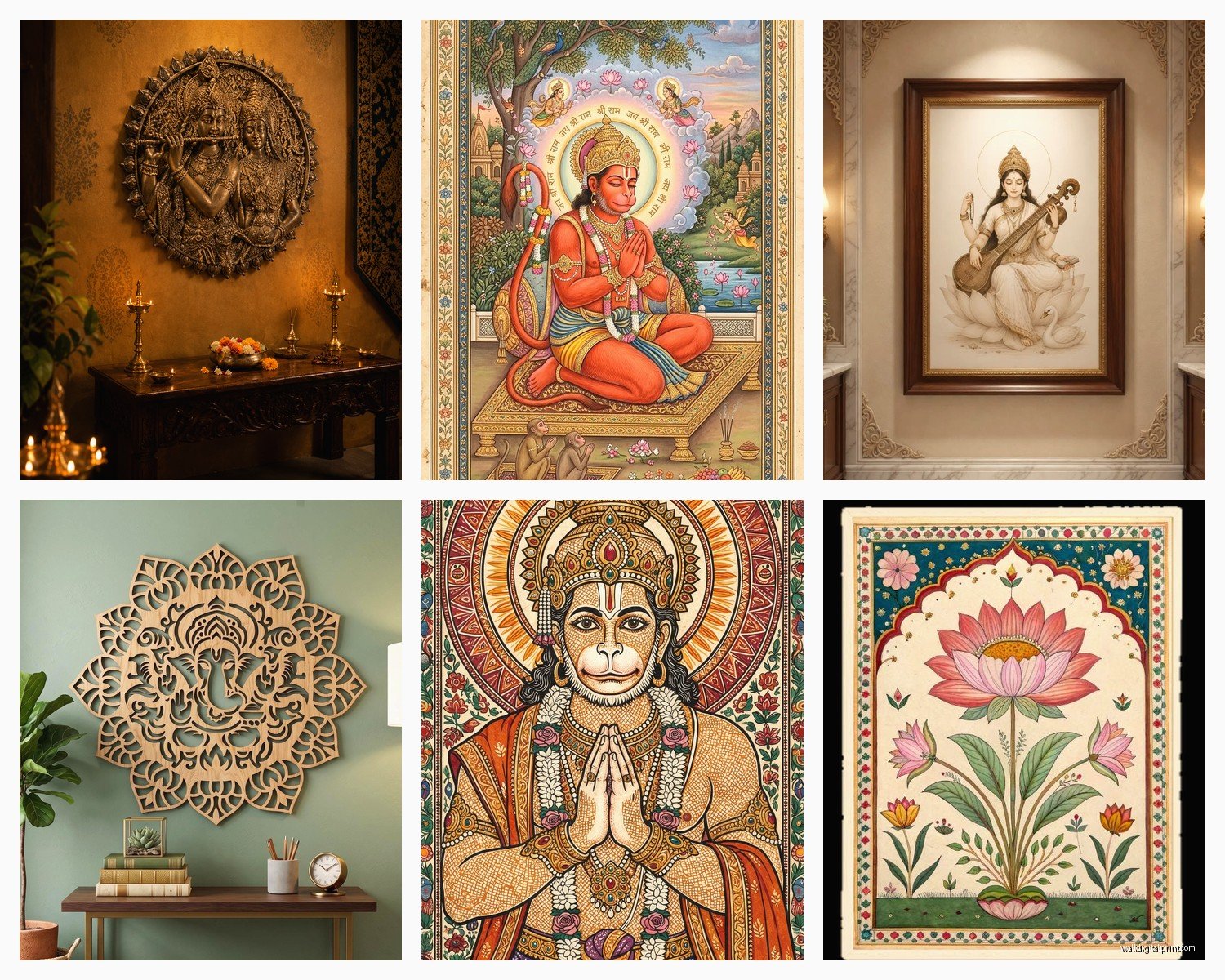
Traditional Tanjore paintings are my absolute favorite if you want authentic South Indian temple art. They’re recognizable by the gold foil work and rich colors – usually done on wood with actual gold leaf and semi-precious stones. Real ones are pricey though, like we’re talking several hundred to thousands of dollars. But the replicas? Actually pretty decent if you buy from the right places.
Pichwai paintings from Rajasthan are these gorgeous devotional pieces, traditionally depicting Krishna. Lots of intricate details, usually featuring cows and lotus flowers. They’re statement pieces for sure – very maximalist.
Oh and another thing – Madhubani art has become super trendy. It’s that folk art style with all the geometric patterns and bright colors, often featuring Hindu deities. More contemporary feeling while still being traditional. I used a Madhubani Radha-Krishna piece in a client’s eclectic living room and it bridged the traditional-modern gap perfectly.
Materials and Quality
Canvas prints are the most accessible option. You can find decent ones online but watch out for color accuracy – I’ve ordered pieces where Rama showed up looking weirdly orange instead of the proper blue-ish skin tone. Always check reviews with photos.
Metal wall art, especially brass or copper, has this amazing dimensional quality. The Tanjore-style pieces with repousse work (that’s the raised metal technique) catch light beautifully. They’re heavier though, so you need proper wall anchors. Learned that when a 15-pound brass Ganesha nearly took down my client’s drywall.
Marble inlay work if you’re really going all out. It’s traditional Mughal technique applied to Hindu themes – usually smaller pieces but absolutely stunning. I saw one at an art fair last month and I’m still thinking about it, though my cat would definitely knock it off the wall within a day.
Print Quality Matters
If you’re going the print route, giclee prints on archival paper actually hold up way better than regular prints. The colors stay vibrant and they don’t fade as quickly in indirect sunlight. Frame them under UV-protective glass if they’re going anywhere near windows.
And speaking of frames – gold or dark wood frames work best for traditional pieces. I tried putting a Durga print in a minimalist white frame once and it just looked… wrong. The ornate imagery needs an equally substantial frame to ground it.
Where to Actually Buy This Stuff
Okay so funny story, I spent like three hours comparing prices between Etsy, Amazon, and specialty Indian art sites. Here’s what I found:
Etsy has tons of independent artists doing contemporary takes on traditional themes. Quality varies wildly but you can find unique pieces. Just read reviews obsessively and check the seller’s return policy.
ExoticIndia and other specialty sites carry more authentic traditional pieces. Prices are higher but the quality is usually legit. They often ship from India so factor in longer delivery times.
Amazon is hit or miss. Lots of cheap prints that look great in photos but arrive looking washed out. But I’ve also found some surprisingly good canvas pieces from Indian sellers. The key is looking for sellers with thousands of reviews and actual customer photos.
Local Indian stores or temple gift shops if you have them nearby – this is actually my favorite option because you can see exactly what you’re getting. Plus you’re supporting community businesses.
Styling Around the Artwork
So this is where my interior styling brain kicks in. These pieces are usually pretty vibrant and ornate, which means your surrounding decor needs to either complement or get out of the way.
For traditional spaces, I go full maximalist – rich jewel tones, brass accents, carved wood furniture, silk textiles. Layer in some marigold colors, deep reds, royal blues. Incense holders, oil lamps (diyas), fresh flowers. Make it a whole vibe.
For modern spaces, you gotta be more careful. I like letting the artwork be the statement piece and keeping everything else pretty minimal. White or cream walls, simple furniture, maybe one or two brass accent pieces to echo the traditional elements. A single large deity painting on an otherwise sparse wall can be incredibly striking.
Wait I forgot to mention – lighting is huge for these pieces. I always add a small picture light or position a floor lamp to highlight the artwork, especially if it has any gold leaf or metallic elements. Makes such a difference in the evening.
Respect and Care Guidelines
This is gonna sound weird but like, don’t hang these pieces in kitchens either. Especially not near where you prepare meat if that’s relevant to your household. There’s traditional guidelines about purity and sacred spaces that matter to a lot of people.
Keep the area around the artwork clean. Many people who display deity art will light incense nearby or place fresh flowers as offerings. You don’t have to do this, but if you’re displaying sacred art, maintaining cleanliness around it is considered respectful.
And please don’t mix and match randomly with other religious iconography. A Hindu deity next to a Buddha statue is generally fine since there’s historical overlap, but throwing everything together like a spiritual buffet comes across as… not great. Be intentional.
Multi-Deity Arrangements
If you want to display multiple pieces, there’s actually a traditional hierarchy. Ganesha is often placed first or to the left since he’s the remover of obstacles. I did a gallery wall for a client with five different deity prints and we spent forever getting the arrangement right according to traditional guidelines her family followed.
Generally keep them at the same level rather than staggering heights randomly. There’s a equality-respect thing happening there. And maintain some space between pieces – they each deserve their own presence rather than being crowded together.
The tri-murti (Brahma, Vishnu, Shiva) works well as a set if you’re going that route. I’ve seen this done beautifully in triptych format, three matching frames side by side.
Seasonal and Festival Pieces
Something I’ve noticed helping clients with – having special pieces for festivals. Like bringing out Durga artwork during Navaratri or featuring Krishna during Janmashtami. You don’t need to do this, but if you’re actively practicing, it’s a nice way to mark the sacred calendar.
I keep extra pieces in storage and rotate them seasonally. Takes up storage space yeah, but it keeps the energy fresh and honors the cyclical nature of the traditions.
Contemporary vs Traditional Approaches
There’s this whole movement of modern Indian artists reimagining deity art in contemporary styles. Geometric interpretations, minimalist line drawings, abstract representations. I’m honestly torn on these. They’re beautiful as art pieces, but something about the traditional iconography – the specific mudras (hand positions), the symbolic objects each deity holds, the color symbolism – gets lost.
That said, I used a really beautiful minimalist Ganesha line drawing in a young couple’s apartment and it worked perfectly for their aesthetic while still being respectful. Just depends on what resonates with you and what you’re trying to create in the space.
One thing though – if you’re buying for someone else, especially if they’re Hindu, go traditional. Don’t get cute with abstract interpretations unless you know for sure that’s their style.
Size Considerations
Bigger isn’t always better with sacred art. I’ve seen people put up these massive deity canvases that completely overwhelm the space. Unless you have cathedral ceilings and a genuinely large room, stick with pieces between 24-40 inches for your main deity artwork.
Smaller pieces work great in groupings or for more intimate spaces. I have an 8×10 Saraswati print on my desk that’s perfect for that spot – anything bigger would be too much.
And actually, oversized pieces in small rooms can feel oppressive rather than inspiring, which kinda defeats the purpose of having uplifting spiritual art in your space.
Okay so that’s basically everything I’ve figured out through trial and error and research and probably annoying my Indian friends with endless questions. The main thing is approaching it with respect and intention rather than just treating it like any other wall decor, and you’ll be fine.