
Wall Art Guide, Wall Art Tutoriels
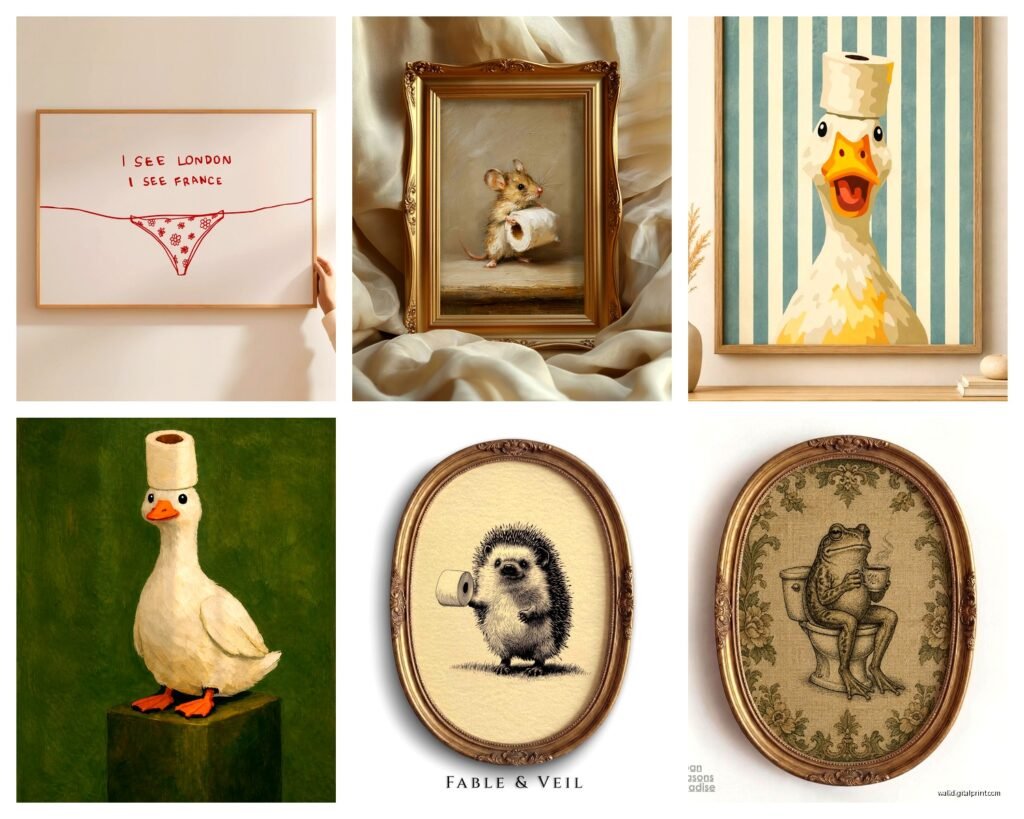
Quirky Bathroom Wall Art: Eccentric Unusual Bath Decor
Aug
So I’ve been putting quirky art in bathrooms for like three years now and honestly it’s become this weird obsession of mine. Started when a client asked for “something unexpected” and I panicked and hung a vintage diagram of cloud formations above their toilet and they LOVED it.
Why Bathrooms Are Actually Perfect for Weird Art
Okay so here’s the thing nobody tells you—bathrooms are like the one room where people actually stop and look at your walls. You’re sitting there, phone’s hopefully not in your hand, and you’re just… looking around. That’s prime real estate for art that makes people think or laugh or go “wait what.”
Plus the stakes are lower? Like if you hang a giant portrait of a Victorian child in your living room, everyone’s gonna have opinions. Same portrait in the bathroom? It’s quirky and conversation-starting. I learned this when I put a framed collection of vintage mustache styles in my own powder room and suddenly every dinner party involved someone coming out laughing about it.
Dealing With Humidity (Because It’s Gonna Ruin Everything Otherwise)
This is where I messed up initially. Hung this gorgeous antique botanical print in a bathroom with a shower and no fan, came back two weeks later and it was literally warped and growing mold at the edges. So now I’m super careful about this.
For bathrooms with showers or tubs you actually use:
- Acrylic or plexiglass frames instead of regular glass—they don’t fog up as badly
- Metal prints are honestly your best friend, water just beads off them
- Sealed canvas or resin-coated pieces
- Ceramic tiles mounted as art (I’ll get to this)
- Anything laminated works surprisingly well
Powder rooms or half baths where there’s no shower? Go wild, basically anything works there. That’s where I put the really delicate vintage stuff.
The Frame Situation
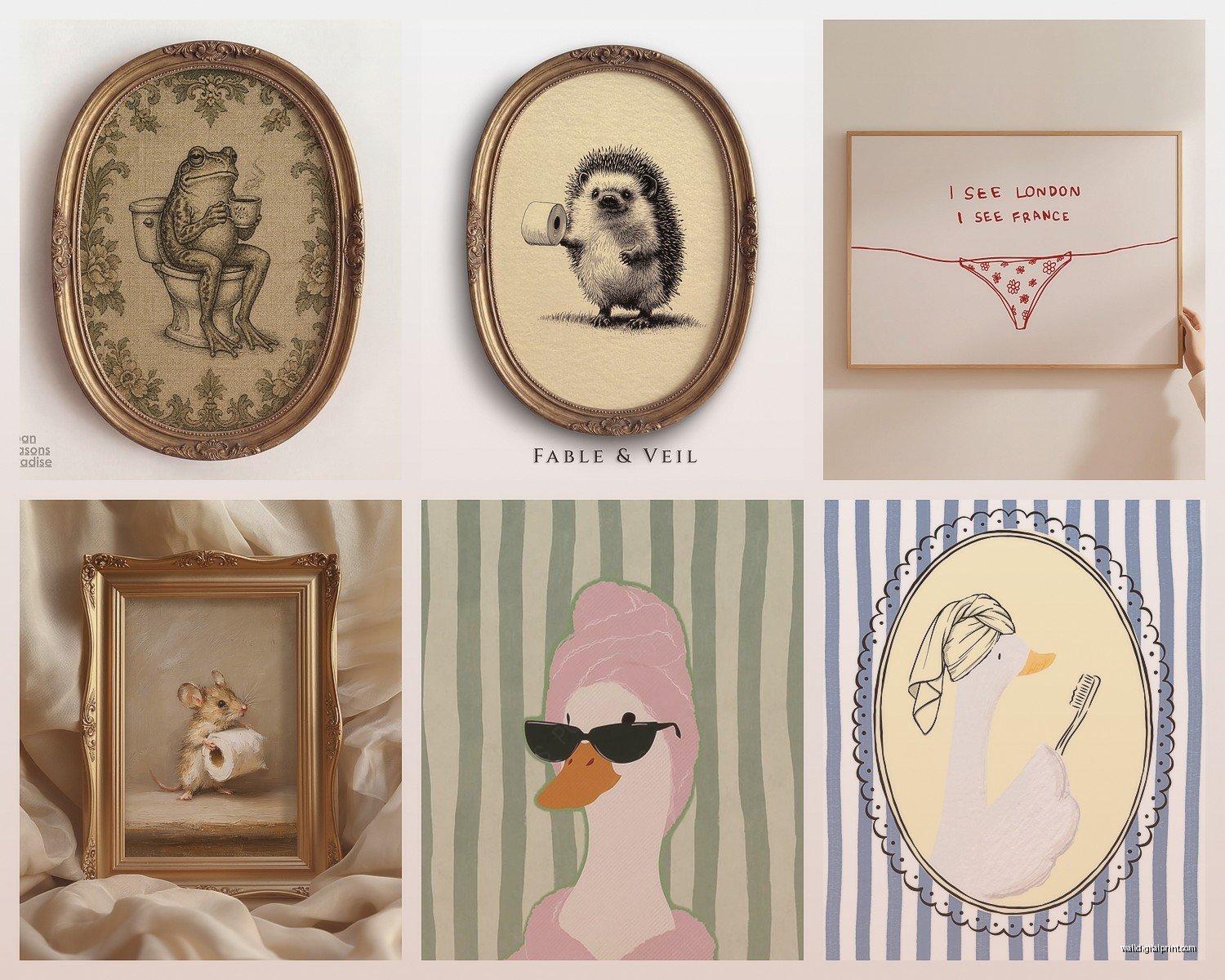
I’ve tested a bunch of frames in humid conditions because my cat knocked over a humidifier once and I basically created a tropical climate in my office bathroom for like three days before I noticed. The cheap frames from target and walmart? The backing gets gross and puffy. Metal frames hold up way better, or those deep shadow box frames where there’s air circulation.
Weird Art Ideas That Actually Work
Okay so funny story, I was watching this documentary about Victorian medical practices at like 2am (can’t sleep without background noise) and realized that vintage anatomy charts are PERFECT for bathrooms. There’s something about the clinical nature that just works?
Vintage Scientific Diagrams
These are my go-to recommendation:
- Mushroom identification charts
- Bird anatomy drawings
- Cloud formation diagrams
- Geometric proofs and mathematical equations
- Marine biology illustrations
- Vintage eye exam charts but make them weird colors
You can find prints on Etsy for like $15-40 depending on size, or honestly I’ve downloaded public domain images from library archives and printed them at FedEx on cardstock. The Biodiversity Heritage Library has thousands of these for free.
Collections of Small Objects
This is gonna sound weird but I’m obsessed with framing weird collections in shadow boxes. Did this thing where I collected 20 different vintage hotel room keys and mounted them in a grid pattern. Put it in a bathroom and suddenly everyone wants to know the story behind each key.
Other collections that work:
- Vintage spoons arranged in patterns
- Old keys in different shapes
- Antique spectacles or monocles
- Vintage buttons sorted by color
- Small ceramic animals (thrift stores are gold for this)
- Test tubes with dried flowers or colored sand
Irreverent Text Art
Wait I forgot to mention—text-based art is HUGE for bathrooms because people actually read it. But skip the “wash your hands” obvious stuff. I mean like:
- Vintage advertisements that are unintentionally hilarious
- Dictionary page definitions of weird words, enlarged
- Old telegram messages
- Vintage patent drawings for bizarre inventions
- Foreign language typography (I have a Japanese bathhouse sign in mine)
There’s this Etsy shop… okay I can’t remember the name right now but they sell prints of Victorian-era complaint letters and they’re SO funny. One’s about someone being mad their neighbor’s chicken was too loud.
The Ceramic Tile Trick
Oh and another thing—you know those plain white ceramic tiles from hardware stores? Like $0.50 each? I’ve been buying vintage transfer-print ceramic tiles from eBay and architectural salvage places and mounting them directly on walls or in cheap frames. They’re naturally waterproof, they come in insane patterns, and there’s something very European bathroom about them.
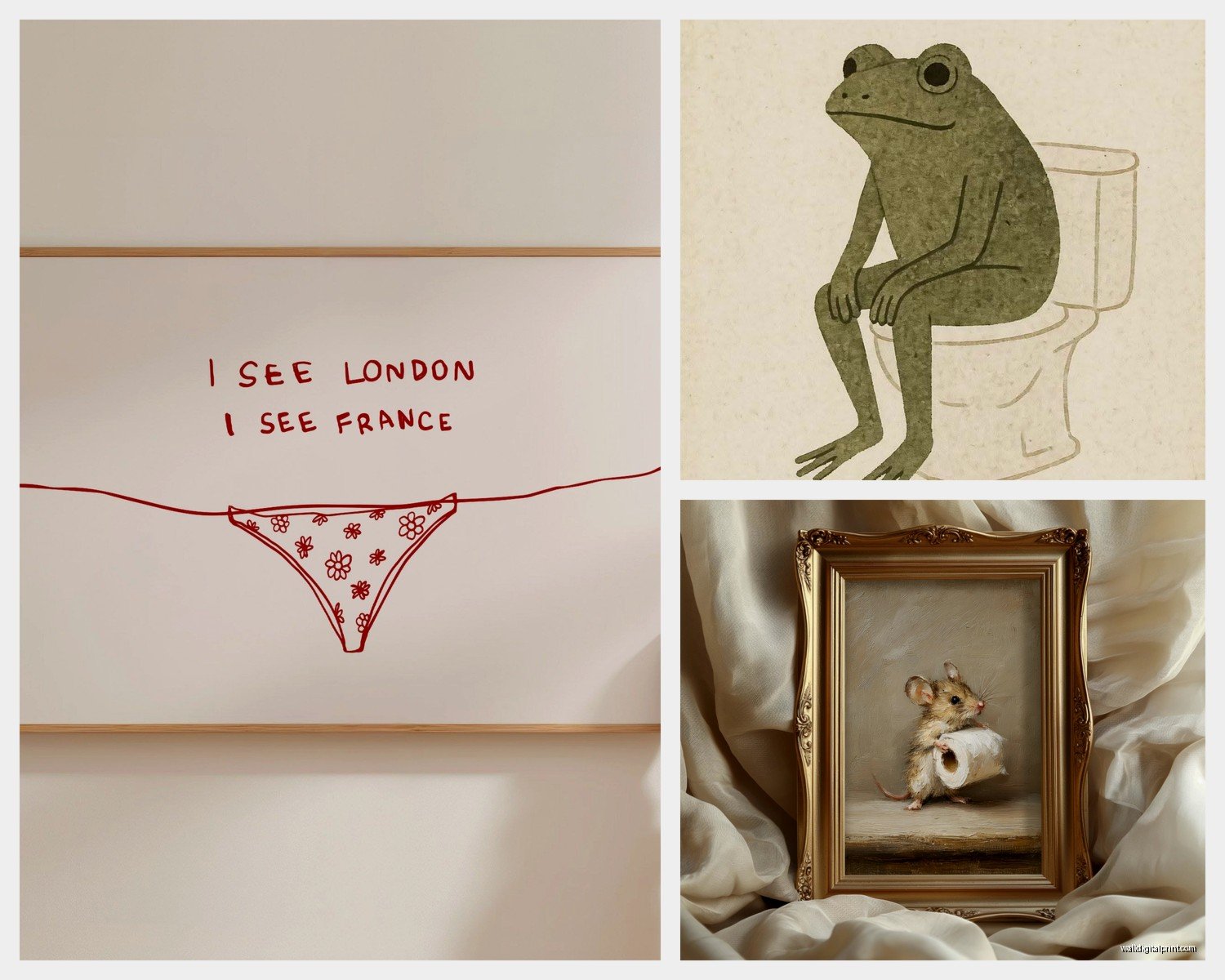
I did a whole wall in a client’s bathroom with mismatched vintage tiles—some had birds, some had geometric patterns, one had a ship. Grouted them irregularly so it looked intentional. Cost maybe $80 total and it looks like a million bucks.
Actual Installation Tips Nobody Talks About
So positioning is everything. I learned this by making mistakes basically.
Height and Placement
The standard “57 inches center to floor” rule? Throw it out for bathrooms. You want art where people’s eyes naturally land when they’re using the space. Above the toilet is obvious but think about:
- Opposite the mirror so you see it reflected
- On the wall next to the toilet at sitting eye level
- Above the towel bar if there’s space
- On the back of the door (everyone forgets this spot)
- That weird narrow wall between the shower and sink
I hung a series of three small prints vertically in that awkward space between someone’s shower and their toilet paper holder—like 8 inches wide—and it made the whole room feel more intentional.
Command Strips vs Real Hardware
Okay so I’ve used both extensively. Command strips are great for renters or if you’re commitment-phobic about placement. They hold up to humidity better than you’d think IF you let them cure for like 24 hours before hanging anything. The trick is wiping the wall with rubbing alcohol first.
But for anything over like 3 pounds or in a really steamy bathroom? Gotta use real anchors. I use those plastic ribbed anchors with screws. Takes 5 extra minutes but nothing’s falling off the wall.
Where to Actually Find This Stuff
My client canceled yesterday so I spent an hour comparing prices across different sites and here’s what I found:
Online Sources
Etsy is still the best for vintage prints and weird specific things. Search terms that work: “vintage ephemera,” “scientific illustration,” “oddities print,” “cabinet of curiosities.” Prices are all over but you can find good stuff for $10-30.
eBay for actual vintage items—original scientific charts, old advertising, ceramic tiles, weird objects to frame. The auction format means you can get stuff cheap if you’re patient.
Public domain sources like Biodiversity Heritage Library, Library of Congress digital collections, Smithsonian Open Access—download high-res images for free and print them yourself. I do this ALL the time.
Society6 and Redbubble have quirky artists but it’s pricier. Good for metal prints though since they’re already sealed.
In-Person Hunting
Thrift stores and estate sales are goldmines. I found a set of four medical school anatomy charts at an estate sale for $20 total. They’re worth like $200+ framed. Look for:
- Old textbook illustrations torn out and framed
- Vintage hotel or restaurant art
- Corporate office art from the 70s and 80s (it’s so bad it’s good)
- Weird objects you can mount—old tools, kitchen implements, architectural fragments
Architectural salvage places have amazing stuff. Bought a cast iron decorative vent cover for $15, mounted it on the wall, everyone thinks it’s expensive art.
Styling Multiple Pieces Without Looking Cluttered
This is where people usually mess up. They get excited and just start hanging everything and it looks chaotic in a bad way instead of intentionally eclectic.
The Rule of Odd Numbers
Groups of 3, 5, or 7 pieces look more intentional than even numbers. I don’t make the rules, it’s just how our brains work apparently. Did a gallery wall in a bathroom with 5 pieces—three vintage mushroom prints and two pressed botanical specimens—and the asymmetry made it interesting.
Common Thread Strategy
Pick ONE thing that ties your pieces together:
- All the same frame color (even if art is different)
- All the same subject matter (all birds, all vintage maps, all typography)
- All the same color palette
- All the same era (all Victorian, all mid-century)
- All the same format (all scientific diagrams, all circular frames)
I did a bathroom with all blue and white—different subjects, different frame styles, but that color scheme unified everything.
Unexpected Things That Work
Gonna rapid-fire some stuff I’ve tried that people loved:
Vintage postcards in floating frames—especially weird tourist attractions or retro hotels. Stack like 10 of them overlapping in one large shadow box.
Framed fabric—bought vintage tea towels with weird prints (mushrooms, European cities, botanical gardens) and stretched them over canvas boards. Looks expensive, costs like $8.
Paint-by-numbers art—but the really bad ones from thrift stores. The worse the execution, the better. I have one of a horse that looks deeply disturbed.
Vintage record sleeves—especially classical or jazz with interesting typography and graphics. They’re exactly the right size for standard frames.
Architectural blueprints—you can buy vintage ones on eBay or modern ones from buildings in your city. Very specific aesthetic but when it works it WORKS.
Dried insects or butterflies—okay hear me out, I know this sounds creepy but properly mounted specimens in shadow boxes are beautiful and very cabinet-of-curiosities. You can buy them already framed or get ethical suppliers online.
Budget Breakdown
Since you’re probably wondering what this actually costs:
Ultra budget (under $50 total): Download and print 3 public domain images at FedEx ($15), buy cheap frames at Michaels with a coupon ($25), use command strips ($8). Done.
Mid-range ($100-200): Mix of Etsy prints, thrift store finds, better frames from Target or Amazon. This is my usual client range.
Splurge ($300+): Original vintage pieces, custom framing, metal prints, multiple walls. I did a bathroom for someone with vintage French pharmacy labels and custom frames—came to about $450 but looked incredible.
Common Mistakes I See
Okay wait before I forget—things that seem like good ideas but aren’t:
Canvas prints in steamy bathrooms—they eventually sag and warp. Learned this the hard way.
Anything with water-based ink in humid spaces—it’ll run eventually. Had someone’s hand-drawn calligraphy piece basically dissolve over time.
Hanging art too high—especially above toilets. You’re sitting down, position it for that viewpoint.
Matching everything too perfectly—quirky bathroom art should feel a little collected over time, not like you bought a set.
Forgetting about cleaning—whatever you hang needs to be wipeable. Dust and bathroom spray get on everything. Smooth surfaces are your friend.
My Current Favorites
Right now I’m really into vintage seed packet labels—they have this amazing typography and color. Found a whole collection at an antique store, framed them in a grid, looks like a museum display. Also been collecting weird vintage warning signs (like “beware of falling rocks” from old national parks) and they’re unexpectedly funny in bathrooms.
Oh and there’s this trend of framing vintage board game boards? Like the actual game board from Monopoly or Clue? Kinda genius because they’re colorful and geometric but also nostalgic.
Last thing—don’t overthink it. The whole point of quirky bathroom art is that it’s personal and weird and makes you smile. I have a client who framed their kid’s really terrible crayon drawing of the family dog and honestly? It’s perfect in their powder room. Makes everyone laugh and it’s waterproof since it’s behind glass.
Start with one piece that genuinely makes you happy or curious, hang it up, see how it feels. You can always add more or swap things out. That’s the beauty of decorating a bathroom—low stakes, high reward, and everyone who visits will actually notice unlike that expensive art in your hallway they walk past without looking.
