
Wall Art Guide, Wall Art Tutoriels
Big Wall Art for Living Room: Large-Scale Main Space Pieces
Sep
So I was literally just helping my friend Sarah pick out this massive piece for her living room last week and honestly, the whole process is so much more complicated than people think. Like, you can’t just grab the biggest frame at HomeGoods and call it a day, you know?
First Thing: Actually Measure Your Wall Because Everyone Gets This Wrong
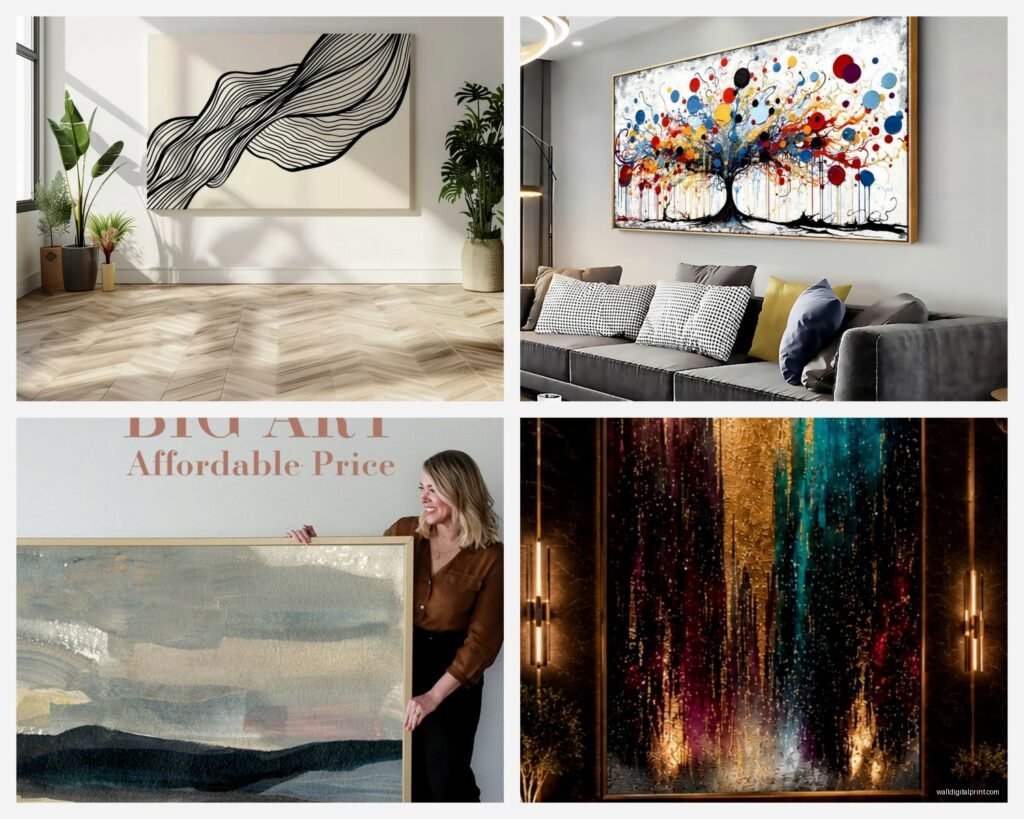
Okay so here’s what I do and what I always tell people to do but they never listen until they’ve already bought something too small. Take painter’s tape and literally map out the size on your wall. I’m serious. Because a 40×60 inch piece sounds HUGE when you’re looking at dimensions online, but then you put it on a 12-foot wall and it looks like a postage stamp floating in space.
The general rule I follow is that your art should take up about two-thirds to three-quarters of the furniture below it. So if you’ve got an 8-foot sofa, you’re looking at somewhere between 5-6 feet of art width. But honestly? I’ve gone bigger and it looks amazing. My own living room has a 7-foot wide piece above a 9-foot sectional and it’s perfect.
What Actually Counts as Large-Scale
I’m gonna say anything over 40 inches in any direction is where you start getting into large-scale territory. But the stuff that really makes an impact? You’re looking at 48×60 minimum, or those gorgeous 60×80 pieces that make people literally stop and stare.
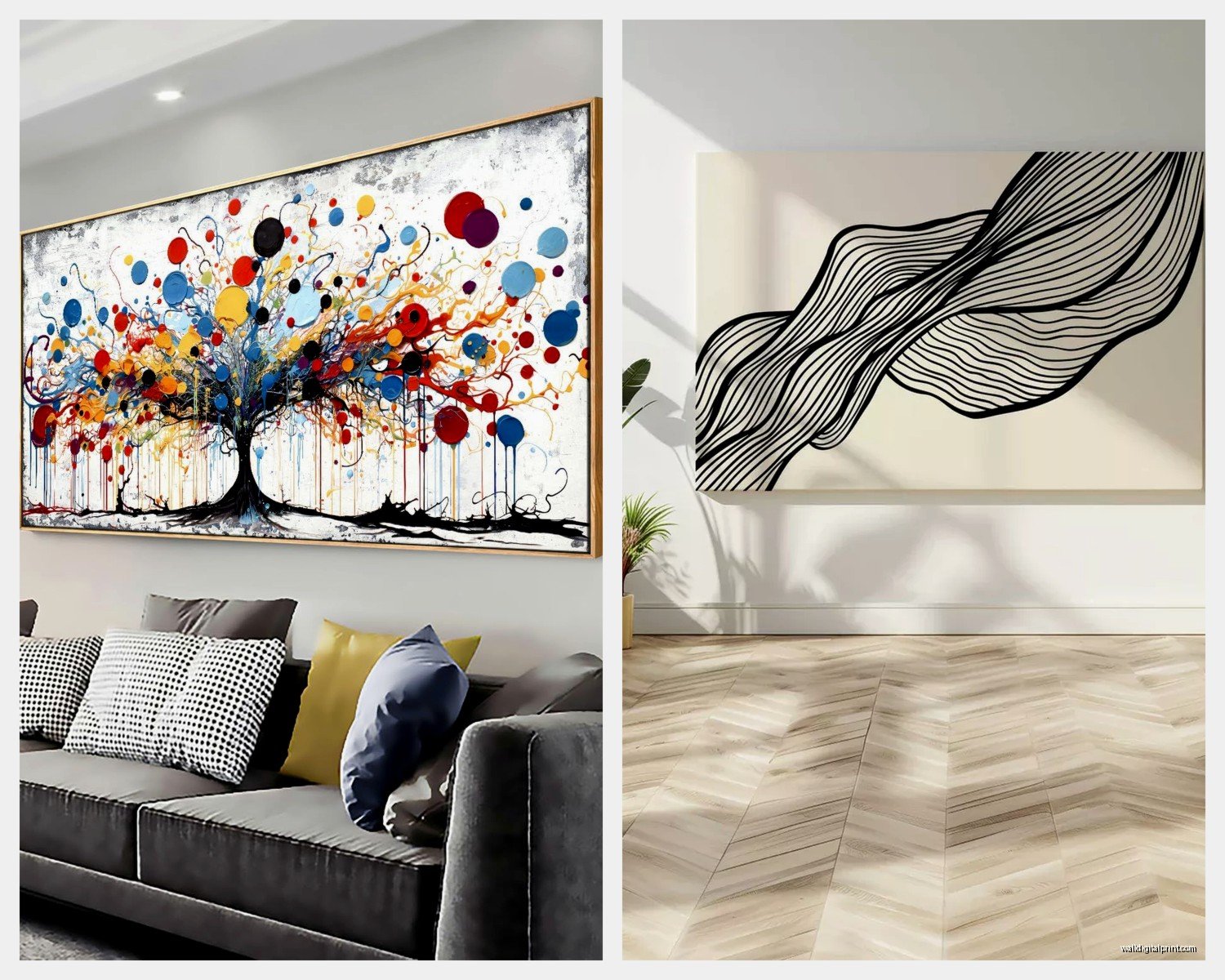
Oh and another thing, orientation matters way more than people realize. I was watching this design show the other night while eating leftover pizza and they had this vertical piece that was like 36×72, and it completely changed the room’s proportions, made the ceiling look higher. So don’t automatically assume you need horizontal just because your sofa is horizontal.
Types of Large-Scale Art That Actually Work
Canvas prints are obviously the most common and honestly the most affordable. You can get massive canvas pieces for like $200-400 if you’re shopping smart. I’ve used CanvasDiscount and Great Big Canvas for clients, and the quality is solid. Not gallery-level, but for a living room? Totally fine.
Framed prints or posters are having this whole moment right now. The trick is getting a substantial frame, not those thin little black frames everyone defaults to. I’m talking 2-3 inch wide frames with some weight to them. Just did this for a client with a vintage botanical print, got it blown up to 50×70, put it in a chunky wooden frame, and it looks like a museum piece.
Metal prints are something I’ve been obsessing over lately. They’re printed directly on aluminum and the colors are SO vibrant. They’re modern though, very sleek, so if your style is more traditional or boho, maybe skip these.
Where to Actually Buy This Stuff
Okay so funny story, I spent three hours last Tuesday comparing prices because my client’s budget was tight, and here’s what I found. Etsy is actually incredible for large-scale digital downloads. You buy the file for like $8-15, then upload it to a printing service. I use Nations Photo Lab or Printique for the actual printing. A 40×60 print costs me around $50-70, then framing is extra but you can use Frame It Easy online and they ship it ready to hang.
Society6 and Redbubble let you buy art directly in large sizes. The markup is higher, but it’s convenient and they handle everything. I’ve found some amazing abstract pieces on there.
For actual original art or if you want something really special, Saatchi Art and Artfinder are where I look. Yeah, it’s more expensive, like $800-3000 range, but you’re getting actual original paintings. I curated a piece from Saatchi for a client’s living room last month, this gorgeous teal and gold abstract, and it’s the only thing anyone talks about when they visit.
Wait I forgot to mention Desenio and Printler, both have really affordable large-format prints, very Scandinavian aesthetic if that’s your thing. Clean lines, muted colors, lots of abstract shapes.
Colors and Style: How to Not Screw This Up
This is gonna sound weird but don’t try to match your art to your throw pillows. I see people do this constantly and it looks so matchy-matchy and staged. Your art should pull from your room’s color palette but not, like, exactly match.

I usually pick one or two colors from the room and make sure they appear somewhere in the artwork. Then I let the art introduce new accent colors. So if your room is gray and navy, maybe your art has those colors plus some rust orange or emerald green that you don’t have anywhere else yet.
For style, just… pick what you actually like? I know that sounds obvious but people get so caught up in trends. If you love that giant monstera leaf print even though it’s been done a million times, get it. You’re the one looking at it every day.
Abstract vs Figurative vs Photography
Abstract is the safest bet honestly. It works with pretty much any decor style and you won’t get tired of it as quickly. I’m obsessed with those big abstract pieces with lots of texture, the ones that look like someone took a palette knife to the canvas.
Photography can be stunning but it needs to be really high quality. A blown-up low-res photo looks terrible, trust me. I learned this the hard way with a client who insisted on using her own vacation photo. We needed the file to be at least 150 dpi at the final print size, and hers was like 72 dpi. Disaster.
Figurative stuff, like portraits or landscapes, is trickier because it’s more specific. But when it works, it REALLY works. I have this massive black and white portrait in my hallway and people are obsessed with it.
Hanging and Installation: The Part Everyone Underestimates
Okay so you’ve got this 50-pound piece of art, now what? First, you gotta find the studs. Use a stud finder, don’t just guess. For anything over 30 pounds, you need to anchor into studs or use heavy-duty drywall anchors rated for the weight.
The hanging height formula I use is 57-60 inches from the floor to the center of the artwork. This is museum standard and it actually works in real homes too. But if you’re hanging above furniture, the bottom of the frame should be 6-10 inches above the furniture top.
My cat knocked over my level last week so I’ve been using a laser level from Amazon, like $25, and honestly it’s so much easier. Gets things perfectly straight without all the measuring and remarking.
Hardware Matters More Than You Think
Don’t use those little sawtooth hangers that come with frames for large pieces. They’re garbage. Get proper D-rings or wire hanging systems. For really heavy pieces, I use French cleats, which is basically two interlocking pieces of wood, one on the wall and one on the frame. Super secure and you can easily adjust the positioning.
Command strips work for lighter canvas pieces under 20 pounds maybe, but I don’t trust them for anything substantial. Too much risk of waking up to crashed art at 3am.
Diptychs and Triptychs: The Multi-Panel Thing
This is another way to go big without buying one massive piece. A triptych is three panels that create one image, diptych is two panels. The advantage is they’re easier to transport and hang, and they create this cool modern gallery feel.
The spacing between panels matters a lot though. I usually do 2-3 inches between each panel, no more than 4 inches. Too much space and they read as separate pieces instead of one cohesive work.
You can also do a gallery wall situation with multiple large pieces, but that’s honestly harder to pull off. You need an odd number usually, like 3 or 5 pieces, and they should vary in size but still feel balanced. I’ve spent hours arranging gallery walls, laying everything out on the floor first.
Budget Real Talk
You can definitely do large-scale art on a budget. The digital download + print method I mentioned earlier? That’s your best bet. Total cost including framing can be under $200 for a 40×50 piece.
Canvas prints directly from printing companies are next level up, maybe $200-400 depending on size.
Custom framing is where costs explode. A custom frame for a 48×60 piece can easily run $400-600. But you can use pre-made frames from places like Michaels or Frame It Easy and save a ton. Just measure carefully.
If you wanna splurge, original art from emerging artists on Instagram or local art shows is usually more affordable than galleries. I’ve found incredible pieces for $600-1200 by just DMing artists directly.
Lighting Your Art: Don’t Skip This
This is gonna sound extra but proper lighting makes such a difference. You spent all this money on art, light it properly. Picture lights are the classic option, those little brass lights that mount above the frame. But I’ve been using wireless LED puck lights lately because they’re like $30 for a pack and they’re battery operated so no wiring.
Track lighting or adjustable can lights are great too if you’re doing a bigger renovation. Just aim them at the art at about a 30-degree angle.
Natural light is tricky because it can fade artwork over time. If your art is in direct sunlight, get UV-protective glass or acrylic for framed pieces, or make sure canvas prints have a UV protective coating.
Common Mistakes I See Literally All The Time
Buying art that’s too small. I already said this but seriously, GO BIGGER. You won’t regret it.
Hanging it too high. Your art should relate to your furniture and the people in the room, not float up near the ceiling.
Choosing art last. Pick your statement piece early and design around it, not the other way around. The art should be the starting point.
Getting too trendy. That millennial pink and copper abstract phase? So many people have art they now hate. Choose something with staying power.
Ignoring scale in the room overall. A massive piece in a tiny room can work actually, it’s dramatic. But you need to balance it with simpler furniture and decor.
Not considering texture. Flat canvas prints are fine but artwork with actual texture, like gallery-wrapped canvas or pieces with visible brushstrokes, adds so much more depth and interest to a space.
Oh wait, I should mention that if you’re renting, there are lean options. You can get a large piece and just lean it against the wall on a console table or on the floor. It’s very editorial and you don’t put any holes in the wall. Just make sure it’s secured somehow so it doesn’t slide around or fall.
