Wall Art Guide, Wall Art Tutoriels
Abstract Mirror Wall Art: Reflective Modern Art Designs
May
So I’ve been obsessing over mirror wall art lately and honestly it’s one of those things that sounds kinda gimmicky until you actually hang one and realize oh wow, this completely changes the room. I just installed three different pieces in a client’s loft last week and the before/after was ridiculous.
Why Mirror Art Actually Works (When Regular Mirrors Don’t)
Okay so here’s the thing about abstract mirror pieces versus like, your basic Target full-length mirror. Regular mirrors are functional, right? You check your outfit, you bounce some light around. But abstract mirror art is doing something completely different because it’s fragmented and sculptural and catches light in ways that create these shifting patterns throughout the day. My living room has this geometric piece with like 20 different angled surfaces and depending on the time of day it either glows or creates these sharp shadow lines on the adjacent wall.
The reflective quality means you’re not getting a clear image of yourself walking by which is actually a good thing because who wants to catch themselves looking rough 47 times a day. Instead you get movement and dimension and this sense that the wall itself is alive somehow.
Types You’ll Actually Find (And Which Ones Don’t Suck)
Geometric Cluster Designs
These are usually a bunch of individual mirror pieces arranged in a pattern. Could be hexagons, triangles, irregular shapes, whatever. I’ve installed probably a dozen of these and the ones that work best have varying depths, not just flat pieces stuck to a backing board. Look for ones where some mirrors jut out further than others because that creates actual shadow play.
The cheap versions from like HomeGoods or whatever are literally just mirror tiles glued to cardboard and they look exactly that cheap once they’re up. Spend the extra $80-120 for something with a metal framework or wooden backing that has some weight to it. I learned this the hard way when a client bought one against my advice and it looked like a craft project gone wrong.
Sunburst and Starburst Styles
Very popular right now, kinda been popular for like five years actually. These radiate out from a center point with mirror strips or panels. They read as more traditional than other abstract styles which can be good or bad depending on your space.
Where these really shine is in entryways or above console tables because they create this focal point that’s dramatic but not overwhelming. I put a 36-inch brass sunburst in a narrow hallway last month and it basically doubled the perceived width of the space. The trick is making sure the finish on the frame complements your other metals in the room because mixing a gold sunburst with all chrome fixtures looks confused.
Irregular Abstract Shapes
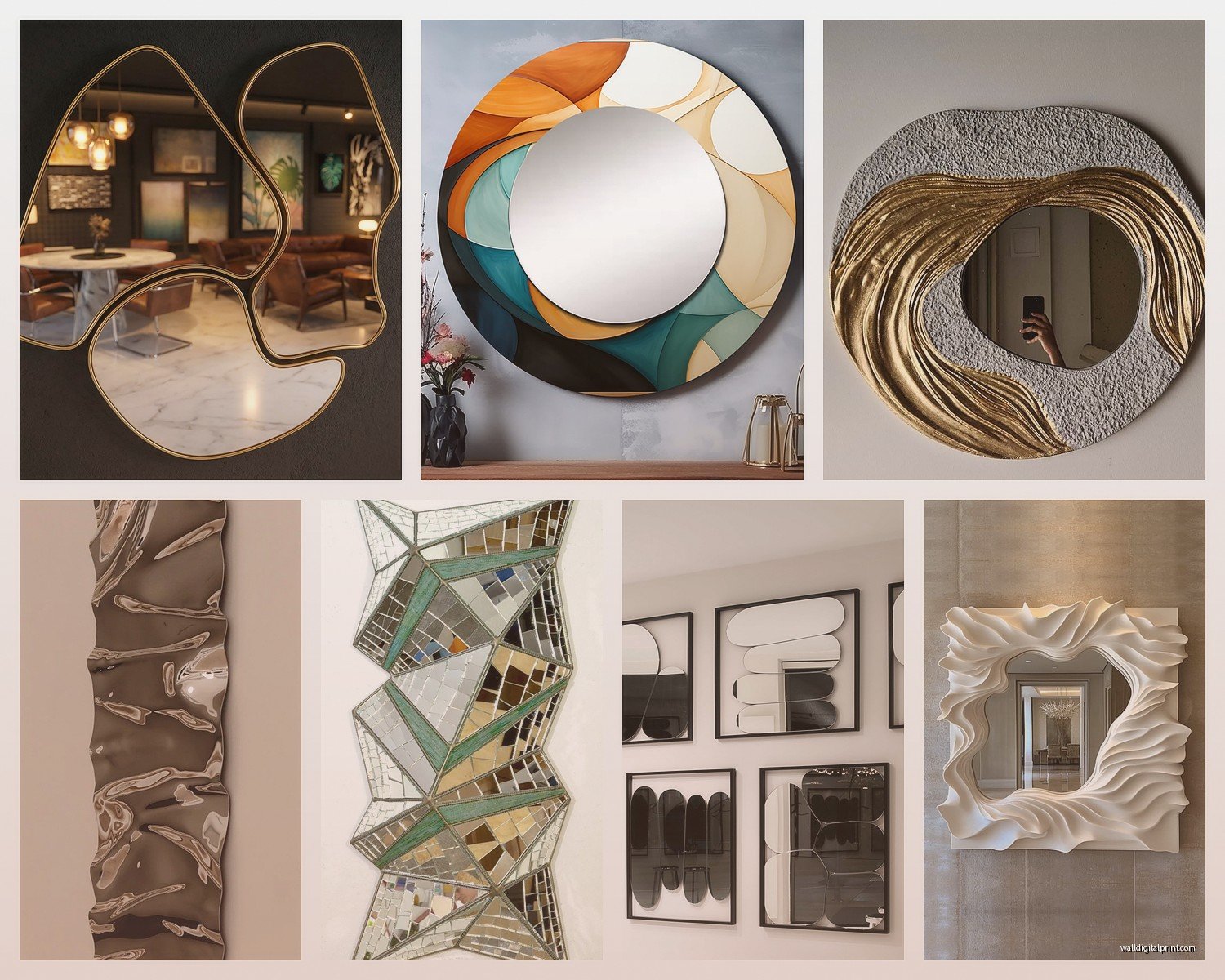
This is my favorite category honestly. Think like, organic flowing shapes or deliberately asymmetrical compositions. There’s this one piece I keep recommending that looks like overlapping water ripples, all different sized circular mirrors with beveled edges. It’s so much more interesting than the geometric stuff but also harder to place because it doesn’t have that obvious symmetry.
These work best on large blank walls where you need something with presence. Don’t try to squeeze one into a gallery wall situation because abstract mirror art needs breathing room to do its thing.
3D Sculptural Pieces
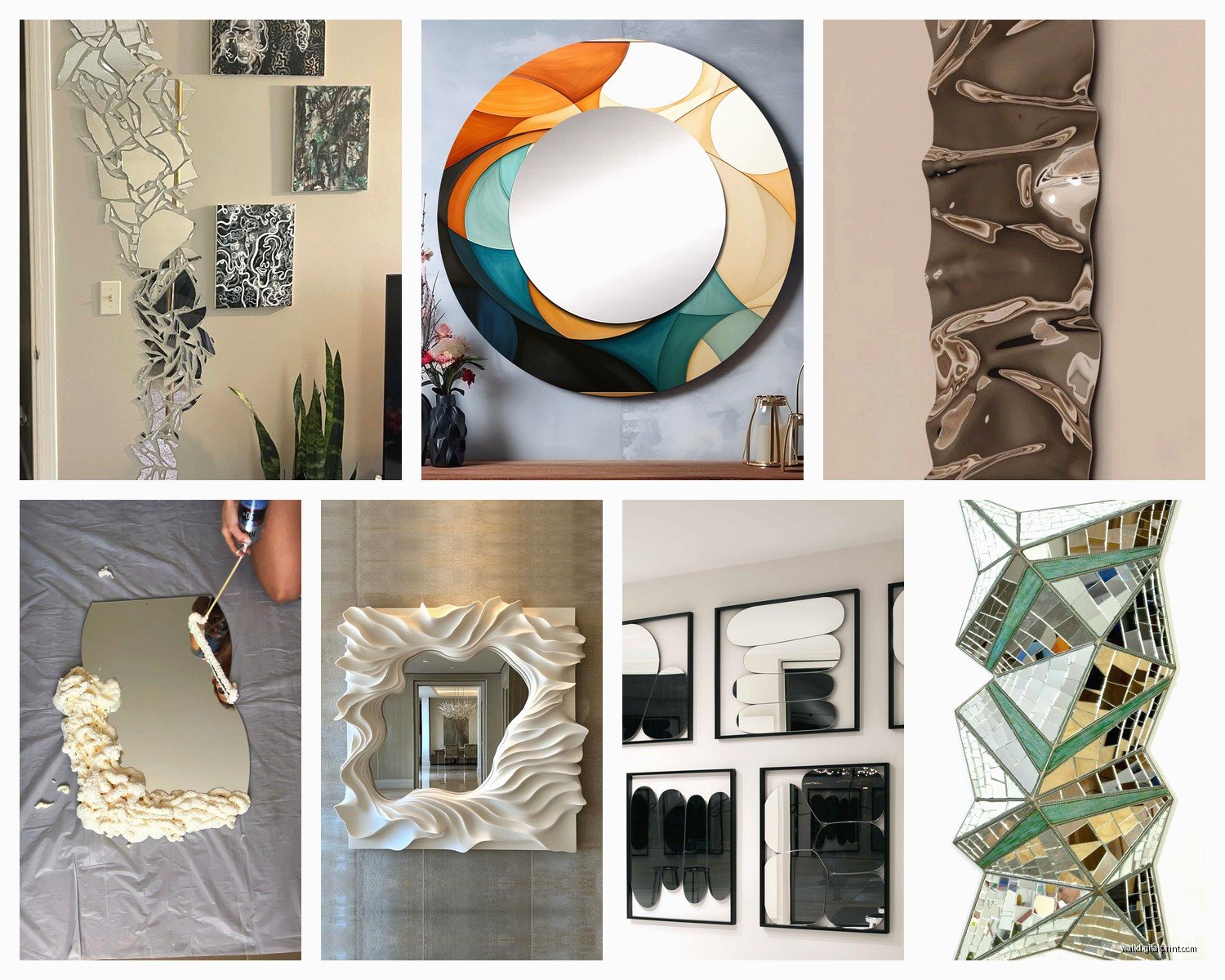
Okay so these are pricier but if you’ve got the budget they’re genuinely art installations. Multiple layers of mirror extending several inches off the wall, creating this dimensional effect. I saw one at a design show that was basically a spiral of mirror fragments and it looked different from every angle in the room.
The downside is they collect dust like crazy because of all the crevices and you gotta be careful with placement because if someone bumps into one the protruding parts could break. My cat knocked into one once and I aged five years in two seconds but it was fine.
Sizing This Stuff (Because Everyone Gets This Wrong)
I cannot tell you how many times I’ve walked into a space and someone has this tiny 18-inch piece on a massive wall and it’s just floating there looking lost. Or the opposite where they’ve crammed a huge piece onto a small wall and it overwhelms everything.
General rule I use is measure your wall space and the piece should take up roughly 2/3 to 3/4 of the available width. So if you’ve got a 6-foot wide wall section, you want something in the 4-5 foot range. This creates enough presence without looking cramped.
For over furniture the standard design rule is 2/3 the width of whatever’s below it but honestly with mirror art I sometimes go bigger because the reflective quality makes it feel less heavy than a solid piece would. That sunburst I mentioned earlier is actually wider than the console beneath it and it works because it’s not visually dense.
Height Placement
Center point should be at eye level which is usually around 57-60 inches from the floor. But if you’re hanging above furniture add the furniture height and then center the piece in the remaining wall space. I use painter’s tape to mock up the size and position before committing because moving these after the fact is annoying.
Where These Actually Work Best
Living rooms: Above the sofa is obvious but also consider the wall opposite your main seating area because then you get to enjoy the art while you’re actually using the space. I’ve also done them on the wall adjacent to windows and the light interaction is chef’s kiss.
Dining rooms: Great for reflecting candlelight during dinners and making the space feel larger. Just don’t put them directly across from where the host sits because catching glimpses of yourself eating is weird.
Bedrooms: I’m gonna be honest I’m not huge on mirror art in bedrooms because some people find it distracting or don’t love the feng shui implications or whatever. But if you’re gonna do it, the wall across from the foot of the bed works better than above the headboard.
Entryways: This is like the perfect application because entryways are usually small and can feel dark and mirror art solves both problems. Plus there’s something nice about that moment of light and reflection when you walk in.
Hallways: Long narrow hallways are basically begging for mirror art because it breaks up that tunnel effect. I did a series of three small geometric pieces down a hallway instead of one large one and it created this rhythm that made the walk down the hall feel intentional.
Lighting Considerations (This Makes or Breaks It)
Natural light is your best friend with mirror art because it changes throughout the day and you get this living quality. But you gotta think about angles because direct harsh sunlight reflecting into someone’s eyes is not the vibe.
I always check the sun’s path before finalizing placement. There’s a client whose west-facing wall gets this amazing golden hour light and the abstract piece there literally glows for like 30 minutes every evening. That was intentional planning not luck.
For artificial lighting, avoid placing mirror art directly opposite a light source unless you want glare city. Instead position it so it catches the light at an angle. Wall sconces flanking a mirror piece can be gorgeous if they’re dimmable because you can control the intensity.
Oh and another thing, if you have recessed lighting make sure the beams aren’t hitting the mirrors straight on. Adjustable recessed lights are worth it for this reason.
Installation Tips From Someone Who’s Hung Way Too Many
These are heavier than they look, especially the sculptural ones. I use heavy-duty picture hanging strips for anything under 15 pounds and they work great plus they’re removable if you’re renting. For heavier pieces you need actual wall anchors or studs.
Always use a level. I know that sounds obvious but I’ve seen so many crooked mirror installations and with geometric pieces even a slight tilt is super noticeable because your eye expects the angles to be precise.
If your piece came with a sawtooth hanger on the back consider replacing it with D-rings because sawtooths can slip over time and with something reflective and potentially breakable you don’t wanna risk it.
For multi-piece installations I lay everything out on the floor first and take measurements between each piece. Then I tape the pattern on the wall with painter’s tape before making any holes. Saves so much frustration.
Cleaning and Maintenance
Microfiber cloths and glass cleaner, that’s it. Don’t use anything abrasive because you’ll scratch the mirror surface. For the sculptural pieces with lots of angles I use a small soft brush to get dust out of crevices first then wipe down with cleaner.
Some pieces have antiqued or tinted mirrors and you gotta be careful with harsh cleaners because they can damage the finish. Test in a corner first or just use water and microfiber.
The frames need attention too depending on material. Metal frames I just wipe down, wooden frames sometimes need furniture polish if they’re looking dull.
Mixing With Other Art
This is tricky because mirror art is already a statement. I generally don’t recommend mixing it into a gallery wall unless the other pieces are super minimal. The reflective quality competes with other art for attention.
What does work is pairing mirror art with one or two other pieces that have some breathing room between them. Like a large abstract mirror on one wall and a painting on an adjacent wall creates this nice dialogue without chaos.
I did a dining room where we put a geometric mirror piece on one wall and a large black and white photograph on the opposite wall and they balanced each other really well because both had strong graphic qualities.
Style Compatibility
Modern and contemporary spaces are the obvious match but I’ve successfully used mirror art in transitional spaces too. The key is choosing pieces where the frame material matches your overall aesthetic. Brass sunbursts can read traditional, matte black geometric pieces feel industrial, natural wood frames work in organic modern spaces.
I wouldn’t force mirror art into a really traditional or rustic space though because it’s gonna feel out of place no matter how you style it.
Budget Ranges and What You Actually Get
Under $100: You’re looking at smaller pieces or very basic designs. These can work fine for starter pieces or smaller spaces but don’t expect amazing quality. The mirrors might be thin, frames might be flimsy. West Elm and CB2 sometimes have decent options in this range during sales.
$100-300: This is the sweet spot honestly. You can get well-made medium to large pieces with good materials and interesting designs. Most of my client projects land in this range because it balances quality with reasonable pricing.
$300-600: Higher end designs, better materials, more intricate compositions. If you’re doing a large statement piece this is probably where you’ll end up. The construction quality is noticeably better and these pieces feel substantial.
$600+: Art territory. These are usually from specific artists or designers, limited production, museum-quality type stuff. I’ve specified pieces in this range for high-end projects and they’re beautiful but not necessary unless you’re really into it.
Mistakes I See Constantly
Hanging too small for the space is number one. People are scared to go big and then the piece looks insignificant.
Putting mirror art in rooms with cluttered backgrounds because then the reflections are just chaos. These need relatively calm surroundings to work properly.
Not considering what the mirrors will actually reflect. I walked into a consultation once where someone had hung a beautiful piece that perfectly reflected their pile of mail and keys on the counter. Just think it through.
Mixing too many metallic finishes without a plan. If your mirror has a gold frame and you’ve got silver lamps and copper accents and chrome hardware it’s gonna look confused. Pick a dominant metal and stick with it mostly.
wait I forgot to mention that you should think about the backing color on cluster-style pieces because some have white backing and some have black and it makes a difference in how the overall piece reads especially if there are gaps between the mirror sections.
Look I’m realizing this is getting long but honestly there’s so much to consider with mirror art because it’s not static like a painting, it’s constantly changing based on light and angle and what’s happening in the room and that’s what makes it cool but also what makes it challenging to get right. Just take your time with placement decisions and don’t be afraid to try a few positions before committing because that perfect spot exists you just gotta find it.