Wall Art Guide, Wall Art Tutoriels
African Animal Wall Art: Safari Wildlife Big Five Decor
Oct
So I’ve been absolutely obsessed with African animal wall art lately and honestly it started because a client wanted to redo their living room with this whole safari vibe but not in that dated 1990s way, you know? And I went down this massive rabbit hole of what actually works versus what just looks like you raided a tourist shop in Nairobi.
The Big Five Thing Everyone Gets Wrong
Okay so first thing – everyone thinks they need all five animals (lion, elephant, leopard, rhino, buffalo) on their wall and that’s gonna look like a zoo exploded in your house. I learned this the hard way when I ordered this set for my own hallway and my sister literally laughed when she saw it. Pick ONE or maybe two max. The elephant is honestly the most versatile because it reads as both powerful and gentle somehow? Lions can go either really regal or really aggressive depending on the photo style.
I’ve found that black and white photography works better than color for the big cats especially. There’s something about a colored lion photo that just screams “I bought this at HomeGoods” whereas a black and white close-up of a lion’s face feels more artistic and intentional.
Print Quality Actually Matters Here
This is gonna sound snobby but hear me out – you need at least 300 DPI if you’re printing anything larger than 16×20. I made the mistake of ordering this gorgeous cheetah print from Etsy and when it arrived it looked pixelated from like 5 feet away. Waste of $45.
For canvas prints specifically:
- Gallery wrapped edges are worth the extra $20 because you don’t need to frame
- Ask if it’s actual canvas or that weird poly-cotton blend that looks plasticky
- Deeper stretcher bars (1.5 inches) look more expensive than the thin ones
- Make sure they’re using UV-resistant inks or it’ll fade within a year near windows
Oh and another thing – those metal prints are having a moment right now. I just installed one in a client’s office last week, it’s a zebra close-up on brushed aluminum and the way it catches light is insane. More expensive though, like $200+ for a decent size.
Where to Actually Buy This Stuff
Etsy is obvious but you gotta dig. Search for “African wildlife photography print” not “safari wall art” because you’ll get better quality independent photographers. I’ve bookmarked like twelve shops at this point.
Society6 and Redbubble let you choose your format which is clutch – same image as a framed print, canvas, or even a tapestry. The quality is hit or miss though. I ordered an elephant print from Society6 and the colors were way more saturated than the preview, but their return policy is decent.
For actual gallery-quality stuff, look at:
- Great Big Canvas – pricey but the quality is consistent
- iCanvas – they have tons of African wildlife options and the framing is solid
- Local print shops if you have a high-res file – sometimes cheaper than online
Wait I forgot to mention – if you’re on a budget, frame your own prints. Buy the print separately from somewhere like Minted or even download from a stock photo site (legally obviously), then get frames from Target or Michael’s with a coupon. I did this for my guest room with three small giraffe prints and spent maybe $60 total versus the $200+ it would’ve been pre-framed.
The Sizing Situation Nobody Talks About
Okay so funny story – I hung what I thought was a massive elephant print above a client’s sofa and when we stepped back it looked like a postage stamp. The general rule is your art should take up 2/3 to 3/4 of your furniture width. So if you have a 90-inch sofa, you’re looking at 60-68 inches of art width.
For African animal art specifically I’ve noticed:
- Single large animal portraits work best 30×40 or bigger
- Landscape safari scenes (acacia trees, sunset backgrounds) can go horizontal and wider
- The Big Five look good in a grid – like 16×20 each in a set of four
Don’t hang anything higher than 57 inches at center point. I see this constantly where people mount their lion print like 7 feet up the wall and you’re straining your neck to look at it.
Color Schemes That Don’t Look Cheesy
This is where most people mess up. They see “African” and immediately think oranges, reds, tribal patterns everywhere. And look, that can work but it’s tricky.
The sophisticated approach I’ve been using:
- Neutral walls (warm whites, taupes, soft grays)
- Let the animal art be the color focal point
- Pull 1-2 accent colors from the print for pillows or throws
- Natural textures like jute, linen, light wood
I did a whole living room around this elephant print that had these gorgeous dust and earth tones. Added some terracotta pots, a jute rug, cream linen sofa. Chef’s kiss. Didn’t need to go full safari theme for it to feel cohesive.
Black and white animal prints though – those you can throw into literally any color scheme. I have a zebra portrait in my bathroom that’s all navy and white and it totally works.
Mixing Photography with Other Art Styles
So you don’t have to commit to ONLY photographic prints. I’m actually really into mixing realistic photos with more abstract or watercolor animal art. Like a realistic elephant photo next to a loose watercolor giraffe. It feels more collected and less matchy-matchy.
Vintage safari posters are another vibe entirely – those retro travel ones. They pair surprisingly well with modern photography if your frames are consistent.
My current obsession is line art animal prints. Single continuous line drawings of elephants or lions. Super minimal, looks expensive, usually costs like $15 on Etsy. I’m gonna order a set for above my bed actually.
Framing Options That Make Sense
The frame can honestly make or break this. I’ve seen gorgeous wildlife photography look cheap because it was in a terrible frame.
For African animal art specifically:
- Black frames – classic, makes colors pop, works with everything
- Natural wood – warmer feel, good for brown/tan animal tones
- White frames – only if your walls aren’t white or it disappears
- No frame (canvas wraps) – modern and clean
Matting is optional but it does add a gallery quality. I usually skip it for canvas or metal prints but use it for paper prints. White or cream mats are safest – don’t try to match mat colors to your decor, it rarely works.
Oh and those floating frames where there’s a gap between the art and frame? So good for botanical or minimal animal line drawings. Gives it dimension.
The Gallery Wall Approach
If you wanna do multiple pieces, plan it out on the floor first. I cannot stress this enough. Use painter’s tape on the wall to map where frames will go before you start drilling holes.
For safari/wildlife gallery walls:
- Keep frames all the same color even if sizes vary
- Mix orientations – some vertical, some horizontal
- Start with your largest piece as the anchor
- Keep spacing consistent (I do 2-3 inches between frames)
- Odd numbers look more balanced than even
I did a grid of six African animal close-ups once – two rows of three – and it looked amazing. All black frames, all 16×20, perfectly aligned. Sometimes simple is better.
What Actually Looks Good in Different Rooms
Living room – go big or go home. This is where you can do that massive elephant canvas above the sofa or a large triptych of African landscapes. It’s your statement space.
Bedroom – I like calmer animals here. Elephants, giraffes, maybe a serene lion (not roaring). Keep the mood peaceful. Black and white works great in bedrooms.
Home office – this is where lions and leopards shine. Power animals, you know? I have a black and white leopard portrait in my workspace and I swear it makes me feel more boss.
Bathrooms – smaller prints work here. A single framed zebra print or a set of three small safari animals. Just make sure if it’s a steamy bathroom you’re using glass/plexiglass to protect the print.
Kids rooms – obviously this depends on age but safari animals are huge for nurseries. Go for gentler expressions and maybe more illustrated styles rather than intense wildlife photography. My friend has this adorable watercolor elephant set in her daughter’s room.
Avoiding the Tourist Trap Look
Okay this is crucial. There’s a difference between sophisticated African wildlife art and looking like you bought everything at a hotel gift shop in Kruger National Park.
What to avoid:
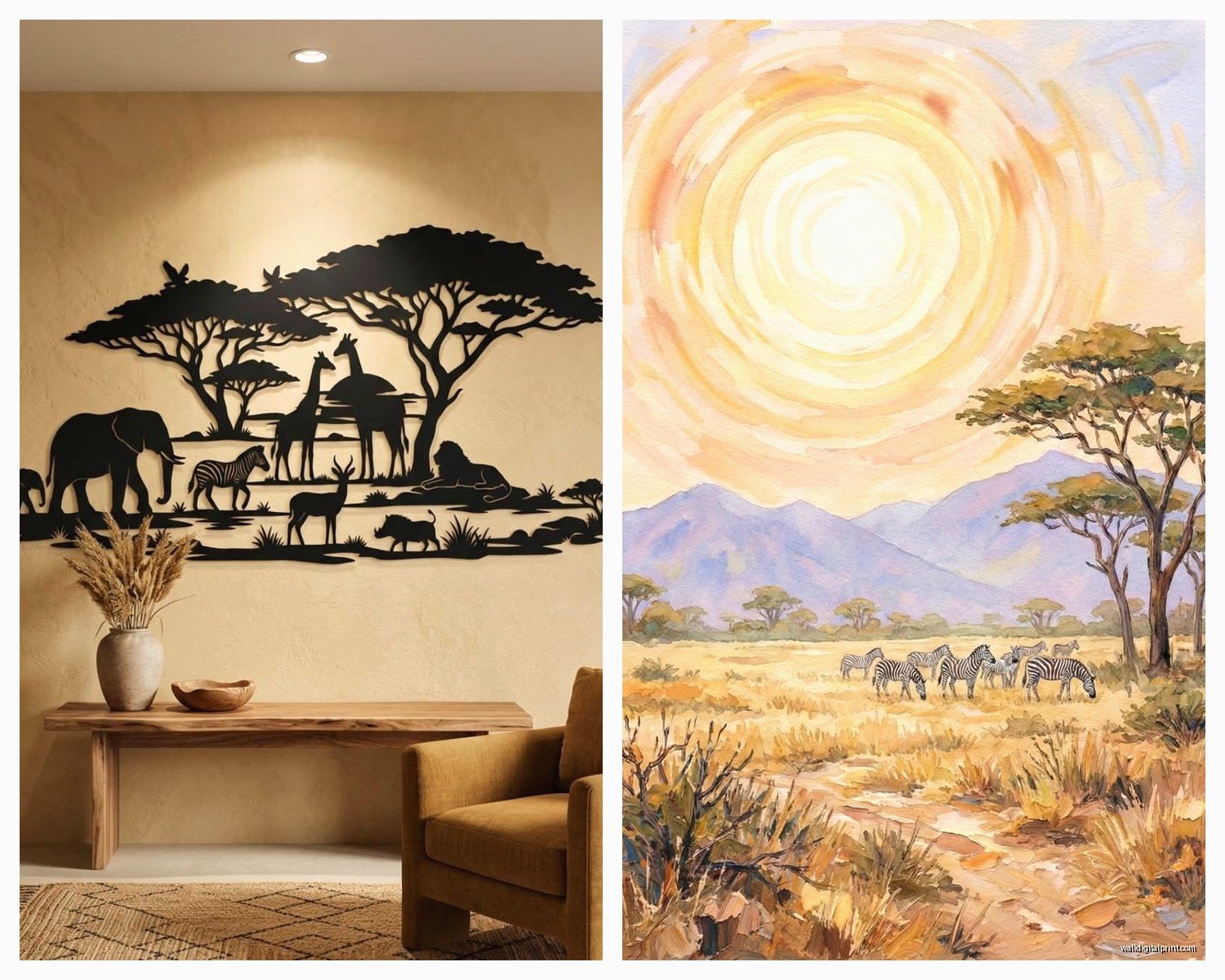
- Sunset silhouettes with acacia trees – overdone
- Multiple animals crammed into one print
- Super saturated orange/red color grading
- Anything with “Live Laugh Safari” type text
- Obvious composites (fake-looking)
What actually looks good:
- Close-up portraits showing texture and detail
- Natural poses in natural lighting
- Muted or black and white color palettes
- Single subject focus
- Artistic composition, not just documentary style
The goal is “I appreciate African wildlife” not “I went on safari once in 2003.”
Lighting Makes a Huge Difference
Something I learned from installing art in like fifty homes – your lighting matters SO much. That elephant print that looked muddy? We added a picture light above it and suddenly you could see all the detail and texture.
For matte prints, avoid direct sunlight or use UV-protective glass. For glossy or metallic prints, angle them where they won’t catch glare from windows or overhead lights.
If you’re doing a gallery wall, consider track lighting or a few spotlights. Makes everything look museum-quality.
Budget-Friendly Tricks I Actually Use
Because not everyone has $500 to drop on wall art, right?
Print your own from high-quality downloads – sites like Unsplash have free high-res wildlife photos, or buy from stock sites for like $20. Print at Costco or a local shop.
Thrift frames and spray paint them – I’ve found amazing vintage frames at Goodwill for $5, spray painted them matte black, boom.
Start with one statement piece rather than multiple small ones – better to have one great large print than three mediocre small ones.
Use removable wallpaper as a backdrop – there’s safari-themed peel-and-stick wallpaper that you could use on one accent wall, then add minimal art over it. Creates impact without tons of frames.
My cat just knocked over my coffee which is perfect timing because I think I’ve covered everything? The main thing is just don’t overthink it too much. Pick animals you actually connect with, make sure the quality is decent, and size it appropriately for your space. The rest kinda falls into place.