Wall Art Guide, Wall Art Tutoriels
Black and White Wall Art Large: Oversized Monochrome Art
May
So I’ve been obsessing over large black and white wall art lately because honestly, it’s the easiest way to make a room look like you hired a designer without actually spending designer money. My client last week wanted to fill this massive blank wall in her living room and we went down this whole rabbit hole of oversized monochrome pieces.
Why Size Actually Matters More Than You Think
Okay so here’s the thing nobody tells you – going too small is worse than having a blank wall. I learned this the hard way in my own apartment like three years ago. Got this cute 16×20 print, hung it on my dining room wall, and it just looked… sad? Like a postage stamp floating in space.
For large walls, you’re looking at minimum 40×60 inches. I know that sounds huge but trust me. If you’ve got a wall that’s 10-12 feet wide, you want something that takes up about two-thirds to three-quarters of that width. My general rule is measure your wall width, multiply by 0.6, and that’s your minimum art width. So a 10-foot wall needs at least a 72-inch wide piece.
The Whole Multi-Panel Thing
You can also do the triptych or multi-panel situation which I’m kinda obsessed with right now. Three panels of like 24×36 each spread across a wall creates this gallery moment without the commitment of one massive piece. Plus it’s easier to transport and if you move you’ve got more flexibility with arrangement.
I just helped my neighbor arrange three 30×40 panels in her bedroom and we spaced them about 3-4 inches apart. The key is keeping the spacing consistent and making sure the overall composition is centered on the wall, not each individual panel centered separately.
What Actually Works in Black and White
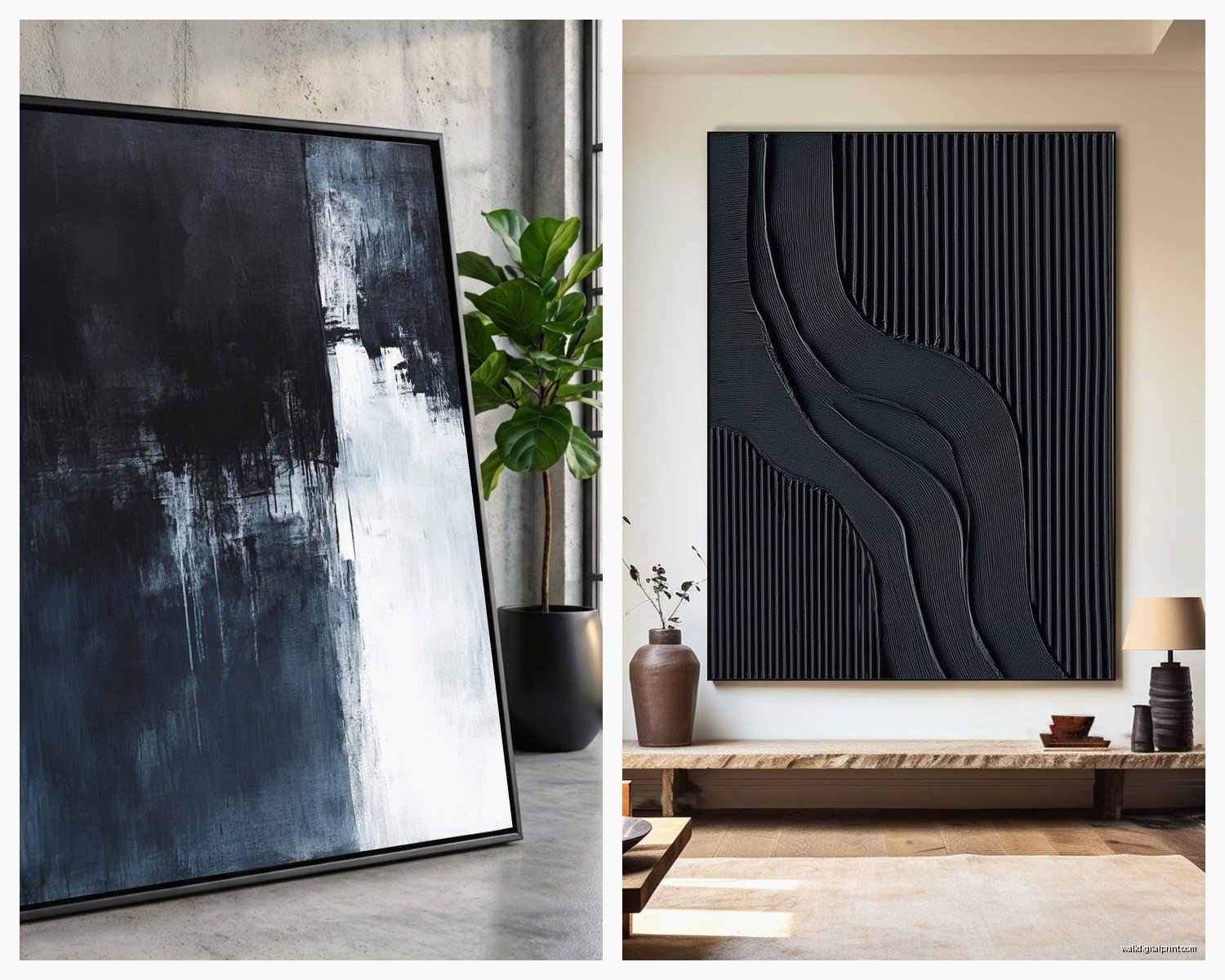
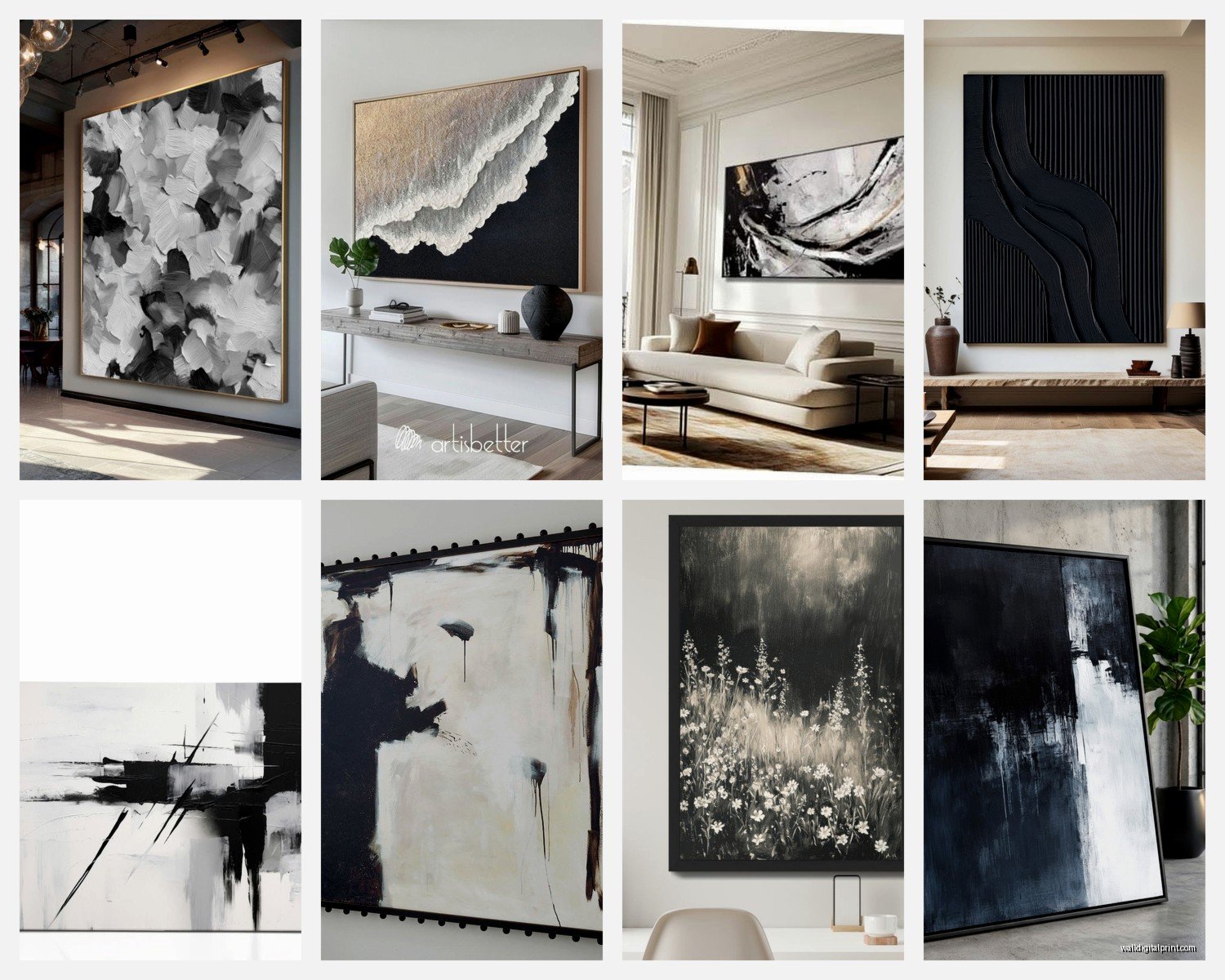
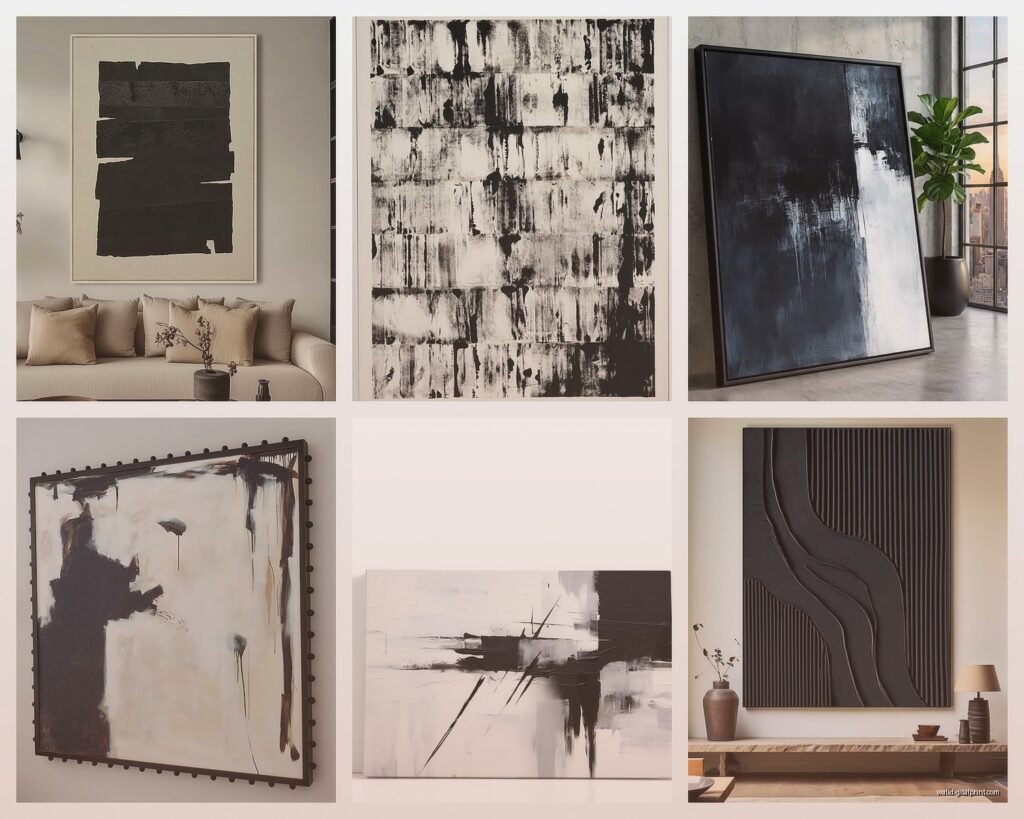
Abstract stuff is obviously the easiest because it goes with everything and nobody can tell you it’s upside down. I’ve been loving these big brushstroke pieces – super bold black strokes on white canvas or vice versa. There’s something about the contrast that just works in literally any room.
Photography is another winner but you gotta be careful. Architectural shots are safe – like those minimalist building photos or geometric patterns. Nature photography in black and white can be stunning but also can read as very 2010s Pottery Barn if you’re not careful. Skip the dandelion wisps and lone trees, basically.
Line drawings are having a moment and I’m here for it. Those single-line face profiles or figure sketches, when blown up large, look expensive even when they’re not. Got one from this Etsy shop last month for like $80 printed on canvas and everyone asks where I got it.
Typography and Words
Okay so funny story, I used to hate word art but the right typography piece can actually be chic? Not like “Live Laugh Love” obviously, but a single powerful word or short phrase in interesting typography. Saw this piece that just said “CHAOS” in this gorgeous serif font at 48×72 and it was perfect for a modern office space.
Just please don’t do the scripty cursive quote thing. We’re past that.
Where to Actually Buy This Stuff
Budget is gonna determine your route here. Let me break down what I’ve tested:
Print-on-Demand (Budget Friendly)
Sites like Printful or Printique let you upload designs and print them massive. Quality is decent if you choose the right substrate. Canvas is popular but I actually prefer the smooth fine art paper mounted on foam board for black and white – the contrast is sharper.
Etsy is wild for this. So many sellers offer digital downloads that you take to a local print shop. I’ve done this probably twenty times. Download a high-res file for like $15-30, take it to a FedEx print center or local printer, and get it printed on whatever you want. The total cost for a 40×60 usually runs me about $80-120 depending on materials.
Mid-Range Options
Desenio and Printler have good stuff in the $100-300 range for large formats. The quality is solid and they have actual artists creating the work. Shipping from Europe takes a minute but I’ve never had issues.
Minted does custom sizing which is clutch. Their black and white photography collection is really strong and you can get stuff printed up to 54×40 on various papers.
Investment Pieces
If you’re spending $500+, look at Saatchi Art or Artsy for original work or limited editions. I found this incredible charcoal abstract on Saatchi last year for a client – 60×80, original piece, $1200. Sounds like a lot but for original art that size it’s actually reasonable.
Local art fairs and gallery sales are also worth checking. End of show sales can get you 30-40% off original large-scale work.
Framing is Gonna Cost You
Real talk – framing large pieces is expensive and heavy. A 48×60 frame with proper matting and museum glass can easily run $400-600 at a frame shop.
For black and white specifically though, you can skip the frame entirely. Canvas wraps look clean and modern without frames. Or do the floating frame thing where it’s just a thin black or white edge – way cheaper and you can find them on Amazon for like $60-100 even in large sizes.
If you want glass, regular framing glass is fine for most situations. Museum glass is amazing for preventing glare but adds so much to the cost. I only recommend it if the piece is valuable or in a room with lots of windows.
The DIY Frame Hack
Okay this is gonna sound weird but I’ve done this successfully multiple times – buy the cheap poster frames from Amazon or Ikea (they make them up to 48×36), then spray paint the frame matte black or white. Costs like $40 total and looks way more expensive. Just remove the plastic front piece first before painting obviously.
Placement and Hanging Without Destroying Your Walls
Center of the artwork should be at 57-60 inches from the floor – that’s standard gallery height and where your eye naturally falls. For really massive pieces like 72 inches tall, you might want to go slightly lower so it doesn’t feel like it’s floating away.
Above a sofa, leave 6-10 inches between the furniture top and the bottom of the art. I see people hang things way too high all the time and it breaks the visual connection between the furniture and the art.
For the actual hanging, large pieces are heavy so you need proper anchors. I use these heavy-duty picture hangers rated for like 50-75 pounds. If you’re going into drywall without studs, get the toggle bolts or molly bolts. French cleats are also amazing for really heavy pieces – super secure and you can adjust side to side easily.
My cat knocked over a ladder while I was hanging a 50×70 piece last month and I almost had a heart attack but this is not relevant just needed to vent about that.
Mixing Monochrome Art With Your Room
The beauty of black and white is it literally works with any color scheme. I’ve put monochrome pieces in rooms with bold jewel tones, pastels, neutrals, everything.
If your room is already mostly neutral, the black and white art becomes the focal point which is perfect. If you’ve got color happening, it grounds the space and gives your eye somewhere to rest.
One thing I’ve learned though – consider your wall color. Black and white art on a white wall is classic but sometimes the white parts of the art disappear. On a dark wall, same issue but reversed. Medium grey walls are actually perfect for monochrome art because both the black and white elements pop equally.
Lighting Makes or Breaks It
You need some kind of lighting situation or your expensive art just looks flat. Picture lights are traditional but honestly I prefer recessed ceiling spots or track lighting aimed at the wall. The angle of light creates dimension and makes the blacks look richer.
If you can’t do ceiling lights, those plug-in LED picture lights from Amazon for like $30 work fine. Just hide the cord behind furniture or use those cable management strips.
Styling Around Large Monochrome Pieces
Don’t clutter around oversized art. The whole point is making a statement so let it breathe. I see people put a huge piece on the wall then surround it with shelves and smaller art and it’s just chaos.
Below the art, a simple console table or credenza with minimal styling works. Maybe a sculptural object or plant, but keep it to 1-3 items max. The art is the moment.
If you’re doing a gallery wall situation with black and white pieces, keep consistent matting or frames. All black frames or all white frames, not mixed. And maintain consistent spacing between pieces – I use 2-3 inches between frames as my standard.
Mistakes I’ve Made So You Don’t Have To
Bought a print that was low resolution and didn’t realize until it arrived and looked pixelated. For large prints, you need at least 150 DPI at the final size. Always check the file resolution before ordering.
Hung a piece without considering the sofa back height and it’s positioned awkwardly. Measure everything before committing to nail holes.
Got a canvas print that arrived warped. Cheap canvas stretchers do this. If ordering canvas, pay extra for gallery-wrapped with proper wooden stretcher bars that are at least 1.5 inches deep.
Chose an image with too much white space thinking it would look minimalist but it just looks empty. There needs to be enough contrast and visual interest to fill the scale.
Quick Style Categories That Work
Modern Minimalist – single line drawings, geometric shapes, stark contrast with lots of white space
Dramatic Contemporary – bold black backgrounds with white elements, high contrast abstract expressionism, dark and moody photography
Organic Modern – botanical drawings blown up large, natural textures like marble or wood grain in monochrome, flowing abstract shapes
Industrial – architectural photography, urban landscapes, textured abstracts with rough edges
Classic Traditional – black and white portraits, classical figure drawings, ornate frames around simpler images
Match your art style to your overall room vibe but honestly black and white is so versatile you can kinda do whatever.
The Commission Route
If you want something truly custom, commissioning an artist isn’t as expensive as you’d think for monochrome work. Since they’re not dealing with color mixing and complexity, some artists charge less. I’ve commissioned three pieces in the $300-600 range for sizes around 48×60.
Instagram is great for finding artists. Search hashtags like #abstractartist #monochromeart #blackandwhiteart and DM people whose style you like. Most artists are happy to discuss custom work.
Just be clear about dimensions, style preferences, and deadline. Get a contract or at least email confirmation of price and timeline.
Okay I think that covers most of what I’ve learned through way too much trial and error with large black and white art. The main thing is just go bigger than you think you should and make sure it’s high quality printing because at that scale, flaws show up.