Wall Art Guide, Wall Art Tutoriels
Buddha Wall Art: Zen Meditation & Buddhist Decor
Jun
So I’ve been setting up meditation corners for clients for like three years now and honestly the whole Buddha wall art thing can go really wrong or really right depending on what you pick and where you put it.
Where to Actually Put Buddha Art Without It Looking Weird
Okay first thing – don’t just slap it above your couch in the living room unless that’s genuinely where you meditate or do yoga. I see this all the time and it feels… performative? Like the living room gets all this foot traffic and people eating pizza and watching reality TV, and then there’s this serene Buddha face staring at everyone. It’s jarring.
The best spots I’ve found are actually kinda obvious once you think about it. Bedrooms work great, especially on the wall you see when you first wake up. There’s something nice about that being your first visual of the day instead of like, your laundry pile. I put a simple bronze Buddha print in my own bedroom last year and it’s just calming when I’m trying to get my brain to shut up at night.
Home offices are surprisingly good too if you face a lot of stress at work. One of my clients put this really minimal line-drawing Buddha behind her desk and she says it reminds her to breathe during Zoom calls that should’ve been emails.
Oh and obviously dedicated meditation spaces or yoga corners. That’s the no-brainer spot.
Picking the Right Style (This Matters More Than You’d Think)
There are SO many styles and honestly some of them are gonna clash hard with your existing decor. I learned this the hard way when I bought this super ornate golden Thai-style Buddha for a client’s minimalist Scandinavian apartment and we both just stared at it like… yeah no.
Minimalist Line Art Buddha Prints
These are my go-to for modern spaces. Just simple black lines on white or cream backgrounds. They work with literally everything – mid-century modern, Scandinavian, contemporary, even industrial spaces. You can find them on Etsy for like $15-40 for a digital download that you print yourself, or get them already framed from places like Society6 for around $60-100.
The thing with these is they’re subtle enough that they don’t scream “I’M SPIRITUAL” but they still have that meditative quality. I’ve used them in at least a dozen client homes.
Vintage-Style Buddha Photography
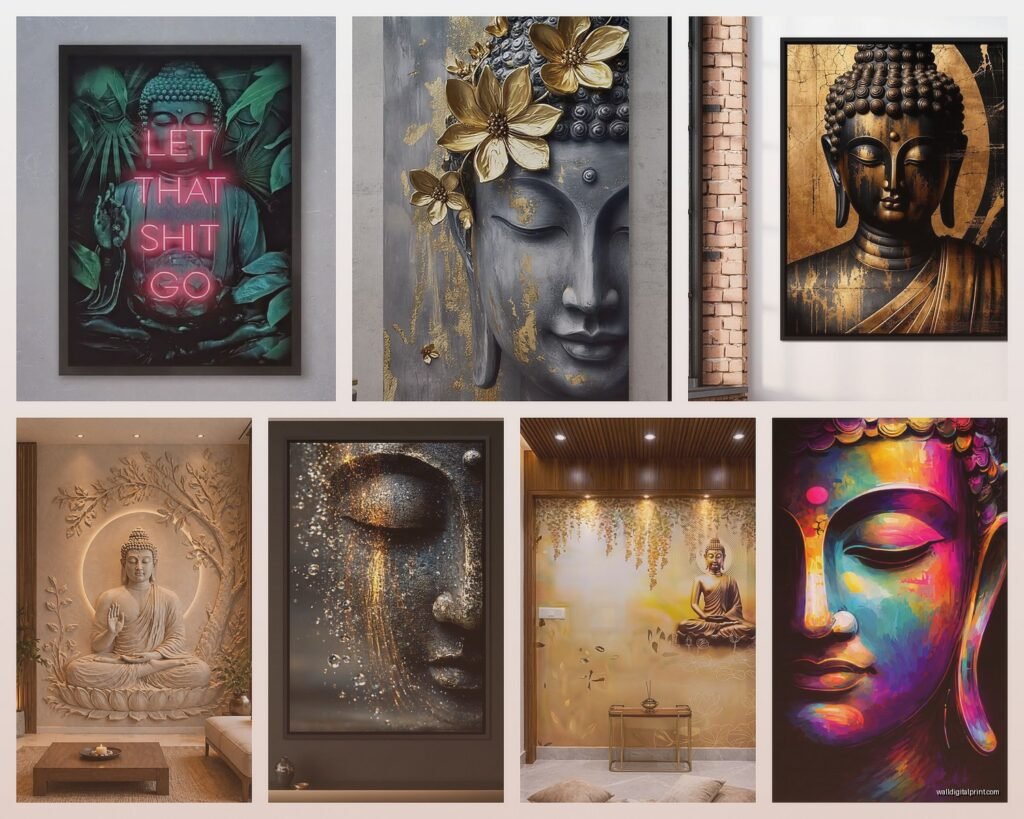
This is more for people who want something with texture and depth. Black and white photos of old Buddha statues, usually shot in temples with really moody lighting. These look incredible in spaces that already have some vintage elements or exposed brick or dark wood furniture.
I found this amazing one on Desenio last month – it’s a close-up of a weathered stone Buddha face and the detail is just *chef’s kiss*. It was around $35 unframed.
Gold Leaf or Metallic Buddha Art
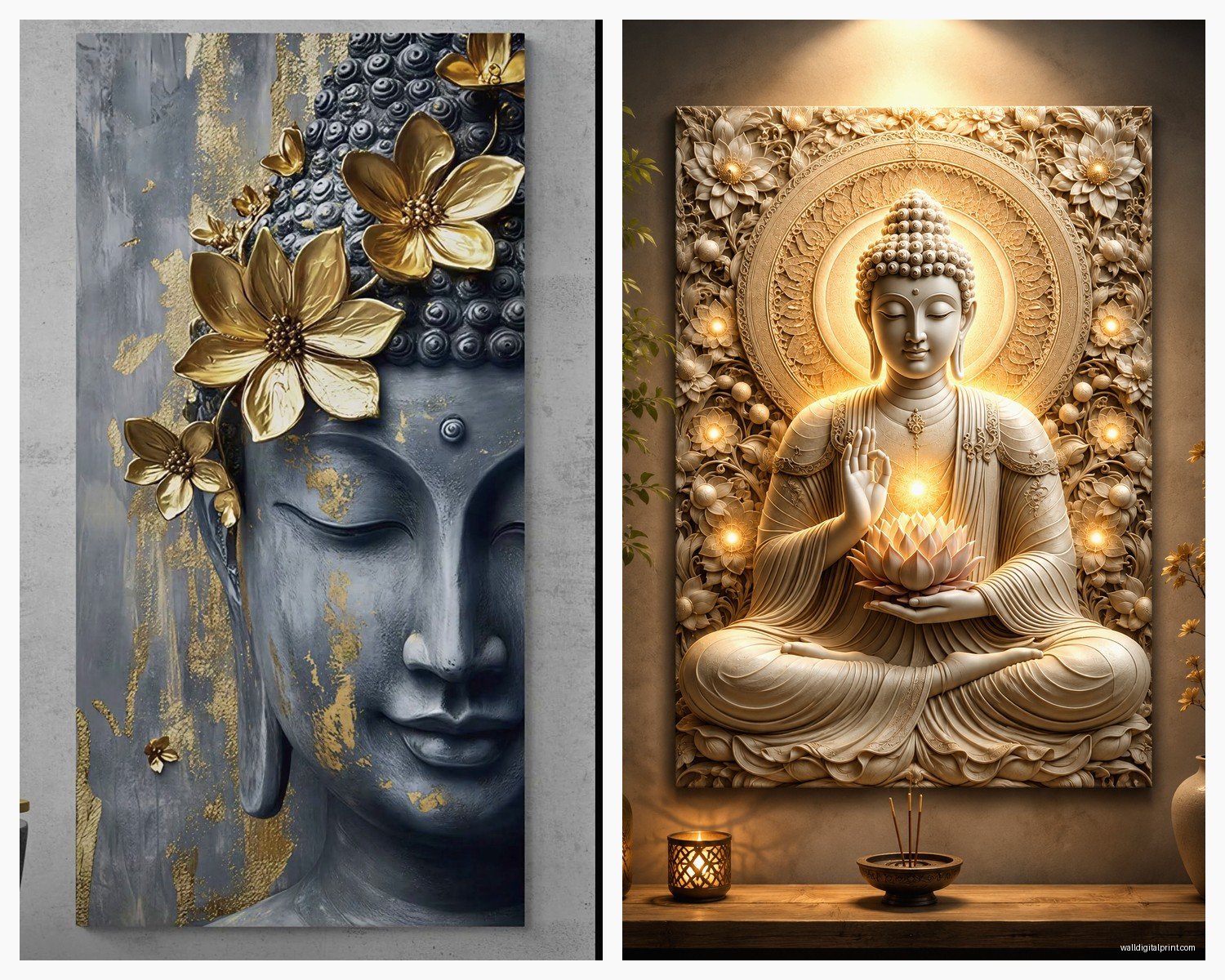
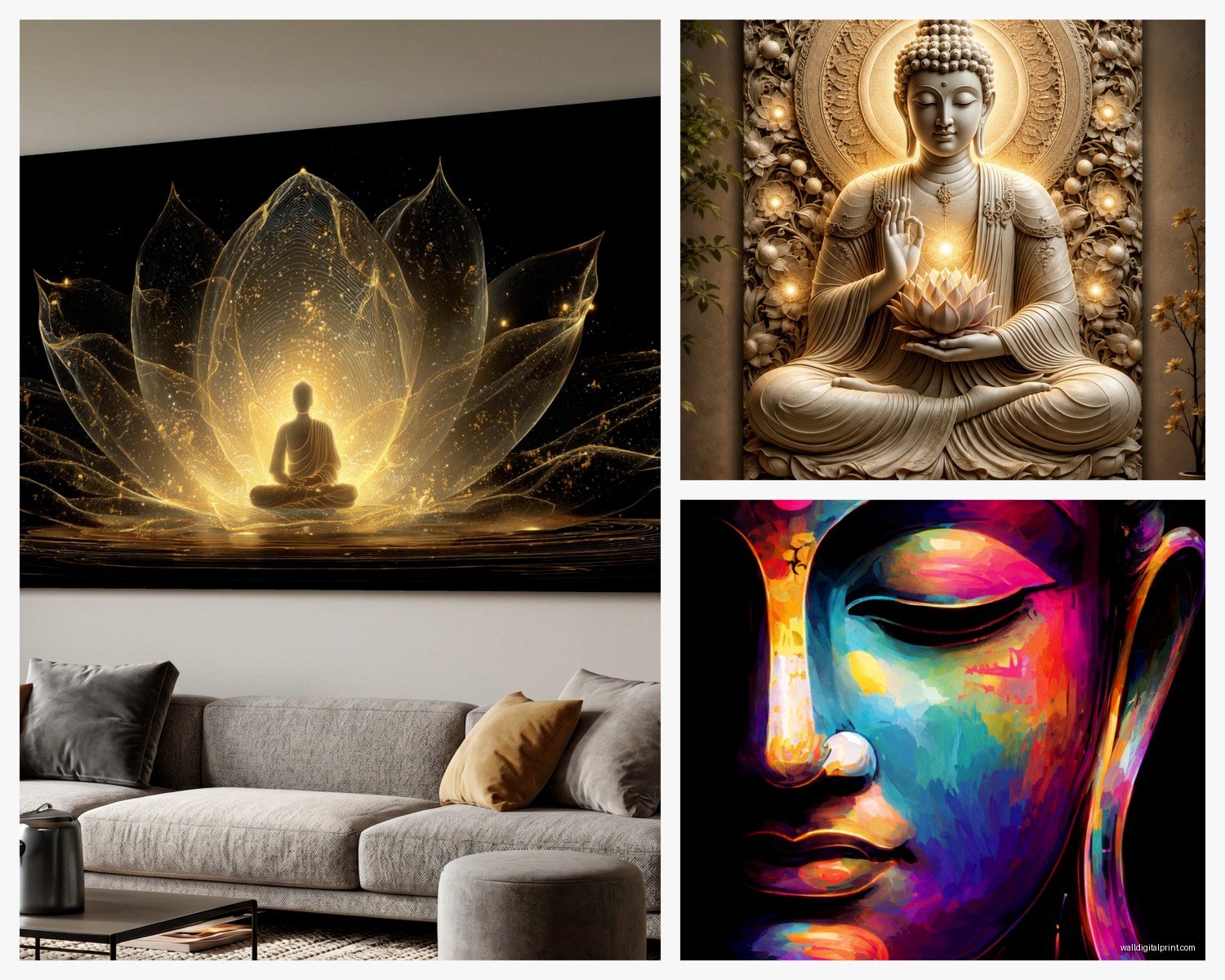
Okay so this is gonna sound weird but these actually work better in glam or eclectic spaces than you’d think. I was watching The Great British Baking Show the other night (my dog was snoring through the whole thing) and got distracted looking at gold leaf Buddha canvases online and found some really beautiful ones.
The key is making sure the gold isn’t too shiny or cheap-looking. You want something with actual texture or hand-painted elements. Expect to pay $80-200 for decent quality. Cheaper ones look like they belong in a college dorm.
Mandala Designs vs Actual Buddha Figures
Wait I forgot to mention – you don’t have to go with an actual Buddha figure. Mandalas are technically Buddhist symbols and they work really well for people who want the meditative vibe without the religious iconography. They’re more geometric and abstract so they fit into more design styles.
I use mandalas a lot for clients who are hesitant about having a Buddha face in their home but still want that zen energy.
Size and Placement Rules That Actually Matter
This is where people mess up the most. They either go too small and it looks like an afterthought, or too big and it overwhelms the space.
For above a meditation cushion or small altar, you want something in the 16×20 to 24×36 inch range. Big enough to be a focal point but not so huge that it feels like it’s looming over you.
For bedroom walls, I usually do 24×36 or even 30×40 if the wall is large and empty. You want it to anchor the space.
The bottom of the frame should be about 6-8 inches above your headboard if you’re putting it above the bed, or at eye level (around 57-60 inches from the floor to the center of the art) if it’s on an empty wall.
Color Palettes That Work
Most Buddha art comes in pretty neutral tones which is great because it’s easy to work with, but you gotta consider what’s already on your walls.
For white or light gray walls: Literally anything works, but I love black and white prints or sepia-toned photography. Creates really nice contrast.
For beige or cream walls: Go with warmer tones – bronze, copper, warm grays. Cool-toned Buddha art can look washed out against beige.
For dark walls (navy, charcoal, forest green): You need something with lighter elements or metallic touches so it doesn’t disappear. White line art on dark backgrounds, or pieces with gold or silver leaf.
For colored accent walls: Stick with black and white or monochromatic Buddha art. You don’t want it competing with your wall color.
Framing Options (Don’t Skip This Part)
Okay so funny story, I once hung a beautiful Buddha print without a frame because my client wanted to save money and within like two months the edges were curling and it looked terrible. Just frame it.
Simple black frames: Work with everything, never go wrong. I get mine from IKEA (the RIBBA series) for $10-30 depending on size.
Natural wood frames: Perfect for bohemian, Scandinavian, or natural modern spaces. Light oak or bamboo frames are especially good with Buddha art.
Floating frames: These are the ones where there’s a gap between the art and the frame edge. They look really high-end and work well with canvas prints or thicker paper. More expensive though – usually $40-80.
No frame (canvas wraps): Only do this if you’re getting a gallery-wrapped canvas where the image extends around the sides. Otherwise it looks unfinished.
Mat or No Mat?
I almost always use a mat with Buddha prints. It gives the piece more presence and makes even cheaper prints look more expensive. Go with a simple white or cream mat, nothing fancy.
Where I Actually Buy This Stuff
Real talk – I’ve ordered from probably 30 different places at this point and here’s what’s actually good:
Etsy: Best for digital downloads and unique handmade pieces. Quality varies wildly so read reviews. I’ve found amazing stuff for $8 and also received garbage that I had to return.
Society6: Consistent quality, lots of indie artists, prices are reasonable. Prints start around $20, framed pieces around $60-100. Shipping takes forever though.
Desenio: My current favorite for affordable prints. They have a whole zen/minimalist section. Prints are $15-50 and the quality is really good for the price.
Minted: More expensive but the quality is noticeably better. Limited selection of Buddha/meditation art but what they have is beautiful. Expect to pay $40-150.
Amazon: Hit or miss. I’ve gotten some decent canvas prints for $30-50 but also some that looked like they were printed on a home inkjet. Check reviews carefully and make sure it’s prime eligible so you can return it easily.
Local art fairs and markets: If you want something unique and can support local artists. I found this incredible hand-painted Buddha on reclaimed wood at a market last summer for $85.
Creating an Actual Meditation Corner (Not Just Wall Art)
Oh and another thing – the wall art is just one piece of the meditation space setup. You’re gonna want to think about the whole corner or area.
I usually do the Buddha art as the focal point on the wall, then add:
- A meditation cushion or yoga mat directly below
- A small low table or shelf for incense, candles, or a singing bowl
- Maybe a small plant (peace lily or snake plant work great)
- Soft lighting – either a small lamp or string lights
The wall art should be the visual anchor but everything else supports the actual function of the space.
Respecting the Symbolism (This Matters)
Okay real quick – Buddha art isn’t just decoration and it’s worth knowing some basic respect guidelines. I learned this from a Buddhist client who gently corrected some things I was doing wrong.
Don’t put Buddha images in bathrooms or on the floor. It’s considered disrespectful in Buddhist traditions.
If you’re placing it above something, make sure that something isn’t garbage cans, shoes, or anything dirty. Seems obvious but I’ve seen it.
In Buddhist practice, the Buddha image should be the highest thing in the room, or at least not below other decorative items. So if you’re creating a meditation corner, don’t put regular art or photos above the Buddha piece.
You don’t have to be Buddhist to have Buddha art, but being aware of its significance and treating it with respect is just… the right thing to do.
Different Buddha Poses Mean Different Things
This is actually pretty interesting. The hand positions (mudras) and poses have specific meanings:
Meditation pose (hands in lap): This is what most people think of. Good for actual meditation spaces.
Teaching pose (one hand raised): Represents sharing wisdom. Works well in home offices or study areas.
Protection pose (hand up like a stop sign): Meant to ward off negativity. Some people like this near entryways.
Reclining Buddha: Represents final nirvana. More peaceful/restful energy, good for bedrooms.
I don’t get super precious about this but it’s cool to know what you’re putting on your wall.
Common Mistakes I See All The Time
Putting it in high-traffic chaotic areas. Your meditation art shouldn’t be in the same room where your kids are fighting over the Xbox.
Going too trendy with the style. That geometric watercolor Buddha might look cool now but will it work with your decor in two years?
Hanging it too high. People always hang art too high. Eye level means eye level.
Mixing too many spiritual symbols in one space. Buddha art + dream catchers + om symbols + hamsa hands = spiritual gift shop vibes. Pick one or two elements max.
Buying the cheapest option without checking reviews. I’ve received “canvas prints” that were literally just posters poorly glued to cardboard. Spend the extra $15 for something decent.
Lighting Your Buddha Art
This makes such a difference and people never think about it. The right lighting can make a $30 print look like a $300 piece.
Picture lights are ideal if you want to get fancy. Those small LED ones that mount above the frame. They’re like $25-50 on Amazon and create that gallery effect.
If that’s too much, just make sure there’s ambient light in the area. A small table lamp nearby works great. Warm white bulbs (2700-3000K) are way better than cool white for meditation spaces.
Natural light is obviously beautiful but watch out for direct sunlight that’ll fade your print over time. I learned this when a client’s beautiful Buddha photograph turned completely washed out after a year in a south-facing window.
Mixing Buddha Art With Other Decor Styles
People worry about this but honestly Buddha art is pretty versatile.
Modern minimalist: Super easy. Stick with simple line drawings or black and white photography. Clean frames, lots of white space.
Bohemian: You can go more colorful and textured here. Mandala tapestries, vintage Buddha prints, mixed metals.
Scandinavian: Light wood frames, simple compositions, neutral colors. Fits perfectly with the hygge vibe.
Industrial: Black and white photography of weathered Buddha statues works surprisingly well with exposed brick and metal elements.
Traditional: This is trickier. You’d need more classical framing and maybe stick with vintage photography or traditional Buddhist art styles rather than modern interpretations.
The key is matching the style and finish of the art to your existing aesthetic, not forcing it.
Size of Your Collection
You don’t need a whole gallery wall of Buddha images. Actually that can feel like overkill. I usually recommend one significant piece as a focal point, maybe a smaller complementary piece if you have a large wall.
For a meditation corner, one piece above where you sit is perfect. For a bedroom, one above the bed or on an accent wall.
My client last month wanted to do three different Buddha prints in a row and we tried it and it just felt… too much? We ended up with one larger piece flanked by simple abstract art in complementary colors and that worked way better.
Less is more with this stuff. The whole point is creating calm and focus, not visual chaos.
Budget Breakdown
Since everyone always asks what this actually costs:
Budget option ($30-60 total): Digital download from Etsy ($10-20) + IKEA frame ($15-25) + printing at Staples or FedEx ($5-15)
Mid-range ($60-150): Pre-printed and framed from Society6, Desenio, or similar. Quality is good, arrives ready to hang.
Investment piece ($150-400+): Original art from local artists, high-quality gallery prints from Minted, or custom framing of special pieces.
I usually tell clients to start mid-range unless they’re really committed to the meditation practice and know this is gonna be a long-term thing in their home.
Look, at the end of the day Buddha wall art should actually serve a purpose in your space beyond just looking pretty. If it helps you pause and breathe during a stressful day or sets the tone for your meditation practice, that’s when it’s worth having. Otherwise you’re just hopping on a decor trend that might not stick.