Wall Art Guide, Wall Art Tutoriels
Farm Animal Wall Art: Barnyard Livestock Country Decor
Jul
So I’ve been obsessing over farm animal wall art lately because my sister asked me to help with her dining room and honestly it started this whole rabbit hole where I tested like every type of barnyard decor you can imagine. Let me just dump everything I learned because you’re gonna save yourself so much time and money.
The Different Types You’ll Actually Find
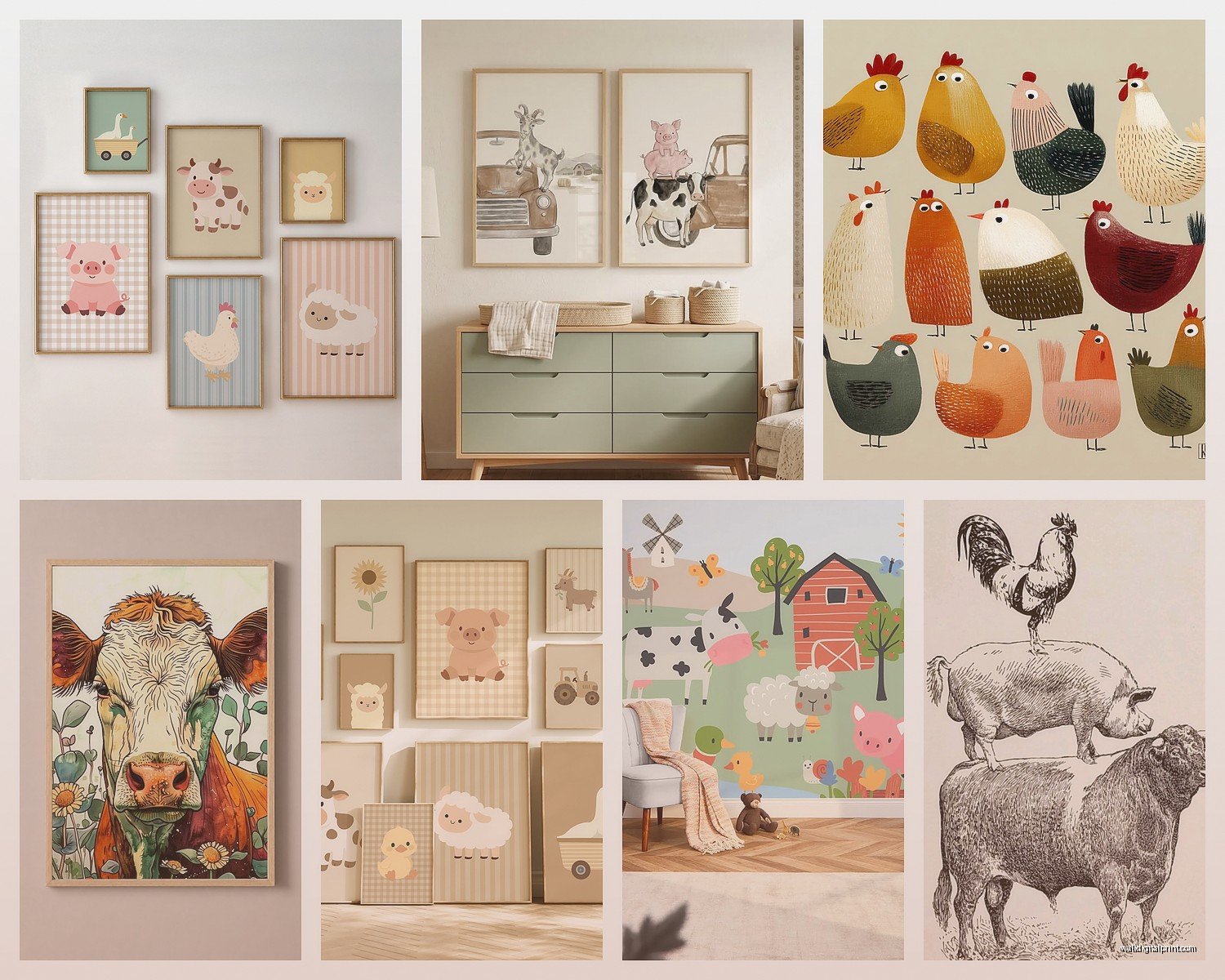
Okay so first thing – farm animal art isn’t just one thing. There’s like five main categories and they give totally different vibes. You’ve got your realistic photography prints which are surprisingly modern looking, then there’s vintage farmhouse illustrations (think old seed catalog vibes), abstract minimalist line drawings of cows and chickens, rustic painted wood signs, and then metal silhouettes.
The photography ones shocked me because they DON’T look country kitsch at all. I found this black and white close-up of a cow’s face from this Etsy shop and it legitimately looks like fine art photography. My client has it in her super modern kitchen and people always ask where she got it. The key with photography is going oversized – like 24×36 minimum – and keeping the framing simple. Black or natural wood frames, nothing ornate.
Vintage illustrations are trickier because they can go twee really fast. What works is getting them as a set of 4-6 smaller prints in matching frames. I did this grid wall thing with old poultry breed illustrations and it looked intentional instead of “I bought everything at Hobby Lobby.” The breeds thing is actually smart – like if you get specific heritage chicken breeds or rare pig varieties, it reads more curated than just random farm animals.
Where to Actually Buy This Stuff
Etsy is obvious but you gotta filter hard. Search for “modern farm animal art” or “minimalist livestock print” instead of just “cow wall art” because otherwise you get buried in the really dated country stuff with roosters and gingham borders. I spent like three hours doing this last Tuesday when I should’ve been working on my blog post about gallery walls.
Society6 and Minted have surprisingly good options that don’t look mass-produced even though they technically are. The advantage is you can get the same design in different sizes and formats – framed, canvas, even tapestries which I’ll get to in a second.
For metal art, check Wayfair but also your local HomeGoods or TJ Maxx. I found this incredible metal rooster silhouette for $29 that would’ve been $120+ online. You just gotta go regularly because their inventory changes constantly. My dog hates when I drag him past there on our walks but whatever.
The Etsy Hack Nobody Talks About
Most Etsy farm animal prints are digital downloads. This means you’re paying like $5-8 for a file you print yourself. At first I was annoyed by this but then I realized it’s actually perfect because you can print it at whatever size you need and you control the paper quality.
Take the file to a local print shop (NOT Staples, their color correction is terrible) or use Printique online. Get it printed on matte photo paper or cardstock. Then frame it yourself with frames from Michaels when they do their 50% off sale which is basically always. You’ll spend maybe $35 total for something that would cost $150+ pre-framed.
Mixing Styles Without It Looking Weird
Okay so this is where people mess up. They think farm animal art has to match perfectly and be all the same style. But that actually looks more staged than mixing it up.
What works: pair a realistic cow photograph with a minimalist line drawing of a chicken. The subject matter connects them but the styles are different enough to be interesting. Or do vintage illustrations but in modern frames with lots of white matting.
I did this whole wall in my sister’s place where we mixed a large canvas print of a pig, two smaller framed chicken illustrations, and a metal barn star. Sounds chaotic but because we kept the color palette to black, white, and natural wood tones, it worked. The rule is basically pick ONE thing to unify – either color scheme, frame style, OR art style. Not all three.
The Three-Piece Formula That Always Works
If you’re stuck, just do this: one large statement piece (cow or horse, 24×36 or bigger), two smaller coordinating pieces (chickens, sheep, whatever). Arrange them in a triangle layout – big piece on one side, two smaller stacked or side-by-side on the other. This took me forever to figure out but now I use it constantly.
For the large piece, go photographic or painted. For the smaller ones, illustrations or line drawings. The contrast in rendering style makes it look collected over time instead of bought all at once.
Colors That Don’t Scream Country Kitchen
This is huge. Traditional farm animal art is all warm reds, yellows, that rooster color palette. If that’s your vibe cool, but if you want it to feel more current you gotta think differently.
Black and white is the easiest cheat code. Any farm animal in black and white photography or ink drawings immediately feels more sophisticated. I have this thing about Holstein cows specifically because they’re already black and white so they photograph incredibly well for modern spaces.
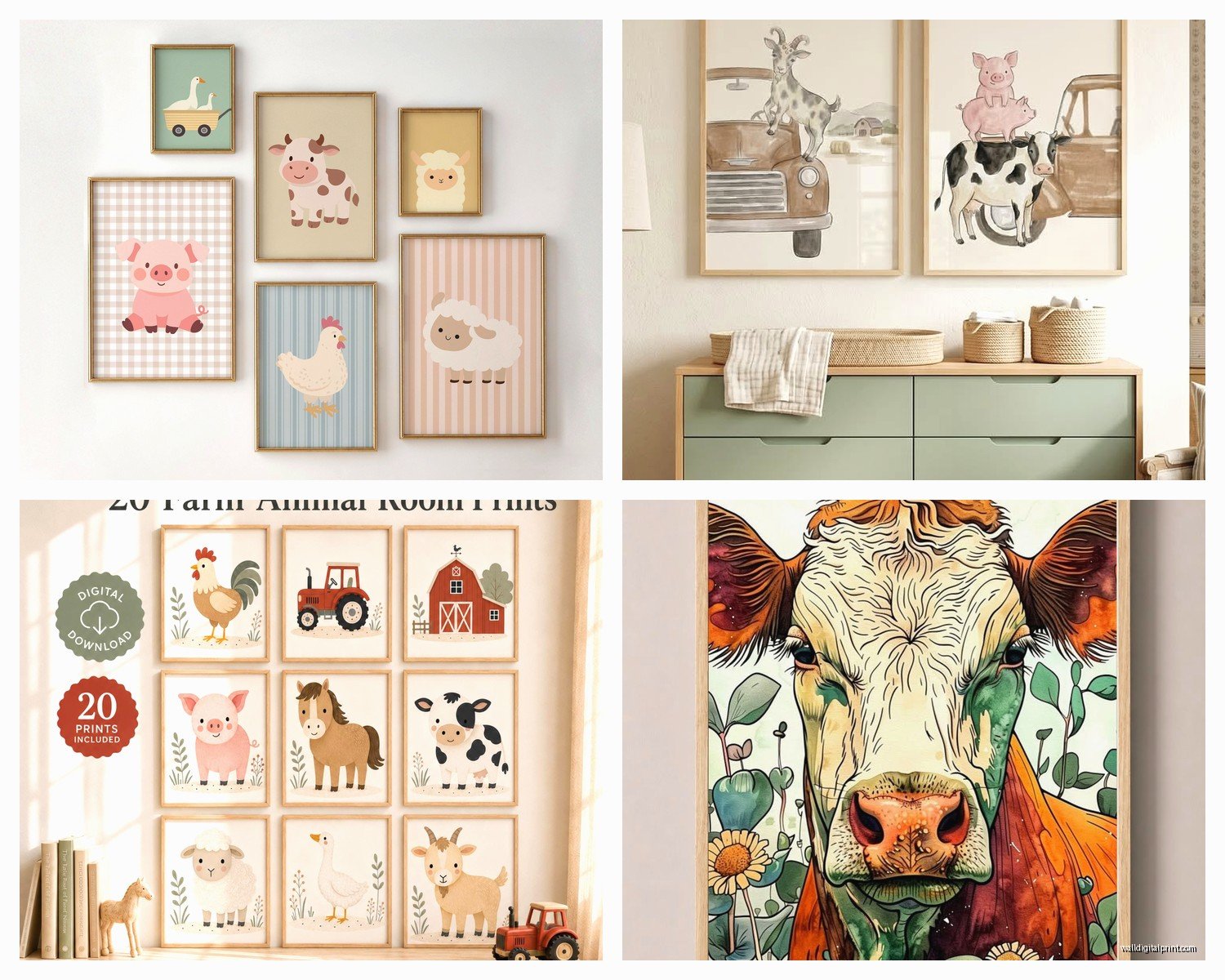
Muted earth tones work too – think sage green, cream, soft browns. There’s this trend of farm animal watercolors in these colors and they’re gorgeous without being too country. Way better than the bright primary colors you see in kids’ farmhouse decor.
Oh and another thing – if you find art you love but the colors are wrong, a lot of Etsy sellers will do custom colorways. I’ve had people change backgrounds from red barn wood to light gray or white and it completely transforms the piece.
Sizing Mistakes I Keep Seeing
People buy farm animal art way too small. Like they get an 8×10 print of a cow and wonder why it looks dinky on their wall. Farm animals are big! The art should reflect that.
Minimum sizes: if it’s your focal piece, 24×36. If it’s part of a gallery wall, nothing smaller than 11×14. The only exception is if you’re doing a grid of multiple small prints – then you can go down to 8×10 but you need at least six of them.
I messed this up in my own place initially. Had this cute little pig print that just disappeared on the wall. Went back, got it printed at 30×40, and suddenly it became the whole vibe of the room. Size matters so much more than people think.
What Actually Fits Where
Dining rooms can handle almost anything – I’ve done everything from chickens to cows to full barn scenes. Kitchen is trickier because you don’t want it to feel too themed. Stick with one or two pieces max, and keep them subtle. A small herb print with a chicken is cute, but five rooster prints is gonna feel like a Cracker Barrel.
Living rooms – this is where you can do your big statement cow or horse portrait. Above the sofa is classic for a reason. Bedrooms are good for softer animals like sheep or the more peaceful cow portraits. Nobody wants an aggressive rooster staring at them while they sleep.
My sister wanted a pig in her bathroom which I thought was weird but we found this really artistic one and honestly it works? So I don’t know, rules are meant to be broken I guess.
The Frame Situation
You’re gonna be tempted by those rustic distressed wood frames. Sometimes they work but often they’re too much with farm animal subject matter – it becomes country overload.
What I use most: simple black frames (goes modern), natural light wood frames (Scandinavian farmhouse vibe), or white frames with wide matting (classic and clean). The frame should calm down the country element, not amplify it.
For canvas prints you don’t necessarily need frames but make sure the edges are gallery-wrapped and finished. Nothing looks cheaper than seeing the staples on the sides of a canvas print.
Metal art obviously doesn’t need framing but consider the finish. Matte black metal reads more contemporary, rusty metal reads more traditional farmhouse. I actually have both and mix them which probably breaks some design rule but whatever, it works in my space.
DIY Options If You’re Crafty
Okay so I’m not super crafty but I’ve done a few DIY farm animal art projects that turned out decent. The easiest is printing on burlap or fabric. You can buy printable fabric sheets on Amazon, print your design using a regular inkjet printer, and then frame it or mount it on wood. Gives it texture without being complicated.
Wood burning is having a moment – if you’re into that, simple line drawings of farm animals on wood rounds look amazing. My friend does these and sells them at farmers markets for like $60 each. You can find free line drawing templates online.
The paint-by-numbers farm animal kits are actually pretty sophisticated now. Not the kids’ ones, but the adult versions have good detail. Takes forever though – I started a cow one while binging that show about the chess player and still haven’t finished it three months later.
Avoiding the Kitsch Factor
This is gonna sound weird but the more specific you get with breeds and accuracy, the less cutesy it becomes. A generic cartoon cow reads childish. A detailed illustration of a Scottish Highland cow reads interesting and intentional.
Same with text. If there’s words on your farm animal art, it better be good. “Fresh Eggs Daily” can be cute if it’s well-designed. “Live Laugh Love on the Farm” needs to be avoided at all costs. Actually any text with “farm” “barn” or “country” in it is probably too on-the-nose.
The animals themselves – I find roosters are the hardest to make not-country. Cows and pigs are easier to modernize. Horses can go either way depending on the style. Sheep are having a moment and tend to look pretty current. Goats are underutilized and actually really cool if you find good portraits.
Seasonal Swapping
Wait I forgot to mention – some people swap their farm animal art seasonally which sounds like a lot but if you’re into it, it works. Spring chickens, summer cows in fields, fall harvest scenes with animals, winter barn interiors. You’d need to store stuff though which is annoying.
I do a lighter version where I just have two sets – my main pieces stay up year-round but I have smaller seasonal additions I swap in. Like I add some lamb prints in spring because they’re baby season and it feels right. Then swap to harvest-themed stuff in fall. This way I’m not taking down and putting up my big frames constantly.
Lighting Makes a Huge Difference
Your farm animal art will look completely different depending on lighting. Natural light is obviously ideal but if your wall doesn’t get much, add picture lights or even small gallery lights above the pieces. I installed some battery-operated puck lights above my dining room cow print and it made it look so much more expensive and intentional.
Also consider what time of day you’re in that room most. My kitchen gets harsh afternoon sun so I specifically chose a high-contrast black and white chicken print that doesn’t wash out. In my bedroom I have a softer watercolor sheep piece because the light there is always gentle.
The Gallery Wall Approach
If you wanna do a whole gallery wall of farm animals without it being too much, mix in some non-animal elements. Barn architecture photos, vintage farm tools, landscape shots of fields. This breaks it up so it’s farm-themed without being animal overload.
I did one with three animal portraits, two vintage seed packets, an aerial photo of farmland, and a botanical print. Seven pieces total arranged asymmetrically. The variety of subject matter while staying in the farm theme made it feel collected and interesting instead of one-note.
Template gallery wall sets exist for this – you can buy them pre-designed which takes the guesswork out. Just make sure you like the specific animals included because switching out pieces in a pre-made set can mess up the whole composition.
Budget Real Talk
You can do this cheap or expensive, both work. Cheap route: digital downloads printed at Costco or a local shop, IKEA frames, maybe one metal piece from HomeGoods. You’ll spend under $100 for a whole wall.
Mid-range: Etsy prints, nice frames from Target or West Elm, maybe one original watercolor from a local artist. $200-400 depending on size.
Splurge: original paintings, custom commissions, high-end photography prints, professional framing. Sky’s the limit but I’ve seen people spend $2000+ on a single cow portrait and it looks incredible but like, you gotta really love cows.
I usually mix budget levels – one nicer piece as the focal point, then surround it with cheaper prints that coordinate. Nobody can tell which is which once it’s all on the wall anyway.
Honestly just start with one piece you really love and build from there. I see people trying to do everything at once and then they’re stuck with stuff they don’t actually like because they rushed it. Take your time, live with pieces for a bit before adding more. Your wall isn’t going anywhere.