Wall Art Guide, Wall Art Tutoriels
Landscape Wall Art: Nature Scenery & Outdoor Photography
Jun
So I’ve been basically living and breathing landscape wall art lately because three different clients all wanted nature pieces at the same time and it sent me down this rabbit hole of what actually works vs what just looks pretty on Pinterest.
Size Is Gonna Make or Break Your Whole Vibe
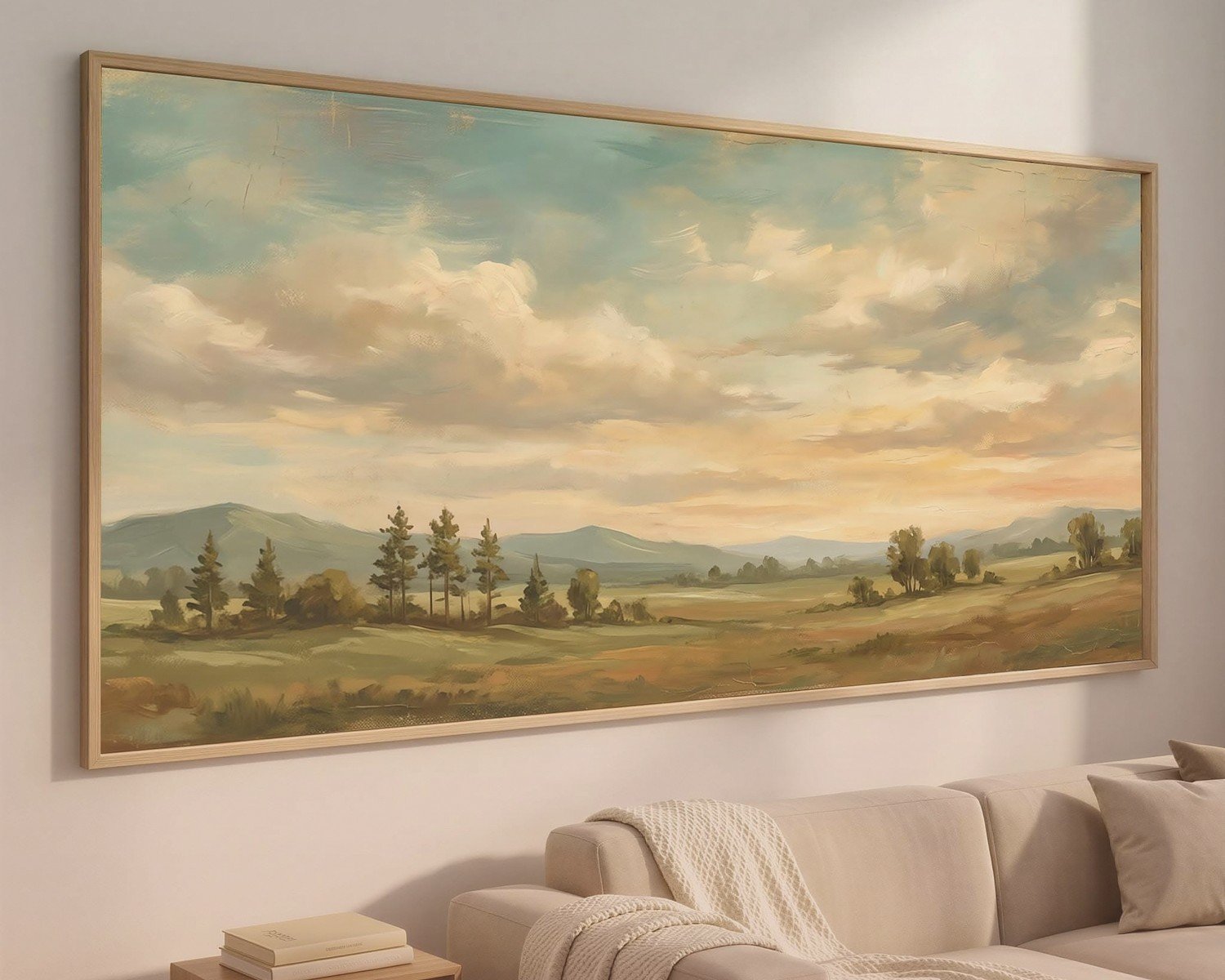
Okay first thing – everyone undersizes their art and it drives me crazy. I did it in my own living room for like two years before I finally admitted defeat. For landscape photography especially, you want to go bigger than feels comfortable at first. Over your sofa? You’re looking at 60-80 inches wide minimum, or a gallery wall that fills about two-thirds of the sofa width. I know it seems huge but trust me, a tiny 24×36 print above a standard couch just looks sad and floaty.
The thing with nature scenery is it’s meant to pull you in, create that window effect, and you can’t do that with something the size of a laptop screen. I had this client who insisted on a 16×20 mountain print for her massive bedroom wall and I literally brought over a 40×60 canvas from my studio to show her the difference. She ordered the larger one that day.
What Kind of Landscape Actually Fits Where
This is where people get tripped up because they just buy what they like without thinking about the room’s personality. Dramatic mountain ranges with moody clouds? Those need high ceilings and space to breathe – think living rooms, offices, above a fireplace. The visual weight is real.
Soft forest scenes, misty meadows, beach photography – that’s your bedroom territory. You want calming, horizontal compositions for spaces where you’re supposed to relax. I’ve got this fog-covered forest print above my bed and honestly it’s the first thing I see in the morning and it doesn’t assault my barely-awake brain.
Desert landscapes are super underrated for modern spaces. The neutral tones, the textures, that minimalist vibe… they work insanely well in contemporary homes. Just hung a Joshua Tree sunset print in a client’s dining room last week and the warm terracotta tones picked up the leather chairs perfectly.
Water scenes – oceans, lakes, rivers – these go literally anywhere but you gotta match the energy. Crashing waves = high energy spaces like entryways or home gyms. Still lake reflections = anywhere you want zen vibes.
Print Quality Because Pixelated Forests Are Depressing
okay so funny story, I ordered what I thought was gonna be this amazing Icelandic waterfall print from a random Instagram ad at like 11pm one night (don’t judge me, I was watching Love Is Blind and not paying attention). It arrived and the quality was SO bad, you could see the pixels from across the room. Fifty bucks down the drain.
Here’s what actually matters for outdoor photography prints:
- Resolution – if you’re going big, make sure the file is at least 150 DPI at the final print size, 300 DPI is better
- Paper type – I’m obsessed with matte finishes for landscapes because glossy creates glare and you lose detail
- Printing method – giclée prints on fine art paper or gallery-wrapped canvas are your friends
- Color accuracy – nature photography needs those greens and blues to look RIGHT, not oversaturated or muddy
Metal prints have been having a moment and I actually love them for certain landscape shots. The vibrant colors work amazing for tropical scenes, waterfalls, autumn foliage. But they’re cold for bedrooms, better for modern kitchens or offices.
Where to Actually Buy Quality Stuff
I’ve tested way too many sources at this point. For actual photography prints, Society6 and Minted have solid quality control and tons of artists. Etsy can be hit or miss – read the reviews obsessively and message the seller about print specs before ordering.
If you want something more curated, Artfully Walls and Juniper Print Shop have beautiful landscape collections. They’re pricier but the quality is consistent. My go-to for clients with bigger budgets is honestly just working with local photographers directly – you get custom sizes, better pricing than galleries, and the files are high-res.
Oh and another thing – don’t sleep on museum shops online. The Met, MoMA, National Parks stores… they have incredible nature photography prints that are already color-calibrated and archival quality.
Color Schemes That Won’t Fight Your Room
This is where my art curator brain kicks in. Your landscape art should either complement your existing palette or be THE color moment in a neutral room. Can’t really do both unless you’re going for maximalist chaos which like, cool if that’s your thing, but most people aren’t.
For neutral rooms (grays, whites, beiges), you have total freedom. This is where those saturated sunset prints, vibrant fall forests, or dramatic blue ocean shots really pop. The art becomes your accent color.
If your room already has a strong color scheme, pull one shade from your existing palette and find landscapes that feature it prominently. Green couch? Forest scenes, mossy rocks, fern close-ups. Navy accents? Oceanscapes, twilight mountain ranges, stormy skies.
I learned this the hard way when I put a golden-hour desert print in a room with cool silver-gray tones and it just… fought everything. Moved it to a warmer space with cognac leather and oak furniture and suddenly it worked perfectly.
Black and White Landscapes Hit Different
Can we talk about how underused B&W nature photography is? It’s sophisticated, it works with literally any color scheme, and it adds drama without being loud. Ansel Adams knew what was up.
Black and white works especially well for:
- Minimalist spaces that need texture without color
- Rooms with lots of competing colors already happening
- Creating a gallery wall with different landscape types that need visual unity
- Architectural nature shots – rock formations, tree silhouettes, structural elements
Just make sure you’re using true black and white, not that weird sepia-toned thing that reads as dated now.
Framing Options That Don’t Cost More Than Your Rent
Okay framing is where costs spiral out of control real fast. Custom framing a large landscape print can easily hit $400-600 and that’s honestly ridiculous unless it’s an investment piece.
My cheat codes:
Canvas wraps – no frame needed, the image wraps around the edges. Clean, modern, saves money. Just make sure the important parts of your composition aren’t on the edges because they’ll wrap around.
Frame TV approach – sounds bougie but hear me out. Samsung Frame TVs can display landscape photography when not in use and you can rotate your “art” seasonally. I’m seeing this more in client homes and it’s actually kinda genius for people who get bored easily.
IKEA frames – I know, I KNOW, but their Ribba and Silverhojden frames are shockingly good for the price. I use them for client projects all the time. Just upgrade the mat to acid-free if you’re framing something valuable.
Framebridge and Level – online framing that’s cheaper than custom shops. You send your print, they frame and ship it back. Used them probably a dozen times now with good results.
Float mounting – for a gallery vibe, mount your print on a backing board so it “floats” inside a shadowbox frame. Creates depth and looks expensive. You can DIY this honestly.
The Gallery Wall Question
Should you do a single large landscape or multiple smaller ones? Depends on your commitment issues honestly.
Single large-scale print:
- Makes a bold statement
- Easier to hang (one nail vs twelve)
- Better for showcasing one incredible photograph
- Less flexibility if you get bored
Gallery wall of multiple landscapes:
- More visual interest and variety
- Can mix different locations and seasons
- Easier to switch out pieces when you want change
- Takes more planning to look cohesive
If you go the gallery wall route with nature photography, keep a unifying element – all same frame color, all from same geographic region, all same time of day, all same color palette. Otherwise it reads as chaotic Pinterest board on your wall.
I did a client’s hallway with seven different national park prints all in matching black frames, different sizes arranged salon-style, and it’s honestly one of my favorite projects. But we spent like two hours arranging them on the floor first with painter’s tape templates on the wall.
The Seasonal Rotation Thing
wait I forgot to mention – some people rotate their landscape art seasonally and I’m kinda here for it? Like spring forest blooms in March, beach scenes in summer, fall foliage in October, snowy mountains in winter. It’s extra but it keeps your space feeling fresh.
You don’t need to buy four sets of expensive prints though. Print-on-demand services let you swap affordably, or just move existing prints between rooms to change up the vibe. My office gets my moody ocean print in winter and a bright meadow scene in summer because the natural light changes so dramatically.
Lighting Your Landscape Art Properly
This is gonna sound weird but terrible lighting ruins good landscape photography on walls. You spent money on that detailed forest print and then you can’t see half the shadows because there’s no direct light on it?
Picture lights are the traditional choice – those little brass or black bars that mount above the frame. They work but they’re kinda old school unless you’re going for traditional decor.
Track lighting or directional recessed lights give you more flexibility. Angle them at 30 degrees to avoid glare on glass or glossy prints. I installed some IKEA track lighting in my own place for like $60 and it completely transformed how my landscape prints look.
Natural light is tricky with photography prints because UV fades them over time. If your art gets direct sun, you need UV-protective glass or acrylic glazing. Or just accept that you’ll replace it in 5-10 years, which honestly some people prefer because they get bored anyway.
My cat keeps sitting directly in front of my hallway landscape print in the morning because that’s where the sun hits and it’s driving me insane but also it’s cute so… I allow it.
What’s Actually Trending Right Now
Aerial landscape photography is everywhere – those top-down views of coastlines, rivers, fields. They’re geometric and abstract while still being nature scenes. Work great in modern spaces.
Minimalist landscapes – think single tree, empty beach, lone mountain. Negative space is having a moment and it fits the “quiet luxury” aesthetic people are obsessed with.
Desert and arid landscapes – Joshua Trees, sand dunes, southwestern canyons. The warm neutrals fit current interior trends perfectly.
Moody, dark landscapes – foggy forests, stormy seas, twilight mountains. That dramatic, almost melancholic vibe is replacing the bright and airy thing that dominated for years.
Honestly though, trends are whatever. Buy landscapes that make you feel something or remind you of places you love. I have a print of the Oregon coast in my bedroom because I proposed to my partner there and every time I see it I remember that day, not because coastal photography is trending.
Custom Photography Options
If you’re feeling fancy or can’t find exactly what you want, commissioning a photographer isn’t as expensive as you’d think. Local landscape photographers often have stock images they’ll license for printing, or they’ll do custom shoots.
I connected a client with a photographer who specialized in local hiking trails and he captured the exact vista she wanted from her favorite trail, printed at 5 feet wide. Cost less than buying from a fancy gallery and meant way more to her.
You can also print your own travel photos if they’re high enough resolution. I’ve done this successfully exactly once – a shot I took in Iceland on my mirrorless camera. The rest of my iPhone photos don’t hold up at wall size, turns out.
The Practical Stuff Nobody Tells You
Hanging heavy landscape prints requires proper hardware. Those command strips aren’t gonna cut it for a 40-pound framed canvas. Use actual wall anchors or find studs. I’ve seen too many prints crash down at 3am and it’s terrifying.
Leave space between your furniture and art – at least 6-8 inches above a sofa, 4-6 inches above a console table. It needs to breathe.
Consider the viewing distance. Huge detailed landscape prints need space to be appreciated – don’t cram a 6-foot mountain panorama in a tiny hallway where you can’t step back to see it.
Clean your prints occasionally. Dust dulls the colors and details over time. Microfiber cloth for canvas and non-glass pieces, proper glass cleaner for framed prints.
Okay I think that covers most of what I’ve learned through trial and error and client projects and my own impulse purchases. The main thing is just go bigger and bolder than you think you should, make sure the quality is actually good, and pick scenes that you won’t be sick of in six months.