Wall Art Guide, Wall Art Tutoriels
Large Minimalist Wall Art: Oversized Simple Clean Designs
May
So I’ve been kinda obsessed with large minimalist wall art lately and honestly it’s one of those things that sounds so simple but there’s actually a lot to consider before you just slap a giant canvas on your wall.
First thing – and I learned this the hard way in my own living room – size matters way more than you think. Like, what looks huge in the store or online often looks weirdly small once it’s actually on your wall. The rule I tell everyone is that your art should take up about two-thirds to three-quarters of the furniture width below it. So if you’ve got a sofa that’s 90 inches wide, you’re looking at art that’s at least 60 inches across. I know that sounds massive but trust me on this one.
Actually Choosing the Right Size
Okay so here’s what I do and it’s gonna sound a bit extra but it works. Take painters tape or even newspaper and tape it to your wall in the dimensions you’re considering. Live with it for like a day or two. Watch TV with it there, have your coffee in the morning, see how it feels. I had a client who was dead set on a 40×60 piece and after we did the tape test she went up to 48×72 and it completely transformed the room.
The ceiling height thing is real too. If you’ve got 8-foot ceilings you don’t wanna go too crazy tall because it’ll make the room feel cramped. But if you’re lucky enough to have 10+ foot ceilings, this is where you can really play with those oversized vertical pieces. I’ve got this one piece in my dining room that’s 36×84 and it draws your eye up in the best way.
What Actually Works Design-wise
Minimalist doesn’t mean boring, it just means intentional. The pieces that work best are usually:
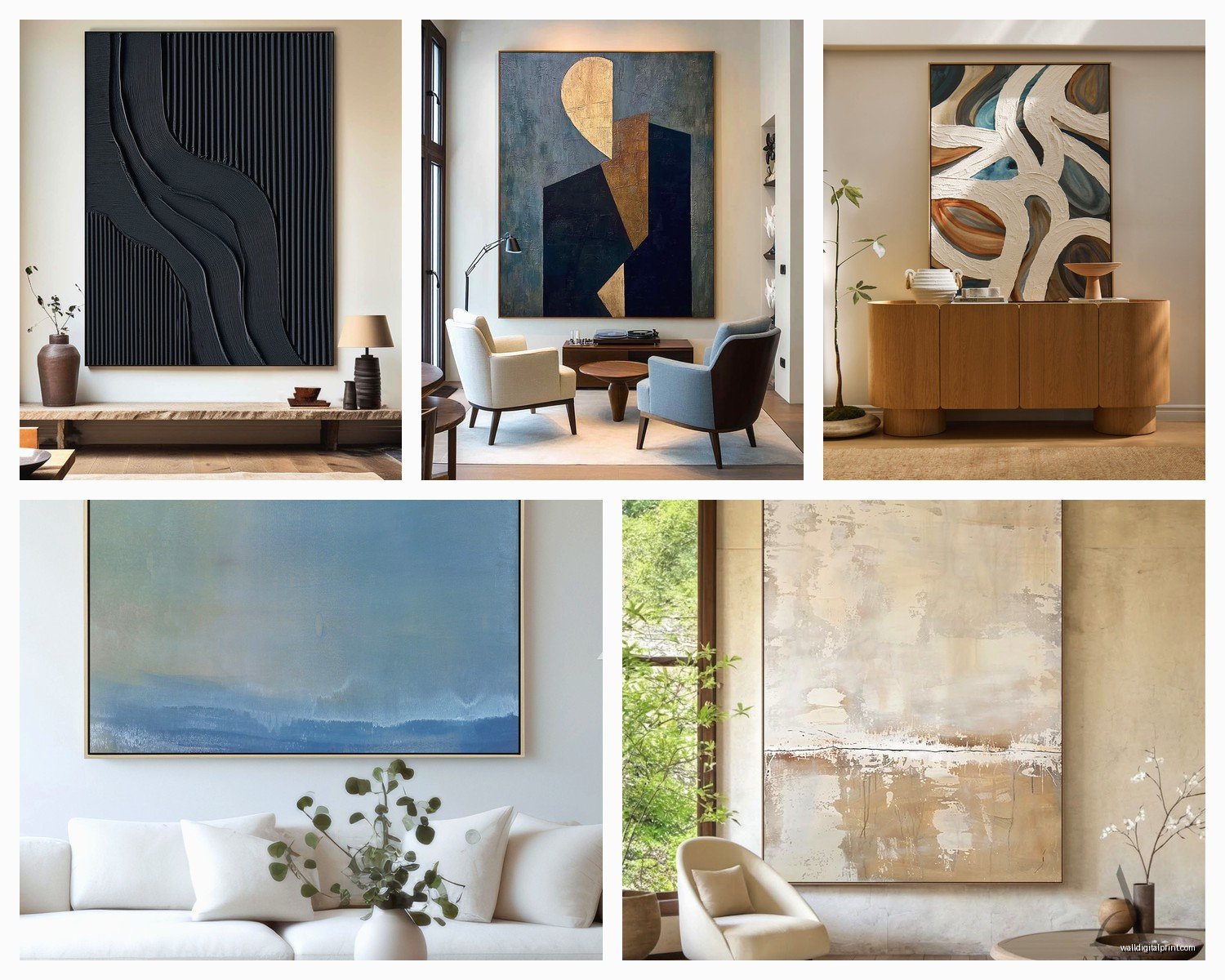
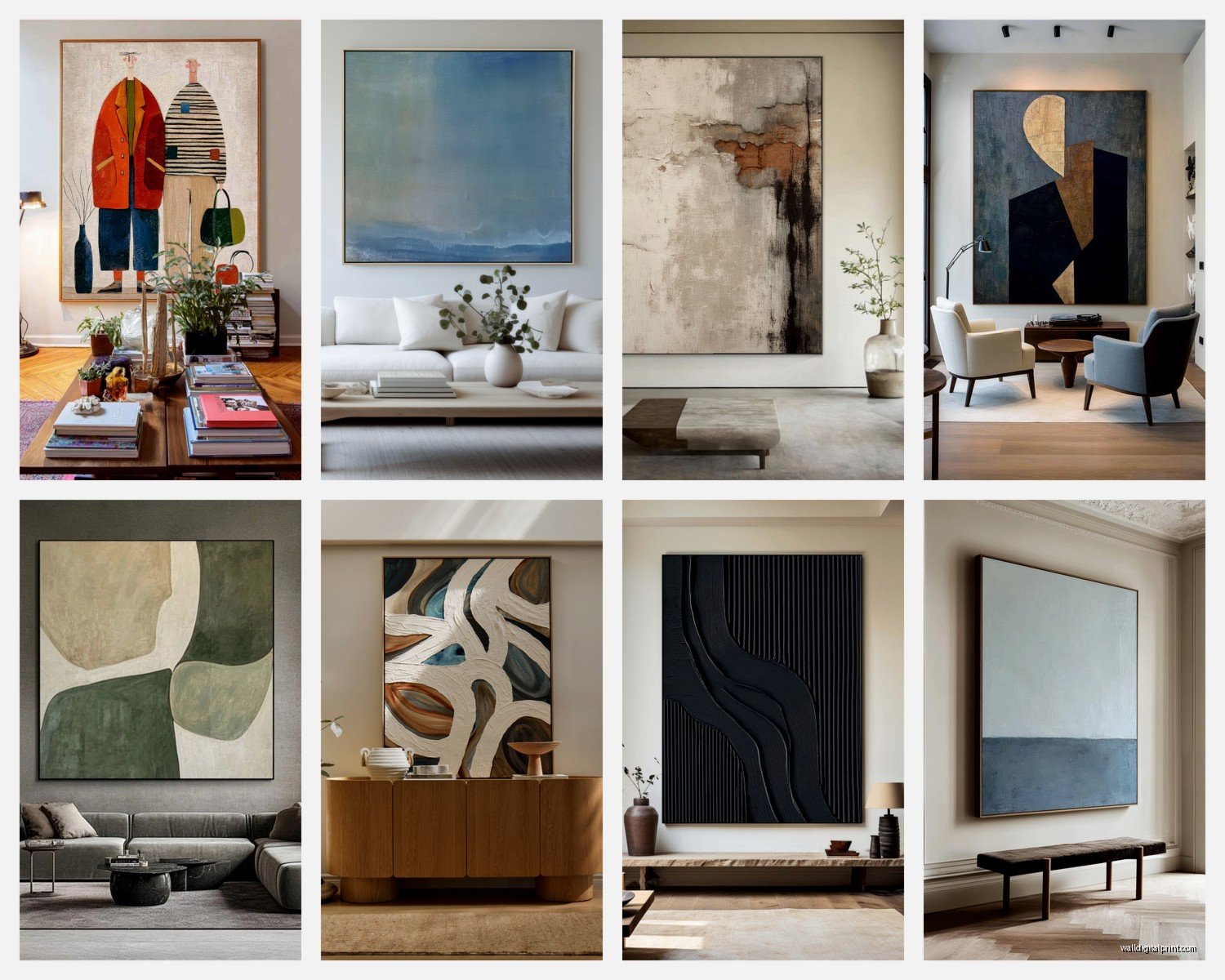
- Abstract geometric shapes in neutral tones
- Single bold brushstrokes or color blocks
- Line drawings that are super simple but striking
- Textured monochrome pieces
- Photography with lots of negative space
I’ve been seeing a lot of beige and cream abstract stuff everywhere right now and while it’s pretty, make sure it’s not gonna disappear into your walls. You want contrast. If your walls are white or light gray, consider pieces with black elements or deeper tones. My bedroom walls are this pale greige and I hung a piece that’s mostly cream with these bold charcoal brushstrokes and it’s *chef’s kiss*.
Wait I forgot to mention – texture is your friend with minimalist art. Since you’re working with simple designs and limited colors, a piece with actual physical texture (thick paint, canvas weave, mixed media) adds so much more interest than a flat print. I picked up this one piece from an Etsy seller last year that’s basically just three horizontal lines but the paint is so thick and glossy it catches light differently throughout the day.
Where to Actually Buy This Stuff
Okay so funny story, I used to think you had to spend thousands on large art and then I discovered you really don’t. Here’s my tier system:
Budget-Friendly (Under $200): Society6 and Redbubble let you get prints in huge sizes. The quality is decent, not amazing, but for a bedroom or office it totally works. I’ve also found some surprisingly good stuff at HomeGoods and TJ Maxx but you gotta go regularly because inventory changes constantly. Target’s Threshold line sometimes has good options too.
Mid-Range ($200-800): This is where Etsy really shines. Search for “large abstract canvas” or “oversized minimal art” and filter by your size needs. A lot of artists will do custom sizes which is clutch. Minted has beautiful stuff in this range too and their framing options are really good. West Elm and CB2 if you want something more curated but you’re paying for the styling.
Investment Pieces ($800+): Local galleries, art fairs, or commissioning directly from artists. I worked with a local artist last year who did a custom 60×80 piece for a client’s living room and it was around $1200 but it’s literally one of a kind.
Oh and another thing – don’t sleep on printable art. If you’ve got access to a good printer or a print shop, you can buy digital files from artists for like $20-50 and print them huge. Then just get it mounted or framed. I did this for my home office with a minimal line drawing and the whole thing cost me maybe $150 for a 40×50 print.
The Framing Situation
This is where people either nail it or completely mess up the vibe. For minimalist art, your framing should be equally minimal.
Gallery wrapped canvas (where the art wraps around the edges) is probably the easiest option because you literally just hang it and you’re done. No frame needed. Make sure the sides are finished nicely though because you’ll see them.
If you’re doing a frame, think thin and simple. Black, white, natural wood, or even a metal frame. Nothing ornate or chunky unless you’re intentionally going for that contrast. I’ve got this one piece that’s super minimal abstract in my hallway and I put it in a chunky gold frame as a deliberate choice to add warmth but that’s like, a whole different vibe than pure minimalism.
Floating frames are having a moment and they work really well with minimalist pieces because they add this architectural element without being fussy. The art appears to float inside the frame with a gap between the edge and the frame itself.
Hanging Height and Placement
Center of the artwork should be at eye level, which is typically 57-60 inches from the floor. But honestly this varies based on your ceiling height and furniture. If it’s going above a sofa, leave 6-10 inches between the top of the sofa and the bottom of the art.
I use those command strips for everything now and I’m not even sorry about it. The heavy duty ones can hold up to 16 pounds per pair and I’ve had zero issues. My cat knocked into a frame last month (she’s an idiot) and it didn’t budge. For anything heavier or if you’re paranoid, proper wall anchors are the way to go.
Color Coordination Without Being Matchy-Matchy
People stress about this too much. Your art doesn’t need to perfectly match your throw pillows or whatever. In fact it’s better if it doesn’t because that looks staged and boring.
What I do: Pull one or two colors from the art and echo them somewhere else in the room, but not everywhere. So if your minimal art has a rust orange element, maybe you have one rust pillow or a rust vase. That’s it. The rest can be completely different.
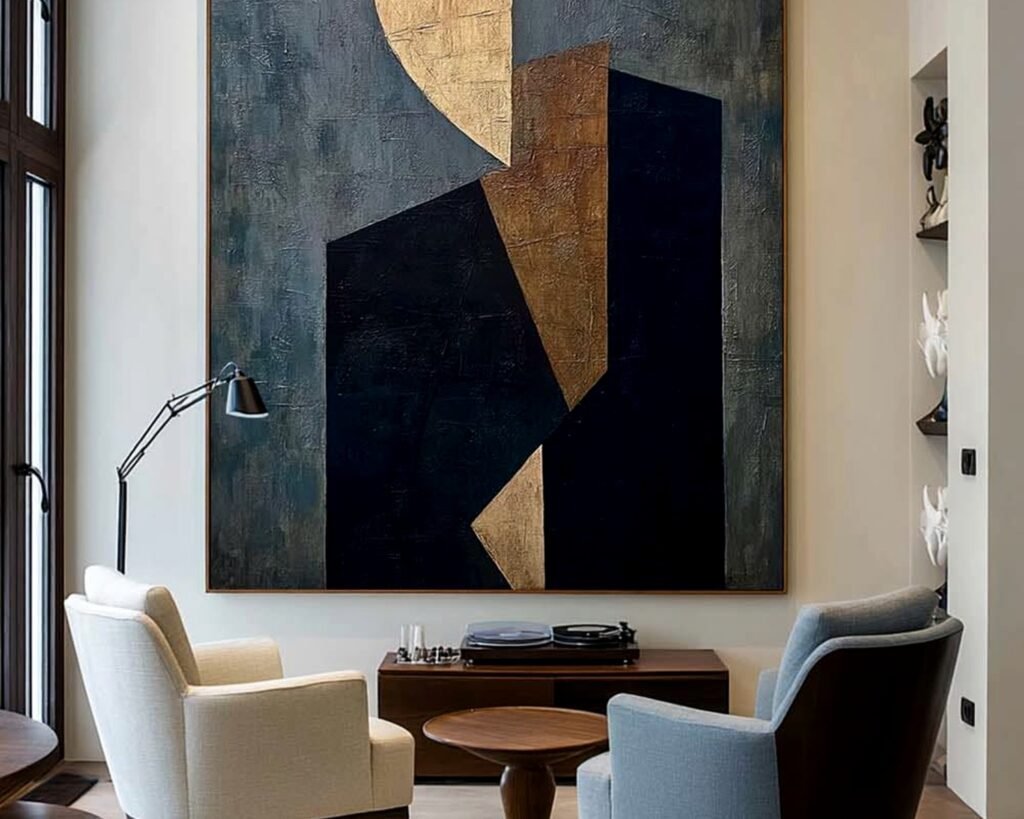
Neutrals are obviously the easiest route – black, white, gray, beige, cream. These work with literally everything. But don’t be afraid of a single bold color in a minimalist piece. A large canvas that’s mostly white with one deep navy geometric shape can be stunning and navy works with warm and cool color schemes.
I’m watching this show while I write this and they just did a whole room in beige and it’s putting me to sleep… anyway, texture and tone variation is what keeps neutral minimalist art from being flat. A cream painting with visible brushstrokes in slightly different cream tones has depth.
Styling Around Large Art
This is gonna sound weird but sometimes the best thing to do with a large minimalist piece is… nothing else. Like, let it be the statement. I see people hang a huge piece and then still add a bunch of smaller art around it and it gets cluttered fast.
If your art is 48 inches or larger, consider making it the only thing on that wall. Maybe a simple console table below it with one sculptural object or a plant, but that’s it. The minimalism should extend to how you style the whole wall.
For gallery walls, you can absolutely include large minimalist pieces but keep the overall arrangement simple. I did one recently with one large 40×50 minimal abstract piece as the anchor and then just three smaller simple line drawings arranged asymmetrically around it. Seven pieces total would’ve been too much.
Lighting Considerations
Natural light can be tricky with art. Direct sunlight will fade prints over time so if your wall gets blasted with afternoon sun, maybe opt for a canvas with UV protection or hang it on a different wall. Or get blackout curtains, which I finally did last year and my sleep has never been better but that’s a different topic.
For artificial lighting, picture lights are classic but can feel formal. Track lighting or even a well-placed floor lamp that bounces light off the wall works great for minimal spaces. I’ve got this one sculptural floor lamp that’s aimed at my large abstract piece and it creates these cool shadows from the texture.
DIY Options If You’re Crafty
Okay so if you’re even slightly artistic or just willing to try, making your own large minimalist art is way easier than you think. I’m talking like kindergarten level painting skills here.
Get a large canvas from a craft store (they have sales constantly, never pay full price). Some acrylic paint in your chosen colors. And just… make shapes. Geometric blocks, brushstrokes, lines. The beauty of minimalist art is that it’s supposed to be simple.
I made a piece for my guest room that’s literally just three horizontal stripes in different shades of gray on white. Took me maybe 30 minutes including drying time between coats. Cost about $60 for a 36×48 canvas. Would’ve been $400+ to buy something similar.
There are tons of YouTube tutorials for this stuff. Search “DIY minimal abstract art” and you’ll find step by step guides. Some people use tape to get clean lines, some do pour painting techniques, some just wing it with a palette knife.
Common Mistakes I See All the Time
Going too small is number one. I can’t stress this enough. When in doubt, size up.
Hanging it too high. Your art shouldn’t be floating near the ceiling. It should relate to the furniture and the people in the space.
Choosing art that’s too similar in tone to your walls. You need some contrast or it just disappears. Even if you’re doing tone-on-tone, there should be enough difference that the art reads as intentional.
Overthinking it. I’ve spent hours agonizing over art choices and honestly sometimes you just gotta pick one and commit. You can always change it later if you hate it, but analysis paralysis helps no one.
Not considering the room’s purpose. A minimal bedroom can handle really subtle, calm pieces. A living room where you entertain might need something with a bit more visual interest even if it’s still minimal in style.
Mixing Minimal Art With Other Styles
You don’t have to go full minimalist in your whole space just because you want minimal art. I’ve got a pretty eclectic style overall but large minimal pieces actually ground all the other stuff.
In my living room I’ve got this huge black and white minimal abstract piece above the sofa, but then I’ve got colorful pillows, a vintage rug, plants everywhere, books stacked on the coffee table. The minimal art gives your eye a place to rest among all the other visual information.
It works in maximalist spaces too – the large simple piece becomes almost like a pause button in an otherwise busy room. Just make sure the colors relate somehow to the rest of your palette.
The key is scale. A large piece has enough presence to hold its own even when surrounded by different styles. A small minimal piece in a busy room just gets lost.
One last thing – don’t be precious about it. Art should make you happy when you look at it, not stressed about whether it’s “right.” I’ve changed out pieces seasonally before just because I felt like it. It’s your space, you can do whatever you want with it.