Wall Art Guide, Wall Art Tutoriels
Mudroom Wall Art: Entry Utility Boot Room Organization
Oct
So I’ve been helping people figure out their mudroom situations for years now and honestly the wall art thing is where everyone gets stuck. Like they’ll spend weeks picking the perfect hooks and bench but then just…leave the walls blank or slap up some random thing that doesn’t work with all the chaos.
First thing you gotta know is that mudroom art isn’t like living room art. It needs to actually survive the environment. I learned this the hard way when I hung this gorgeous watercolor in a client’s entry and within three months the humidity from wet coats and boots had totally warped the frame. Not cute.
What Actually Works on Mudroom Walls
Okay so the materials matter way more than you’d think. I always tell people to go with either metal signs, sealed wood pieces, or prints behind acrylic instead of glass. Glass gets foggy and gross in humid spaces, and if a hockey stick or backpack swings into it…yeah. Acrylic is basically indestructible and doesn’t fog up the same way.
Metal signs are honestly my favorite for mudrooms because they read as intentional and kind of industrial which works with all the utilitarian stuff happening in the space. Not like those generic “Home Sweet Home” things though. I’m talking vintage-style metal prints or custom pieces that actually mean something to the family.
Wood signs work too but they need to be properly sealed. I use a matte polyurethane on anything wooden going in a mudroom. My brother didn’t do this and his cute wooden family name sign got all warped and the paint started peeling after one winter. Just seal it, takes like 20 minutes.
Size and Placement Strategy
This is where people mess up constantly. They either go too small so it looks like an afterthought, or they try to do a big gallery wall in a space that’s already visually cluttered with coats and bags and shoes everywhere.
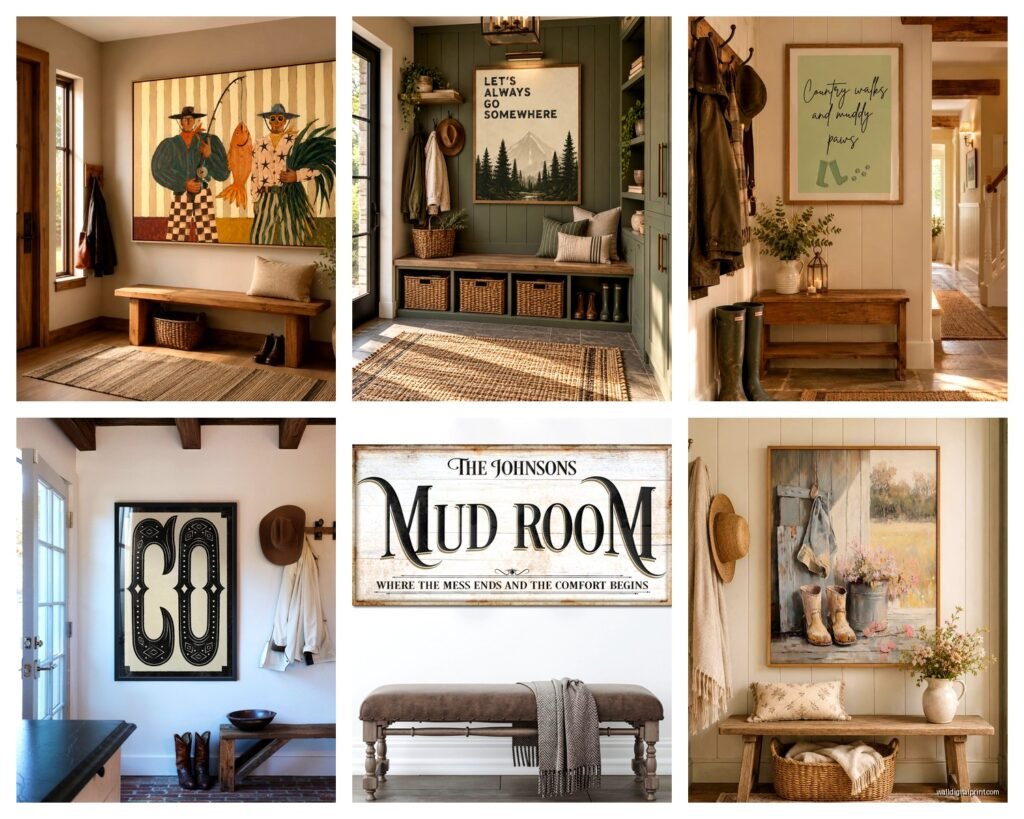
For a standard mudroom with hooks and a bench, I usually do one larger piece above the bench area. Like 24×36 inches or bigger. It needs to hold its own against all the stuff hanging below it. If you go too small, it just disappears into the visual noise.
Wait I forgot to mention…measure your wall space AFTER you install all your hooks and shelving. I cannot tell you how many times I’ve seen people pick art based on the empty wall and then realize half of it gets covered by the coat rack they installed later.
The sweet spot is usually mounting art about 6-8 inches above your highest hook or shelf. This gives enough breathing room so coats aren’t touching the frame but it’s not floating awkwardly near the ceiling.
What to Actually Put Up There
So this is super personal but here’s what I’ve seen work really well. Family-focused stuff actually makes sense in mudrooms because it’s literally where everyone comes and goes. But not like formal family photos…those feel weird with muddy boots underneath.
Things that work:
- Vintage ski lodge posters or national park prints if you’re outdoorsy
- A big map of your area or somewhere meaningful
- Oversized family calendar or command center that doubles as art
- Metal or wood coordinates of your home location
- Vintage advertisements for outdoor gear or boots
- Bold typography with family name or house number
- Chalkboard or whiteboard styled as art for messages
The outdoor vintage poster thing is huge right now and I actually love it for mudrooms because it ties into the whole function of the space. Like you’re literally gearing up to go outside, so having a vintage Yosemite poster or ski resort print just…makes sense? It’s not trying too hard.
The Gallery Wall Debate
Okay so funny story, I used to be totally against gallery walls in mudrooms. Too busy, too much visual clutter, whatever. But then I did this mudroom for a family with four kids and we needed to cover this massive wall and one big piece just looked lonely and weird.
We did a gallery wall but with a very specific approach. All matching frames in black metal, all the same size (11×14), arranged in a perfect grid. The uniformity kept it from feeling chaotic even though there were like 12 pieces. Each frame had a different vintage national park poster.
The key is commitment to a system. If you’re gonna do multiple pieces, they need a strong unifying element. Same frames, same mats, arranged geometrically. Don’t do the organic scattered look in a mudroom…it just adds to the chaos instead of containing it.
Practical Installation Tips
Use proper anchors. Mudrooms get a lot of vibration from doors slamming and kids running through. I’ve had pieces fall because someone just used a basic nail in drywall. Get the good wall anchors or hit a stud.
Also this is gonna sound weird but consider how you clean. Mudrooms get dusty and dirty fast. If you do a complicated gallery wall with 15 pieces, are you actually gonna dust all of them regularly? Probably not. One or two larger pieces is way easier to maintain.
My cat knocked over my coffee while I was planning a mudroom last week and it made me think about this…stuff happens in high-traffic areas. Keep art high enough that it’s not in the danger zone for daily chaos but not so high that it feels disconnected from the space.
Color Coordination
Your mudroom probably has a lot of colors happening already with everyone’s coats and bags and shoes. The art should either complement the permanent fixtures (like your hooks and bench color) or be neutral enough to work with whatever rainbow of gear is hanging there.
I usually go with black and white prints, warm wood tones, or muted vintage colors. Bright bold modern art can work but it’s risky because it might clash with someone’s bright red backpack or whatever.
One client had all brass hooks and a navy bench and we did botanical prints with gold frames. Looked amazing and elevated but still practical. The gold picked up the brass and made it feel intentional instead of just “we bought whatever hooks were on sale.”
Command Center Integration
Oh and another thing…a lot of people want their wall art to also be functional. Like a big framed chalkboard or corkboard. This can totally work but you gotta commit to actually using it.
I’ve installed so many “message centers” that just become decoration because the family never actually writes on them. If you’re not naturally a leave-notes-for-each-other family, don’t force it. Just get regular art.
But if you ARE that family, a large framed chalkboard above the bench area is super practical. You can write reminders, grocery lists, schedules, whatever. Just make sure it’s big enough to be useful. Those tiny 8×10 chalkboards are pointless.
Seasonal Rotation
Some people like to rotate their mudroom art seasonally and honestly it’s a nice way to refresh the space without spending much. I have a client who swaps between four different prints throughout the year…beach scene in summer, autumn leaves in fall, you get it.
The trick is having a frame that makes swapping easy. Those poster frames with the little metal clips on the back are perfect for this. You can change the print in like 30 seconds.
But also like…don’t stress about this if it sounds like too much work. A good year-round piece is totally fine. Not everything needs to be a whole project.
Budget Options That Don’t Look Cheap
You don’t need to spend a fortune. I’ve done amazing mudroom art for under fifty bucks. Print your own design from Etsy, get it printed at a local print shop, frame it yourself. Boom.
Target and HomeGoods actually have decent options for mudroom-appropriate art. Look for the metal signs or wood pieces, avoid anything too trendy or with glitter or whatever. Simple is better in mudrooms.
Thrift stores are goldmines for vintage outdoor prints and signs. I found an old ski resort sign at Goodwill for eight dollars and it’s now the centerpiece of a client’s mudroom. Just clean it up and maybe reseal it.
What to Avoid
Okay real talk, some things just don’t work in mudrooms:
- Delicate paper art without protection
- Anything with fabric or textile elements
- Super trendy stuff that’ll look dated fast
- Religious or political statements unless that’s really your thing
- Neon signs (I know they’re having a moment but they feel weird in mudrooms)
- Mirrors if the wall is opposite the door (just trust me on this)
Actually wait, mirrors can work on side walls for last-minute checks before heading out. But facing the door is bad feng shui or whatever and also just creates weird visual stuff with the door opening and closing.
Making It Feel Cohesive
The best mudroom art ties into your overall home style but also acknowledges that mudrooms are working spaces. Like if your house is all modern farmhouse, your mudroom art should nod to that but in a more rugged practical way.
I did a mudroom where the rest of the house was very coastal grandmother aesthetic…lots of blue and white, elegant, collected. In the mudroom we did vintage beach club posters in weathered wood frames. Same vibe but appropriate for the space.
The art should feel like it belongs to the same family as your home decor but it’s the outdoorsy cousin who doesn’t mind getting dirty.
Installation Height Formula
Since people always ask about this specifically…if you have a bench, measure 6-8 inches above the bench back (or where someone’s head would be sitting). If you have hooks, measure 6-8 inches above the highest hook. If you have neither, standard eye level is 57-60 inches to the center of the artwork.
But honestly every space is different. Hold it up, step back, see how it looks. I’ve broken the “rules” plenty of times when the space just needed something different.
The goal is for the art to feel like it anchors the space and gives your eye somewhere to land that isn’t just piles of shoes and coats. It should make the mudroom feel intentional instead of just functional.
Anyway that’s basically everything I tell people about mudroom art. Start with durability, pick something that fits your life, install it properly, and don’t overthink it. It’s a mudroom, not a gallery.