Wall Art Guide, Wall Art Tutoriels
Muslim Wall Art: Islamic Faith Mosque Calligraphy Decor
Aug
So I’ve been working with Islamic wall art for years now and honestly it’s one of those things where people get super overwhelmed because there’s SO much to choose from and the quality varies wildly. Let me just dump everything I know about this.
The Calligraphy Situation
Okay first thing, Arabic calligraphy comes in different styles and you gotta know what you’re looking at. There’s Thuluth which is like the fancy curvy one you see everywhere, Kufic which is more geometric and angular, and Diwani which is super ornate. I had this client last month who bought this gorgeous piece thinking it said Bismillah but it was actually just decorative nonsense because she ordered from some random dropshipper. So here’s what you do: if you’re getting something with actual verses or phrases, verify it with someone who reads Arabic or buy from reputable Islamic art shops.
The most common phrases you’ll see are Bismillah ar-Rahman ar-Rahim, Ayat al-Kursi, the Shahada, Alhamdulillah, SubhanAllah, and Mashallah. Each one has different vibes for different rooms which I’ll get to in a sec.
Materials and Quality Stuff
Canvas prints are gonna be your most affordable option and they’re fine, honestly. I’ve used tons of them. But here’s the thing about canvas, it needs to be thick enough that you don’t see the texture pattern looking cheap. Look for at least 300gsm weight. The really budget ones at like 200gsm or less just look flat and sad on the wall.
Metal prints are having a moment right now and I’m kinda obsessed? They’re usually aluminum with this UV coating and the depth of color is insane. They work really well with geometric Islamic patterns because the metallic finish adds dimension. Downside is they show fingerprints like crazy during installation so wear gloves or you’ll be cleaning them forever.
Wooden wall art, especially the laser cut stuff, is beautiful but you gotta be careful with sizing. I made this mistake in my own living room where I ordered a 24-inch piece that looked massive online but when it arrived it just disappeared on my wall. For wood, go bigger than you think you need.
Framed prints are classic and you can’t really go wrong. Just make sure if you’re getting gilded or gold leaf calligraphy that the frame doesn’t compete with it. Simple black or dark wood frames work best.
Where to Actually Put This Stuff
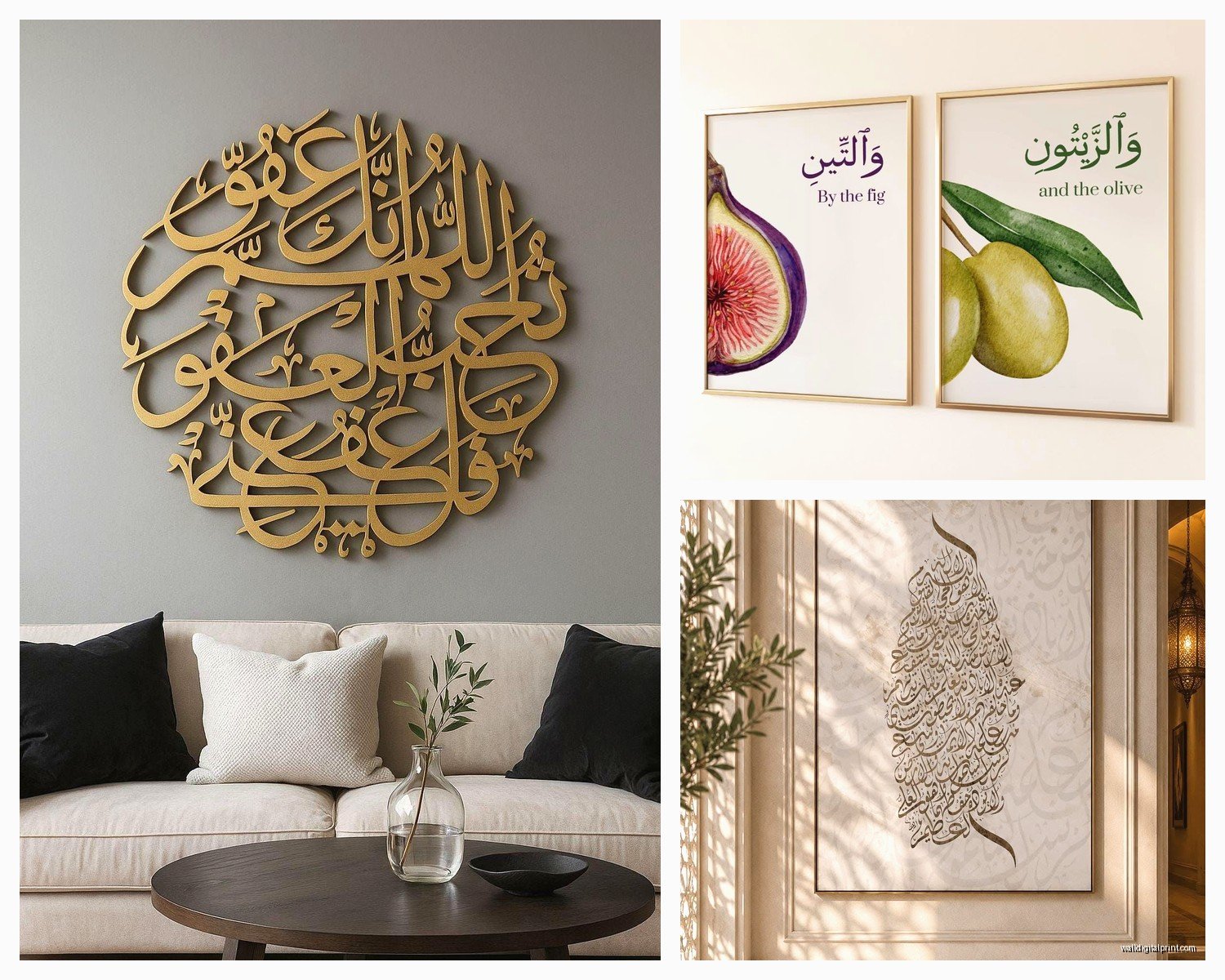
Living room is obvious but placement matters. The wall behind your sofa is prime real estate. I usually do a large three-piece set there, like a triptych with Ayat al-Kursi split across three panels. It fills the space without looking cluttered. Or if you’ve got a big blank wall, one massive statement piece works too.
Entryway or foyer should have something welcoming. Bismillah makes sense here because it’s literally “in the name of God” so it’s like you’re invoking blessing as people enter. I’ve also done Mashallah in entryways which feels protective and positive.
Dining areas, I usually suggest Alhamdulillah because it’s about gratitude and thankfulness which fits the whole breaking bread together vibe. Had a client put it above their dining table and it just felt right you know?
Bedrooms are tricky because some people have different comfort levels with religious text in sleeping areas. But if you’re cool with it, something peaceful like Ayat al-Kursi or just “Allah” in beautiful calligraphy works. Keep it calm, not too bold or it’ll dominate the space.
Home offices or study areas are perfect for motivational Islamic quotes. There are tons beyond the main phrases like “Verily with hardship comes ease” or “And He is with you wherever you are.” These work great above desks.
The Mosque Imagery Thing
Okay so mosque wall art is its own category. You’ve got photographic prints of actual mosques like the Blue Mosque, Masjid al-Haram, Al-Aqsa, or the Prophet’s Mosque. These are gorgeous but here’s what I learned the hard way: black and white or sepia tones are way more versatile than full color.
I had this situation where a client wanted a bright turquoise and gold photo of a mosque dome and it clashed with literally everything in her neutral-toned room. We switched it to a black and white print and suddenly it worked perfectly.
Silhouette art of mosques, especially at sunset or with moon imagery, is super popular right now and for good reason. It’s dramatic without being overwhelming. The negative space makes them feel modern.
Color Schemes That Actually Work
Gold and black is the classic combination and it works in like 90% of spaces. The gold adds luxury without being too much if it’s just in the calligraphy against black background.
Teal and gold is very traditional Islamic art colors and looks amazing but your room needs to support it. If you’ve got a lot of warm browns and beiges, teal might feel off. But with grays and whites? Perfect.
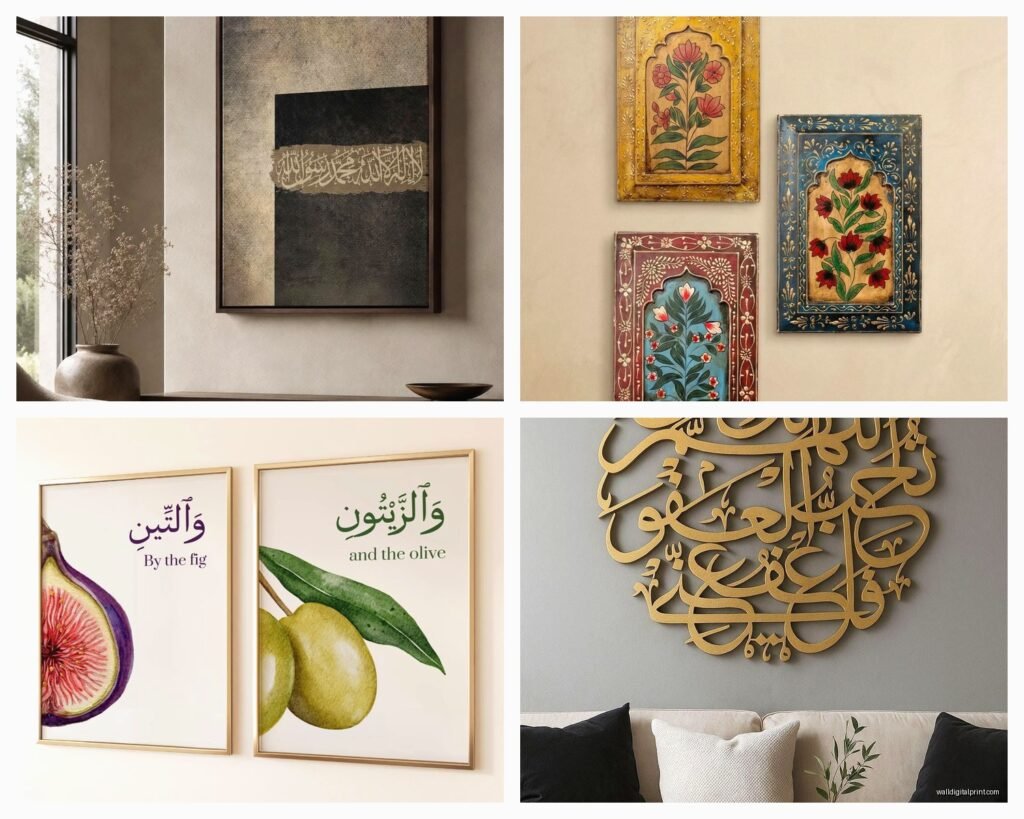
All white or cream calligraphy on white background is super modern and minimalist. My cat knocked over my coffee looking at one of these samples yesterday which was annoying but anyway, these work great in Scandinavian or minimalist interiors where you want the spirituality without bold colors.
Navy blue with gold or silver is underrated. It feels regal and calm at the same time.
Sizing Guide Because Everyone Gets This Wrong
For above a sofa, you want the art to take up about two-thirds to three-quarters of the sofa width. So if your sofa is 84 inches, you’re looking at around 56-63 inches of art width total. This could be one piece or a multi-panel set.
Single walls need anchor pieces. I usually go minimum 30×40 inches for a statement piece, bigger if the wall is large. Those tiny 16×20 prints just float awkwardly unless you’re doing a gallery wall.
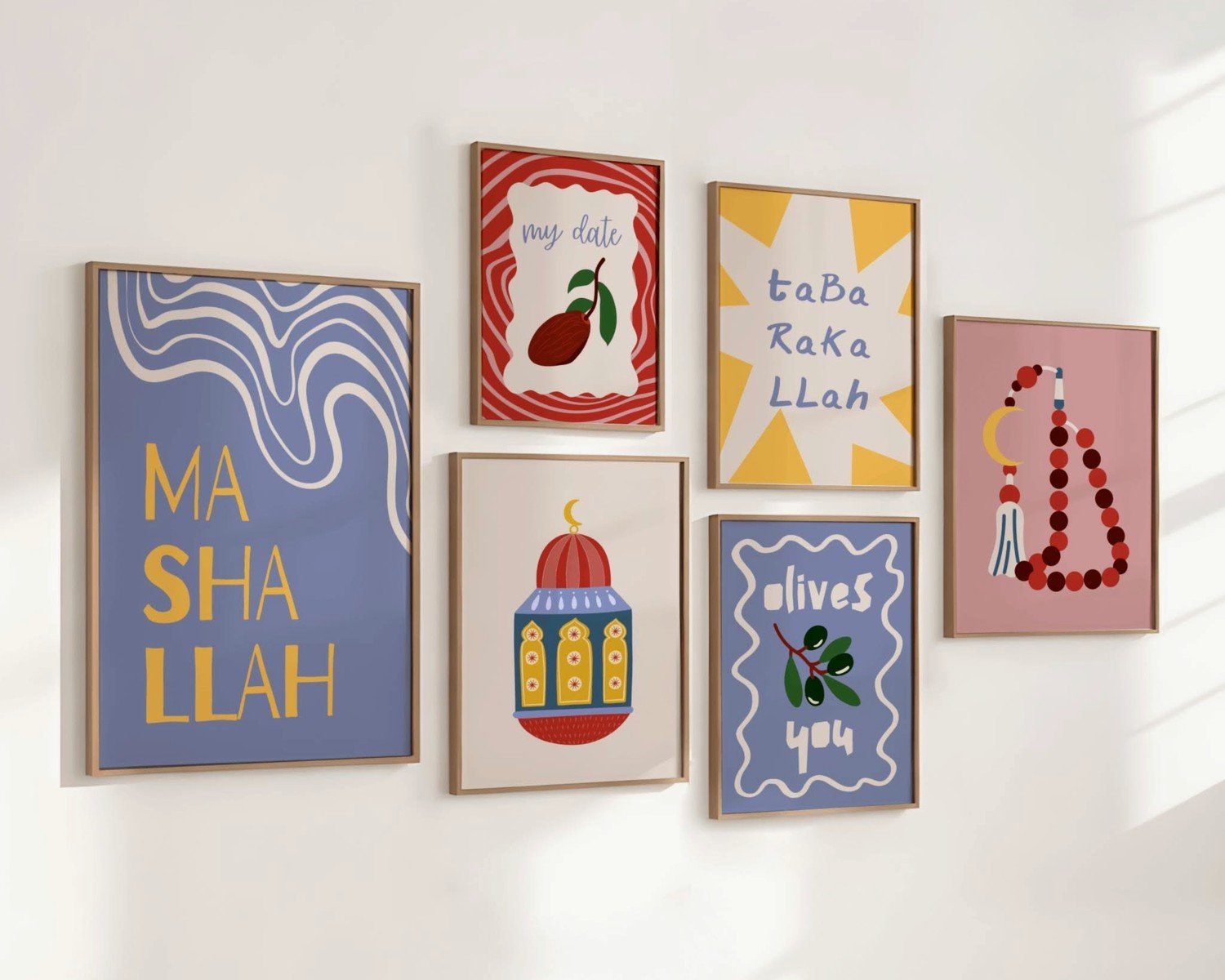
Gallery walls with Islamic art are tricky because you don’t want it to look too busy. I’d say stick to 5-7 pieces max, mix sizes but keep a consistent color palette. Odd numbers look better than even for some reason, it’s just a design thing.
Narrow walls like hallways can handle vertical pieces really well. A tall narrow canvas with vertical calligraphy looks intentional.
The 3D and Textured Options
Okay so there’s this whole category of dimensional Islamic wall art that’s been blowing up. Laser cut wood or metal that creates shadows and depth. I’m gonna be honest, these look incredible in person but photograph weirdly so don’t judge them by online pics alone.
Acrylic layered pieces where they stack clear or colored acrylic sheets to create depth are modern and catch light beautifully. They work especially well in rooms with good natural light.
Crystal or rhinestone embellished calligraphy is very extra but some people love it. It’s not my personal style but I’ve installed it for clients who wanted that glam look and it does sparkle nicely.
What to Avoid
Printed-on-demand stuff from random sellers where you can’t verify the Arabic is correct. I can’t stress this enough. The number of times I’ve seen gibberish or incorrectly written phrases is wild.
Overly busy patterns that compete with your furniture. Islamic geometric patterns are beautiful but if everything in your room is already patterned, adding more pattern is gonna give you a headache.
Plastic-looking finishes or super glossy prints unless you’re specifically going for that modern acrylic vibe. They usually just look cheap.
Mixing too many different calligraphy styles in one space. Pick a style and stick with it. Thuluth in the living room, Thuluth in the hallway. Don’t do Thuluth in one room and Diwani in the next unless they’re far apart.
Installation Tips Nobody Tells You
Canvas pieces are light so command strips work fine for most of them. But if you’re hanging metal or wood, use proper anchors. I’ve had a wooden Ayat al-Kursi fall at 2am and it scared me half to death.
Multi-panel sets need to be level and evenly spaced or they look terrible. Use a level, measure the gaps, don’t just eyeball it. I learned this after installing a three-panel set slightly crooked and having to redo it.
If you’re hanging above furniture, leave 6-8 inches between the furniture and the bottom of the art. Too high and it floats, too low and it looks cramped.
For heavy pieces, find the studs. Drywall anchors are okay for medium weight but anything over like 15 pounds should go into a stud.
Caring for Your Islamic Wall Art
Dust it regularly with a microfiber cloth. Canvas can be gently vacuumed with a brush attachment if you’re careful.
Keep it out of direct sunlight because colors will fade over time, especially prints. UV-protective glass helps if it’s framed.
Metal pieces can be cleaned with a slightly damp cloth but dry immediately to prevent water spots.
Wood pieces just need dusting, maybe a tiny bit of wood polish once in a while if they’re natural wood.
Budget Breakdown
You can find decent canvas prints for like $30-60 in smaller sizes. Mid-range stuff with better quality runs $80-150. High-end custom calligraphy or original art can be $300-1000+ easily.
Metal prints usually start around $70 and go up based on size. The 24×36 inch ones I’ve bought were around $120-140.
Wooden laser cut pieces vary wildly but expect $60-200 for good quality depending on complexity and size.
Multi-panel sets are often sold as packages which is more economical than buying separately. A three-piece set might be $90-180 for decent quality.
Mixing Islamic Art with Other Decor Styles
Modern minimalist works surprisingly well with simple calligraphy. Clean lines, monochromatic color schemes, one or two statement pieces.
Bohemian spaces can handle more ornate pieces and mixed patterns. Geometric Islamic art fits right in with macrame and layered textiles.
Traditional or classic interiors pair beautifully with framed calligraphy in ornate frames, especially gold or dark wood.
Scandinavian style needs the more subtle approach, white on white or very minimal black calligraphy.
Industrial loft spaces look amazing with large metal Islamic art pieces. The materials complement each other.
Custom vs Ready-Made
Ready-made is obviously faster and cheaper. You know what you’re getting and it ships quickly. The selection is huge now so you can usually find what you need.
Custom work lets you pick specific verses, color combinations, sizes, and styles. It takes longer, costs more, but you get exactly what you want. I’ve commissioned custom pieces for clients with specific Quranic verses that meant something personal to them and those projects always feel special.
If you go custom, make sure you’re working with an actual calligraphy artist who knows what they’re doing, not just someone who’s gonna use a digital font.
Oh and another thing, consider the lighting in your room. Art looks completely different in warm vs cool light. If you’ve got warm yellow bulbs, cool-toned art might look off and vice versa. I usually recommend people check their bulb temperature before committing to colors.
Wait I forgot to mention the whole appropriation thing, if you’re not Muslim but appreciate the art, that’s generally fine but be respectful about it. Don’t put Quranic verses in bathrooms or other inappropriate places. When in doubt, stick to geometric patterns or get advice from Muslim friends or designers.
The best Islamic wall art I’ve installed has always been pieces where the client actually connected with the meaning, not just the aesthetics. So pick phrases or imagery that resonate with you spiritually or culturally, and the rest of the design stuff will fall into place way easier.