
Wall Art Guide, Wall Art Tutoriels
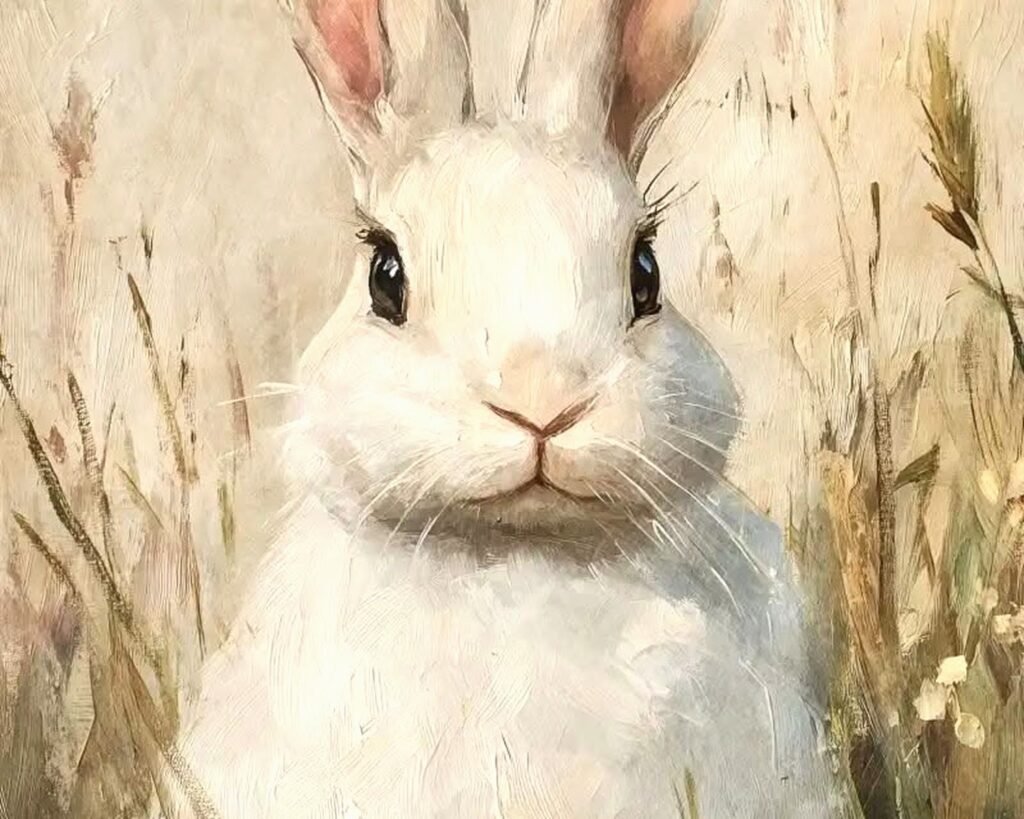
Rabbit Wall Art: Bunny Hare Woodland Easter Animal
Sep
So I’ve been obsessing over rabbit wall art lately because honestly, it started when a client asked me to help with her daughter’s nursery and wanted something “woodland but not too baby” and that sent me down this whole rabbit hole (pun totally intended). Anyway, here’s what I’ve actually learned from hanging like fifteen different bunny prints in various spaces over the past year.
Finding the Right Style Without Losing Your Mind
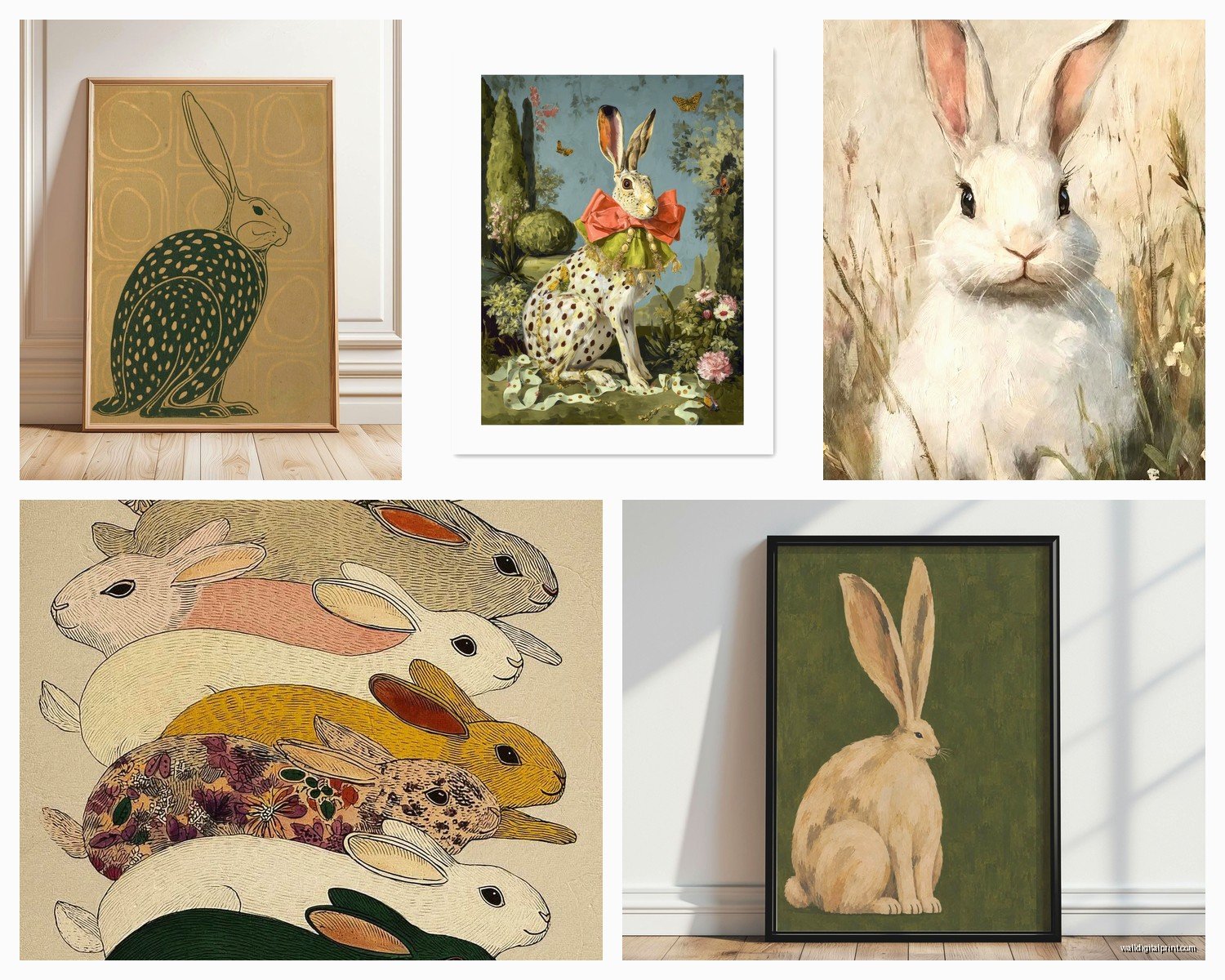
Okay so first thing – rabbit art comes in basically every style imaginable and you gotta figure out what vibe you’re actually going for. I learned this the hard way when I bought this super realistic hare print thinking it would be “sophisticated” and it just looked like I was really into hunting, which… no.
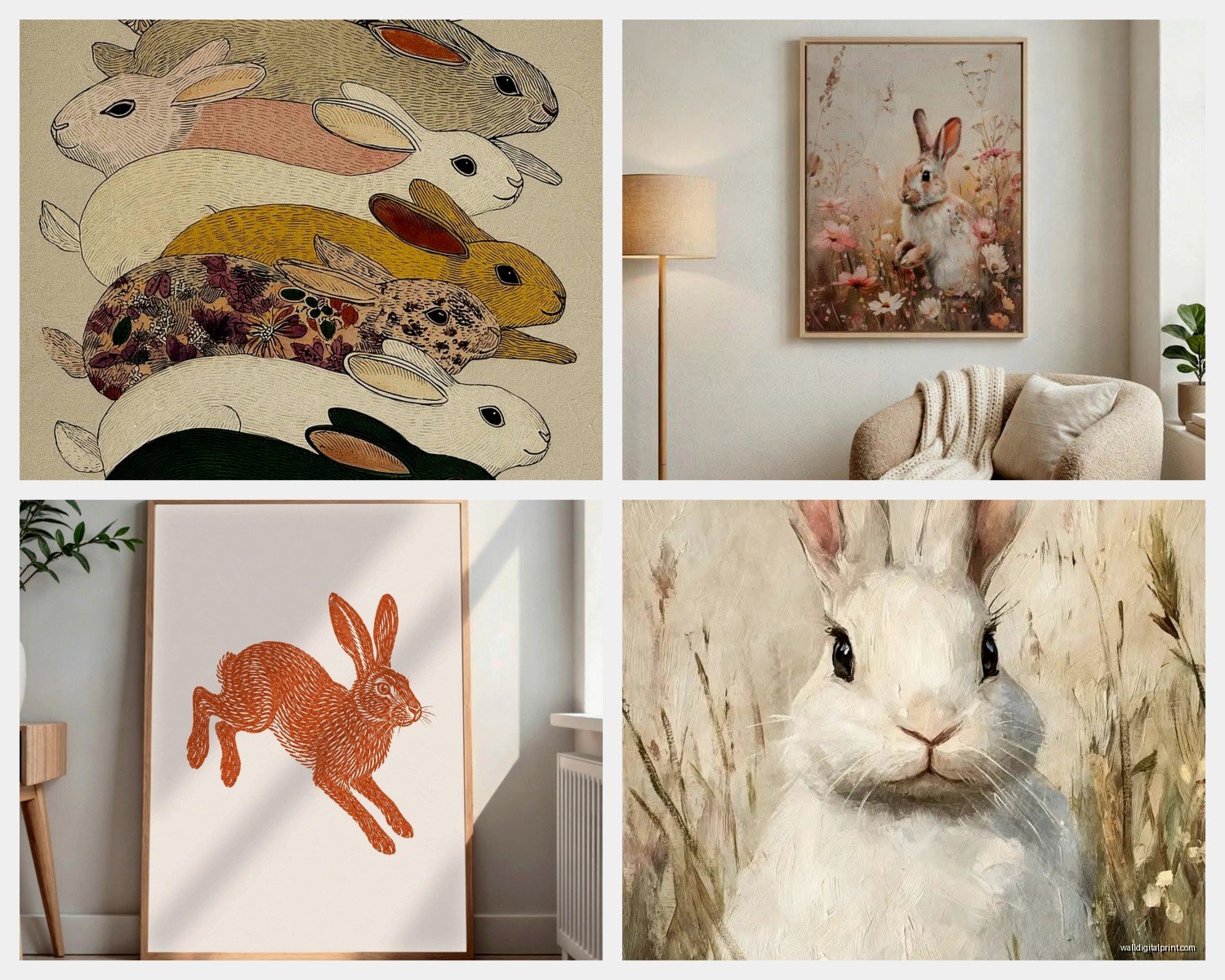
The main categories I’ve noticed are:
- Realistic watercolor rabbits – these work amazing in farmhouse or cottage-core spaces
- Minimalist line drawings – perfect for modern or Scandinavian rooms
- Vintage botanical style prints – you know, the ones that look like old natural history illustrations
- Whimsical illustrated bunnies – great for kids’ rooms but can work in adult spaces if they’re sophisticated enough
- Abstract or geometric rabbits – surprisingly hard to find good ones
The realistic watercolor ones from places like Etsy tend to run around $15-40 for digital downloads, and honestly that’s the route I go most of the time now because you can print them at whatever size you need. I use a local print shop that does really nice cardstock prints for like $8-12 depending on size, and the quality is way better than my home printer which always makes things look slightly… off.
Size and Placement Because This Actually Matters
Here’s where people mess up constantly – they buy art they love and then it’s the wrong size for their wall. I did this with a gorgeous bunny print that was 8×10 and I tried to put it above a console table that was like 48 inches wide and it just looked lost and sad floating there.
General rule I follow now: if you’re hanging above furniture, the art should be roughly 2/3 the width of the furniture piece. So for that console table, I needed something around 30-32 inches wide. Which meant either one large piece or a gallery wall situation.
Gallery Wall Configurations That Don’t Look Messy
Gallery walls with rabbit art can look SO good but also chaotic if you don’t have a plan. What works for me is picking one “anchor” piece (usually the biggest one, maybe 16×20) and then surrounding it with smaller coordinating pieces. I did this in my own hallway with a large hare portrait in the center and then four smaller 8×10 prints of different rabbit breeds around it.
Oh and another thing – stick to either all color or all black and white. I tried mixing and it looked like I just grabbed random prints from different decades, which I guess I did, but still.
Framing Options Without Spending Your Entire Paycheck
Okay so framing is where costs can get absolutely ridiculous. Custom framing a single print can run you $150-300 easily, and if you’re doing multiple pieces that adds up so fast. Here’s what I actually do:
IKEA frames are gonna be your friend for standard sizes. Their RIBBA frames come in black or white, they’re like $15-20, and honestly they look way more expensive than they are. I’ve used them in client homes that have $3000 sofas and nobody’s ever commented that the frames look cheap.
For odd sizes (because of course that gorgeous Etsy print you fell in love with is 11×14 instead of a standard size), I use a site called Frame It Easy. You input custom dimensions and pick your frame style and mat, and it’s still cheaper than custom framing at a frame shop. Usually runs around $40-80 depending on size.
Mat or No Mat
This is gonna sound weird but I almost always use a mat for rabbit prints specifically. Something about the subject matter reads more “collected” and “curated” with that white border around it. Without the mat, bunny art can sometimes look too casual or craft-fair-ish unless it’s a really sophisticated piece.
My cat just knocked over my water bottle so that’s fun… anyway, where was I.
Where to Actually Buy This Stuff
I’ve bought rabbit wall art from probably twenty different sources at this point, so here’s the real breakdown:
Etsy: Best selection by far, especially for downloadable prints. Search terms that work: “hare watercolor print,” “vintage rabbit illustration,” “minimalist bunny art.” Price range is all over the place – $5-50 for digital downloads. The quality really varies though, so check the reviews and look at the seller’s other work. I’ve gotten some stunning pieces and also some that looked pixelated when printed.
Society6: Good for when you want the printing and framing handled for you. More expensive (prints start around $25, framed around $80) but the quality is consistent. Their bunny selection isn’t huge but what they have tends to be more artistic and modern.
Minted: Similar to Society6 but slightly more upscale feeling. I bought a really beautiful minimalist rabbit print from here for a client’s office and it was like $38 for just the print. Worth it though – the paper quality was noticeably better.
Juniper Print Shop: If you want that vintage botanical vibe, this is where I go. They have gorgeous natural history style prints including several rabbit ones. Around $30-40 for an 11×14 print.
Amazon: Okay hear me out, I know it’s not the cool artsy option, but they actually have some decent rabbit canvas prints. The thing with Amazon is you really gotta read reviews carefully because quality is inconsistent. But I’ve found some surprisingly nice pieces for like $25-40 that come ready to hang.
Styling Different Rooms With Rabbit Art
This is where it gets fun because bunny art is weirdly versatile if you do it right.
Living Room
Go sophisticated here – realistic hare portraits, vintage hunting prints (the artistic kind not the weird taxidermy kind), or large-scale minimalist pieces. I hung a 24×36 charcoal hare drawing above a client’s sofa and it became this amazing conversation piece. People don’t expect rabbit art to look that elegant.
Pair it with neutral furniture and maybe some natural elements like a wood coffee table or woven baskets. The rabbit art brings in that woodland organic vibe without being too literal about it.
Kids’ Rooms
Obviously this is prime bunny territory, but try to avoid anything too baby-ish if you want it to grow with the kid. I look for illustrated rabbits with a storybook quality – think Beatrix Potter but more modern. There’s this one artist on Etsy called “Pumpkin and Possum” who does these gorgeous watercolor woodland animals that work from nursery through elementary school age.
Gallery walls work great in kids’ rooms. Mix rabbit prints with other woodland creatures, some ABC prints, maybe a name sign. Keep the frames all matching though or it gets too busy.
Dining Room or Kitchen
Wait I forgot to mention – vintage rabbit prints work amazingly in dining spaces, especially if you have a farmhouse or French country aesthetic. Those old natural history illustrations or vintage Easter postcards blown up and framed look really collected and intentional.
I did a series of three vintage rabbit breed illustrations in a client’s breakfast nook and paired them with some old botanical prints and it created this cool cabinet of curiosities vibe.
Bedroom
Keep it subtle here. Maybe a single larger piece above the bed or a pair of matching prints on either side. I like watercolor rabbits in soft colors for bedrooms – they add personality without being too stimulating. There’s something calming about a simple bunny portrait in muted tones.
Seasonal vs Year-Round
Okay so here’s a question I get a lot – is rabbit art too Easter-specific? And honestly, it depends on how you style it. If you’ve got bunnies surrounded by pastel eggs and spring flowers, yeah, that’s seasonal decor. But a beautiful hare portrait or a minimalist rabbit silhouette? That’s year-round art.
I keep my rabbit art up all year because it reads more as “woodland creature” than “Easter decoration” when it’s done right. The key is avoiding anything with obvious spring symbols or pastel color schemes unless you’re specifically going for seasonal decor.
That said, I do have a client who swaps in some more whimsical bunny prints around Easter and then switches back to her regular art, and that works too if you’re into changing things seasonally.
Color Coordination Tips
This is gonna sound obvious but match your rabbit art to your existing color scheme, or use it to introduce a new accent color. I did a nursery with gray walls and used rabbit prints with soft pink accents to bring in that color without painting another wall.
Black and white rabbit prints are the most versatile obviously – they work with literally any color scheme. But don’t sleep on colorful options if they match your space. I have this gorgeous rabbit print with a blue-gray background that I used in a bedroom with navy bedding and it tied everything together perfectly.
DIY Framing Tricks I’ve Learned
If you’re really trying to save money, you can do some creative framing yourself. I bought a pack of those poster hangers (the magnetic wooden ones) from Amazon for like $20 and they actually look really modern and intentional with the right prints. Works best with minimalist or line drawing style rabbit art.
Clipboards are another option I’ve used for kids’ rooms – get wooden clipboards, paint them if you want, and clip your prints to them. Easy to switch out and has that casual collected vibe.
Oh and thrift stores sometimes have great frames that you can spray paint. I’ve found some really nice wood frames for $3-5 that just needed a coat of white or black spray paint to look current.
Common Mistakes I See People Make
Hanging art too high – the center of your art should be at eye level, which is around 57-60 inches from the floor. I see so many people hang things way up near the ceiling and it just looks wrong.
Buying prints that are too small for the space – bigger is almost always better. If you’re debating between sizes, go larger.
Mixing too many different art styles in one room – pick a lane. All vintage, all modern, all watercolor, whatever. Mixing styles can work but it’s tricky and usually just looks cluttered.
Not considering the frame style – the frame matters as much as the print. A modern print in an ornate gold frame or vice versa just looks confused.
What Actually Works in Real Life
After doing this for years now, here’s what I keep coming back to: simple watercolor rabbits in neutral tones, framed in basic black or white frames with white mats. It sounds boring but it works in so many different spaces and styles. You can dress it up or down depending on what else is in the room.
The vintage botanical style is my second favorite – it has that collected antique vibe that makes a space feel layered and interesting without being too themed or cutesy.
And for modern spaces, those minimalist line drawing rabbits are perfection. Clean, simple, adds personality without cluttering the aesthetic.
My current favorite combo is three prints in a row – all the same size, matching frames, similar style but slightly different poses or perspectives. It creates this cohesive gallery wall effect without being too complicated to put together.
Anyway, I should probably actually get some work done today instead of rambling about rabbit art, but hopefully this helps you figure out what direction to go. Just remember to measure your wall space before you buy anything, and when in doubt, go bigger and simpler than you think you need.
