Wall Art Guide, Wall Art Tutoriels
Tall Wall Art: Extra High Vertical Portrait Format
Oct
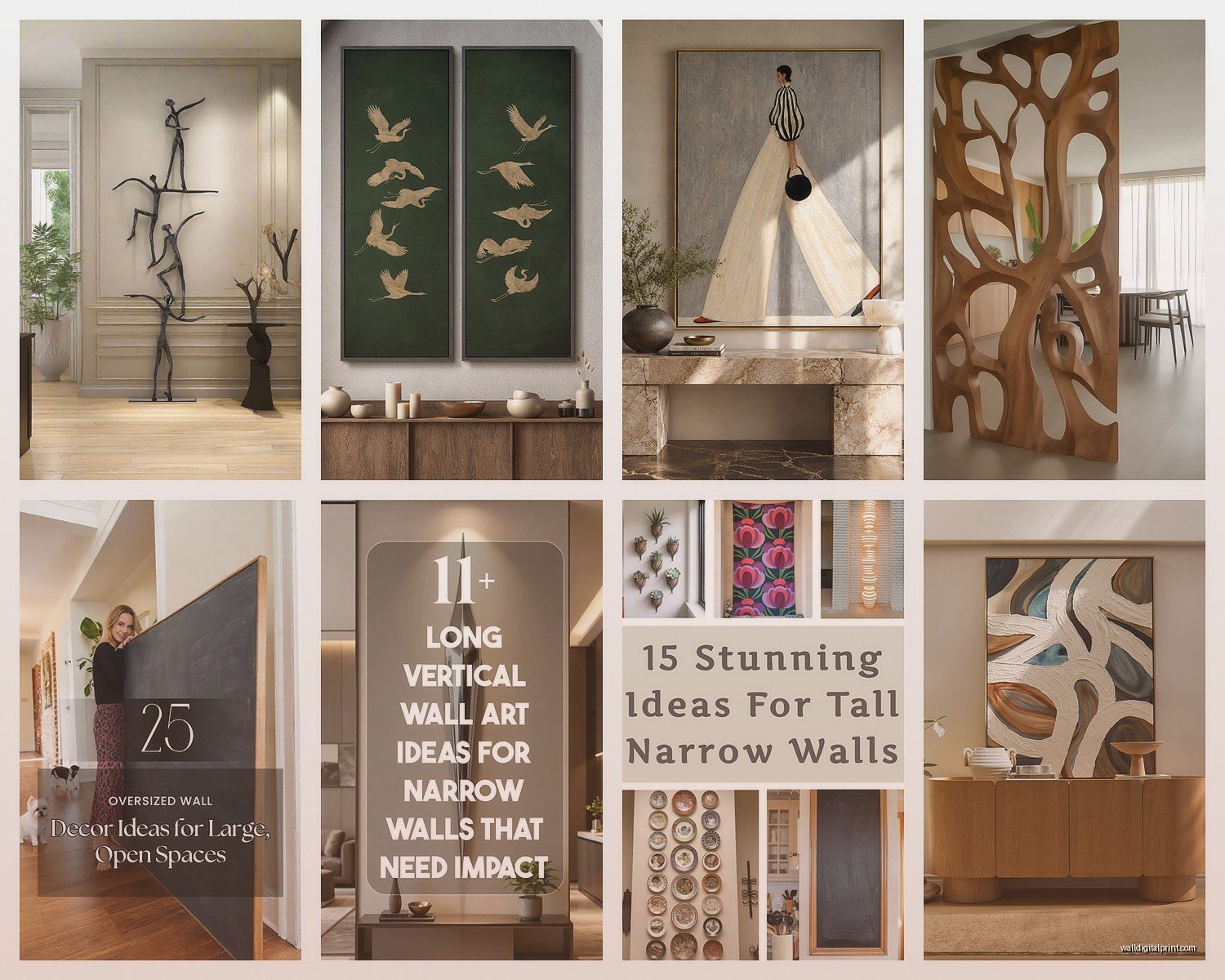
So I’ve been dealing with tall wall art for like three years now and honestly it’s one of those things where everyone gets it wrong at first because the proportions just feel… weird? Like you walk into a space with high ceilings or a narrow wall and your brain just doesn’t know what to do with all that vertical space.
The Actual Height Thing Nobody Talks About
Okay so first thing – when I say tall wall art I’m talking about pieces that are minimum 48 inches high, but really the sweet spot is 60-96 inches. Anything shorter and you’re just gonna have awkward empty space above it. I learned this the hard way in my own hallway where I hung what I THOUGHT was a tall piece and it was only 40 inches and it just looked… sad? Like it was floating in this sea of beige wall.
The rule I use now is that your art should take up about 60-75% of the available wall height. So if you’ve got a 10-foot ceiling that’s 120 inches, you want art that’s roughly 72-90 inches tall. But also this depends on where your ceiling line actually feels like it ends because crown molding changes everything.
Where This Actually Works
- Narrow hallways where you literally cannot fit wide art
- Between windows that are super close together
- Next to doorframes or built-ins
- Stairwell walls oh my god stairwells are the WORST without vertical art
- That random skinny wall in your bathroom that’s like 18 inches wide
- Above console tables that are narrow
I had a client last month who had this gorgeous entryway but the wall space between her coat closet and the living room entrance was maybe 24 inches wide and she’d been trying to make a horizontal landscape piece work there for months and it just… didn’t.
Shopping for This Format Is Annoying
Real talk – most art comes in landscape because that’s what fits above sofas and beds. Finding actual vertical portrait pieces that are EXTRA tall requires knowing where to look.
Online Sources That Actually Have Selection
Minted has a decent filter system where you can select dimensions. I usually search for anything 24×60 or taller. Their photography prints work really well in this format – lots of architectural shots and nature stuff that naturally lends itself to vertical.
Society6 lets you customize sizes on a lot of their prints which is honestly amazing. You can take artwork that exists and just… make it taller. Though fair warning the quality varies wildly by artist so always read reviews.
Etsy is where I find most of my really unique tall pieces but you gotta be specific with your search terms. Try “vertical wall art 60 inches” or “tall narrow canvas” or “portrait format large.” There are shops that specialize in this and once you find one good shop their recommendations algorithm actually helps.
Oh and another thing – Desenio has some European-sized formats that are naturally taller and narrower than standard US sizes. Their 50x70cm and 61x91cm prints translate to roughly 20×28 and 24×36 inches which work great stacked or alone.
Custom Printing Route
Sometimes you just gotta make your own. I use Nations Photo Lab for large format printing when I have a specific image in mind. You can upload pretty much any high-res image and print it at custom dimensions. Did this with a photo I took in Portugal last year and printed it at 30×80 inches for like $180 including mounting.
Frame It Easy does custom frames for weird sizes which you’re definitely gonna need because finding a frame for a 28×84 inch piece at HomeGoods? Not happening.
The Content Question
What you actually PUT in that tall vertical space matters more than with regular proportions because the eye travels differently. It moves up and down instead of side to side which sounds obvious but really changes what works.
Stuff that looks amazing tall:
Single trees or branches – the verticality just makes sense naturally. I have a eucalyptus branch print that’s 24×72 in my own bathroom and people always ask about it.
Architectural elements like doorways, columns, church interiors, staircases. Basically anything that’s already tall in real life.
Abstract color fields that bleed from one color to another top to bottom. There’s this artist on Saatchi Art who does ombre pieces and the 20×60 versions are stunning.
Narrow city streets shot looking down the perspective. Like those European alleyway photos.
Single figure portraits – not headshots but full body or 3/4 length figures have that natural portrait orientation.
Botanical prints especially those vintage scientific illustration style ones with the whole plant from root to flower.
What doesn’t work as well:
Horizontal landscapes that you just rotate 90 degrees… they just look wrong
Really busy patterns with no clear vertical movement because your eye doesn’t know where to go
Wide panoramic photos cropped to vertical – the composition just fights itself
Hanging This Without Losing Your Mind
Okay so funny story I once hung a 72-inch piece by myself and dropped it twice before I figured out the actual technique. You cannot do this alone if it’s over 48 inches unless you enjoy drywall repair.
The center point rule still applies but it’s trickier. You want the center of the artwork at roughly 57-60 inches from the floor which is average eye level. But with really tall pieces this means the bottom edge might be at like 12 inches off the floor which LOOKS low when you’re measuring but trust me it works.
Wait I forgot to mention – measure from the floor not from where you think eye level is because everyone’s eye level guess is different and you’ll end up with crooked decisions.
Actually Hanging It
Use two hanging points minimum for anything over 40 inches tall. The piece will tilt forward at the top otherwise and it’ll drive you insane. I use two D-rings positioned about 1/3 down from the top edge.
For really heavy pieces over 50 inches I use french cleats instead of wire or D-rings. Way more secure and the weight distributes better across the wall. You can buy cleat sets on Amazon for like fifteen bucks.
Stud finder is not optional here. Drywall anchors work for lighter stuff but once you’re over 20 pounds you really wanna hit a stud. My Zircon stud finder has paid for itself like 50 times over.
Blue painter’s tape is your friend for planning placement. Cut strips the exact dimensions of your art and tape them to the wall. Live with it for a day or two. Move it around. This has saved me so many unnecessary holes in walls.
Framing Tall Pieces Is Expensive Unless
Custom framing for oversized vertical pieces gets crazy expensive fast. I’m talking $400-600 for a simple frame on a 30×72 piece. So here’s what I actually do:
Canvas prints don’t need frames – just hang them as is or get them gallery wrapped where the image continues around the edges. Saves hundreds of dollars.
Poster hangers or magnetic hangers work great for paper prints and they actually suit the tall narrow aesthetic. I use the wood ones from Artifact Uprising and they’re like $25 for a set that holds up to 24×36.
IKEA RIBBA frames max out at 24×35 inches but you can stack two or three of them vertically with small gaps between for a modern gallery wall effect. Did this in my office with three 24×35 black and white photos and it reads as one tall installation.
For actual custom framing I use a local shop not a chain because they’ll work with you on price and they do better corner joints on tall pieces which matters because any wobble shows up more on vertical formats.
Styling Around Tall Art
The furniture situation under tall art is specific. You can’t really do the whole “fill the console table with stuff” thing because it competes with the verticality.
Keep it minimal underneath – one sculptural object or a simple plant. Maybe a stack of two books. That’s it. The art needs to be the statement.
Actually my cat knocked over a vase I had under my hallway art last week and I just… never replaced it and it looks better empty so there’s that lesson learned.
Side by side pairings can work if you’ve got the wall width. Two tall narrow pieces about 6-12 inches apart creates this cool rhythm. Just make sure they’re the same height or it looks accidental.
Lighting these pieces matters more than you think because the shadows cast differently on tall vertical surfaces. I usually put a picture light at the top or use a floor uplighter positioned about 3 feet away angled up.
The DIY Tall Art Route
If you’re crafty at all you can make your own tall pieces pretty easily. I’ve done this for clients on budget projects and it always looks more expensive than it is.
Stretched canvas from Blick Art Materials comes in tall sizes. Get a 24×60 blank canvas for like $45, paint it a single bold color or do a simple color block design. Genuinely no one can tell it’s not a $400 piece.
Fabric wall hangings work brilliantly in tall formats. Get a curtain rod the width you want, hem a piece of interesting fabric top and bottom, slide it on the rod. I’ve used vintage kimono fabric, mudcloth, even nice bedsheets for this.
Pressed botanical specimens in a tall shadow box frame. Collect branches or flowers, press them, arrange them vertically in a deep frame. Very museum-quality looking for under $100 in materials.
Large scale photo printing at Costco or Walmart is stupid cheap. Like you can get a 20×60 print for maybe $30. Mount it on foam core yourself with spray adhesive.
Common Mistakes I See Constantly
Hanging it too high because people panic about the height and overcompensate. Then you’ve got this tall piece with its bottom edge at like 40 inches off the floor and acres of empty wall below it.
Choosing art that’s too narrow for the wall width. If your wall is 36 inches wide your art should be at least 24 inches wide even if it’s 72 inches tall. Otherwise it looks like a bookmark.
Not considering the viewing distance. In a narrow hallway you’re seeing the art from like 4 feet away so detail matters. In a large room with a tall piece you might view it from 15 feet so it needs to read from a distance.
Mixing aspect ratios in a gallery wall that includes tall pieces – just commit to either all vertical or a very intentional mix because accidental-looking is still just… accidental.
The Price Reality
You’re gonna pay more for tall art because it uses more material and shipping is more expensive. A 24×36 print might be $50 but a 24×60 in the same image will be $120. It’s just the reality of larger formats.
That said I’ve found amazing tall pieces at HomeGoods and TJ Maxx randomly. You gotta go in person and dig through the art section but I’ve scored 20×60 canvas prints for like $40. They come and go fast though.
Okay so this is gonna sound weird but estate sales sometimes have really great tall vintage art because mid-century homes had different proportions and people bought art to fit those spaces. Found an amazing 30×72 abstract from the 70s for $35 at an estate sale in my neighborhood.
The main thing with tall wall art is just committing to the proportion and not trying to make it work like regular art. It’s its own thing with its own rules and once you get the hang of it those awkward vertical spaces become like… the most interesting walls in your place.