Wall Art Guide, Wall Art Tutoriels
40×60 Wall Art: Large Vertical Canvas Size Guide

Oct
So I just hung this massive 40×60 canvas in my living room last week and honestly, I’m still staring at it trying to figure out if I nailed the placement or if it’s slightly off center…but anyway, you asked about these large vertical pieces and I’ve been working with them for years now, so let me dump everything I know.
Why 40×60 is Actually Perfect (and Also Tricky)
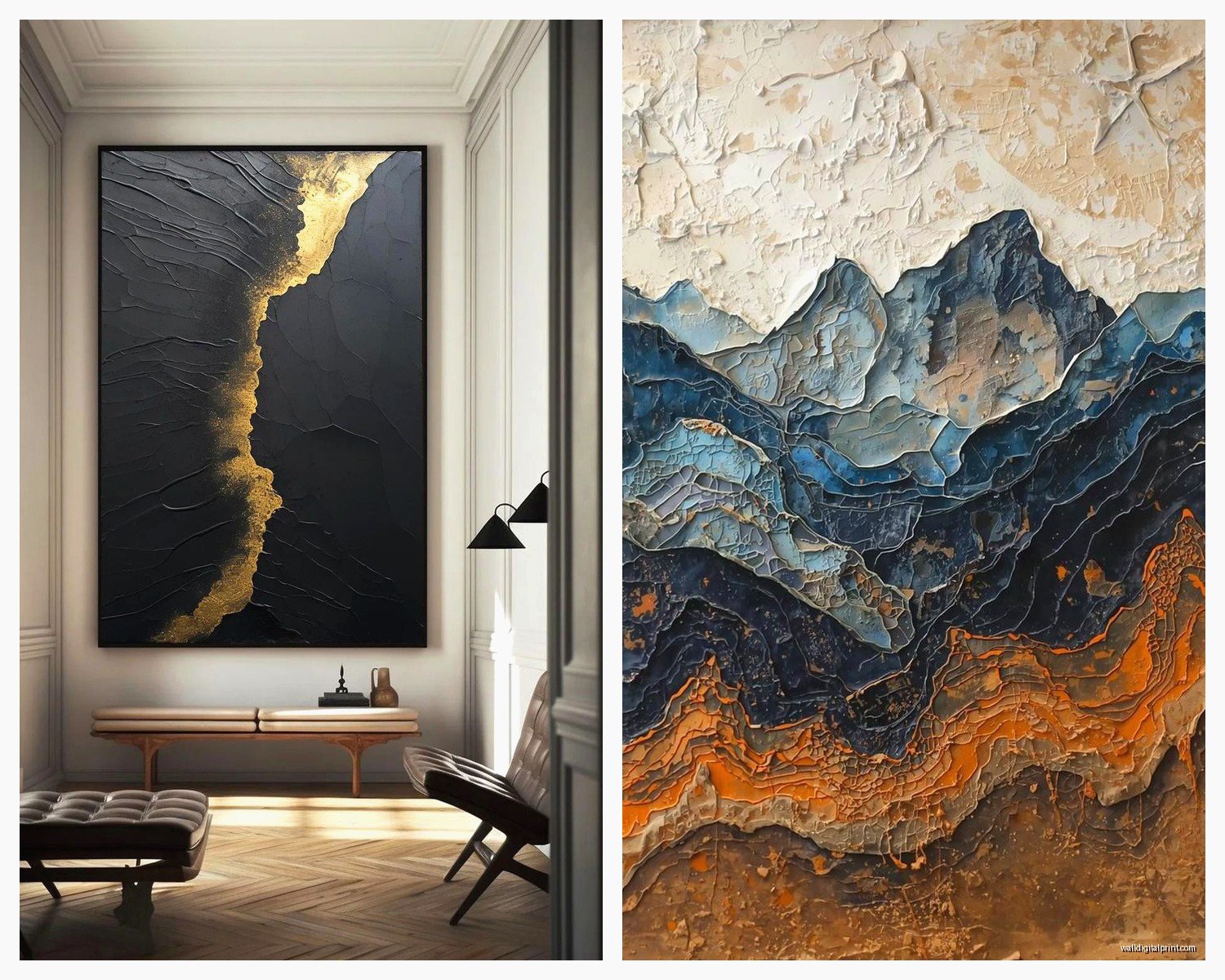
Okay so first thing – a 40×60 inch canvas is HUGE. Like, my assistant brought one over and we literally couldn’t fit it in my car. Had to borrow my neighbor’s SUV which was awkward because I barely know her but whatever. The dimensions are 40 inches wide by 60 inches tall, and that vertical orientation is what makes it so dramatic. It pulls your eye up, makes ceilings feel higher, and honestly works in spaces where you’d think “that’s too big” but then it’s actually perfect.
The thing is, most people underestimate how much wall space these actually need. You can’t just slap a 40×60 on any wall and call it done. I learned this the hard way at a client’s apartment where we had to return the piece because their ceiling was only like 8 feet and it just looked…wrong.
Measuring Your Wall Space (The Stuff Nobody Tells You)
Here’s what you gotta do before you even think about buying:
- Measure your wall height from floor to ceiling
- Measure the width of the wall section where you want it
- Account for furniture below – sofas, consoles, whatever
- Take a photo of the wall and literally tape paper cutouts to visualize
That last one sounds insane but I do it all the time. I keep this huge roll of brown packing paper and just cut out shapes. My boyfriend walked in once while I was doing this and was like “are you okay” because I had paper taped all over three different walls trying to figure out a gallery situation.
For a 40×60 to work, you really want at least 9-foot ceilings, preferably 10. With 8-foot ceilings it can work but you need to be strategic about placement and it can’t be above anything too tall.
The Spacing Rules I Actually Follow
So art school and design books will tell you all these official rules but here’s what actually works in real homes:
Above Furniture: Keep 6-8 inches between the top of your sofa/console and the bottom of the canvas. I usually aim for 7 inches because it’s right in the middle and my measuring skills are…not great. If you go too high, the art feels disconnected. Too low and it’s like the furniture is eating the artwork.
Eye Level Thing: Everyone says hang art at eye level but whose eye level?? I’m 5’6″ and my eye level is different than my 6’2″ client’s. What I actually do is put the center of the artwork at about 57-60 inches from the floor. With a 40×60, that means the bottom edge sits around 27-30 inches up. Do the math – the center of 60 inches is 30 inches, so 57 minus 30 equals 27 inches from floor to bottom edge.
Wait I forgot to mention – if you’re hanging it in a space where people are mostly sitting (like a dining room), you can go a bit lower. Maybe center it at 54 inches instead.
Weight and Hanging Hardware (The Scary Part)
Okay so funny story, I once hung a 40×60 canvas using those little sawtooth hangers because I didn’t know better and it fell off the wall at like 3am. Scared the absolute crap out of me and my cat didn’t come out from under the bed for hours.
These big canvases are HEAVY. We’re talking 15-30 pounds depending on if it’s a real stretched canvas or a print. You need serious hanging hardware:
- Heavy-duty D-rings or wire on the back of the canvas
- Two wall anchors rated for at least 50 pounds each
- A level because eyeballing it is how you end up with crooked art
- A stud finder if possible – hitting a stud is ideal
I always use two hanging points for anything over 36 inches wide. One hook in the center is gonna make it tilt eventually, trust me. And get the good wall anchors – I like the toggle bolt kind that open up behind the drywall. They’re like $8 for a pack and worth every penny.
My Actual Hanging Process
This is how I do it and I’ve hung probably 200+ large pieces at this point:
First, I mark where I want the center to be. Then I measure from the top of the canvas down to where the wire or D-rings are when pulled taut. Subtract that number from my center point to figure out where the hooks go. Mark it with painter’s tape because pencil marks stress me out.
Then I install the anchors, put in the hooks, and get someone to help me lift it. Do NOT try to hang a 40×60 by yourself. I did this once and nearly dropped it on my foot.
Where These Actually Work Best
I’ve installed 40×60 canvases in a bunch of different spots and here’s where they really shine:
Above a Sofa: This is the classic spot. Your sofa should be at least 72 inches wide, ideally more like 84-90 inches. The art should take up about 2/3 to 3/4 of the sofa width. A 40-inch width works perfectly over most standard sofas.
Entryway or Hallway: Vertical pieces are amazing in narrow spaces. If you’ve got a long hallway that’s like 4-5 feet wide, a 40×60 makes it feel intentional instead of just…a hallway. I did this in my own place and people always comment on it.
Stairwell: Going up stairs with a tall vertical piece following the angle is *chef’s kiss* but also complicated. You need to account for the slope and it’s a whole thing. Maybe save this for when you’re feeling ambitious.
Bedroom: Above the bed is obvious, but I actually love a 40×60 on the wall opposite the bed. It’s what you see when you wake up and it doesn’t have that “hotel room” vibe that art above the bed can sometimes have.
Picking the Right Image for This Size
Not every image works at 40×60. I’ve seen people blow up photos that were clearly not high enough resolution and it’s just…pixelated and sad.
For this size, you want:
- Images that are at least 300 DPI at final size
- Vertical compositions or square images that can crop vertically
- Bold, simple subjects – super detailed stuff can get lost
- Good contrast so it reads from across the room
Abstract art works great at this scale. Landscapes in vertical orientation are gorgeous – think tall trees, waterfalls, cliff faces. Portraits can work but make sure they’re not gonna feel weird and giant staring at you all the time.
Oh and another thing – think about your color palette. A 40×60 is a major focal point, so it’s gonna influence the whole room’s vibe. I usually pull 2-3 colors from the art and echo them in pillows, throws, or other decor.
Canvas vs. Print vs. Other Options
So you’ve got options for what actually gets printed at 40×60:
Stretched Canvas: This is the classic gallery wrap where the image wraps around the edges. No frame needed. Looks modern and clean. Can be pricey – expect $200-600 depending on quality and where you buy.
Framed Print: A paper or canvas print in a frame. The frame adds another 2-4 inches to each dimension, so factor that in. A 40×60 print in a frame becomes more like 44×64 total. Also heavier.
Acrylic or Metal Prints: These are having a moment and they’re stunning. The colors are super vibrant. Also expensive and the glare can be an issue depending on your lighting.
Tapestry or Fabric: I’m seeing more of these lately. Lighter weight, easier to hang, but less formal. Good for bohemian or eclectic spaces.
I usually recommend stretched canvas for most people because it’s that sweet spot of quality, price, and ease of hanging. Plus if you hate it, you can paint over it which I’ve definitely done before.
Where to Actually Buy These
I’ve ordered from a bunch of places:
Printful and Printify if you want custom prints – their quality is pretty good and the prices are reasonable. Etsy has tons of sellers doing large format prints, but quality varies wildly so read reviews obsessively. Society6 and Minted have curated options and their printing is solid. If you want something really high-end, find a local print shop that does giclée printing.
IKEA has affordable large art but the sizes are limited and it’s very…IKEA-looking, you know? Target sometimes has surprisingly good stuff in their Opalhouse line.
Lighting Makes or Breaks It
I cannot stress this enough – you can have the most gorgeous 40×60 canvas and if the lighting sucks, it’s just a dark rectangle on your wall. Been there, fixed it approximately 100 times.
Options that work:
- Track lighting aimed at the piece
- Picture lights mounted above (need hardwiring or those battery ones)
- Floor lamps positioned to wash light across it
- Natural light is great but watch for sun damage over time
I installed these wireless picture lights from Cocoweb at a client’s place and they’re honestly game-changing. Battery powered, LED, and they have a remote. No electrician needed.
Avoid putting your 40×60 directly across from a window if possible because the glare is real, especially with any kind of glossy finish.
The Style/Room Matching Thing
Your art doesn’t have to match your decor exactly but it should feel intentional. Like, a super modern geometric abstract piece in a traditional Victorian room could work if you’re going for eclectic, but it might also just feel confused.
I try to match either the color palette OR the style vibe. So in my living room which is mostly neutral with warm wood tones, I have this massive 40×60 abstract in rust, cream, and dark teal. The colors tie in but the style is contemporary which keeps it from feeling too matchy.
For minimalist spaces, a single large piece is better than multiple smaller ones. For maximalist/”more is more” spaces, you might actually want to think twice about a 40×60 because it’ll compete with everything else. Or lean in and make it even more dramatic, I dunno, depends on your tolerance for visual chaos.
Common Mistakes I See All the Time
Hanging it too high – seriously this is the #1 issue. People think “big wall, put it up high” but then it’s floating near the ceiling and looks weird.
Choosing art that’s too small for the space – if you’re considering a 40×60, you probably need a 40×60. Don’t chicken out and get a 24×36 instead. It’ll look lonely.
Not considering the room’s traffic flow – make sure your giant canvas isn’t blocking doorways or in a spot where people’s bags and coats are gonna hit it constantly.
Forgetting about the thickness – stretched canvases stick out from the wall about 1.5 inches. Make sure you have clearance if it’s near a corner or door.
Using cheap hardware and then being shocked when it falls – don’t be me at 3am with a crashed canvas and a traumatized cat.
Okay I think that’s everything I’ve learned from years of dealing with these big vertical pieces…just measure twice, use good hardware, and trust that going bigger is usually the right call.