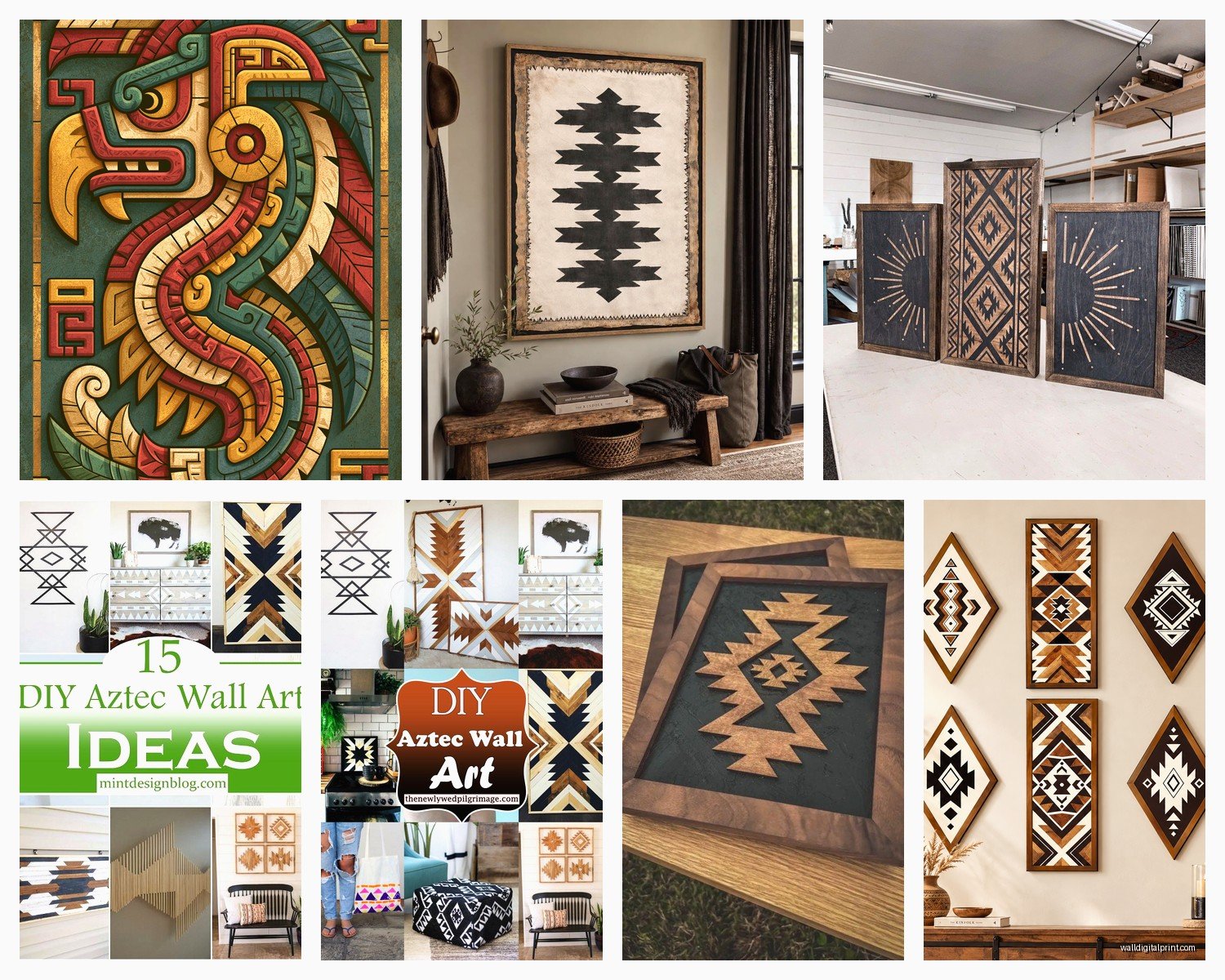
Wall Art Guide, Wall Art Tutoriels
Aztec Wall Art: Mexican Indigenous Ancient Tribal Designs
Nov
So I’ve been obsessed with Aztec wall art lately and honestly it started because a client asked me to source some for their loft and I fell down this entire rabbit hole of Mexican indigenous designs. Like I spent three hours researching when I should’ve been doing my quarterly taxes but whatever.
Understanding What You’re Actually Looking At
Okay so first thing – Aztec wall art isn’t just random geometric patterns, though that’s what a lot of people think. These designs actually mean something. The stepped patterns represent pyramids or mountains, the spirals are about life cycles, and those sun motifs? Super significant because the sun god was basically everything to the Aztecs. When you’re shopping around, you’ll see a lot of stuff labeled “Aztec” that’s really just southwestern geometric vibes, which fine, but it’s not the same thing.
The real Aztec stuff pulls from codices (ancient books basically), temple carvings, and pottery designs. You’ll recognize it by the really specific iconography – eagles, jaguars, serpents, calendar symbols. My favorite piece in my own apartment is this print of the sun stone calendar, which everyone calls the Aztec calendar even though that’s not technically accurate but I digress.
Where to Actually Find Good Quality Pieces
This is gonna sound weird but Etsy has been surprisingly solid for authentic-looking Aztec art. I found this artist in Mexico City who does hand-painted reproductions of codex illustrations and they’re stunning. Cost me like $180 for a large piece but it’s actual quality – the paint has texture, the canvas is thick, you can tell someone spent time on it.
Avoid the mass-produced stuff from those generic home decor sites unless you just want something cheap to fill space. The colors are always off – too bright, too digital-looking. Real Aztec color palettes used natural pigments so you’re looking at earthy reds, deep turquoises, ochres, blacks. If it looks like someone cranked up the saturation slider in Photoshop, that’s your sign.
Oh and another thing, indigenous artists selling on platforms like Novica or directly through their own sites – that’s where you get pieces that actually support the communities these designs come from. I try to buy from Mexican artists when I can because like, these are their cultural heritage and it feels weird to buy from some dropshipper in Ohio, you know?
Materials Matter More Than You Think
Canvas prints are fine but they feel kinda flat for Aztec designs. I’ve had better luck with:
- Wood panels – there’s something about the texture that works with the geometric patterns
- Metal prints – sounds weird but the slight sheen makes the gold tones in sun motifs really pop
- Woven textiles – tapestries with Aztec designs have this dimensional quality that prints don’t
- Hand-carved wood – if you can find it and afford it, absolutely worth it
I bought this metal print of Quetzalcoatl last year and my sister thought it cost like $500 but it was actually $89. The metallic surface just elevates it somehow.
Styling This Stuff Without Looking Like a Theme Restaurant
Okay so this is where people mess up. They get excited about Aztec art and suddenly their whole room looks like a Tex-Mex restaurant waiting room. Been there, almost did that.
The key is treating these pieces like the statement art they are. One large Aztec piece as a focal point works better than scattering small ones everywhere. I did a client’s dining room last month with one massive Aztec warrior print above the sideboard and kept everything else minimal – white walls, simple furniture, maybe one terracotta pot. The art became the whole vibe without overwhelming the space.
If you wanna do multiple pieces, they should be part of a gallery wall where you’re mixing them with other stuff. I’ve got my sun calendar print next to some black and white photography and a small abstract piece. The Aztec design holds its own but isn’t competing with clones of itself.
Color Coordination That Actually Works
Your room doesn’t have to match the art exactly but it helps to pull one or two colors through. If your Aztec piece has prominent turquoise, throw in some turquoise pillows or a vase. The terracotta reds work beautifully with warm wood tones and cream walls.
Wait I forgot to mention – neutral backgrounds are your friend. Aztec designs are busy by nature, so putting them against a bold colored wall can be too much. I learned this the hard way when I hung a piece against a burnt orange wall and it just… fought with itself? Moved it to a white wall and suddenly it was perfect.
DIY Options If You’re Crafty
My cat knocked over my coffee while I was working on this but anyway – if you’re into DIY, Aztec patterns are actually pretty forgiving because they’re geometric. You don’t need to be a master painter.
I’ve done a couple of stencil projects that turned out decent. You can buy Aztec pattern stencils online or make your own if you’re patient. The process is pretty straightforward:
- Get a large canvas or wood panel
- Paint your base color – black, cream, or terracotta work well
- Let it dry completely (I never wait long enough and always regret it)
- Use your stencil with contrasting colors
- Layer patterns if you’re feeling ambitious
- Seal it with a matte varnish
The stencil route gives you that hand-made look without needing actual artistic skills. Plus you can customize the colors to match your space exactly.
Free Resources for Patterns
The Codex Borgia and other Aztec codices are public domain, which means you can literally download high-res images, print them, and frame them. I’ve done this for my office and it cost maybe $30 total for printing and a frame. Museums like the National Museum of Anthropology in Mexico City have digital collections you can access.
There’s also this website called Mexicolore that has tons of Aztec imagery and explanations of what everything means. Super helpful when you’re trying to pick designs that actually resonate with you rather than just looking cool.
Size and Placement Strategy
This is gonna sound obvious but I see people mess this up constantly – measure your wall before you buy anything. I almost ordered a piece that would’ve been comically small for the space I had in mind.
For above a sofa, you want your art to be about two-thirds to three-quarters the width of the sofa. Aztec pieces tend to be square or circular (like calendar designs) so plan accordingly. A circular piece above a rectangular sofa can look amazing if it’s sized right.
Living room focal wall? Go big or go home. Like 40×40 inches minimum. These designs have detail that gets lost when they’re too small. I’ve got a 48×48 piece in my living room and people always comment on it – it’s the first thing you see when you walk in.
Hallways are actually perfect for vertical Aztec designs. Those tall narrow temple motifs or warrior figures fit the space naturally.
Mixing Aztec with Other Styles
You don’t have to commit to a full southwestern or Mexican-inspired room to incorporate Aztec art. I’ve successfully mixed it with:
- Mid-century modern furniture – the clean lines don’t compete with the patterns
- Minimalist spaces – one ornate Aztec piece against stark minimalism creates nice tension
- Bohemian rooms – obviously this works, just don’t go overboard
- Industrial lofts – the ancient/modern contrast is *chef’s kiss*
What doesn’t really work is mixing it with other really busy patterns like florals or paisley. Too much visual noise. Keep the surrounding decor relatively simple and let the Aztec design be the complex element.
Lighting Considerations
Okay so funny story – I hung this gorgeous Aztec textile piece and couldn’t figure out why it looked muddy and flat. Turns out the lighting in that corner was terrible. Added a picture light above it and suddenly all the colors and details came alive.
These designs need good lighting to show their complexity. Natural light is great but can fade colors over time, so keep that in mind if you’re hanging near a sunny window. I use UV-protective glass on my more expensive pieces.
For artificial lighting, warm white LEDs work better than cool white. The warm tones complement the earthy colors in traditional Aztec palettes. Track lighting or picture lights let you highlight the piece specifically.
Framing and Presentation
Simple frames work best. Black, dark wood, or metallic gold/copper frames complement Aztec designs without competing. I avoid ornate frames – the art itself is already decorative enough.
Floating frames can look really cool with Aztec art because they add dimension. The piece appears to float off the wall slightly, which gives it more presence.
For textiles, you’ve gotta stretch them properly or they’ll look sloppy. I learned this after buying a beautiful woven piece and just tacking it to the wall with pushpins like I was in college. Eventually took it to a framer who stretched it over a frame and now it looks legit.
The Matting Debate
I go back and forth on this. Sometimes a wide mat in cream or black makes an Aztec print feel more gallery-worthy. Other times it creates too much distance between you and the art. Depends on the piece honestly.
Calendar designs and circular motifs look good with mats because the negative space emphasizes their shape. But busy rectangular codex reproductions? I usually skip the mat and let the image fill the frame.
Budget Breakdown
Since you’re probably wondering about costs:
Budget-friendly ($20-$100): Prints from Etsy, Society6, or Redbubble. Quality varies but you can find decent stuff. DIY stencil projects. Digital downloads you print yourself.
Mid-range ($100-$400): Hand-painted reproductions from Mexican artists. Original pieces from emerging artists. Quality woven textiles. Custom sizing and framing.
Investment ($400+): Original artwork. Museum-quality reproductions. Hand-carved pieces. Large-scale installations. Authentic vintage textiles.
I usually tell clients to spend more on one really good piece than spreading their budget across multiple mediocre ones. That one statement piece will give you more joy and visual impact than three okay pieces.
Authenticity and Cultural Respect
This feels important to mention – there’s a difference between appreciating Aztec art and appropriating it. Buying from indigenous Mexican artists, learning about what the symbols mean, and displaying these pieces with respect for their cultural significance matters.
I try to avoid pieces that feel like caricatures or that reduce these sacred symbols to just trendy patterns. If something’s being sold as “tribal chic decor” with no context about its meaning or origin, that’s usually a red flag.
When clients ask about pieces, I share what I’ve learned about the symbolism. It makes the art more meaningful and shows respect for the culture it comes from.
Maintenance and Care
Canvas and paper prints need dusting regularly with a soft brush. Don’t use cleaning sprays directly on them – if you need to clean, use a barely damp cloth and be gentle.
Textiles should be vacuumed gently with the upholstery attachment every few months. Keep them away from direct sunlight to prevent fading.
Metal and wood pieces are pretty low maintenance. Just dust them and avoid hanging in humid areas like bathrooms where moisture could cause issues.
I rotate my art seasonally sometimes, which helps prevent fading and keeps things fresh. My Aztec pieces usually go up in fall and winter when I’m gravitating toward warmer, earthier decor.
Oh and if you’re buying vintage or antique pieces, consider getting them professionally cleaned and sealed. Worth the investment to preserve them properly.
So yeah, that’s basically everything I’ve figured out through trial and error with Aztec wall art. The main thing is choosing pieces that actually speak to you rather than just following trends, and being thoughtful about how you display them. Start with one piece, live with it for a while, see how you feel. You can always add more later but it’s harder to scale back once you’ve committed to a whole wall of stuff.